
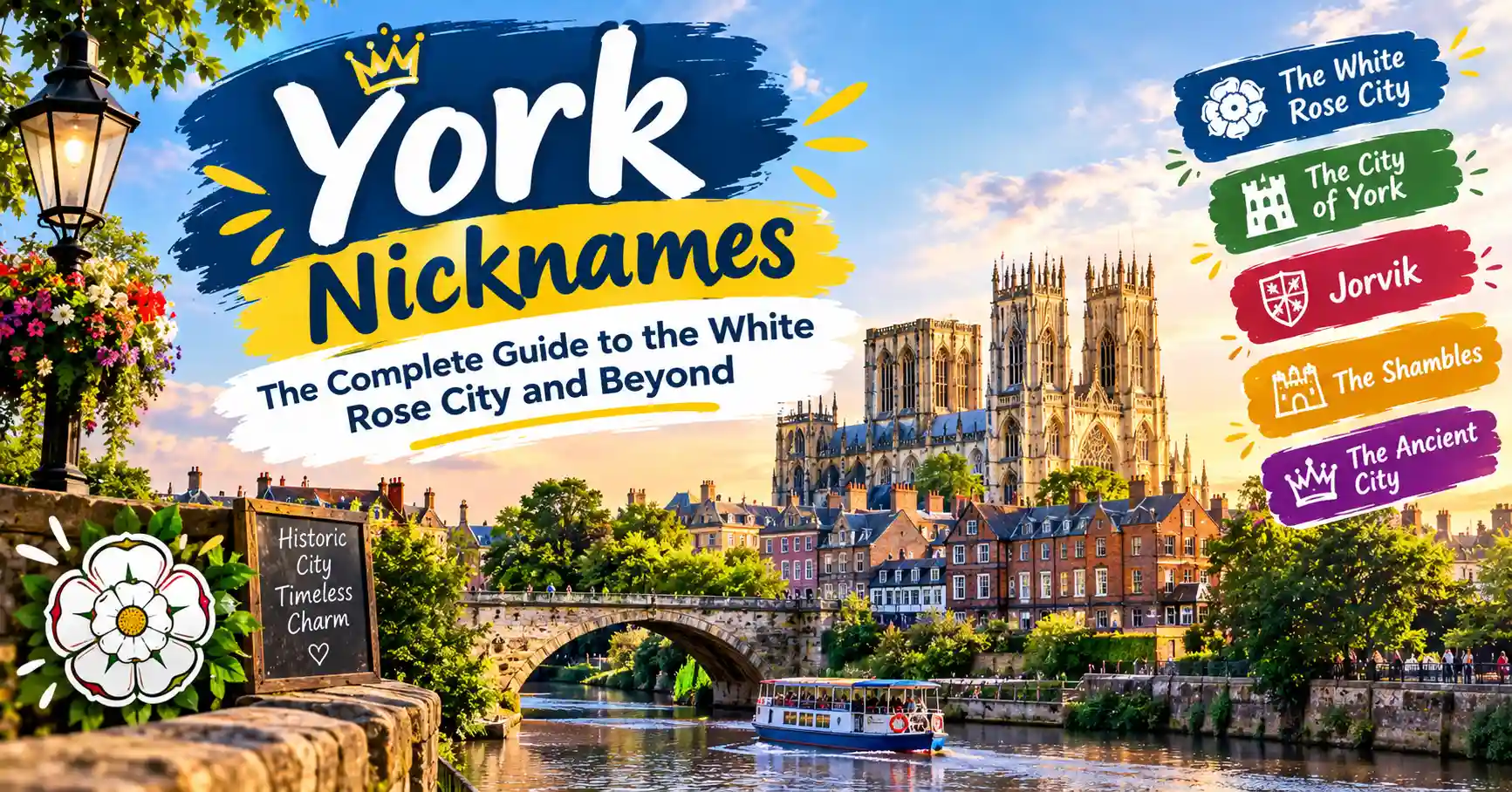
York, England, stands as one of the most historically significant cities in the United Kingdom, with roots stretching back nearly two millennia. From its Roman foundations to its Viking heritage and medieval glory, this ancient walled city has accumulated a fascinating collection of monikers that reflect its remarkable journey through time. Understanding York nicknames opens a window into the city’s soul—its triumphs, its tragedies, and its enduring place in British culture.
The city’s nicknames tell stories of royal conflicts, architectural grandeur, and civic pride. Whether you know it as “The White Rose City” or “The Ancient Capital of the North,” each name captures a different facet of York’s identity. This comprehensive guide explores every major York nickname, their origins, meanings, and how they’re used today.
🏛️ Quick Answer Box
Quick Answer
The most famous nickname for York is “The White Rose City,” derived from its association with the House of York during the Wars of the Roses. Other well-known nicknames include “The Ancient City,” “The City of a Thousand Years,” and “The Viking City.”
📊 Quick Facts Table
| Attribute | Details |
|---|---|
| City | York |
| Country | England, United Kingdom |
| Official Nickname | None officially designated |
| Most Famous Nickname | The White Rose City |
| Population | Approximately 210,000 (2021 census) |
| Founded | 71 AD (Roman settlement of Eboracum) |
| Known For | York Minster, medieval walls, Viking heritage, railway history |
| Region | North Yorkshire, England |
📜 Official Nickname of York
York does not have an officially designated nickname by any governing authority. However, “The White Rose City” functions as a de facto official nickname due to its deep historical roots and widespread recognition. This moniker is historical and commonly recognized rather than legally established.
The city’s association with the white rose stems from the House of York, a royal dynasty that used the white rose as its emblem during the Wars of the Roses (1455–1487). This connection has endured for over five centuries and remains central to York’s civic identity. While other nicknames like “The Ancient City” are descriptive and widely used, none carries the same cultural weight as “The White Rose City.”
🏰 What Are the Nicknames of York?
York nicknames reflect the city’s layered history—from Roman military outpost to Viking stronghold, medieval powerhouse to modern tourist destination. Each nickname captures a specific era or characteristic that has shaped York’s identity.
The city’s nicknames can be categorized into several groups:
- Royal and Heraldic Nicknames: These relate to York’s role in English royal history, particularly the Wars of the Roses. “The White Rose City” is the most prominent example.
- Historical Era Nicknames: These reference specific periods in York’s long history. “The Viking City” and “The Roman City” acknowledge the city’s ancient roots.
- Descriptive and Honorific Nicknames: These highlight York’s architectural beauty, age, or significance. “The Ancient Capital of the North” and “The City of a Thousand Years” fall into this category.
- Cultural and Tourism Nicknames: These have emerged in modern times to promote the city’s attractions. “The Ghost City” references York’s reputation as one of Europe’s most haunted cities.
📋 Complete List of York Nicknames
| Nickname | Meaning | Origin | Popularity |
|---|---|---|---|
| The White Rose City | Reference to House of York emblem | Wars of the Roses (15th century) | Very High |
| The Ancient City | Reference to York’s age and history | Roman era onwards | High |
| The Viking City | Norse heritage and Jorvik settlement | Viking rule (866–954 AD) | High |
| The Ancient Capital of the North | York’s historical role as northern capital | Medieval period | Medium |
| The City of a Thousand Years | Poetic reference to enduring history | Literary and tourism usage | Medium |
| The Ghost City | Reputation for paranormal activity | Modern tourism marketing | Medium |
| The Chocolate City | Rowntree’s and Terry’s chocolate heritage | Industrial era (19th–20th century) | Medium |
| The Railway City | Birthplace of modern railway systems | 19th century railway development | Medium |
| Eboracum | Roman name meaning “place of the yew trees” | Roman Britain (71 AD) | Historical |
| Jorvik | Norse name for the Viking settlement | Viking era (9th–10th century) | Historical |
⭐ Most Popular Nicknames of York
Among the many York nicknames, several stand out for their widespread recognition and cultural significance. “The White Rose City” dominates public consciousness, appearing on everything from tourism materials to local sports teams. “The Ancient City” resonates with visitors who marvel at York’s medieval walls and cobbled streets. “The Viking City” has gained tremendous popularity through the Jorvik Viking Centre, which has welcomed millions of visitors since opening in 1984.
The most recognized York nicknames include:
- The White Rose City – Universally associated with York’s royal heritage
- The Ancient City – Emphasizes York’s incredible age and preserved history
- The Viking City – Celebrates York’s Norse heritage and popular attractions
- The Ancient Capital of the North – Acknowledges York’s historical importance
- The Ghost City – Capitalizes on York’s reputation for hauntings
🌹 Main Nicknames Explained
The White Rose City
Meaning: This nickname references the white rose, the heraldic emblem of the House of York, which ruled England during periods of the 15th century.
Short Origin Story: During the Wars of the Roses, the House of York adopted the white rose as its symbol to distinguish itself from the House of Lancaster, which used a red rose. The conflict, which lasted from 1455 to 1487, saw York emerge as a royal powerhouse.
Historical Background: The white rose became inextricably linked with York’s identity following the ascension of Edward IV in 1461. The city served as a key stronghold for the Yorkist cause, and the emblem appeared on banners, coins, and buildings throughout the region.
Modern Usage: Today, the white rose appears on Yorkshire’s flag, on local sports team emblems, and throughout York’s tourism branding. The Yorkshire Regiment and Yorkshire County Cricket Club both incorporate the white rose into their insignia.
Cultural Impact: The white rose has become synonymous with Yorkshire pride. The phrase “God’s Own County” often accompanies white rose imagery, and the symbol unites the entire region in a shared identity.
Interesting Fact: The white rose is technically a stylized heraldic representation rather than a specific botanical variety, though Rosa × alba is often cited as the inspiration.
The Ancient City
Meaning: This nickname emphasizes York’s extraordinary age and the remarkably preserved state of its historical architecture.
Short Origin Story: York’s history spans nearly two thousand years, beginning with the Roman founding of Eboracum in 71 AD. The city has been continuously inhabited ever since, leaving layer upon layer of history.
Historical Background: From Roman legionary fortress to Viking trading hub to medieval ecclesiastical center, York has played a pivotal role in every major period of English history. Its city walls, dating largely from the 12th to 14th centuries, remain among the best-preserved in Europe.
Modern Usage: Tourism materials frequently employ “The Ancient City” to attract visitors interested in history and heritage. The nickname appears in guidebooks, travel articles, and official city promotions.
Cultural Impact: The nickname reinforces York’s position as a living museum, drawing millions of tourists annually who come to experience its historical atmosphere.
Interesting Fact: York’s Shambles, a medieval street, is often cited as the inspiration for Diagon Alley in the Harry Potter series.
The Viking City
Meaning: This nickname celebrates York’s significant Viking heritage, when the city was known as Jorvik and served as a major Norse settlement.
Short Origin Story: Viking forces captured York in 866 AD, establishing it as the capital of their Northumbrian kingdom. The city flourished as a trading center under Norse rule for nearly a century.
Historical Background: The Viking period left an indelible mark on York’s culture, language, and street layout. Archaeological excavations in the 1970s and 1980s uncovered remarkable artifacts that transformed understanding of Viking life in England.
Modern Usage: The Jorvik Viking Centre, opened in 1984, brings this heritage to life through immersive exhibits. The annual Jorvik Viking Festival attracts enthusiasts from around the world.
Cultural Impact: “The Viking City” has become a powerful tourism brand, distinguishing York from other historic English cities and attracting visitors fascinated by Norse culture.
Interesting Fact: Many common English words, including “window,” “knife,” and “egg,” entered the language through Viking influence in York and surrounding areas.
The Ancient Capital of the North
Meaning: This honorific acknowledges York’s historical role as the second city of England and the administrative center of northern Britain.
Short Origin Story: During the medieval period, York served as the seat of the Archbishop of York, the second-highest position in the Church of England. The city also hosted royal courts and parliaments.
Historical Background: From the Norman Conquest through the Tudor period, York functioned as the effective capital of northern England. The Council of the North, established in 1472, governed the region from York until 1641.
Modern Usage: The nickname appears in historical contexts and tourism materials, emphasizing York’s former prominence.
Cultural Impact: This nickname positions York as a rival to London in historical importance, celebrating the city’s role in shaping English history.
Interesting Fact: York Minster, the city’s magnificent cathedral, is the largest Gothic cathedral in Northern Europe.
The Ghost City
Meaning: This nickname references York’s reputation as one of the most haunted cities in Europe, with countless ghost stories and paranormal legends.
Short Origin Story: York’s long history, combined with its preserved medieval architecture and documented tragedies, has generated numerous ghost stories over centuries.
Historical Background: Executions, plagues, and religious conflicts have left their mark on York’s collective memory. Sites like the Treasurer’s House and York Dungeon are famous for reported paranormal activity.
Modern Usage: Ghost tours operate nightly throughout the city, and the nickname features prominently in tourism marketing targeting visitors interested in the supernatural.
Cultural Impact: “The Ghost City” has become a significant tourism draw, with some visitors specifically seeking paranormal experiences.
Interesting Fact: York was named the most haunted city in Europe by the Ghost Research Foundation International.
🏆 Which Nickname Is Most Famous?
“The White Rose City” stands as York’s most famous nickname, and for good reason. Its fame stems from several factors:
First, the nickname connects directly to one of English history’s most dramatic periods—the Wars of the Roses. This conflict, popularized through Shakespeare’s plays and countless historical works, remains a subject of enduring fascination.
Second, the white rose symbol extends beyond York to represent all of Yorkshire. This regional significance amplifies the nickname’s reach, making it recognizable even to those unfamiliar with York specifically.
Third, the nickname has been consistently used for over 500 years, embedding itself in the cultural DNA of the region. It appears on flags, sports uniforms, and official insignia.
Finally, “The White Rose City” carries emotional resonance, evoking pride, heritage, and identity. Unlike purely descriptive nicknames, it tells a story of royal ambition and regional loyalty.
📖 How York Got Its Nicknames
York’s nicknames emerged from the city’s remarkable journey through history. The Roman founding of Eboracum established the settlement’s strategic importance, while the Viking conquest transformed it into a thriving Norse capital. The medieval period brought ecclesiastical power and royal intrigue, culminating in the Wars of the Roses and the white rose legacy.
Industrial development in the 19th century added new dimensions to York’s identity, with railway innovation and chocolate manufacturing creating fresh associations. Modern tourism has generated additional nicknames, as marketers seek to capture the city’s unique appeal.
Each nickname reflects a particular moment or movement in York’s long story. Together, they create a complex portrait of a city that has been Roman fortress, Viking stronghold, medieval capital, industrial pioneer, and modern tourism destination.
📝 Other Nicknames at a Glance
- The Chocolate City – References York’s chocolate-making heritage, including Rowntree’s and Terry’s
- The Railway City – Acknowledges York’s role in railway development and the National Railway Museum
- Eboracum – The Roman name for York, meaning “place of the yew trees”
- Jorvik – The Viking name for York, now used by the famous Viking Centre
- The Minster City – Highlights York Minster’s dominating presence
- The Walled City – References York’s remarkably preserved medieval walls
- The Snickelway City – Celebrates York’s unique network of narrow passageways
- The Tea Room City – Acknowledges York’s famous Bettys Tea Rooms
- The Free City – Historical reference to York’s medieval self-governance
- The Second City – Historical acknowledgment of York’s former status
🎉 Fun Facts About York
- Roman Emperor Connection: Constantine the Great was proclaimed Roman Emperor in York in 306 AD.
- Largest Gothic Cathedral: York Minster is the largest Gothic cathedral in Northern Europe, with construction spanning over 250 years.
- Viking Archaeology: The Coppergate excavations uncovered over 40,000 Viking-era artifacts, revolutionizing understanding of Norse England.
- Chocolate Innovation: The Kit Kat, Smarties, and Terry’s Chocolate Orange were all invented in York.
- Railway Revolution: The first passenger railway station in the world opened in York in 1839.
- Ghostly Reputation: York has more ghost sightings per square mile than any other European city.
- Medieval Walls: York’s city walls stretch for 2.5 miles and are the most complete medieval walls in England.
- The Shambles: This medieval street inspired Diagon Alley in the Harry Potter series.
- Guy Fawkes: The infamous Gunpowder Plot conspirator was born in York in 1570.
- Double York: York, Pennsylvania, USA, was named after York, England, and both share the white rose symbol.
🎯 Famous Attractions in York
York’s attractions draw millions of visitors annually and connect directly to the city’s nicknames. York Minster dominates the skyline, its Gothic towers visible for miles around. The medieval city walls offer walking tours with panoramic views. The Jorvik Viking Centre brings Norse history to life through immersive exhibits.
The Shambles, a preserved medieval street, charms visitors with its overhanging timber-framed buildings. The National Railway Museum celebrates York’s railway heritage with an impressive collection of locomotives. The York Dungeon and numerous ghost tours capitalize on the city’s haunted reputation.
Other notable attractions include the York Castle Museum, Clifford’s Tower, the Treasurer’s House, and Bettys Tea Rooms, which has served afternoon tea since 1919.
⚖️ Nickname Comparison
🔗 Related Cities and Their Nicknames
Chicago Nicknames
Discover why Chicago is called “The Windy City” and explore its other famous monikers.
Las Vegas Nicknames
From “Sin City” to “The Entertainment Capital of the World”—explore Vegas’s many names.
Austin Nicknames
Learn why Austin is known as “The Live Music Capital of the World” and more.
Miami Nicknames
Explore Miami’s nicknames, from “The Magic City” to “The Gateway to the Americas.”
❓ Frequently Asked Questions
What is the official nickname of York?
York has no officially designated nickname. However, “The White Rose City” functions as a de facto official nickname due to its deep historical roots and widespread recognition. The city council and tourism boards consistently use white rose imagery in official branding.
Why is York called “The White Rose City”?
York is called “The White Rose City” because the white rose was the heraldic emblem of the House of York, a royal dynasty that ruled England during the 15th century. The symbol became permanently associated with the city following the Wars of the Roses.
Who gave York its nickname?
No single person gave York its nicknames. “The White Rose City” emerged organically from the city’s association with the House of York during the Wars of the Roses. Other nicknames developed over centuries through popular usage, literary references, and tourism marketing.
When did the nickname become popular?
The white rose association became prominent during the Wars of the Roses (1455–1487) and has remained popular for over five centuries. Other nicknames like “The Viking City” gained widespread popularity following the opening of the Jorvik Viking Centre in 1984.
What are other nicknames of York?
Other York nicknames include “The Ancient City,” “The Viking City,” “The Ancient Capital of the North,” “The City of a Thousand Years,” “The Ghost City,” “The Chocolate City,” and “The Railway City.” Historical names include Eboracum (Roman) and Jorvik (Viking).
What does “Eboracum” mean?
Eboracum is the Roman name for York, likely derived from a Brythonic word meaning “place of the yew trees.” The name evolved through various forms—Eboracum, Eoforwic, Jorvik—before becoming the modern “York.”
Is the nickname officially recognized?
While no nickname has official legal status, “The White Rose City” is widely recognized and used by official organizations, including the City of York Council and Visit York tourism board. The white rose appears on Yorkshire’s official flag.
Do locals use these nicknames?
Locals commonly use “The White Rose City” and identify strongly with the white rose symbol. “The Ancient City” and “The Viking City” are more frequently used in tourism contexts than in everyday conversation among residents.
🌟 Conclusion
York nicknames capture the essence of one of England’s most remarkable cities—a place where Roman walls, Viking heritage, medieval glory, and modern innovation coexist within a compact historic center. From the royal resonance of “The White Rose City” to the archaeological intrigue of “The Viking City,” each nickname tells a story of York’s enduring significance.
Whether you’re planning a visit or simply fascinated by English history, understanding these nicknames enriches your appreciation of York’s unique character. The city’s ability to preserve its past while embracing the present ensures that these nicknames will continue to resonate for generations to come.
For those seeking authoritative historical information about York and its heritage, Historic England provides comprehensive resources on the city’s architectural and archaeological treasures.