Chicago, Illinois, is a city of towering skyscrapers, deep-dish pizza, and rich cultural history. Over the decades, the city has earned a colorful collection of Chicago nicknames that reflect its resilient spirit, political swagger, and architectural grandeur. These names aren’t just random labels—they each tell a story of a metropolis that rose from the ashes and never stopped reinventing itself.
From the globally recognized “Windy City” to the gritty “City of Big Shoulders,” these monikers capture everything from the city’s character to its contradictions. In this article, we’ll explore every notable nickname, their origins, and the cultural footprints they leave behind, giving you a one-stop resource for the fascinating world of Chicago nicknames.
🏙️ What Are Chicago Nicknames?
A nickname isn’t always official; it’s a badge of identity worn with pride, earned through history, geography, literature, or even humor. Chicago’s nicknames are a perfect example. Some date back over a century, born in newspaper rivalries, political banter, or the verses of a poet. Others emerged from blues songs and hip-hop culture. Together they form a linguistic skyline as impressive as the city’s famous architecture. Below, a quick look at the most recognizable moniker begins the journey.
🗣️ Quick Answer: Chicago’s Most Famous Nickname
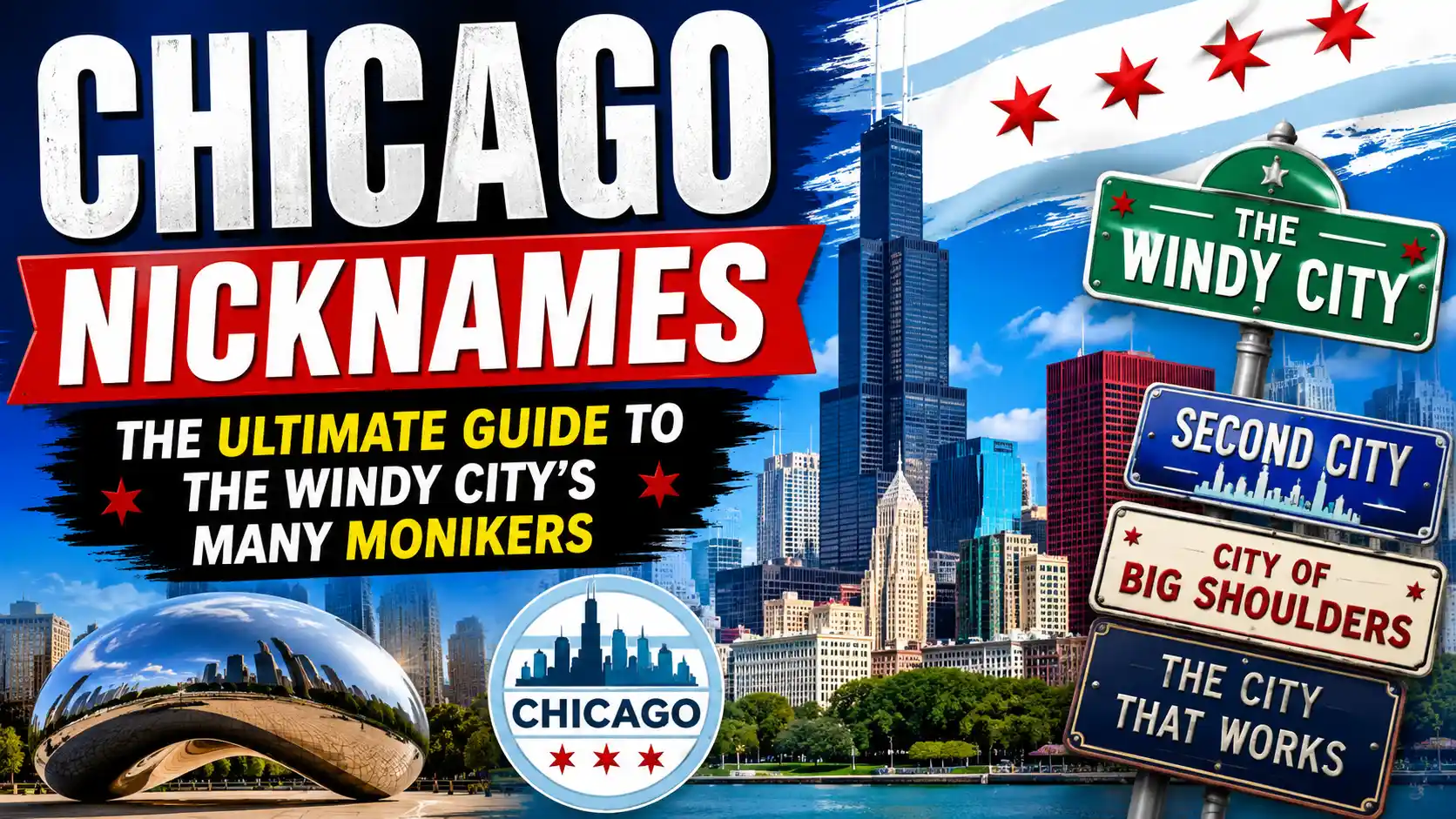
The most famous nickname of Chicago is “The Windy City.” Other widely recognized nicknames include “The Second City” (a nod to its rebirth after the Great Fire), “Chi-Town” (a casual, modern shorthand), and “The City of Big Shoulders” (from Carl Sandburg’s 1914 poem).
📋 Quick Facts About Chicago
📜 The Official Nickname of Chicago
Interestingly, Chicago does not have a legally designated, official nickname. While many U.S. cities adopt a single moniker through municipal resolution or historical charter, Chicago’s most famous nicknames have always been informal, driven by media, literature, and popular culture. The closest thing to an “official” status belongs to “The Windy City,” which appears on countless souvenir items, in tourism branding, and even in official city communications—but it has never been codified into law. This unofficial nature is part of the city’s charm: multiple nicknames peacefully coexist, each shining a light on a different facet of Chicago’s identity.
📝 Complete List of Chicago Nicknames
| 🌃 Nickname | 📖 Meaning | ⏳ Origin | 📊 Popularity |
|---|---|---|---|
| The Windy City | Long-winded politicians, also breezy lakefront | Late 19th-century newspaper rivalries | ⭐⭐⭐⭐⭐ (Very High) |
| The Second City | Rebuilt after Great Fire; self-deprecating comparison to NYC | 1890s, popularized by A.J. Liebling in 1952 | ⭐⭐⭐⭐⭐ (Very High) |
| Chi-Town | Affectionate abbreviation of Chicago | 20th-century slang, embraced in hip-hop | ⭐⭐⭐⭐ (High) |
| City of Big Shoulders | Blue-collar strength, industrial might | Carl Sandburg’s poem “Chicago” (1914) | ⭐⭐⭐⭐ (High) |
| The White City | Gleaming neoclassical buildings | 1893 World’s Columbian Exposition | ⭐⭐⭐ (Moderate) |
| Hog Butcher for the World | Meatpacking industry dominance | Sandburg’s “Chicago” (1914) | ⭐⭐⭐ (Moderate) |
| The City That Works | Hardworking, no-nonsense ethos | Coined by Mayor Richard J. Daley in the 1960s | ⭐⭐⭐ (Moderate) |
| Paris on the Prairie | Architectural elegance amid flatlands | Late 19th/early 20th-century boosters | ⭐⭐ (Low) |
| The Black City | Industrial soot, contrast to White City | Late 19th century, post-industrial imagery | ⭐ (Historical) |
| Sweet Home Chicago | Endearing blues anthem phrase | Robert Johnson song (1936), later Blues Brothers | ⭐⭐⭐⭐ (Cultural High) |
🌟 Most Popular Nicknames of Chicago
While Chicago nicknames range from affectionate to historical, a handful have become household names across the United States and beyond. The most popular are “The Windy City,” “The Second City,” “Chi-Town,” and “The City of Big Shoulders.” These four are used daily by locals, journalists, and tourists alike. Below we explain each in more depth, uncovering the stories that gave them staying power.
🔍 Main Nicknames Explained
💨 The Windy City
- Meaning: Often misunderstood as a reference to breezy lake winds, the nickname actually points to the “windy” rhetoric of Chicago’s politicians and boosters in the 19th century.
- Short Origin Story: The term was popularized in the 1870s and 1880s during a rivalry with Cincinnati newspapers. Chicago was vying to host the 1893 World’s Fair, and Eastern critics called its spokespeople full of hot air.
- Historical Background: While lake breezes do exist, meteorological records show Chicago is not the windiest U.S. city. The label stuck because it perfectly captured the city’s bombastic self-promotion, especially in the newspaper wars.
- Modern Usage: Today it’s embraced with pride; “Windy City” appears on everything from sports team marketing to restaurant names, and residents wear it as a badge of audacity.
- Cultural Impact: It has become a global identifier, frequently used in movies, songs, and travel guides. The term overshadows almost all other nicknames.
- Interesting Fact: The first known printed use of “Windy City” referring to Chicago appeared in the Chicago Tribune in 1876, but it was the New York Sun that weaponized the term against Chicago’s lobbying efforts.
🥈 The Second City
- Meaning: A double-edged sword: it acknowledges Chicago as the nation’s second-largest city (historically behind New York), but also celebrates its rebirth after the devastating Great Fire of 1871—a second Chicago built from ashes.
- Short Origin Story: The phrase gained traction in the late 19th century as a factual ranking, but writer A.J. Liebling famously derided Chicago in a 1952 New Yorker piece, cementing the inferiority-complex connotation. Locals flipped it into fuel.
- Historical Background: After the Great Fire destroyed much of the city, Chicago rebuilt rapidly, emerging more modern and ambitious. The “second” city wasn’t just a rank; it was a testament to resurrection.
- Modern Usage: The name lives on through the world-renowned comedy theater The Second City, which launched countless comedians. It’s also used self-referentially by Chicagoans who acknowledge the sibling rivalry with NYC while celebrating their own distinct culture.
- Cultural Impact: The nickname embodies Chicago’s chip-on-the-shoulder resilience. It fuels debates about architecture, food, and arts, keeping the city’s competitive spirit alive.
- Interesting Fact: Some historians argue that the “Second City” label originated even earlier, describing the temporary city that existed while the permanent one was being rebuilt post-fire.
🏙️ Chi-Town
- Meaning: A casual, shortened form of “Chicago,” used primarily as a term of endearment and city pride.
- Short Origin Story: “Chi” (pronounced “shy”) is the phonetic abbreviation of the city’s first syllable. The “-Town” suffix follows the pattern of many U.S. city nicknames. It gained traction in the mid-20th century and exploded in popular music during the 1980s and 1990s.
- Historical Background: While less historical than others, Chi-Town was heavily popularized by Chicago-based hip-hop artists like Common, Kanye West, and Twista, who used it to represent their hometown in lyrics.
- Modern Usage: It’s widely used in social media hashtags, local branding, and everyday conversation, especially among younger generations. It conveys an insider’s intimacy.
- Cultural Impact: The nickname helped shape Chicago’s image as a center of urban cool, distinct from the formal “Windy City.” It bridges the gap between high culture and street-level identity.
- Interesting Fact: Even though it’s popular, some Chicago purists prefer “The City” or “Chicagoland” and consider “Chi-Town” a bit touristy. Nevertheless, its staying power is undeniable.
🏗️ City of Big Shoulders
- Meaning: A poetic tribute to the city’s working-class strength, industrial prowess, and physical labor that built the metropolis.
- Short Origin Story: The phrase comes from the opening lines of Carl Sandburg’s 1914 poem “Chicago”: “Hog Butcher for the World, / Tool Maker, Stacker of Wheat, / Player with Railroads and the Nation’s Freight Handler; / Stormy, husky, brawling, / City of the Big Shoulders.”
- Historical Background: In the early 20th century, Chicago was the nexus of railroads, meatpacking, and steel. Sandburg saw the city not as a polished gem but as a muscular giant, and his words immortalized that gritty grandeur.
- Modern Usage: The nickname is often referenced in journalism, documentaries, and civic speeches when highlighting Chicago’s blue-collar heritage. It’s less used in daily small talk but remains a powerful literary symbol.
- Cultural Impact: “City of Big Shoulders” has inspired murals, business names, and educational programs, reinforcing the idea that Chicago’s soul lies in its workers and builders.
- Interesting Fact: Sandburg’s poem originally faced criticism for being too vulgar and unpoetic, but Chicagoans immediately adopted its raw energy as an authentic portrait.
🏆 Which Nickname Is Most Famous?
Without question, “The Windy City” is the most famous and universally recognized nickname of Chicago. It appears on souvenir t-shirts, in official tourism campaigns, and in the first line of countless travel articles. While some locals might argue that “The Second City” better captures the city’s spirit, “Windy City” has global mindshare. Its mysterious origins—half weather, half political hot air—only add to its allure, making it the go-to moniker for anyone referencing Chicago around the world.
🛠️ How Chicago Got Its Nicknames
Chicago’s nicknames didn’t come from a single source—they bubbled up from a mixture of journalism, literature, boosterism, and genuine historical events. The city’s explosive growth in the 19th century made it a natural subject for hyperbolic descriptions. When the Great Fire leveled the city in 1871, the subsequent rebirth gave rise to “The Second City.” Simultaneously, newspaper editors fighting for circulation birthed “The Windy City.” Poets and novelists later added the literary layer, capturing the working-class soul in “City of Big Shoulders.” Later, hip-hop culture and the internet age gave us “Chi-Town,” proving that the city’s naming tradition is never finished.
📋 Other Nicknames at a Glance
- The White City – For the dazzling white stucco buildings of the 1893 World’s Fair.
- The Black City – The industrial, soot-covered counterpart to the White City.
- Hog Butcher for the World – A poetic but once-literal job description of the Union Stock Yards.
- The City That Works – A 20th-century political slogan emphasizing efficiency and labor.
- Paris on the Prairie – A nod to Chicago’s unexpectedly elegant boulevards and architecture in a flat landscape.
- Sweet Home Chicago – Not an official nickname but an inseparable cultural tag from the blues anthem.
- The Jewel of the Midwest – Early boosters’ attempt to paint the city as a refined treasure.
🎉 Fun Facts About Chicago
- The Chicago River is dyed green every St. Patrick’s Day, a tradition since 1962.
- The world’s first skyscraper, the Home Insurance Building, was built in Chicago in 1885.
- Deep-dish pizza was invented at Pizzeria Uno in 1943.
- The term “jazz” was first popularized in Chicago, although its roots are in New Orleans.
- Chicago is home to more movable bridges than any other city in the world (37 in total).
- The Great Chicago Fire of 1871 lasted two days and destroyed 3.3 square miles, but it spared the Water Tower, which still stands.
- Willis Tower (formerly Sears Tower) was the world’s tallest building from 1974 to 1998.
- The Art Institute of Chicago houses one of the largest collections of Impressionist paintings outside Paris.
- The 1893 World’s Fair introduced the Ferris Wheel, invented by George Washington Gale Ferris Jr.
- Route 66 historically starts in Chicago, marked by a sign on Adams Street.
🏛️ Famous Attractions in Chicago
- Millennium Park – Cloud Gate (“The Bean”), Crown Fountain, and summer concerts.
- Navy Pier – Ferris wheel, boat tours, and entertainment on Lake Michigan.
- Willis Tower Skydeck – Step out onto The Ledge, a glass balcony 1,353 feet up.
- The Art Institute of Chicago – World-renowned art museum with iconic lion statues.
- Field Museum – Home to Sue, the most complete T. rex skeleton ever found.
- Magnificent Mile – Premier shopping district on Michigan Avenue.
- Wrigley Field – Historic baseball stadium and home of the Cubs.
- Chicago Riverwalk – A vibrant pedestrian waterfront with dining and architecture tours.
🆚 Nickname Comparison: Chicago vs. New York City
Both Chicago and New York City carry legendary nicknames that reflect their attitudes and history. Check out how they stack up side by side.
🌬️ Chicago
- 🔹 The Windy City – Political bluster & lake breezes
- 🔹 The Second City – Rebirth after fire, sibling rivalry with NYC
- 🔹 Chi-Town – Urban shorthand, hip-hop flavor
- 🔹 City of Big Shoulders – Blue-collar poetry
🗽 New York City
- 🔹 The Big Apple – Jazz-age term for the ultimate prize
- 🔹 The City That Never Sleeps – 24/7 energy
- 🔹 Gotham – From Washington Irving to Batman
- 🔹 Empire City – Ambition and grandeur
Discover more about New York’s iconic monikers in our New York City Nicknames guide.
🌐 Related Cities and Their Nicknames
Springfield, Peoria, Rockford & more 🇺🇸 USA City Nicknames
Coast-to-coast monikers 🌉 St. Louis Nicknames
Gateway to the West 🏎️ Detroit Nicknames
Motor City & more
❓ Frequently Asked Questions
What is the official nickname of Chicago?
Chicago does not have an official, legally recognized nickname. “The Windy City” is the most famous and widely used, but it remains unofficial.
Why is Chicago called the Windy City?
The nickname originally referred to the long-winded, boastful politicians and city boosters of the 19th century, not the weather. Rival newspapers, especially from Cincinnati and New York, popularized the term during the competition to host the 1893 World’s Fair.
Who gave Chicago its nickname?
No single person can be credited. The term “Windy City” emerged from the newspaper wars of the 1870s–1880s, with New York and Cincinnati journalists using it to mock Chicago’s relentless self-promotion.
When did the nickname “Second City” become popular?
It gained popularity after the Great Fire of 1871, when the city was literally rebuilt as a second version of itself. The phrase was later cemented in public consciousness by A.J. Liebling’s 1952 writings and the founding of The Second City comedy theater in 1959.
What are other nicknames of Chicago?
Beyond the famous ones, Chicago is also known as the White City, the Black City, Hog Butcher for the World, the City That Works, Paris on the Prairie, and Sweet Home Chicago (from the blues song), among others.
🏁 Conclusion
From the proud boast of the “City of Big Shoulders” to the affectionate shorthand of “Chi-Town,” Chicago nicknames reveal a city that cannot be captured in a single phrase. Each nickname serves as a time capsule, preserving a moment in history, a cultural shift, or a literary spark. They reflect a metropolis that rose from flames, talked louder than anyone else, and built a skyline worthy of poems and songs.
Whether you call it the Windy City, the Second City, or simply home, the many names of Chicago prove that identity is a living, breathing story. To dive even deeper into the city’s layered past, explore the authoritative resources at the Encyclopedia of Chicago (encyclopedia.chicagohistory.org), an invaluable collection curated by the Chicago History Museum.