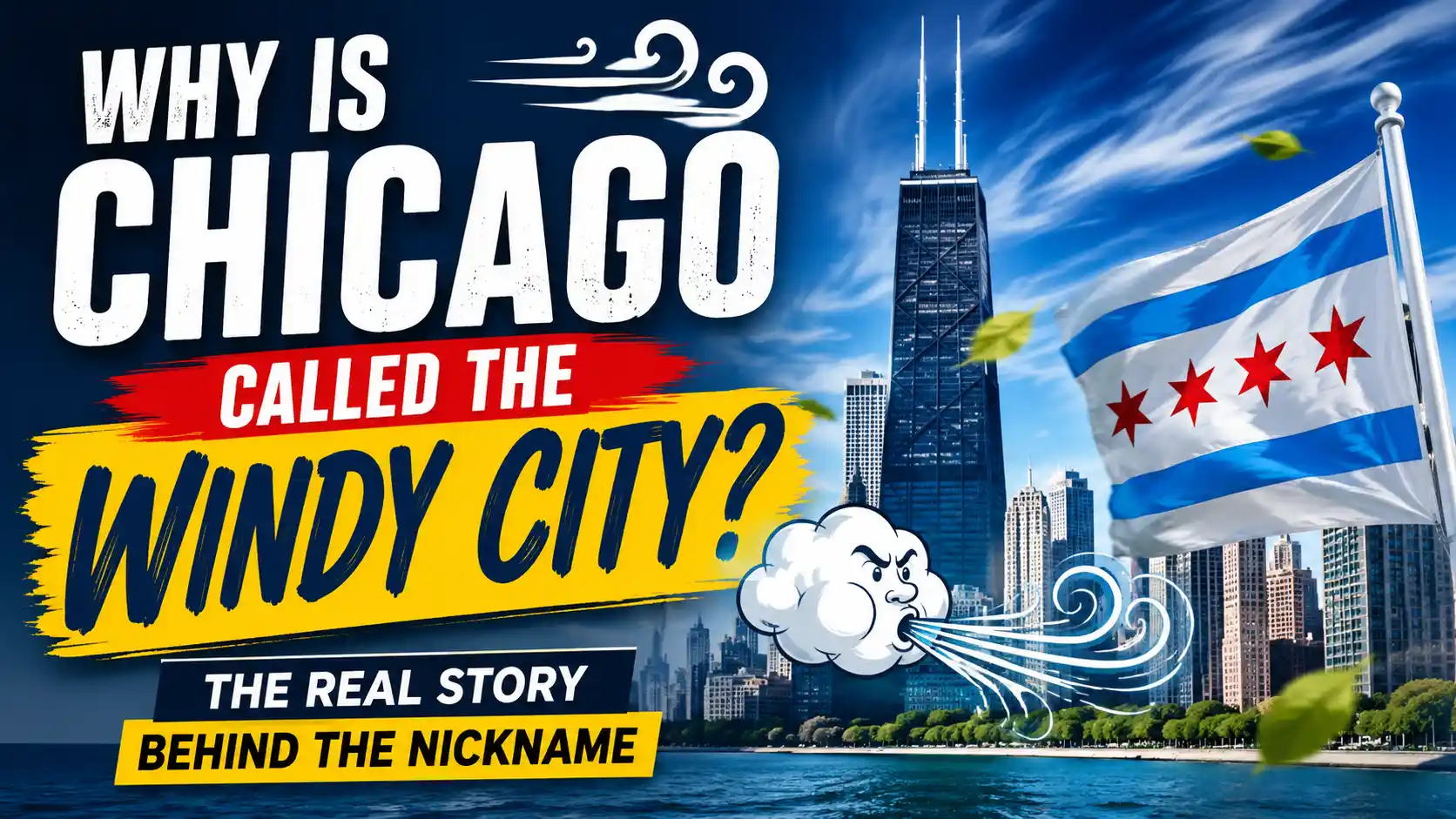
If you want to know about “Why Is Chicago Called the Windy City?” Here is a Ans below
Short Answer: Chicago is called the “Windy City” mostly because of its history of long‑winded, boastful politicians and tireless boosters, not because of a weather record. The nickname exploded nationally during a fierce rivalry over who would host the 1893 World’s Fair. While it originally carried a mocking tone, Chicagoans eventually embraced it — and yes, the breezes off Lake Michigan helped the name stick.
What Does “Windy City” Mean?
On the surface, “Windy City” sounds like a weather report. But the nickname has always operated on two levels. The older, literal meaning points to the persistent breezes that whip through the city’s streets, especially near Lake Michigan. The more famous, historically sharper meaning refers to windbags — politicians and promoters who, in the 19th century, talked so much and so loudly that observers said they could blow you over with words.
Today the label is worn with pride. It suggests a city that is vibrant, bold, and impossible to ignore — a place where both the air and the ambition are constantly moving.
Why Is Chicago Called the “Windy City”?
The complete answer weaves together three distinct threads: political hot air, a cutthroat competition for the 1893 World’s Fair, and the very real climate of the Great Lakes. No single event created the nickname; it simmered for decades before Charles Dana’s editorial turned it into a national catchphrase.
Chicago in the 1800s was a boomtown of staggering growth. After the Great Fire of 1871, it rebuilt itself with swagger and speed. City leaders crisscrossed the country, bragging about Chicago’s size, its railroads, its grain elevators, and its destiny. To outsiders, this relentless self‑promotion came off as arrogance. By the late 1880s, Chicago was in a slugfest with New York, St. Louis, and Cincinnati to land the World’s Columbian Exposition. Chicago’s delegation talked so incessantly — and so grandiosely — that one journalist decided to permanently label them.
The Origin of the Nickname
The nickname has roots in both meteorology and mockery. Before the famous political putdown, “windy city” had already appeared in Chicago newspapers as a weather descriptor. The city sits on the southwestern shore of Lake Michigan, where cold air clashing with warmer urban surfaces creates a near‑constant corridor of wind. In the 1870s, the Chicago Tribune itself called Chicago “the Windy City” when describing summer lake breezes.
But the origin that stuck is the political one. In the decades after the Civil War, Chicago earned a reputation for hyperbolic boosterism. Other cities found it insufferable. When Chicago began campaigning for the 1893 World’s Fair, its boosters descended on Washington, D.C., and New York, promising the most spectacular fair in human history. Opponents seized on the phrase “windy city” to discredit them — and a nickname was born.
Who Coined the Nickname?
There isn’t a single inventor, but the leading theory points to Charles A. Dana, the powerful editor of the New York Sun. In an 1890 editorial arguing that New York should host the World’s Fair instead of Chicago, Dana wrote, “Don’t pay any attention to the nonsensical claims of that windy city. Its people could not build a World’s Fair even if they won it.” The line was immediately picked up by papers across the country. Chicago got the fair anyway and turned it into a landmark event, but the name stuck fast.
However, earlier printed uses exist. Lexicographer Barry Popik traced “Windy City” as applied to Chicago back to 1856, when a poem in the Chicago Daily Tribune called it the “Windy City” in reference to weather. A Louisville newspaper used the phrase in 1858. So Dana did not coin the term; he weaponized it and gave it a permanent place in American English.
History Behind the Nickname
During the 1880s, Chicago and New York were locked in a fierce cultural and economic rivalry. Chicago had just passed Philadelphia as the nation’s second‑largest city and was hungry for recognition. New York elites mocked Chicago as a coarse, pushy upstart. The World’s Fair fight became a proxy war for cultural dominance. Chicago boosters promised a fair so grand it would “out‑Eiffel Eiffel,” a boast that resulted in the Ferris Wheel.
In that charged atmosphere, Dana’s “windy city” barb landed as a perfect insult — suggesting that Chicago was full of empty talk. The city’s own newspapers debated the term. The Chicago Tribune sometimes embraced it, sometimes bristled. Over time, Chicagoans began to reclaim the phrase, recognizing that a little windiness — meteorological and rhetorical — was part of their identity.
Timeline of the Nickname
How the Nickname Became Popular
Dana’s editorial acted as a spark, but the fire was fed by several forces. Chicago newspapers couldn’t stop reprinting and debating the phrase. Out‑of‑town reporters covering the 1893 World’s Fair used it constantly, tying it to the city’s breakneck energy. In the early 20th century, tourism brochures began to mention the “Windy City” with a wink, and jazz‑age writers found it a handy, rhythmic descriptor.
Perhaps the biggest amplifier was radio. When WGN (call letters that originally stood for “World’s Greatest Newspaper”) broadcast across the Midwest, it cemented “Windy City” in the ears of millions. By the 1920s, sports headlines routinely called Chicago teams “Windy City warriors.” Politicians on the national stage — for better or worse — reinforced the connection between Chicago and hot air.
Myths vs Facts
Is the Nickname Still Used Today?
Absolutely. “Windy City” is woven into everyday life. You’ll see it on restaurant signs, hear it in radio station IDs, and spot it on t‑shirts at O’Hare Airport. Chicagoans introduce their hometown with the phrase unselfconsciously. It’s an official‑unofficial brand mark that carries a sense of momentum and character. No local ordinance or proclamation ever made it official, but the nickname functions as a de facto second name for the city.
Cultural Impact of the Nickname
Local Identity
Chicagoans have a complicated relationship with their city’s image — fiercely proud yet quick to mock its own political history. The “Windy City” label captures that duality: it acknowledges the city’s brash history while also signaling resilience. It says, “We talk big, but we deliver bigger.”
Tourism Branding
Visit Chicago and Choose Chicago routinely lean into the nickname. Campaigns use images of wind‑blown lakefronts and skyline silhouettes paired with the tagline. No other American city has a tourism brand built on a term that once was an insult.
Sports Teams
Though no major pro team is officially named the “Windy City” squad, the term is inseparable from Chicago sports. The WNBA’s Chicago Sky nodded toward the blustery theme. Broadcasters and sportswriters call Bears games “Windy City football.” Even the Chicago Marathon is often marketed as running through the Windy City.
Media References
From Frank Sinatra crooning about “Chicago, that toddlin’ town” to the hit musical Chicago, the windy persona is everywhere. In the 1990s, the sitcom Perfect Strangers set its opening credits against the windy city skyline. News outlets worldwide use “Windy City” as shorthand in headlines.
Popular Culture
Songs, novels, and films have reinforced the nickname for generations. Composer Sufjan Stevens titled a track “The Seer’s Tower” and evoked wind‑swept imagery. Countless mystery novels use “Windy City” in their titles to evoke a gritty, atmospheric setting. The nickname even appears in comic books: Gotham’s windy, urban landscape is partially inspired by Chicago.
Interesting Facts About the Nickname
- The Chicago Tribune once ran an editorial asking readers to stop using “Windy City” — a campaign that entirely failed.
- The 1893 World’s Fair, the very event that ignited the nickname, attracted over 27 million visitors and introduced the Ferris wheel, shredded wheat, and the zipper.
- Meteorologists confirm that Chicago’s average wind speed (around 10 mph) is only slightly higher than the national average. Amarillo, Texas, averages over 13 mph.
- In the 1970s, a group of Chicago aldermen proposed making “Windy City” the city’s official slogan — but the motion died after jokes about producing more hot air.
- The Chicago Public Library’s special collections hold an 1856 newspaper featuring the earliest known “Windy City” reference — a poem about the city’s breezes.
- During Prohibition, gangsters and bootleggers from “the Windy City” were romanticized in newspapers, further linking the name to danger and excitement.
- WGN radio, which began broadcasting in 1924, helped export the nickname across the Great Plains and the South, where many first heard Chicago called “Windy City” on the air.
- The “Windy City” nickname appears in more than 200 trademark filings with the U.S. Patent and Trademark Office, covering everything from hot dog stands to law firms.
- Legendary Chicago columnist Mike Royko once joked that Chicago is called the Windy City “because the politicians in City Hall produce enough wind to power a small country.”
- The phrase is so deeply embedded that Chicago’s sister city relationships abroad sometimes reference it — promotional materials for the Chicago‑Warsaw partnership translate the nickname as “Wietrzne Miasto.”
Other Nicknames of Chicago
Chicago has collected many names over the years. “The Second City” references its rebuilding after the Great Fire and its once‑perpetual rivalry with New York. “City of Big Shoulders,” taken from Carl Sandburg’s poem, celebrates the city’s blue‑collar muscle. “Chi‑Town” is a modern, casual nickname. “The City That Works” emphasizes its pragmatic, industrial roots. Each one reveals a different layer of Chicago’s personality. To explore all of them in depth, visit the full Chicago Nicknames page.
Windy City vs Big Apple: How Two Nicknames Took Different Paths
Chicago and New York have been competing for national attention for more than a century, and their most famous nicknames reveal the personality of each place.
Windy City (Chicago)
Origin: Political bombast and lake breezes; popularized by Charles Dana in 1890.
Original tone: Sarcastic insult.
Turnaround: Embraced by locals after the 1893 World’s Fair proved Chicago’s capability.
Modern vibe: Gritty, confident, self‑aware.
Big Apple (New York City)
Origin: Horse‑racing slang in the 1920s; revived by a 1970s tourism campaign.
Original tone: Jazzy insider term.
Turnaround: Rescued from obscurity to sell a city in crisis.
Modern vibe: Glamorous, aspirational, world‑class.
Where the Windy City nickname was born from rivalry and mockery, the Big Apple was deliberately cultivated to polish a tarnished image. Both, however, show how a city’s name can become a story — and how residents can turn a jab into a badge of honor. Discover the full saga behind Why New York Is Called the Big Apple.
Frequently Asked Questions
What is the meaning of the Windy City nickname?
It’s a double meaning: historically, it referred to Chicago’s long‑winded, boastful politicians and boosters; physically, it references the persistent winds off Lake Michigan.
Who coined the term Windy City?
No single person invented it. New York Sun editor Charles A. Dana popularized it in 1890, but printed uses date back to at least 1856 in the Chicago Daily Tribune.
When did Chicago first become known as the Windy City?
The earliest known printed use of “Windy City” for Chicago appeared in a poem in 1856. The nickname entered popular speech during the 1880s and exploded nationally around 1890.
Is Chicago really the windiest city in the United States?
No. Chicago’s average wind speed is around 10 mph. Several cities, including Boston, Amarillo, and Dodge City, have higher annual averages. The nickname is not a meteorological ranking.
Why is Chicago called the Windy City if it’s not the windiest?
Because the nickname stuck for historical and cultural reasons, not climatic ones. The lake breeze provides a physical reminder, but the label’s fame comes from political bombast.
Did the nickname start as an insult?
Yes. The “Windy City” was originally a jab at Chicago’s self‑promotion and long‑winded claims. It took decades for locals to fully embrace it as a point of pride.
What was the role of the 1893 World’s Fair?
Chicago’s aggressive campaign to host the World’s Columbian Exposition intensified the use of “Windy City” as a critique. When Chicago built and delivered the fair, the nickname began to transform into a symbol of energetic ambition.
How do Chicagoans feel about the nickname today?
Most Chicagoans accept it with a knowing smile. It’s used on merchandise, in local business names, and in everyday conversation without any stigma.
Are there any official documents using “Windy City”?
No city ordinance or state law designates “Windy City” as an official nickname. It exists purely through popular and cultural use.
What are other nicknames for Chicago?
The Second City, City of Big Shoulders, Chi‑Town, The City That Works, and Mud City (a very early, now forgotten label). Each tells a different chapter of Chicago’s story.
How is the Windy City used in sports?
Sports media routinely refer to Chicago teams as the Windy City squad. The WNBA’s Chicago Sky play on the windy theme. Former indoor soccer and minor league teams have carried the Windy City name officially.
Did the Chicago Tribune hate the nickname?
At times, yes. The paper oscillated between using it proudly and running editorials urging people to drop what it saw as an undignified label. The public, however, ignored those pleas.
Was there a rivalry with Cincinnati over the nickname?
Yes, Cincinnati newspapers were among the earliest to call Chicago “windy” in the 1870s and 1880s. The Ohio city saw Chicago’s meteoric rise with a mix of envy and derision, and used the epithet to cut Chicago down to size.
Is the name used in songs or movies?
Frequently. Countless blues and jazz songs reference the Windy City. Films from The Untouchables to Ferris Bueller’s Day Off use the nickname to anchor the Chicago setting.
What is the Second City nickname about?
“The Second City” originally referred to Chicago’s rebuilding after the Great Fire of 1871 and its status as the second‑largest U.S. city after New York. It also inspired the world‑famous comedy theater of the same name.
Explore More
Conclusion
Chicago’s “Windy City” nickname is a masterpiece of linguistic accident. It began as a weather note, sharpened into a political insult, and matured into an emblem of urban toughness. The next time you feel the wind funnel down Michigan Avenue or hear a passionate Chicagoan talk up their hometown, you’ll know the nickname isn’t just about the breeze. It’s about a city that has always known how to tell its own story — loudly, proudly, and with the volume turned all the way up.