
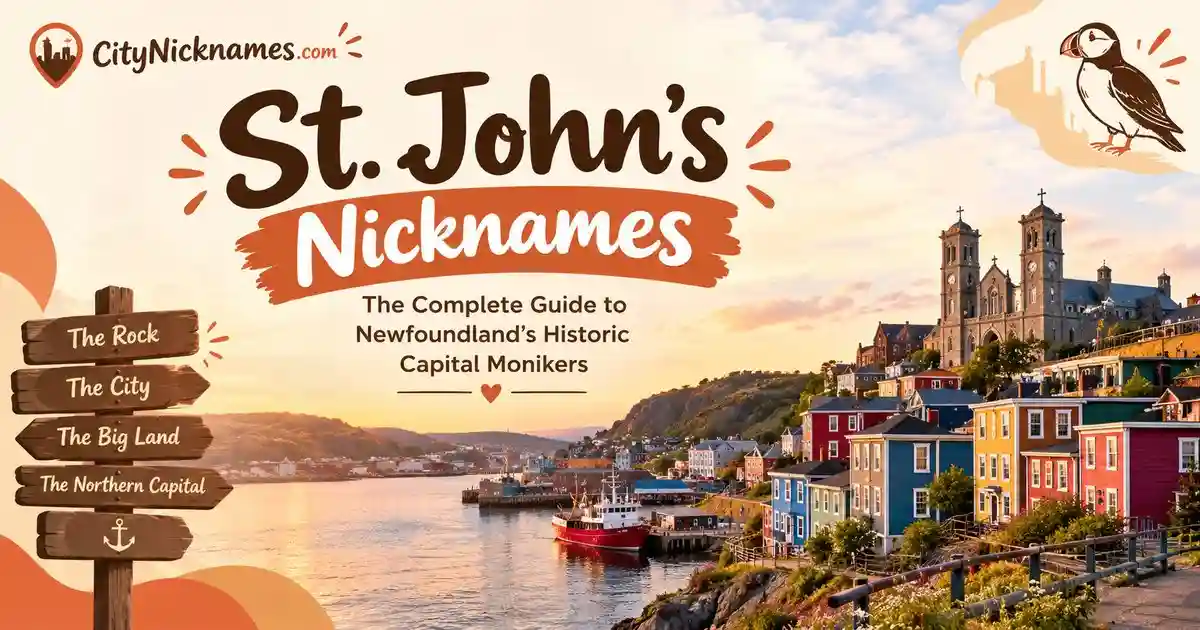
St. John’s, the vibrant capital of Newfoundland and Labrador, sits perched on the easternmost edge of North America, where rugged cliffs meet the wild Atlantic. This historic port city has accumulated a fascinating collection of nicknames throughout its centuries-long story. From “The Rock City” to “Jellybean Row,” St. John’s nicknames reveal the character of Canada’s oldest city.
📦 Quick Answer Box
⚡ Quick Answer: What Is St. John’s Most Famous Nickname?
The most famous nickname of St. John’s is “The Rock City” or simply “The Rock.” Other well-known nicknames include “Jellybean Row,” “Town,” and “The Far East of the West.” These names reflect the city’s rocky terrain, colorful architecture, and unique geographic position.
📊 Quick Facts Table
🏛️ Official Nickname of St. John’s
St. John’s does not have an officially designated nickname by any governmental or municipal authority. However, “The Rock City” and its shortened form “The Rock” are widely recognized and commonly used by residents, media, and visitors alike. These nicknames function as unofficial but deeply embedded identifiers that capture the essence of the city’s geography and character.
The nickname “The Rock” actually serves double duty in Newfoundland culture. It refers both to the island of Newfoundland itself and, more specifically, to St. John’s as the island’s capital and largest city. When Newfoundlanders say they’re “going to The Rock,” they typically mean returning to Newfoundland. When they say they’re “from The Rock,” they’re expressing pride in their island home.
🏙️ What Are the Nicknames of St. John’s?
St. John’s has accumulated numerous nicknames over its 400-plus years of documented history. These names come from various sources: its geography, its architecture, its cultural quirks, and its position on the map. Some nicknames are used primarily by locals, while others have gained wider recognition across Canada and beyond.
The city’s nicknames generally fall into a few categories:
- Geographic nicknames that reference the rocky terrain and coastal location
- Cultural nicknames that celebrate local traditions and community spirit
- Descriptive nicknames that highlight distinctive features like colorful buildings
- Positional nicknames that emphasize the city’s extreme eastern location
📋 Complete List of St. John’s Nicknames
🌟 Most Popular Nicknames of St. John’s
Among the many nicknames associated with St. John’s, a few stand out as the most recognized and frequently used. “The Rock City” dominates local and external references, appearing in tourism materials, media coverage, and everyday conversation. “Jellybean Row” has become equally iconic, particularly in visual media where the city’s colorful architecture takes center stage.
“Town” holds a special place in local vocabulary. When someone in Newfoundland says they’re “going to Town,” every local understands they mean St. John’s. This simple nickname reflects the city’s status as the undisputed urban center of the province.
📚 Main Nicknames Explained
🪨 The Rock City / The Rock
Meaning: A direct reference to Newfoundland’s rocky, rugged terrain and the island’s geological composition.
Short Origin Story: Newfoundland’s landscape is famously rocky, with thin soil and dramatic cliffs. The island itself became known as “The Rock” long before St. John’s specifically adopted the nickname. As the capital city and cultural heart of the island, St. John’s naturally inherited and amplified the association.
Historical Background: The term “The Rock” for Newfoundland appears in writings dating back to at least the 19th century. It was likely used by sailors and fishermen who navigated the island’s treacherous rocky shores. Over time, it became an affectionate term of endearment for both the island and its capital.
Modern Usage: Today, “The Rock” is used interchangeably for both Newfoundland and St. John’s, though context usually clarifies which is meant. Sports teams, businesses, and media outlets across Canada use the nickname regularly.
Cultural Impact: The nickname represents resilience. Newfoundlanders are proud of their rocky homeland and the toughness it represents. Calling St. John’s “The Rock City” acknowledges both the physical landscape and the sturdy character of its people.
Interesting Fact: The geological formations around St. John’s are among the oldest in the world, with some rocks dating back over 500 million years.
🌈 Jellybean Row
Meaning: A whimsical reference to the brightly colored row houses that line many downtown St. John’s streets.
Short Origin Story: The colorful houses of downtown St. John’s have existed for generations, but the “Jellybean Row” nickname gained traction in the late 20th century as tourism marketing embraced the city’s distinctive visual identity.
Historical Background: The tradition of painting houses in vibrant colors has practical roots. In foggy maritime climates, bright colors helped fishermen and sailors identify their homes from the water. Over time, the practice became a cherished aesthetic tradition.
Modern Usage: “Jellybean Row” appears in tourism brochures, Instagram posts, and travel guides worldwide. The actual streets—including Gower Street, Cochrane Street, and others—have become photography destinations.
Cultural Impact: The nickname has become synonymous with St. John’s visual identity. Artists, photographers, and filmmakers seek out these colorful streets to capture the city’s unique charm.
Interesting Fact: The colors are so iconic that local paint stores often have specific “Jellybean Row” color palettes available for homeowners wanting to maintain the tradition.
🏘️ Town
Meaning: A simple, affectionate shorthand for St. John’s as the primary urban center.
Short Origin Story: In Newfoundland vernacular, “Town” always means St. John’s. This usage developed because the city was historically the only significant urban settlement on the island.
Historical Background: For centuries, St. John’s was the commercial, political, and cultural hub of Newfoundland. People from outport communities would say they were “going to Town” when traveling to the capital for supplies, medical care, or business.
Modern Usage: The nickname persists in everyday conversation across Newfoundland. Radio hosts, news anchors, and locals all use “Town” to refer to St. John’s without confusion.
Cultural Impact: Using “Town” signals local knowledge and belonging. It’s a shibboleth that identifies true Newfoundlanders.
Interesting Fact: Even residents of other Newfoundland communities like Corner Brook or Gander understand that “Town” refers specifically to St. John’s.
🌅 The Far East of the West
Meaning: A geographic descriptor highlighting St. John’s position as the easternmost city in North America.
Short Origin Story: This nickname emerged from the city’s unique position at the eastern edge of the continent, where North America meets the Atlantic Ocean.
Historical Background: St. John’s has always been a gateway between the Old World and the New. Ships arriving from Europe first sighted land here, making it North America’s first port of call.
Modern Usage: The phrase appears in tourism materials and geographic descriptions, emphasizing the city’s unique position.
Cultural Impact: The nickname captures the sense of St. John’s as a place where east meets west, Europe meets North America, and the old world meets the new.
Interesting Fact: St. John’s is closer to London, England than it is to Vancouver, British Columbia.
🎭 City of Legends
Meaning: A reference to the rich folklore, storytelling tradition, and legendary characters associated with St. John’s and Newfoundland.
Short Origin Story: Newfoundland has one of the richest oral traditions in North America. Stories of fairies, ghosts, sea monsters, and larger-than-life characters have been passed down for generations.
Historical Background: The isolation of Newfoundland communities fostered a strong storytelling culture. Winter evenings were spent sharing tales, and St. John’s became the center of this tradition.
Modern Usage: The nickname celebrates Newfoundland’s literary and cultural heritage, from traditional folk tales to modern authors like Wayne Johnston.
Cultural Impact: The nickname reinforces the city’s identity as a place of imagination, creativity, and cultural richness.
Interesting Fact: Newfoundland has its own version of fairies—the “Little People”—who feature prominently in local folklore.
🏆 Which Nickname Is Most Famous?
“The Rock City” or simply “The Rock” stands as St. John’s most famous nickname. Its dominance comes from several factors. First, it applies to both the island and the city, giving it broader recognition. Second, it captures something essential about the place—the rocky, resilient character of both the land and its people. Third, it’s used consistently across Canada and internationally.
While “Jellybean Row” has gained significant popularity through social media and tourism marketing, “The Rock” remains the primary identifier. It’s shorter, punchier, and more versatile. You can say “I’m from The Rock” and immediately convey both geographic origin and cultural pride.
🗺️ How St. John’s Got Its Nicknames
St. John’s nicknames emerged from a combination of geography, culture, and circumstance. The city’s location on a rocky island in the North Atlantic naturally inspired “The Rock” designation. Its colorful architecture, born from practical maritime needs, gave rise to “Jellybean Row.” The city’s role as the only major urban center created the simple but meaningful “Town.”
Unlike some cities where nicknames are manufactured by marketing departments, St. John’s nicknames developed organically from the lived experience of residents. They reflect genuine aspects of the city’s character rather than promotional inventions. This authenticity gives them staying power and emotional resonance.
📝 Other Nicknames at a Glance
- The Oldest City – Reference to St. John’s status as North America’s oldest continuously settled city
- Gateway City – Acknowledging its historic role as entry point to North America
- The City of Colour – Celebrating the vibrant painted houses
- Fog City – A playful nod to the frequent fog that blankets the area
- The Eastern Edge – Geographic descriptor emphasizing the city’s position
- North America’s First City – Historical designation based on 1583 founding
🎉 Fun Facts About St. John’s
- Oldest City in North America: St. John’s was officially claimed for England by Sir Humphrey Gilbert on August 5, 1583, making it the oldest continuously settled city in North America.
- Colorful by Law (Almost): While there’s no actual law requiring colorful houses, local tradition and pride maintain the Jellybean Row aesthetic. Paint stores even stock specific heritage color palettes.
- George Street Reputation: George Street in downtown St. John’s has more bars and pubs per square foot than any other street in North America.
- Close to Europe: St. John’s is closer to London than to Vancouver, making it a surprising geographic fact for many Canadians.
- Fog Capital: The city experiences over 120 days of fog annually, giving rise to the local saying that “if you don’t like the weather, wait five minutes.”
- Signal Hill History: Signal Hill, overlooking the city, received the first transatlantic wireless signal in 1901, when Guglielmo Marconi received signals from Cornwall, England.
- Mummering Tradition: St. John’s maintains the unique Christmas tradition of mummering, where people visit neighbors in disguise during the holidays.
- Unique Dialect: The Newfoundland English dialect spoken in St. John’s preserves archaic English and Irish expressions found nowhere else in the world.
- UNESCO Recognition: In 2016, St. John’s was designated a UNESCO City of Music, recognizing its rich musical heritage.
- Cabot Tower: The iconic Cabot Tower on Signal Hill was built in 1897 to commemorate Queen Victoria’s Diamond Jubilee and the 400th anniversary of John Cabot’s voyage.
🏛️ Famous Attractions in St. John’s
St. John’s offers visitors a remarkable blend of history, culture, and natural beauty. Signal Hill stands as the city’s most iconic landmark, offering panoramic views and containing Cabot Tower, where Marconi received the first wireless signal. The Battery neighborhood features colorful houses clinging to cliffs, while George Street pulses with nightlife and live music.
The Rooms showcases the province’s art, history, and culture in a striking modern building. Quidi Vidi Village, a historic fishing village within the city limits, offers a glimpse into traditional Newfoundland life. The Basilica of St. John the Baptist represents the city’s strong Irish Catholic heritage.
Cape Spear, just outside the city, is the easternmost point in North America. Visitors can explore the oldest surviving lighthouse in Newfoundland and watch the sunrise first over the continent. Pippy Park, one of Canada’s largest urban parks, provides green space and recreational opportunities.
⚖️ Nickname Comparison: St. John’s vs Chicago
🏙️ The Rock City vs The Windy City
Both cities have nicknames rooted in their distinctive characteristics. While Chicago’s “Windy City” references its weather and politics, St. John’s “The Rock” celebrates its rugged geography. Explore more Chicago nicknames here.
🔗 Related Cities and Their Nicknames
🍎 New York City
The Big Apple, The City That Never Sleeps
🎰 Las Vegas
Sin City, Vegas, The Entertainment Capital
☘️ Boston
Beantown, The Cradle of Liberty
🌧️ Seattle
The Emerald City, Rain City
🍁 Canadian Cities
Explore nicknames across Canada
❓ Frequently Asked Questions
What is the official nickname of St. John’s?
St. John’s does not have an officially designated nickname. However, “The Rock City” and “The Rock” are the most widely recognized and commonly used nicknames for the city. These names are used informally by residents, media, and tourism organizations.
Why is St. John’s called “The Rock”?
St. John’s is called “The Rock” because of Newfoundland’s rocky, rugged terrain. The island’s landscape is characterized by thin soil, dramatic cliffs, and abundant rock formations. The nickname applies both to the island of Newfoundland and specifically to St. John’s as its capital city.
Who gave St. John’s its nickname?
The nickname “The Rock” developed organically over centuries, likely originating with sailors and fishermen who navigated Newfoundland’s rocky shores. No single person is credited with creating the nickname—it evolved naturally from the shared experience of living on and around the island.
When did “Jellybean Row” become popular?
“Jellybean Row” gained widespread popularity in the late 20th century as tourism marketing embraced the city’s colorful architecture. The nickname became especially prominent with the rise of social media, when photos of the brightly painted houses went viral online.
What does “The Far East of the West” mean?
“The Far East of the West” refers to St. John’s geographic position as the easternmost city in North America. It highlights the unique situation of a North American city that is closer to Europe than to many parts of its own continent.
🎯 Conclusion
St. John’s nicknames tell the story of a city shaped by its geography, culture, and history. From “The Rock City” to “Jellybean Row,” each nickname captures a different facet of this remarkable place. The rocky terrain that gave the city its most famous moniker also forged the resilient character of its people. The colorful houses that inspired “Jellybean Row” reflect the vibrant spirit that thrives even in one of North America’s harshest climates.
Understanding St. John’s nicknames provides insight into what makes this city unique among Canadian and North American urban centers. For those interested in exploring more city nicknames across Canada and around the world, National Geographic’s city guides offer excellent resources for further discovery. Whether you call it “The Rock,” “Town,” or simply St. John’s, this historic capital on Canada’s eastern edge remains one of the continent’s most distinctive and welcoming cities.