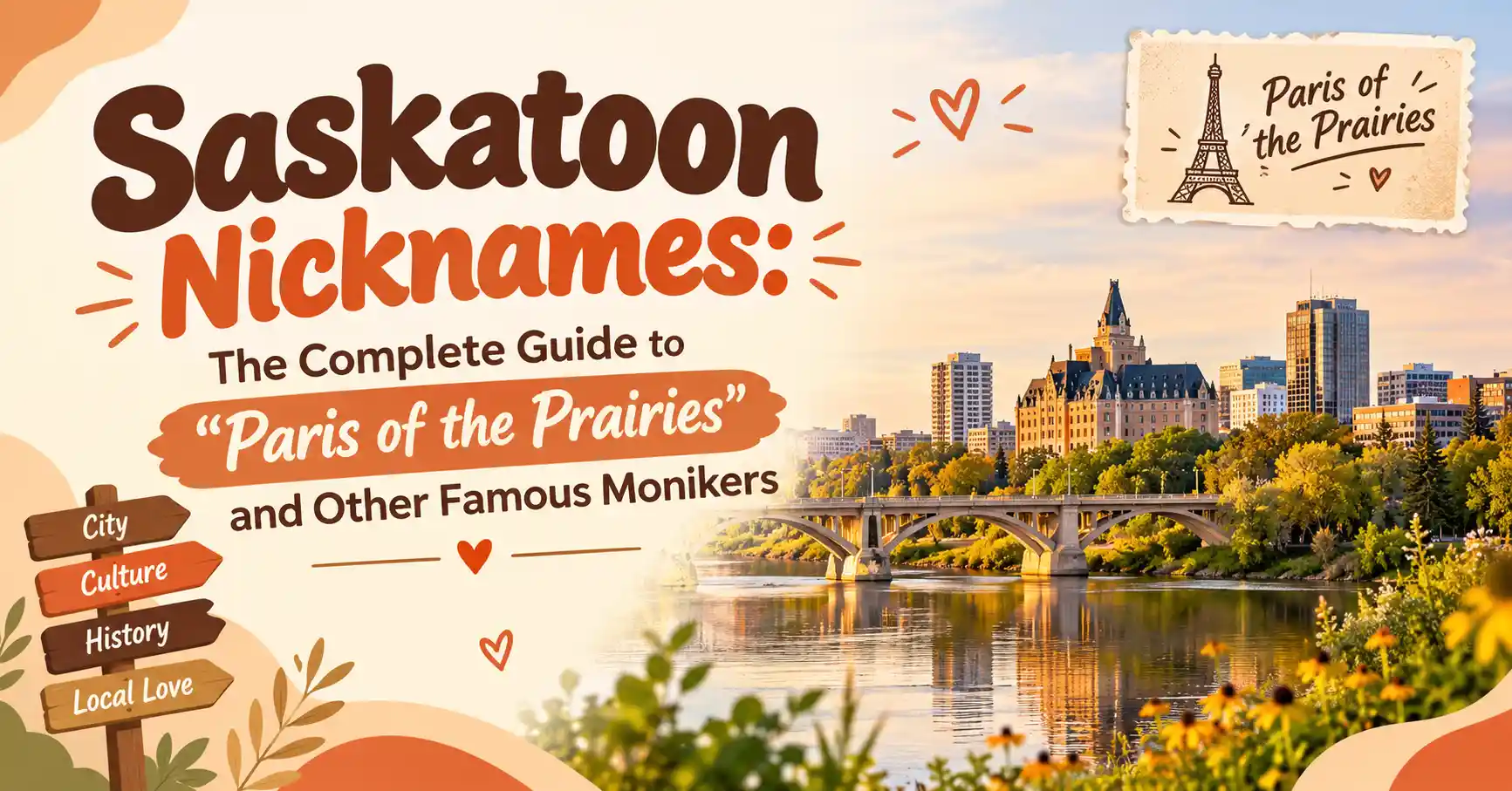
Saskatoon, Saskatchewan’s largest city, sits gracefully along the South Saskatchewan River, earning it a reputation as one of Canada’s most beautiful urban centers. Known for its stunning riverbank trails, vibrant arts scene, and warm prairie hospitality, this dynamic city has accumulated several memorable Saskatoon nicknames over its rich history.
📊 Quick Facts Table
| Attribute | Details |
|---|---|
| City | Saskatoon |
| Province/Country | Saskatchewan, Canada |
| Official Nickname | None officially designated |
| Most Famous Nickname | “Paris of the Prairies” |
| Population | Approximately 266,000 (2021 Census) |
| Founded | 1882 (incorporated as a city in 1906) |
| Known For | Riverbank trails, University of Saskatchewan, potash mining, vibrant arts scene |
| Number of Bridges | 7 major bridges crossing the South Saskatchewan River |
🏛️ Official Nickname of Saskatoon
Saskatoon does not have an officially designated nickname by the city government. However, “Paris of the Prairies” is the most widely recognized and commonly used moniker, appearing in tourism materials, media reports, and popular culture. The nickname is considered unofficial but is deeply embedded in the city’s identity and frequently used by locals and visitors alike.
Unlike some cities that have formally adopted nicknames through municipal proclamation, Saskatoon’s nicknames have evolved organically through public usage, media coverage, and community pride. The “Paris of the Prairies” designation reflects the city’s commitment to urban beauty, cultural richness, and its stunning river valley setting.
🌆 What Are the Nicknames of Saskatoon?
Saskatoon’s nicknames reflect different aspects of the city’s character—its physical beauty, architectural features, economic role, and cultural identity. These monikers have developed over more than a century of urban growth and community development.
The nicknames generally fall into several categories:
- Geographic and Aesthetic Nicknames – Names highlighting the city’s natural beauty and river valley setting
- Infrastructure-Based Nicknames – Names referencing the city’s distinctive bridge network
- Economic and Regional Nicknames – Names reflecting Saskatoon’s role as a prairie hub
- Historical and Cultural Nicknames – Names connected to specific historical events or cultural movements
- Informal and Affectionate Nicknames – Casual names used by locals in everyday conversation
📋 Complete List of Saskatoon Nicknames
| Nickname | Meaning | Origin | Popularity |
|---|---|---|---|
| Paris of the Prairies | Refers to the city’s beauty, culture, and romantic riverbank setting | Early 20th century; popularized in tourism and media | Very High |
| City of Bridges | References the 7 major bridges spanning the South Saskatchewan River | Mid-20th century as bridge network expanded | High |
| Hub City | Recognizes Saskatoon as a central economic and distribution center | Early 1900s during railway expansion | Moderate |
| POW City | Derived from “Saskatoon” sounding like “Sask-a-toon”; cartoon reference | Late 20th century pop culture | Moderate |
| Toon Town | Affectionate shortening of Saskatoon; casual local reference | Late 20th century local usage | Moderate |
| Saskabush | Humorous blend of “Saskatoon” and “bush”; prairie wilderness reference | Mid-20th century informal usage | Low |
| City of the Arts | Highlights vibrant arts, music, and cultural scene | Contemporary; gained traction in 21st century | Low |
⭐ Most Popular Nicknames of Saskatoon
Among the various Saskatoon nicknames, a few stand out as particularly significant and widely recognized. “Paris of the Prairies” dominates public perception, appearing in everything from travel guides to local business names. “City of Bridges” has gained substantial traction due to the city’s distinctive geography, while “Hub City” reflects Saskatoon’s historical and ongoing role as a regional economic center.
📖 Main Nicknames Explained
🗼 Paris of the Prairies
Meaning: This nickname compares Saskatoon to Paris, France, emphasizing its aesthetic beauty, cultural sophistication, and romantic atmosphere. The comparison highlights the city’s picturesque river valley, tree-lined streets, and thriving arts community.
Short Origin Story: The nickname emerged in the early to mid-20th century as Saskatoon developed into a cultural and educational center on the Canadian prairies. Travel writers and journalists began using the comparison to describe the city’s unexpected beauty amid the flat prairie landscape.
Historical Background: Saskatoon’s location on the South Saskatchewan River created a natural setting that reminded visitors of European river cities. The establishment of the University of Saskatchewan in 1907 brought intellectual and cultural development that reinforced the Parisian comparison.
Modern Usage: Today, “Paris of the Prairies” appears in tourism marketing, local business names, and media coverage of the city. It remains the go-to nickname for journalists writing about Saskatoon’s attractions.
Cultural Impact: The nickname has shaped how both residents and outsiders perceive Saskatoon, fostering civic pride and positioning the city as a cultural destination on the prairies.
Interesting Fact: The comparison is particularly striking given Saskatoon’s relatively small size compared to actual Paris—yet locals embrace the nickname as a testament to their city’s outsized cultural offerings.
🌉
City of Bridges
Meaning: This nickname directly references Saskatoon’s seven major bridges that span the South Saskatchewan River, connecting the city’s east and west sides.
Short Origin Story: As Saskatoon grew and expanded across the river, the construction of multiple bridges became a defining feature of the city’s landscape. The nickname emerged as the bridge network became integral to daily life.
Historical Background: The first bridge, the Broadway Bridge, opened in 1932. Subsequent bridges including the University Bridge, Senator Sid Buckwold Bridge, and Circle Drive Bridge expanded connectivity and shaped the city’s development.
Modern Usage: “City of Bridges” is commonly used in tourism materials and civic branding. The bridges themselves have become iconic landmarks and gathering places.
Cultural Impact: The nickname celebrates Saskatoon’s engineering achievements and the bridges’ role in unifying the community across the river.
Interesting Fact: Saskatoon’s bridges are illuminated at night with different colors, creating a stunning visual display that reinforces the nickname’s romantic connotations.
🚂 Hub City
Meaning: “Hub City” reflects Saskatoon’s role as a central distribution point and economic engine for the surrounding agricultural region.
Short Origin Story: During the early 20th century, Saskatoon became a major railway hub, with multiple rail lines converging on the city. This strategic position made it a natural center for trade and commerce.
Historical Background: The arrival of the Canadian Pacific Railway and later the Canadian National Railway established Saskatoon as a critical link in the prairie transportation network.
Modern Usage: While less commonly used than “Paris of the Prairies,” “Hub City” still appears in economic development materials and historical contexts.
Cultural Impact: The nickname speaks to Saskatoon’s practical importance as a regional center for agriculture, mining, and commerce.
Interesting Fact: Saskatoon remains a major hub for potash mining, with the world’s largest potash producer headquartered in the city.
🎨 POW City
Meaning: “POW City” is a playful nickname derived from the “toon” sound in Saskatoon, referencing cartoons and comic book culture.
Short Origin Story: This nickname gained popularity in the late 20th century as a lighthearted, pop-culture-inspired alternative to more formal nicknames.
Historical Background: The nickname reflects Saskatoon’s youthful energy, driven in part by its large student population at the University of Saskatchewan.
Modern Usage: “POW City” appears in local branding, event names, and social media, particularly among younger residents.
Cultural Impact: The nickname adds a fun, irreverent dimension to Saskatoon’s identity, balancing the more romantic “Paris of the Prairies.”
Interesting Fact: The nickname has been used by local businesses, including comic shops and entertainment venues, capitalizing on its playful energy.
🎭 Toon Town
Meaning: “Toon Town” is an affectionate, casual shortening of Saskatoon used primarily by locals.
Short Origin Story: This nickname evolved naturally from the city’s name, following common patterns of creating friendly diminutives.
Historical Background: “Toon Town” has been used informally for decades, appearing in local conversations, social media, and community events.
Modern Usage: The nickname is most commonly used by residents in everyday speech and online.
Cultural Impact: “Toon Town” represents the friendly, approachable nature of Saskatoon’s community.
Interesting Fact: Despite the cartoonish sound, “Toon Town” is used with genuine affection by proud Saskatonians.
🏆 Which Nickname Is Most Famous?
“Paris of the Prairies” is unquestionably the most famous Saskatoon nickname. This moniker has achieved the widest recognition both within Canada and internationally. Its appeal lies in the aspirational comparison to one of the world’s most beloved cities, suggesting that Saskatoon offers a similar blend of beauty, culture, and romance—all within a prairie setting.
The nickname’s dominance stems from several factors:
- Media Usage: Travel journalists and tourism boards consistently use “Paris of the Prairies” when promoting Saskatoon
- Civic Pride: Residents embrace the nickname as a point of pride
- Distinctiveness: Unlike generic nicknames like “Hub City,” “Paris of the Prairies” is unique to Saskatoon
- Evocative Imagery: The comparison creates vivid mental images that capture the city’s essence
🔍 How Saskatoon Got Its Nicknames
Saskatoon’s nicknames have developed organically over more than a century, reflecting the city’s evolution from a small railway town to a thriving metropolitan center. The nicknames emerged from various sources:
- Natural Beauty: The city’s stunning river valley setting inspired aesthetic nicknames
- Infrastructure: The distinctive bridge network generated descriptive monikers
- Economic Role: Saskatoon’s position as a regional hub influenced practical nicknames
- Popular Culture: Creative wordplay produced playful, informal nicknames
Unlike cities that have formally adopted official nicknames, Saskatoon’s monikers have been bestowed by residents, journalists, and visitors who recognized something special about the city.
📝 Other Nicknames at a Glance
- Bridge City – Simple variation of “City of Bridges”
- Saskatoon Berry City – Reference to the saskatoon berry that gave the city its name
- The Saskatoon – Streamlined version used in some contexts
- Prairie Metropolis – Recognition of Saskatoon’s status as Saskatchewan’s largest city
- Cultural Capital of Saskatchewan – Acknowledges the city’s arts and cultural prominence
🎉 Fun Facts About Saskatoon
- Unique Name Origin: “Saskatoon” comes from the Cree word “misâskwatômina,” referring to the saskatoon berry that grows abundantly in the region.
- Growing City: Saskatoon is one of Canada’s fastest-growing cities, with a population that has more than doubled since 1991.
- Bridge Capital: With seven river crossings, Saskatoon has more bridges per capita than almost any other Canadian city.
- University City: The University of Saskatchewan, founded in 1907, is one of Canada’s leading research institutions and a major cultural influence.
- Potash Powerhouse: Saskatoon is known as the “Potash Capital of the World,” with the mineral playing a central role in the local economy.
- Riverbank Paradise: The Meewasin Valley Trail system spans over 60 kilometers along the river, offering year-round recreation.
- Music Scene: Saskatoon has produced numerous successful musicians, including Joni Mitchell, who spent part of her childhood in the city.
- Festival City: The city hosts over 100 festivals annually, including the Saskatoon Jazz Festival and Shakespeare on the Saskatchewan.
- Beautiful Sunsets: Saskatoon’s prairie location and river valley setting create spectacular sunsets that have become a source of local pride.
- Warm Hospitality: Despite harsh winters, Saskatoon is known for its warm, welcoming community spirit.
🎯 Famous Attractions in Saskatoon
Saskatoon offers numerous attractions that showcase the city’s beauty and culture:
- Meewasin Valley Trail – A scenic 60+ kilometer trail system along the South Saskatchewan River
- Remai Modern – A world-class art museum featuring contemporary and modern art
- University of Saskatchewan – Historic campus with beautiful architecture and the Canadian Light Source synchrotron
- Broadway Avenue – Vibrant shopping and dining district with independent businesses
- Wanuskewin Heritage Park – Indigenous cultural site and museum
- Saskatoon Forestry Farm Park & Zoo – Family-friendly attraction with animals and gardens
- Delta Bessborough – Iconic castle-like hotel on the riverbank
- Midtown Plaza – Downtown shopping center
- Western Development Museum – Preserving Saskatchewan’s history
- Shakespeare on the Saskatchewan – Summer theater festival
⚖️ Nickname Comparison
🌍 Saskatoon vs Chicago Nicknames
🇨🇦 Saskatoon
- Paris of the Prairies
- City of Bridges
- Hub City
- POW City
Focus: Beauty, culture, connectivity
🇺🇸 Chicago
- The Windy City
- The Second City
- The City of Big Shoulders
- Chi-Town
Focus: Character, resilience, influence
While Chicago’s nicknames emphasize its bold personality and political significance, Saskatoon’s nicknames highlight its unexpected beauty and cultural richness on the Canadian prairies.
🔗 Related Cities and Their Nicknames
🏙️ Chicago Nicknames
The Windy City & More
🍎 New York City Nicknames
The Big Apple & More
🎰 Las Vegas Nicknames
Sin City & More
🇨🇦 Toronto Nicknames
The Six & More
🌊 Vancouver Nicknames
Hollywood North & More
❓ Frequently Asked Questions
What is the official nickname of Saskatoon?
Saskatoon does not have an officially designated nickname. However, “Paris of the Prairies” is the most widely recognized and commonly used moniker, appearing in tourism materials and media coverage.
Why is Saskatoon called “Paris of the Prairies”?
Saskatoon earned this nickname due to its beautiful river valley setting, thriving arts scene, and cultural amenities that seemed unexpected for a prairie city. The comparison to Paris emphasizes the city’s aesthetic appeal and sophisticated character.
Who gave Saskatoon its nickname?
The “Paris of the Prairies” nickname emerged organically through travel writers, journalists, and visitors who recognized the city’s unique beauty. No single person is credited with coining the term.
When did the nickname become popular?
The nickname gained widespread popularity in the mid-20th century as Saskatoon developed its cultural institutions and tourism infrastructure. It has remained popular ever since.
What are other nicknames of Saskatoon?
Other nicknames include “City of Bridges,” “Hub City,” “POW City,” “Toon Town,” “Saskabush,” and “City of the Arts.”
What does “City of Bridges” mean?
This nickname references Saskatoon’s seven major bridges that cross the South Saskatchewan River, connecting the city’s various neighborhoods.
Is the nickname officially recognized?
No, Saskatoon’s nicknames are unofficial and have developed through popular usage rather than formal designation.
Do locals use these nicknames?
Yes, locals frequently use “Paris of the Prairies,” “Toon Town,” and “City of Bridges” in everyday conversation and social media.
🎬 Conclusion
Saskatoon’s nicknames capture the essence of a city that defies expectations. From the romantic “Paris of the Prairies” to the practical “Hub City,” these monikers reflect different facets of Saskatoon’s identity—its beauty, connectivity, economic importance, and cultural vitality. Whether you’re a resident, visitor, or simply curious about Canadian cities, understanding these Saskatoon nicknames offers insight into what makes this prairie city truly special.
For those interested in exploring more city nicknames across Canada and beyond, resources like Tourism Saskatchewan provide additional context about the province’s unique communities and attractions.