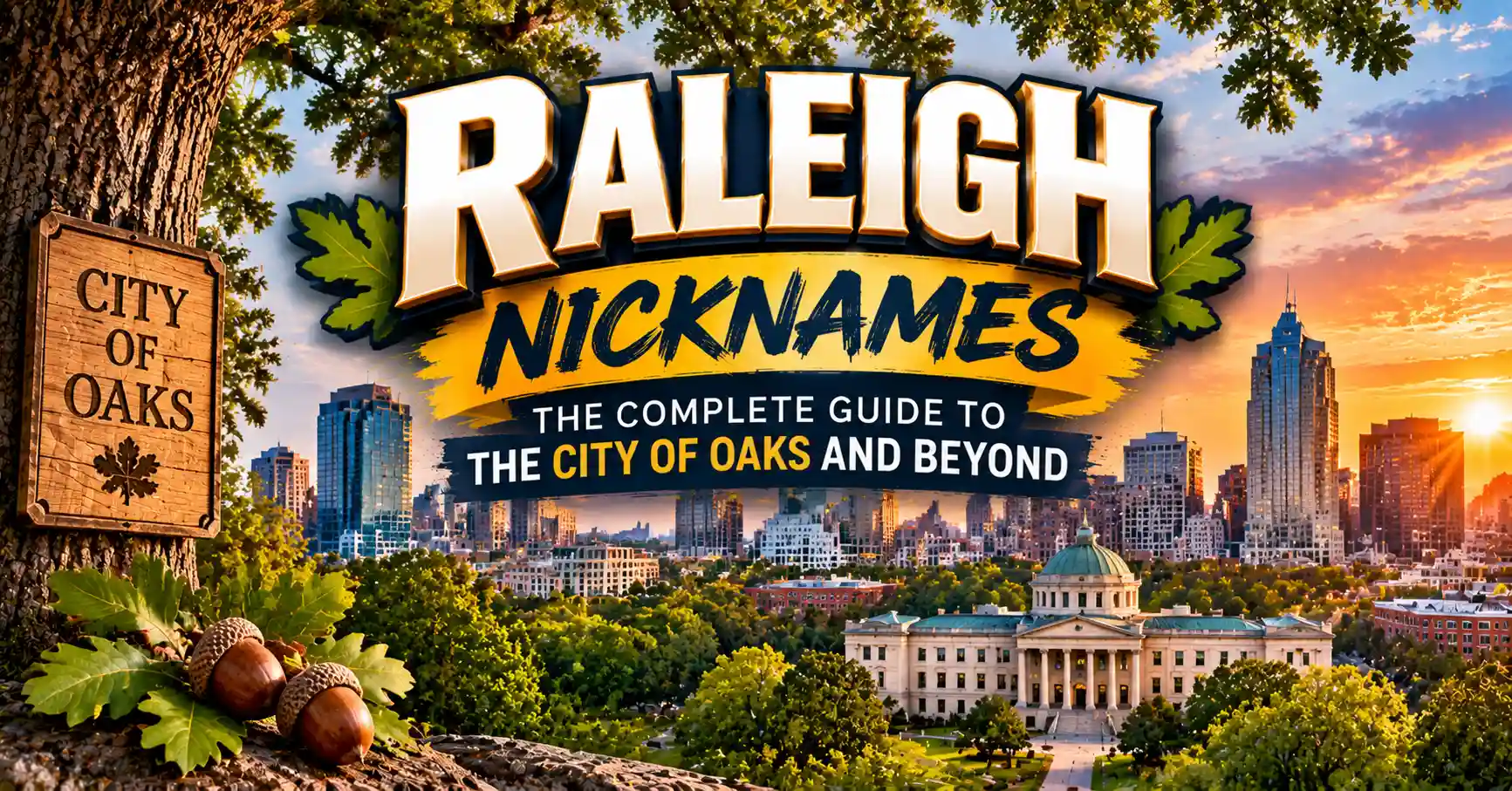
Raleigh, North Carolina’s vibrant capital city, has earned a fascinating collection of nicknames throughout its storied history. From “The City of Oaks” to “The Triangle,” these monikers capture the essence of a community that blends Southern charm with innovation, education, and natural beauty. Understanding Raleigh nicknames reveals the city’s identity, values, and the stories that shaped this dynamic Southern metropolis.
Whether you’re a longtime resident, a curious traveler, or someone researching the Tar Heel State’s capital, this comprehensive guide explores every nickname Raleigh has carried—past and present—along with their origins, meanings, and cultural significance.
⚡ Quick Answer: What Is Raleigh’s Most Famous Nickname?
The most famous nickname for Raleigh is “The City of Oaks” or simply “Oak City,” inspired by the abundant oak trees throughout the city. Other notable nicknames include “The Triangle” (referring to the Research Triangle region), “Raleighwood” (for its growing film industry), and “The Capital City” (as North Carolina’s seat of government).
📊 Quick Facts About Raleigh
🏛️ Official Nickname of Raleigh
Raleigh does not have an officially designated nickname by city ordinance or government proclamation. However, “The City of Oaks” functions as the city’s de facto official nickname, appearing in official city documents, tourism materials, and civic branding. The Raleigh City Council and local organizations consistently reference the oak tree theme, which is also reflected in the city’s official seal and flag.
While “The City of Oaks” holds semi-official status through widespread civic usage, other nicknames like “Oak City” and “The Triangle” are commonly recognized but remain unofficial. The nickname’s staying power comes from its deep roots in Raleigh’s history and landscape—oak trees have shaded the city’s streets since its founding.
🌳 What Are the Nicknames of Raleigh?
Raleigh’s nicknames reflect different aspects of its identity: its natural environment, its role as a capital, its educational and technological prominence, and its cultural evolution. These nicknames have emerged organically over more than two centuries, each capturing a distinct facet of the city.
Categories of Raleigh Nicknames
Nature-Inspired Nicknames
- The City of Oaks – References the abundance of oak trees planted throughout Raleigh’s streets and parks
- Oak City – A shortened, casual version of the city’s most beloved nickname
- City of Flowers – Occasionally used for Raleigh’s beautiful gardens and floral displays
Geographic and Regional Nicknames
- The Triangle – Refers to the Research Triangle region encompassing Raleigh, Durham, and Chapel Hill
- Capital City – Highlights Raleigh’s status as North Carolina’s seat of government
- The City of Culture – Occasionally used to emphasize Raleigh’s growing arts and cultural scene
Modern and Pop Culture Nicknames
- Raleighwood – A playful nod to the city’s growing film and television production industry
- Silicon Valley of the East – References the tech boom in the Research Triangle area
- Smithsonian of the South – Sometimes used due to the concentration of museums in the area
📋 Complete List of Raleigh Nicknames
⭐ Most Popular Nicknames of Raleigh
Among Raleigh’s many nicknames, three stand out as the most widely recognized and used: The City of Oaks, Oak City, and The Triangle. These nicknames appear regularly in local media, tourism marketing, business branding, and everyday conversation among residents.
“The City of Oaks” and its casual variant “Oak City” are deeply embedded in Raleigh’s civic identity. The city’s official website, local businesses, and community organizations frequently incorporate oak imagery. Meanwhile, “The Triangle” has gained prominence due to the region’s economic significance and national recognition as a tech and research hub.
📖 Main Raleigh Nicknames Explained
🌳 The City of Oaks
Meaning: A direct reference to the abundance of oak trees that line Raleigh’s streets, parks, and public spaces.
Short Origin Story: When Raleigh was established as North Carolina’s capital in 1792, the area was covered in dense oak forest. City planners intentionally preserved many of these trees as they laid out streets and public squares.
Historical Background: The oak tree became a symbol of Raleigh’s commitment to preserving natural beauty within an urban setting. In 1975, the city adopted the oak as its official tree, and oak leaf motifs appear on the Raleigh city flag and seal.
Modern Usage: “The City of Oaks” appears in tourism campaigns, city documents, and local business names. The Raleigh Convention Center, local breweries, and community events frequently reference the nickname.
Cultural Impact: The nickname shapes Raleigh’s identity as a green, livable city. The annual Raleigh Oaks Festival and various tree-planting initiatives reinforce this connection to nature.
Interesting Fact: Raleigh’s oak canopy is so significant that the city has a dedicated Urban Forestry Division to maintain and protect its trees, with some oaks estimated to be over 200 years old.
🌲 Oak City
Meaning: A shortened, affectionate version of “The City of Oaks.”
Short Origin Story: As Raleigh grew in the 20th century, residents naturally abbreviated the formal nickname into the casual “Oak City” for everyday use.
Historical Background: The term gained popularity in local newspapers and radio broadcasts during the mid-1900s, becoming a shorthand way to refer to the capital.
Modern Usage: “Oak City” appears in hashtags, social media, local merchandise, and event names like “Oak City Comedy Festival” and “Oak City Cares.”
Cultural Impact: The nickname feels approachable and community-oriented, reflecting Raleigh’s friendly Southern character.
Interesting Fact: Local businesses from Oak City Coffee to Oak City CrossFit have adopted the nickname, making it a recognizable brand throughout the region.
🔺 The Triangle
Meaning: Refers to the Research Triangle region, which includes Raleigh, Durham, and Chapel Hill—three cities that form a geographic triangle in central North Carolina.
Short Origin Story: The name emerged in the 1950s when local leaders established Research Triangle Park (RTP) between the three cities to attract technology and research companies.
Historical Background: RTP was founded in 1959 and became one of the most successful research parks in the world, home to companies like IBM, Cisco, and GlaxoSmithKline.
Modern Usage: “The Triangle” is used regionally and nationally to describe the Raleigh-Durham metropolitan area. It appears in business recruitment materials, real estate listings, and news coverage.
Cultural Impact: The nickname symbolizes innovation, education, and economic opportunity. It connects Raleigh to a broader regional identity beyond just the capital city.
Interesting Fact: The Triangle consistently ranks among the best places to live and work in the United States, often cited for its combination of Southern charm and high-tech opportunity.
🎬 Raleighwood
Meaning: A playful blend of “Raleigh” and “Hollywood,” referencing the city’s growing film and television production industry.
Short Origin Story: As North Carolina became a popular filming location in the 1980s and 1990s, Raleigh and surrounding areas attracted productions seeking diverse locations and favorable tax incentives.
Historical Background: Films like “Bull Durham” (1988) and TV shows like “Dawson’s Creek” (1998-2003) brought attention to the region’s production capabilities.
Modern Usage: “Raleighwood” appears in entertainment news and local pride campaigns. Major productions continue to film in the area, including shows for Netflix and HBO.
Cultural Impact: The nickname celebrates Raleigh’s creative economy and its connection to the entertainment industry.
Interesting Fact: North Carolina’s film industry generates hundreds of millions of dollars annually, with Raleigh serving as a central hub for production activity.
🏛️ Capital City
Meaning: A straightforward reference to Raleigh’s status as the capital of North Carolina.
Short Origin Story: Raleigh was specifically chosen and designed to be the state capital in 1792, replacing the previous capital of New Bern.
Historical Background: The city was named after Sir Walter Raleigh and planned from the beginning as a seat of government, with the State Capitol building at its center.
Modern Usage: “Capital City” is used in tourism materials, local sports team names, and official communications.
Cultural Impact: The nickname emphasizes Raleigh’s political importance and its role as a center of government, law, and public service.
Interesting Fact: Raleigh is one of the few planned capital cities in the United States, designed specifically for that purpose rather than growing organically into the role.
🏆 Which Raleigh Nickname Is Most Famous?
“The City of Oaks” is unequivocally Raleigh’s most famous nickname. It has the longest history, the deepest cultural roots, and the widest recognition both locally and nationally. The nickname appears in official city branding, tourism campaigns, and countless local business names.
While “The Triangle” is widely recognized regionally, it refers to a broader area rather than Raleigh specifically. “Oak City” is popular locally but less known outside North Carolina. “The City of Oaks” strikes the perfect balance of specificity, historical authenticity, and broad appeal.
📜 How Raleigh Got Its Nicknames
Raleigh’s nicknames emerged from different eras and aspects of its development. “The City of Oaks” arose from the city’s natural landscape and intentional preservation of oak trees during its founding. “The Triangle” developed in the mid-20th century as the Research Triangle Park transformed the region’s economy.
More recent nicknames like “Raleighwood” reflect the city’s evolving identity as a center for entertainment and technology. Each nickname captures a moment in Raleigh’s ongoing story—from a planned capital in the forest to a modern hub of innovation and culture.
📝 Other Raleigh Nicknames at a Glance
- The City of Culture – Highlights Raleigh’s museums, theaters, and arts scene
- The Smithsonian of the South – References the concentration of free museums
- Tech Hub of the South – Emphasizes the technology industry’s presence
- The All-America City – Award given multiple times by the National Civic League
- The Park City – References the many parks and green spaces
- City of Medicine – Acknowledges the healthcare and research institutions
🎉 Fun Facts About Raleigh
- Raleigh was named after Sir Walter Raleigh, the English explorer who sponsored the lost Roanoke Colony.
- The city was intentionally designed as a capital and is one of the few planned state capitals in the U.S.
- Raleigh’s oak trees are protected by city ordinance, making it illegal to remove certain trees without permission.
- The Research Triangle Park is the largest research park in the United States, covering over 7,000 acres.
- Raleigh hosted the 1987 and 2007 U.S. Olympic Festivals, showcasing the city’s sports facilities.
- The North Carolina State Capitol building is a National Historic Landmark and one of the best-preserved examples of Greek Revival architecture in the country.
- Raleigh’s Pullen Park is the fifth-oldest operating amusement park in the United States, opening in 1887.
- The city is home to three major universities: North Carolina State University, Shaw University, and William Peace University.
- Raleigh’s warehouse district has been transformed into a vibrant arts and entertainment destination.
- The city consistently ranks among the best places to live in national surveys, cited for its quality of life, job opportunities, and cultural amenities.
🎯 Famous Attractions in Raleigh
Raleigh offers a rich array of attractions that draw visitors from across the country. The North Carolina Museum of Art houses an impressive collection spanning 5,000 years of artistic achievement. Pullen Park, one of the oldest amusement parks in America, offers family-friendly rides and beautiful gardens.
The North Carolina State Capitol stands as a testament to the city’s governmental heritage, while the City Market district provides shopping and dining in a historic setting. Dorothea Dix Park, the city’s largest park, offers stunning skyline views and hosts community events throughout the year.
The Raleigh Little Theatre, Red Hat Amphitheater, and numerous galleries in the Warehouse District showcase the city’s thriving arts scene.
⚖️ Nickname Comparison: Raleigh vs. Charlotte
How do North Carolina’s two largest cities compare when it comes to their nicknames?
Both cities embrace their nicknames as part of their civic identity, though Raleigh’s “City of Oaks” emphasizes natural beauty while Charlotte’s “Queen City” highlights its namesake’s royal connection.
🔗 Related Cities and Their Nicknames
Explore more city nickname guides from across the United States:
🌬️ Chicago Nicknames
The Windy City, Second City, and more
🗽 New York City Nicknames
The Big Apple, Gotham, and more
🎰 Las Vegas Nicknames
Sin City, Entertainment Capital, and more
🎸 Austin Nicknames
Live Music Capital, ATX, and more
🌴 Miami Nicknames
Magic City, Gateway to the Americas, and more
👑 Charlotte Nicknames
The Queen City, Hornet’s Nest, and more
❓ Frequently Asked Questions About Raleigh Nicknames
What is the official nickname of Raleigh?
Raleigh does not have an officially designated nickname by law or proclamation. However, “The City of Oaks” functions as the de facto official nickname, appearing in city branding and official communications. The oak tree is the city’s official tree, reinforcing this connection.
Why is Raleigh called The City of Oaks?
Raleigh is called “The City of Oaks” because of the abundance of oak trees throughout the city. When Raleigh was founded in 1792, the area was covered in oak forest, and city planners intentionally preserved many trees as they developed the city. Today, oak trees line streets, fill parks, and remain a defining feature of Raleigh’s landscape.
Who gave Raleigh its nickname?
The nickname “The City of Oaks” emerged organically from residents and visitors who noticed the abundance of oak trees. It was not attributed to a single person but developed naturally over time. The nickname gained formal recognition through its use in city documents and civic branding.
When did Raleigh’s nicknames become popular?
“The City of Oaks” became popular in the 19th century as the city developed and its tree canopy became a point of pride. “The Triangle” emerged in the 1960s after the founding of Research Triangle Park. “Raleighwood” gained traction in the 1990s and 2000s as the film industry grew.
What are other nicknames for Raleigh?
Other nicknames for Raleigh include “Oak City,” “The Triangle,” “Raleighwood,” “Capital City,” “Silicon Valley of the East,” “Smithsonian of the South,” and “City of Flowers.” Each nickname reflects a different aspect of Raleigh’s identity and history.
🏁 Conclusion
Raleigh’s nicknames tell the story of a city that values nature, education, innovation, and community. From the historic “City of Oaks” to the modern “Raleighwood,” these monikers capture the evolving identity of North Carolina’s capital. Whether you call it Oak City, The Triangle, or simply home, Raleigh’s nicknames reflect the pride and affection residents feel for this dynamic Southern city.
For more comprehensive information about Raleigh’s history and attractions, visit the official City of Raleigh website, which provides authoritative resources on the city’s government, services, and community initiatives. Understanding Raleigh nicknames offers a window into the city’s soul—a place where oak trees shade innovation, and Southern charm meets global ambition.