
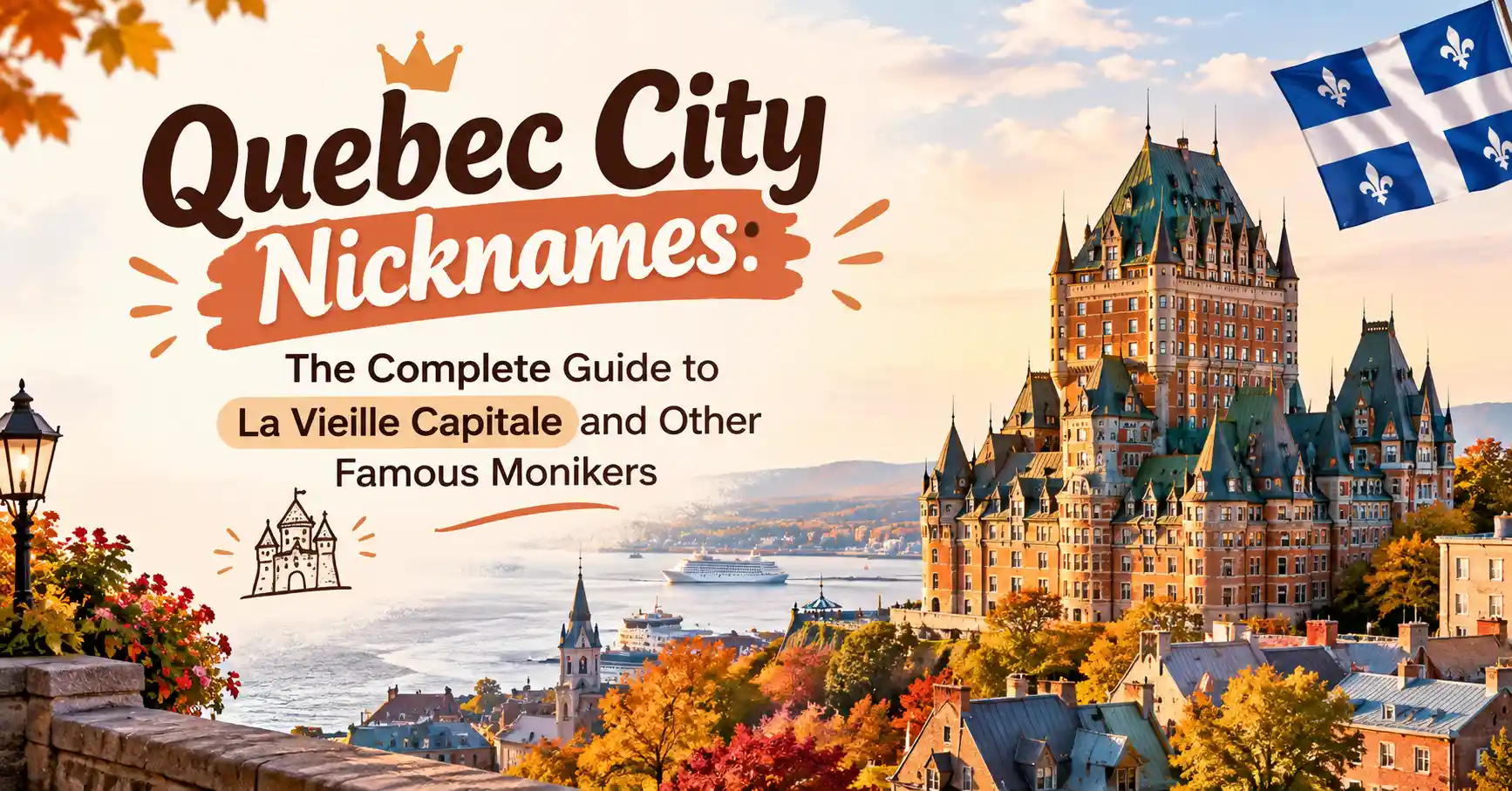
Perched majestically on the banks of the Saint Lawrence River, Quebec City stands as one of North America’s most enchanting destinations. As the only fortified city north of Mexico and a UNESCO World Heritage Site, this French-Canadian gem has earned several affectionate nicknames throughout its storied history. From “La Vieille Capitale” to the “Gibraltar of America,” these Quebec City nicknames reflect the city’s remarkable heritage, strategic importance, and enduring charm that captivates millions of visitors annually.
🎯 Quick Answer Box
Quick Answer
The most famous nickname of Quebec City is “La Vieille Capitale” (The Old Capital). Other well-known Quebec City nicknames include “The Gibraltar of America,” “The Walled City,” and “The Cradle of French Civilization in North America.”
📊 Quick Facts Table
🏛️ Official Nickname of Quebec City
Quebec City does not have a legally designated official nickname. However, “La Vieille Capitale” (The Old Capital) functions as a de facto official nickname, widely used by government institutions, tourism boards, and media outlets across the province. This nickname holds semi-official status due to its extensive adoption in formal contexts.
The distinction between official and unofficial nicknames matters for understanding Quebec City’s identity. While cities like Chicago have multiple well-known nicknames without formal designation, Quebec City’s “La Vieille Capitale” carries particular weight because it references the city’s historical role as the capital of New France and later the capital of Lower Canada and Quebec.
Historically, the city was simply known as “Québec,” derived from the Algonquin word “kebec” meaning “where the river narrows.” This original name remains the only formal designation, while all nicknames exist as cultural additions that reflect various aspects of the city’s character.
📍 What Are the Nicknames of Quebec City?
Quebec City’s nicknames emerge from its unique position in North American history. As the oldest European settlement in Canada and the cradle of French civilization on the continent, the city has accumulated monikers that celebrate its age, strategic military importance, architectural heritage, and cultural significance.
The Quebec City nicknames fall into several categories:
- Historical references honoring its role as the former capital of New France
- Military designations acknowledging its formidable fortifications
- Cultural identifiers celebrating its French heritage
- Geographic descriptions highlighting its dramatic location
Each nickname tells a story about how residents and visitors perceive this remarkable city, from its dramatic clifftop setting to its enduring French character.
📋 Complete List of Quebec City Nicknames
🌟 Most Popular Nicknames of Quebec City
Among the various Quebec City nicknames, several stand out for their widespread recognition and cultural significance. “La Vieille Capitale” dominates French-language usage and appears throughout official communications, tourism materials, and everyday conversation among Quebecers. English speakers often reference “The Gibraltar of America” when discussing the city’s military history, while “The Walled City” resonates with visitors impressed by the surviving ramparts.
The most recognized Quebec City nicknames share a common thread: they celebrate what makes this city unique among North American destinations. Whether emphasizing its age, fortifications, or French character, these nicknames capture essential aspects of Quebec City’s identity that distinguish it from every other city on the continent.
📖 Main Nicknames Explained
🏰 La Vieille Capitale (The Old Capital)
Meaning: This French nickname translates directly to “The Old Capital,” referencing Quebec City’s historical role as the capital of New France, Lower Canada, and briefly, Canada.
Short Origin Story: The nickname emerged as Quebec City’s political importance diminished following the British Conquest of 1759 and the eventual transfer of capital status to Ottawa in 1857. French-speaking residents adopted “La Vieille Capitale” as a term of endearment that honored their city’s glorious past.
Historical Background: From 1608 until the British conquest, Quebec served as the heart of French colonial administration in North America. Even after losing political primacy, the city remained the spiritual and cultural capital of French Canada, making the nickname both nostalgic and defiant.
Modern Usage: Today, “La Vieille Capitale” appears everywhere in Quebec City—in tourism campaigns, newspaper headlines, business names, and casual conversation. It functions as both a geographic descriptor and a cultural statement.
Cultural Impact: The nickname reinforces Quebec City’s sense of itself as a living museum of French civilization in North America. It connects modern residents to their ancestors and affirms the city’s enduring significance despite its political decline.
Interesting Fact: The term “La Vieille Capitale” is so ingrained in local identity that businesses, restaurants, and even sports teams incorporate it into their names, from “Vieux-Québec” establishments to the former “Capitales de Québec” baseball team.
🏛️ Gibraltar of America
Meaning: This nickname compares Quebec City’s formidable fortifications to the Rock of Gibraltar, the famous British fortress at the entrance to the Mediterranean Sea.
Short Origin Story: British military commanders coined this nickname after taking control of Quebec in 1759. They recognized that the city’s natural clifftop position and extensive defensive works made it virtually impregnable—much like Gibraltar, which Britain considered unconquerable.
Historical Background: The comparison gained currency during the American Revolutionary War when American forces under Benedict Arnold and Richard Montgomery attempted to capture Quebec City in 1775. The failed assault, in which Montgomery was killed, seemed to confirm the city’s reputation for invincibility.
Modern Usage: The nickname appears primarily in historical contexts, tourism materials focused on military heritage, and discussions of the city’s fortifications. It remains a point of pride for residents aware of their city’s martial history.
Cultural Impact: “Gibraltar of America” emphasizes Quebec City’s strategic importance throughout North American history. It positions the city as a key military prize contested by French, British, and American forces.
Interesting Fact: Despite the nickname, Quebec City did fall to British forces in 1759 after the Battle of the Plains of Abraham. However, the subsequent successful defense against American invasion in 1775-76 cemented its reputation for near-impregnability under proper defense.
🧱 The Walled City
Meaning: This descriptive nickname references Quebec City’s surviving fortification walls, which encircle the old town and represent the only remaining fortified city walls in North America north of Mexico.
Short Origin Story: The nickname emerged naturally from the city’s most distinctive physical feature. While other North American cities demolished their walls as they expanded, Quebec City preserved its ramparts, creating a unique urban environment.
Historical Background: The walls date primarily from the 17th and 18th centuries, with major expansions under French and British rule. By the 19th century, as the city outgrew its fortifications, officials debated demolishing the walls but ultimately preserved them for their historical value.
Modern Usage: “The Walled City” appears frequently in tourism marketing and visitor guides. It serves as shorthand for the historic district and emphasizes Quebec City’s unique status among North American destinations.
Cultural Impact: The walls define Quebec City’s physical and psychological boundaries between the ancient and modern city. They create a tangible connection to the past that few North American cities can match.
Interesting Fact: Quebec City’s fortifications were designated a UNESCO World Heritage Site in 1985, recognizing them as “the best-preserved fortified city north of Mexico” and an outstanding example of colonial-era military architecture.
🗼 Cradle of French Civilization in North America
Meaning: This elaborate nickname positions Quebec City as the birthplace and nurturing ground of French language and culture on the North American continent.
Short Origin Story: French-Canadian intellectuals and cultural leaders developed this nickname to emphasize Quebec City’s foundational role in establishing French civilization in the New World, distinguishing it from Montreal’s later commercial dominance.
Historical Background: Samuel de Champlain founded Quebec in 1608 as a permanent settlement, making it the first enduring French colony in North America. From this base, French explorers, missionaries, and traders spread across the continent.
Modern Usage: The nickname appears in cultural discourse, academic writing, and official communications celebrating Quebec’s French heritage. It carries significant emotional weight for francophone Quebecers.
Cultural Impact: This nickname reinforces Quebec City’s role as the guardian of French language and culture in North America. It supports the city’s self-image as the authentic heart of French Canada, as opposed to Montreal’s more cosmopolitan character.
Interesting Fact: The nickname’s use intensified during the Quiet Revolution of the 1960s when Quebec nationalism emphasized the province’s distinct identity and Quebec City’s historical primacy in establishing French civilization on the continent.
🏆 Which Nickname Is Most Famous?
“La Vieille Capitale” stands as the most famous Quebec City nickname for several compelling reasons. First, it enjoys near-universal recognition among French-speaking Quebecers and has crossed linguistic boundaries to be used even in English-language contexts. Second, it captures the essence of Quebec City’s identity—its glorious past as the center of French power in North America and its continued cultural significance despite political changes.
The nickname’s fame also stems from its emotional resonance. Unlike purely descriptive nicknames such as “The Walled City,” “La Vieille Capitale” carries a sense of nostalgia and pride that resonates with residents and visitors alike. It acknowledges that Quebec City’s best days may lie in the past while celebrating that past’s enduring value.
Finally, “La Vieille Capitale” has achieved something rare among city nicknames: it functions practically as an official designation. Tourism Quebec, municipal government communications, and media outlets use it routinely, cementing its status as the definitive Quebec City nickname.
🗺️ How Quebec City Got Its Nicknames
Quebec City’s nicknames emerged from distinct historical circumstances and serve different purposes in the city’s ongoing identity construction.
The French-language nicknames—”La Vieille Capitale” and “Cradle of French Civilization”—developed organically from the city’s historical experience. After losing political capital status, Quebec City needed new ways to assert its importance. These nicknames provided that by emphasizing historical primacy and cultural significance rather than current political power.
The English-language nicknames—”Gibraltar of America” and “The Walled City”—originated from military and physical characteristics. British observers recognized the city’s strategic value and architectural distinctiveness, creating nicknames that emphasized these practical attributes.
Over time, these different nickname traditions have merged into a shared identity. Both French and English speakers now use all these nicknames, recognizing that each captures something true about Quebec City’s character. The nicknames collectively tell the story of a city that has been French, British, and Canadian while maintaining its unique identity throughout.
📝 Other Nicknames at a Glance
Beyond the major nicknames, Quebec City has accumulated additional monikers:
- The Old City (Vieux-Québec): Common reference to the historic district
- The Citadel City: Highlighting the star-shaped fortress at its heart
- The City of Champlain: Honoring its founder
- The French Capital of North America: Emphasizing cultural leadership
- The Snow Capital: Celebrating its winter carnival and snowy climate
- The City on the Rock: Referencing its dramatic clifftop location
- America’s Most European City: Tourism marketing slogan
🎉 Fun Facts About Quebec City
- Oldest City in Canada: Quebec City is the oldest European settlement in Canada, predating Montreal by 34 years.
- UNESCO Recognition: The historic district was among the first North American sites inscribed on the UNESCO World Heritage list in 1985.
- Château Frontenac: This iconic hotel is the most photographed hotel in the world, according to Guinness World Records.
- Winter Carnival: The Quebec Winter Carnival is the world’s largest winter festival, attracting over a million visitors annually.
- North America’s Only Walled City: Quebec City is the only city north of Mexico with intact fortified walls.
- French First: Over 95% of residents speak French as their first language, making it one of the most francophone cities in the Americas.
- Ice Hotel: The Hôtel de Glace, North America’s only ice hotel, is built fresh each winter near Quebec City.
- Battle of the Plains of Abraham: This 1759 battle, fought on a field within city limits, determined the fate of North America.
- Funny Name Origin: The name “Quebec” comes from the Algonquin word “kebec,” meaning “where the river narrows.”
- Funicular History: The Old Quebec Funicular, connecting Upper and Lower Town, has operated since 1879.
🏰 Famous Attractions in Quebec City
Quebec City’s attractions reflect its rich history and French character:
Château Frontenac: This castle-like hotel dominates the skyline and serves as the city’s most recognizable symbol, perched atop Cap Diamant overlooking the Saint Lawrence River.
Old Quebec (Vieux-Québec): The historic district comprises Upper Town, with its fortifications and religious institutions, and Lower Town, with its charming narrow streets and Place Royale.
La Citadelle: This active military installation and official residence of the Governor General of Canada offers guided tours and stunning views.
Plains of Abraham: This historic battlefield is now a sprawling urban park where locals picnic, jog, and attend summer festivals.
Petit-Champlain: Often called the most beautiful street in North America, this charming lane in Lower Town features boutique shops and cafés.
Notre-Dame de Québec Basilica-Cathedral: The oldest church in Canada and the first parish church north of Mexico.
Musée de la Civilisation: A modern museum exploring human history and culture, particularly focused on French North America.
Île d’Orléans: This pastoral island just outside the city offers wineries, farms, and traditional Quebecois culture.
⚖️ Nickname Comparison: Quebec City vs Montreal
🔗 Related Cities and Their Nicknames
Montreal Nicknames
La Métropole, Sin City of Canada, and more from Quebec’s largest city
Ottawa Nicknames
Bytown, The Capital, and nicknames from Canada’s current capital city
Toronto Nicknames
The 6ix, Hogtown, and nicknames from Canada’s largest city
Vancouver Nicknames
Hollywood North, Rain City, and nicknames from Canada’s Pacific gem
Canada City Nicknames
Explore nicknames from cities across the Great White North
❓ Frequently Asked Questions
What is the official nickname of Quebec City?
Quebec City does not have a legally official nickname. However, “La Vieille Capitale” (The Old Capital) functions as a de facto official nickname, widely used by government institutions, tourism boards, and media. It holds semi-official status due to its extensive adoption in formal contexts.
Why is Quebec City called “La Vieille Capitale”?
Quebec City earned this nickname because it served as the capital of New France from 1608 to 1763, the capital of Lower Canada from 1791 to 1841, and briefly as the capital of the Province of Canada. Even after losing political capital status to Ottawa, the city remained the cultural and spiritual capital of French Canada, making “The Old Capital” a fitting tribute to its historical importance.
Who gave Quebec City its nickname “Gibraltar of America”?
British military commanders coined this nickname after capturing Quebec in 1759. They recognized that the city’s natural clifftop position and extensive fortifications made it virtually impregnable—much like Gibraltar, the famous British fortress. The nickname gained further currency after the failed American invasion of 1775-76.
When did the nickname “La Vieille Capitale” become popular?
The nickname gained widespread popularity in the 19th century as Quebec City’s political importance diminished following the transfer of capital status. French-Canadian residents adopted it as a term of endearment that honored their city’s glorious past while affirming its continued cultural significance.
Do locals use these nicknames?
Yes, locals regularly use “La Vieille Capitale” in everyday conversation, and it appears constantly in local media and business names. “The Walled City” and “Gibraltar of America” are more commonly used in tourism contexts and English-language discussions, but residents recognize and embrace all these nicknames as part of their city’s identity.
🎬 Conclusion
Quebec City’s nicknames—from “La Vieille Capitale” to “The Gibraltar of America”—capture the essence of a city that has played a unique role in North American history. These Quebec City nicknames reflect the community’s French heritage, military significance, and enduring cultural importance. As the only fortified city north of Mexico and a UNESCO World Heritage Site, Quebec City continues to enchant visitors with its historic charm and vibrant francophone culture.
For those interested in exploring more about Canadian history and heritage, Parks Canada provides excellent resources on Quebec City’s fortifications and historic sites, offering deeper insights into the city’s remarkable past.
Whether you call it La Vieille Capitale, The Walled City, or simply Quebec, this remarkable destination remains one of North America’s most captivating places—a living testament to French civilization on the continent and a must-visit destination for anyone seeking to experience centuries of history within beautifully preserved walls.