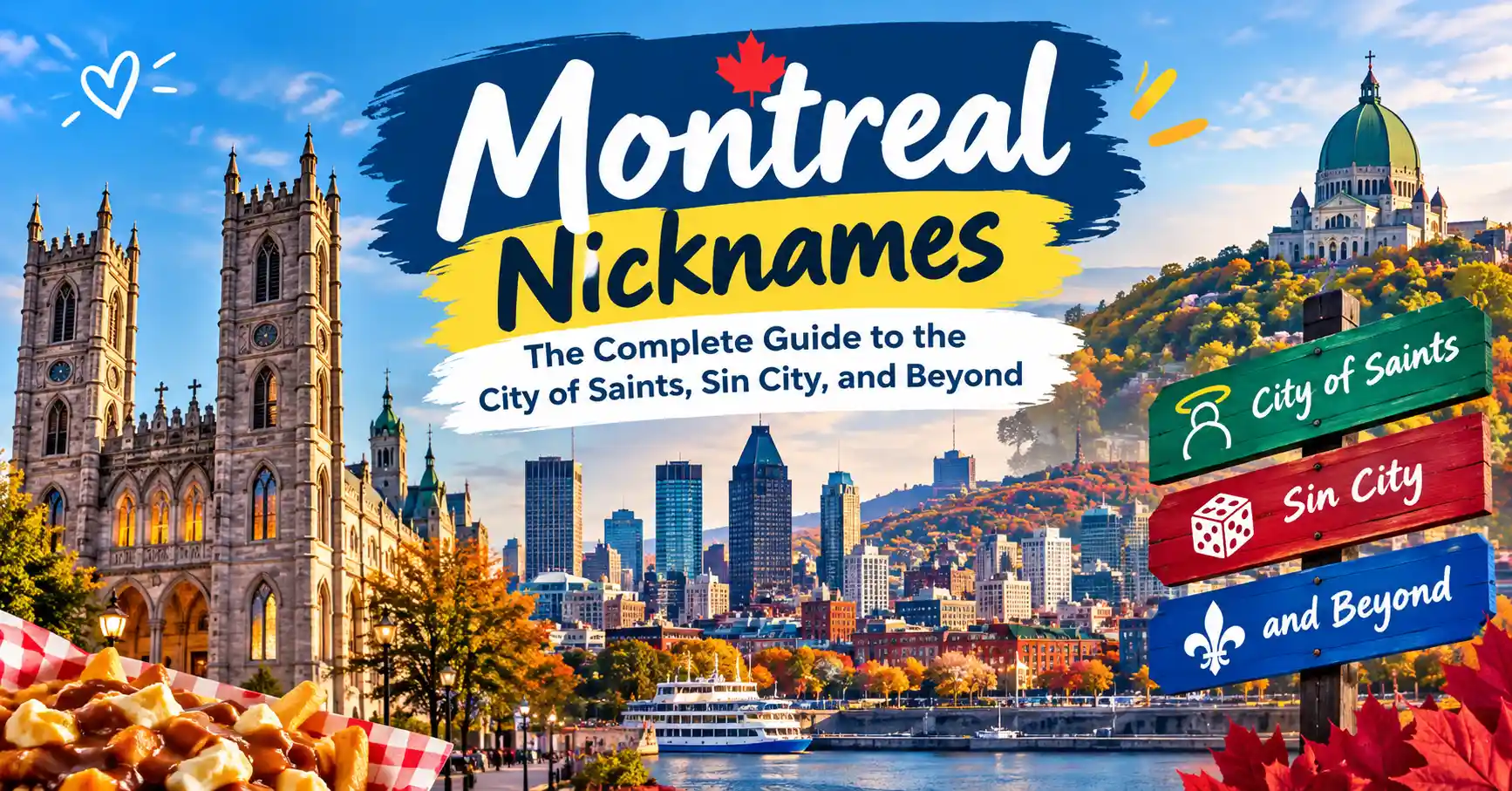
Montreal is a city of dualities—where historic cobblestone streets meet modern skyscrapers, where French joie de vivre blends with North American ambition. This cultural crossroads has earned several evocative Montreal nicknames that capture its unique spirit, from its religious heritage to its reputation for vibrant nightlife.
Quick Answer Box
🏙️ What Is Montreal’s Most Famous Nickname?
The most famous nickname of Montreal is “The City of Saints” (Ville des Saints), referencing its religious heritage. Other well-known nicknames include “Sin City” for its nightlife and “The Paris of North America” for its European charm.
Quick Facts Table
| Fact | Details |
|---|---|
| City | Montreal |
| Province/Country | Quebec, Canada |
| Official Nickname | None officially designated |
| Most Famous Nickname | “The City of Saints” |
| Population | 1.8 million (city); 4.3 million (metro) |
| Founded | 1642 (as Ville-Marie) |
| Known For | Bilingual culture, festivals, cuisine, architecture |
Official Nickname of Montreal
Montreal does not have an officially designated municipal nickname. Unlike some cities that have adopted formal nicknames through government proclamation, Montreal’s nicknames have emerged organically through popular usage, historical events, and cultural identity.
The nickname “Ville-Marie” (City of Mary) holds the closest claim to an “official” title, as it was the original name given to the settlement when founded in 1642 by Paul de Chomedey de Maisonneuve. This name remains in use for the historic district and appears in religious and historical contexts. However, “Ville-Marie” functions more as the city’s founding name rather than a contemporary nickname.
The moniker “The City of Saints” gained widespread recognition through historical usage and remains the most commonly cited nickname in tourism materials and cultural references. It is considered a “commonly recognized” nickname rather than an official one.
What Are the Nicknames of Montreal?
Montreal’s nicknames reflect different aspects of its identity—its religious foundations, its reputation for nightlife and vice, its European character, and its linguistic duality. These Montreal nicknames have developed over centuries, shaped by the city’s unique position as a French-speaking metropolis within English-speaking North America.
The nicknames generally fall into several categories:
- Religious/Historical nicknames: References to the city’s Catholic heritage and founding
- Cultural/Geographic nicknames: Comparisons to European cities and descriptions of its character
- Reputation-based nicknames: Associations with nightlife, vice, and entertainment
- Bilingual/Identity nicknames: Names reflecting the French-English duality
Complete List of Montreal Nicknames
| Nickname | Meaning | Origin | Popularity |
|---|---|---|---|
| The City of Saints | Reference to religious heritage and numerous churches | 19th century religious devotion | ⭐⭐⭐⭐⭐ Very High |
| Sin City | Reputation for nightlife, gambling, and vice | Prohibition era and mid-20th century | ⭐⭐⭐⭐ High |
| The Paris of North America | European architecture, French culture, café society | 20th century tourism promotion | ⭐⭐⭐⭐ High |
| Ville-Marie | “City of Mary” – original settlement name | 1642 founding name | ⭐⭐⭐⭐ High (historical) |
| The City of a Hundred Steeples | Numerous church spires visible on skyline | 19th-20th century observation | ⭐⭐⭐ Moderate |
| MTL | Abbreviation used locally and in branding | Modern colloquial usage | ⭐⭐⭐⭐⭐ Very High (informal) |
| La Métropole | “The Metropolis” – recognition of status | French Canadian usage | ⭐⭐⭐ Moderate |
Most Popular Nicknames of Montreal
The most recognized Montreal nicknames are “The City of Saints,” “Sin City,” and “The Paris of North America.” Each captures a distinct facet of the city’s personality and history. “The City of Saints” reflects Montreal’s deep Catholic roots and the prominent role of the church in its development. “Sin City” emerged during the mid-20th century when Montreal gained notoriety for its open nightlife, gambling, and relaxed attitudes toward vice compared to other North American cities. “The Paris of North America” highlights the city’s French character, historic architecture, and café culture that remind visitors of the French capital.
Main Nicknames Explained
The City of Saints
Meaning: A reference to Montreal’s religious heritage and the numerous churches and religious institutions that once dominated the cityscape.
Short Origin Story: The nickname emerged in the 19th century when Montreal was known for its devout Catholic population and the prominent role of the church in daily life.
Historical Background: During the 1800s and early 1900s, Montreal was home to hundreds of churches, convents, and religious institutions. The city was a major center for Catholic education and missionary work in North America.
Modern Usage: While less commonly used today, the nickname appears in historical contexts, tourism materials, and cultural references. It remains a point of pride for many long-time residents.
Cultural Impact: The nickname shaped Montreal’s identity as a spiritual and cultural center, influencing everything from architecture to social values.
Interesting Fact: At its peak, Montreal reportedly had more churches per capita than any other city in North America.
Sin City
Meaning: A reference to Montreal’s reputation for vibrant nightlife, gambling, and a more permissive attitude toward vice.
Short Origin Story: The nickname gained popularity during the Prohibition era when Montreal became a destination for Americans seeking alcohol and entertainment.
Historical Background: From the 1920s through the 1950s, Montreal’s nightlife flourished, with clubs, casinos, and red-light districts operating more openly than in most North American cities. This era was later romanticized in literature and film.
Modern Usage: The nickname is still used in tourism marketing and popular culture, though it represents a historical era more than current reality. Montreal’s nightlife remains vibrant but operates within modern regulations.
Cultural Impact: “Sin City” contributed to Montreal’s reputation as a city of excitement and freedom, attracting visitors seeking entertainment and nightlife experiences.
Interesting Fact: During Prohibition, Montreal’s nightlife was so famous that it inspired the nickname “The Paris of the North” for its perceived moral permissiveness.
The Paris of North America
Meaning: A comparison to Paris, France, emphasizing Montreal’s European architecture, French culture, and sophisticated urban atmosphere.
Short Origin Story: The nickname emerged in the early-to-mid 20th century as tourism promoters and writers sought to position Montreal as a European destination within North America.
Historical Background: Montreal’s historic districts, particularly Old Montreal, feature architecture reminiscent of French cities. The city’s French language, cuisine, and cultural traditions reinforced the comparison.
Modern Usage: The nickname remains popular in tourism marketing and is frequently used by visitors describing their impressions of the city.
Cultural Impact: This nickname has helped establish Montreal as a unique destination that offers European charm without requiring a transatlantic flight.
Interesting Fact: Montreal is the largest French-speaking city in the Americas, with French as the primary language for most residents.
Ville-Marie
Meaning: “City of Mary,” the original name given to the settlement by its founders.
Short Origin Story: Founded in 1642 by Paul de Chomedey de Maisonneuve and Jeanne Mance, the settlement was named Ville-Marie in honor of the Virgin Mary.
Historical Background: The original settlement was established as a Catholic mission on the island of Montreal. The name Ville-Marie remained in use for the settlement and later the surrounding district.
Modern Usage: Ville-Marie is now used for the borough that includes downtown Montreal and for various institutions and locations throughout the city.
Cultural Impact: The name connects modern Montreal to its religious origins and founding vision as a place of faith and community.
Interesting Fact: The Ville-Marie borough is the central borough of Montreal and includes the historic Old Montreal district.
The City of a Hundred Steeples
Meaning: A poetic reference to the numerous church spires that once dominated Montreal’s skyline.
Short Origin Story: This nickname became popular in the 19th and early 20th centuries when the city’s skyline was defined by church architecture.
Historical Background: Before skyscrapers transformed the skyline, Montreal’s silhouette was characterized by church steeples, bell towers, and crosses atop religious buildings.
Modern Usage: The nickname is now primarily historical, used in nostalgic or poetic contexts to evoke a bygone era.
Cultural Impact: The image of “a hundred steeples” shaped perceptions of Montreal as a deeply religious and traditional city.
Interesting Fact: Many of Montreal’s historic churches remain today, including Notre-Dame Basilica, one of the most visited attractions in the city.
Which Nickname Is Most Famous?
“The City of Saints” is generally considered Montreal’s most famous nickname. It has the longest history of continuous usage, appears most frequently in historical and cultural references, and captures a defining aspect of the city’s identity. The nickname’s staying power comes from its connection to Montreal’s foundational religious character and the visible legacy of churches and religious institutions throughout the city.
“Sin City” and “The Paris of North America” are also widely recognized but represent different aspects of Montreal’s character. “Sin City” emphasizes the city’s nightlife and entertainment culture, while “The Paris of North America” focuses on its European character and cultural sophistication.
How Montreal Got Its Nicknames
Montreal’s nicknames developed organically over centuries, reflecting the city’s evolution from a religious mission to a major metropolitan center. The earliest nicknames, like Ville-Marie, were directly tied to the city’s founding and religious purpose. As Montreal grew and developed a reputation for nightlife and entertainment, nicknames like “Sin City” emerged to capture this aspect of its identity. The comparison to Paris developed as visitors and promoters recognized the city’s unique blend of French culture and North American energy.
Unlike cities that have officially adopted nicknames through government action, Montreal’s nicknames reflect the collective perception of residents, visitors, and observers over time. They represent different eras and aspects of the city’s complex identity.
Other Nicknames at a Glance
- The City of Festivals – For its year-round schedule of cultural events
- The Cultural Capital of Canada – Recognizing its artistic and cultural prominence
- The Island City – Reference to its location on an island in the St. Lawrence River
- The City of Spires – Variant of “City of a Hundred Steeples”
- The Second City of Canada – Sometimes used in comparison to Toronto
- The City of Light – Occasionally used, borrowing from Paris’s nickname
Fun Facts About Montreal
- Montreal is the second-largest French-speaking city in the world after Paris.
- The city’s Underground City (RÉSO) spans over 32 kilometers of tunnels connecting shopping centers, metro stations, and office buildings.
- Montreal’s Notre-Dame Basilica was the first Gothic Revival church in Canada.
- The city hosted Expo 67, considered one of the most successful World’s Fairs in history.
- Montreal’s bagels are famous worldwide, with two competing institutions—St-Viateur and Fairmount—both claiming the title of best.
- The Montreal Canadiens are the oldest continuously operating professional hockey team in the world.
- Montreal has more than 6,000 restaurants, offering cuisine from around the globe.
- The city’s Mount Royal Park was designed by Frederick Law Olmsted, who also designed New York’s Central Park.
- Montreal was the first city in North America to host the Summer Olympics in a French-speaking country (1976).
- The city’s name comes from Mount Royal, the prominent hill at its center.
Famous Attractions in Montreal
Montreal offers countless attractions that reflect its rich history and vibrant culture. Old Montreal (Vieux-Montréal) features cobblestone streets, historic buildings, and the stunning Notre-Dame Basilica. Mount Royal provides hiking trails and panoramic views of the city. The Montreal Museum of Fine Arts houses an extensive collection spanning centuries. The Jean-Talon Market offers a taste of local cuisine and culture. The Olympic Stadium and Biodôme showcase the city’s modern achievements. The Plateau Mont-Royal neighborhood exemplifies Montreal’s characteristic architecture with its colorful staircases and wrought-iron balconies.
Nickname Comparison
For more city nickname comparisons and comprehensive guides, explore our resources on New York City Nicknames and Chicago Nicknames.
Related Cities and Their Nicknames
🍁 Toronto Nicknames
The Six, Hogtown, T-Dot
🏰 Quebec City Nicknames
The Old Capital, La Vieille Capitale
☘️ Boston Nicknames
Beantown, The Hub, Athens of America
🌲 Vancouver Nicknames
Hollywood North, Rain City
🇺🇸 USA City Nicknames
Complete guide to American city nicknames
Frequently Asked Questions
What is the official nickname of Montreal?
Montreal does not have an officially designated nickname. “Ville-Marie” (City of Mary) is the city’s original founding name from 1642 and is sometimes treated as an official historical name. “The City of Saints” is the most commonly recognized nickname but is not officially designated by the municipal government.
Why is Montreal called “The City of Saints”?
Montreal earned this nickname due to its deep Catholic heritage and the prominent role of the church in its history. During the 19th and early 20th centuries, the city was known for its numerous churches, religious institutions, and devout population, leading to the comparison with a city of saints.
Who gave Montreal the nickname “Sin City”?
The nickname “Sin City” emerged organically during the Prohibition era and mid-20th century when Montreal gained a reputation for open nightlife, gambling, and vice. American visitors and journalists popularized the term to describe the city’s permissive atmosphere compared to other North American cities.
When did “The Paris of North America” become popular?
This nickname gained popularity in the early-to-mid 20th century as tourism promoters and writers sought to highlight Montreal’s European character. The comparison became more widely used as the city developed its reputation for French culture, cuisine, and architecture.
Do locals use these nicknames?
Montreal residents primarily use “MTL” as an informal abbreviation and may reference the city’s historical nicknames in cultural contexts. “The City of Saints” and “Sin City” are more commonly used by outsiders, historians, and in tourism materials. Locals typically refer to the city simply as Montreal or by neighborhood names.
Conclusion
Montreal’s nicknames tell the story of a city with a rich, complex identity. From its religious origins as Ville-Marie to its reputation as both “The City of Saints” and “Sin City,” these names capture the contradictions and charms that make Montreal unique among North American cities.
Whether you know it as “The Paris of North America” or simply “MTL,” Montreal remains a city of captivating contrasts—deeply traditional yet modern, distinctly French yet undeniably North American. For those interested in exploring how other cities earned their famous monikers, the Canadian Encyclopedia offers excellent historical resources on Canadian cities and their cultural identities.