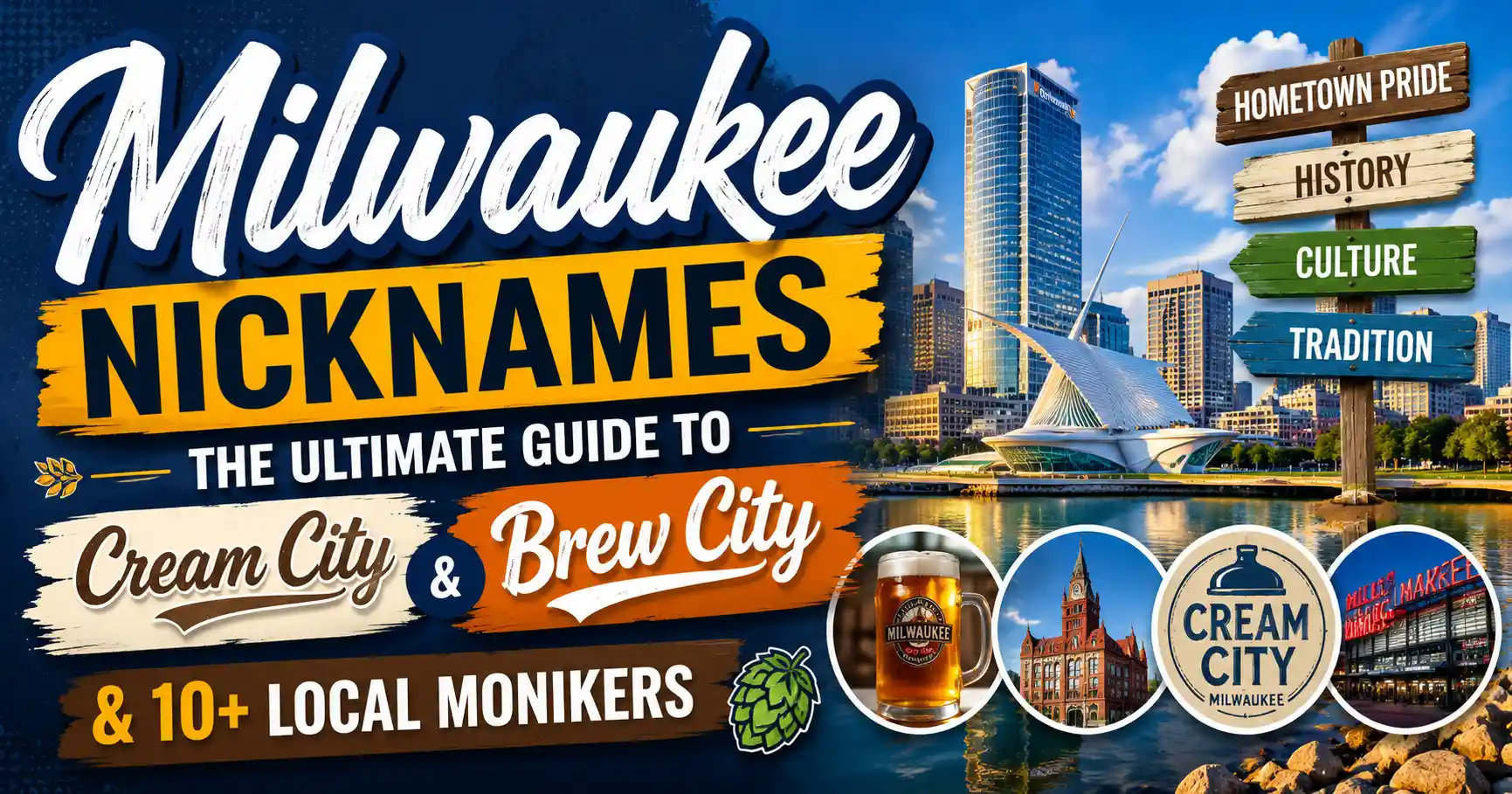
Milwaukee is a Great Lakes city built on beer, bricks, and a summer festival culture that spills onto the lakefront every year. Its nicknames are a shortcut to understanding that identity.
The full list of Milwaukee nicknames spans architecture, industry, Native American place names, and modern pop culture—from Cream City to The 414. Here’s a fact-packed look at the city’s most famous monikers.
⚡ Quick Answer: Milwaukee Nicknames
The most famous nickname of Milwaukee is “Cream City,” a reference to the cream-colored bricks made from local clay in the 1800s. “Brew City” is also widely used because of Milwaukee’s deep beer heritage. Other popular monikers include City of Festivals, The Good Land, and The 414.
📊 Milwaukee Nicknames: Quick Facts
| City | State/Country | Official Nickname | Most Famous Nickname | Population | Founded | Known For | More |
|---|---|---|---|---|---|---|---|
| Milwaukee | Wisconsin, USA | Cream City (common; not legally codified) | Cream City / Brew City | 577,222 (2020 census) | 1846 | Brewing, Summerfest, Harley-Davidson, lakefront | Area codes: 414/262 |
📘 Official Nickname of Milwaukee
Milwaukee does not have one legally adopted, official nickname. Cream City is the most historically recognized and commonly used civic moniker, functioning as the city’s unofficial official nickname. Brew City is another strong civic brand. In city documents, tourism campaigns, and everyday speech, Cream City and Brew City are the two nicknames that carry the most weight.
🧀 What Are the Milwaukee Nicknames?
Milwaukee answers to nicknames that come from its geology, beer industry, immigrant culture, Indigenous place name, area code, and modern branding. The city’s best-known monikers include Cream City, Brew City, City of Festivals, The Good Land, and The 414.
📋 Complete List of Milwaukee Nicknames
| Nickname | Meaning | Origin | Popularity |
|---|---|---|---|
| Cream City | Cream-colored brick buildings | Local clay that fired into pale yellow bricks in the 1800s | Very high |
| Brew City | Beer brewing capital | 19th-century breweries like Miller, Pabst, Schlitz, and Blatz | Very high |
| City of Festivals | Packed summer festival calendar | Summerfest and ethnic festivals along the lakefront | High |
| The Good Land | “Good land” or “gathering place by water” | Indigenous/Algonquian place-name interpretation; pop culture boost from Wayne’s World | Medium |
| The Gathering Place by the Water | Meeting place near the lake and rivers | Indigenous place-name meaning | Medium |
| The 414 | Area code shorthand | 414 telephone area code | High |
| MKE | City/airport abbreviation | Milwaukee Mitchell International Airport code | Medium |
| A Great Place on a Great Lake | Civic slogan | Tourism promotion tied to Lake Michigan | Medium |
| German Athens | 19th-century German culture and education | Large German immigrant community and cultural institutions | Low/Historical |
| Beer Capital of the World | Recognized brewing dominance | National reputation built by Milwaukee breweries | Medium/Historical |
| Machine Shop of the World | Manufacturing strength | Early 20th-century heavy industry and skilled labor | Low/Historical |
| Miltown / Mil-town | Casual local shortening | Folksy abbreviation of Milwaukee | Low |
🌟 Most Popular Nicknames of Milwaukee
The most popular Milwaukee nicknames are Cream City, Brew City, City of Festivals, The Good Land, and The 414. Each one captures a different part of the city’s identity: architecture, industry, festival culture, Indigenous place names, and modern local pride.
🧱 Cream City
- Meaning: A moniker tied to Milwaukee’s cream-colored brick buildings.
- Short Origin Story: Local clay deposits fired into a pale yellow or cream brick in the mid-1800s.
- Historical Background: Cream City brick became a signature building material after the 1850s and was exported throughout the Midwest. Many early homes, churches, and commercial blocks used it.
- Modern Usage: The nickname appears in business names, historic preservation efforts, and the Milwaukee Bucks’ “Cream City” alternate uniforms.
- Cultural Impact: Cream became a visual symbol of Milwaukee’s architectural heritage and resilience.
- Interesting Fact: Because cream brick was porous and weathered poorly, many older buildings were later covered or painted—but original examples remain in older neighborhoods.
🍺 Brew City
- Meaning: A nickname for Milwaukee’s beer-brewing heritage.
- Short Origin Story: In the mid-1800s, German immigrants opened breweries that grew into national giants.
- Historical Background: Miller, Pabst, Schlitz, and Blatz made Milwaukee beer famous across the country. Brewery tours, beer caves, and riverfront brewhouses shaped the city’s economy and culture.
- Modern Usage: “Brew City” appears in sports broadcasts, tourism campaigns, and everyday conversation. The Milwaukee Brewers name and beer-related tourism keep it alive.
- Cultural Impact: The nickname shifted Milwaukee’s identity from a manufacturing town to a hospitality and tourism destination.
- Interesting Fact: At its peak, Milwaukee produced a massive share of the nation’s beer, and Schlitz was once one of the world’s best-selling beers.
🎉 City of Festivals
- Meaning: A celebration of Milwaukee’s many cultural and music festivals.
- Short Origin Story: Summerfest began in 1968 and grew into a huge lakefront event.
- Historical Background: Ethnic festivals such as German Fest, Polish Fest, Festa Italiana, and Irish Fest built on Milwaukee’s immigrant communities and summer traditions.
- Modern Usage: The phrase is used widely by local media, tourism groups, and residents.
- Cultural Impact: It reinforced Milwaukee as a summer destination and a place where different cultures share the lakefront.
- Interesting Fact: Summerfest is often called “The World’s Largest Music Festival” by attendance.
🌊 The Good Land
- Meaning: A phrase popularly interpreted as “good land” or “gathering place by the water.”
- Short Origin Story: The name Milwaukee likely derives from Indigenous Algonquian or Ojibwe/Potawatomi terms. The phrase gained pop culture fame through a memorable line in the movie Wayne’s World.
- Historical Background: Indigenous peoples used the area for trade, gathering, and settlement long before European arrival.
- Modern Usage: The nickname appears on T-shirts, social media posts, and local branding.
- Cultural Impact: Pop culture gave the phrase a second life and made it a playful local badge.
- Interesting Fact: The Wayne’s World line is catchy, but the exact original linguistic meaning of “Milwaukee” is still debated by historians.
📞 The 414
- Meaning: Area code shorthand for Milwaukee.
- Short Origin Story: The 414 area code has covered Milwaukee since the mid-20th century.
- Historical Background: As area code splits occurred in Wisconsin, 414 remained with Milwaukee County and nearby communities.
- Modern Usage: Used in sports branding, social media hashtags, and local business names.
- Cultural Impact: The 414 became a youthful, urban badge of identity for the city.
- Interesting Fact: Milwaukee is one of the few large U.S. cities where a three-digit area code functions as a mainstream nickname.
🏆 Which Nickname Is Most Famous?
Cream City is the most famous Milwaukee nickname because it is unique to Milwaukee and rooted in a physical feature—the pale brick that gave the old city its look. Brew City is the strongest national rival because Milwaukee’s beer history is widely known, but Cream City is the nickname most tightly linked to Milwaukee’s local identity.
📜 How Milwaukee Got Its Nicknames
The story behind Milwaukee nicknames is rooted in geography, immigration, and industry. The clay-rich river valleys produced cream bricks. German immigrants built breweries that made Milwaukee a beer capital. Indigenous names and later local slang added The Good Land and The 414. Each nickname stuck because it captured something everyday people could see, taste, or take pride in.
📝 Other Nicknames at a Glance
- German Athens: 19th-century German culture, music, societies, and schools.
- Beer Capital of the World: Historical title from Milwaukee’s brewing output.
- Machine Shop of the World: Early 20th-century manufacturing strength.
- MKE: Airport and city abbreviation used online.
- Miltown / Mil-town: Casual local shortening.
- A Great Place on a Great Lake: Tourism slogan tied to Lake Michigan.
🎯 Fun Facts About Milwaukee
- Milwaukee was once among the world’s largest beer-producing cities.
- The first practical typewriter was invented in Milwaukee by Christopher Latham Sholes in 1868.
- Harley-Davidson was founded in Milwaukee in 1903 and still has a museum there.
- Summerfest has been called the world’s largest music festival by attendance.
- Milwaukee is located at the confluence of the Milwaukee, Menomonee, and Kinnickinnic rivers.
- Cream City brick gave Milwaukee a distinct architectural palette in the 1800s.
- The Milwaukee Art Museum’s Quadracci Pavilion has a moveable, wing-like brise soleil.
- The city’s lakefront hosts Henry Maier Festival Park, home to many ethnic and music festivals.
🏛️ Famous Attractions in Milwaukee
- Milwaukee Art Museum
- Harley-Davidson Museum
- Henry Maier Festival Park / Summerfest
- Milwaukee Public Market
- Historic Third Ward
- Pabst Mansion
- American Family Field
- Fiserv Forum
- Milwaukee Riverwalk
- Mitchell Park Domes
🆚 Nickname Comparison: Milwaukee vs Chicago
🧀 Milwaukee Nicknames
Cream City — pale brick architecture
Brew City — beer heritage
City of Festivals — Summerfest and ethnic festivals
Explore Milwaukee Nicknames🌬️ Chicago Nicknames
The Windy City — politics and lake breeze
Second City — rebuilt after the Great Fire
City of Big Shoulders — industrial grit
Read Chicago Nicknames🗺️ Related Cities and Their Nicknames
The Windy City 🗽 New York City Nicknames
The Big Apple 🎰 Las Vegas Nicknames
Sin City 🎸 Austin Nicknames
Live Music Capital of the World 🌴 Miami Nicknames
Magic City
❓ Frequently Asked Questions About Milwaukee Nicknames
What is the official nickname of Milwaukee?
Milwaukee does not have one legally adopted official nickname. Cream City is the most historically recognized and commonly used civic nickname, while Brew City is also widely used in tourism and branding.
Why is Milwaukee called Cream City?
Milwaukee is called Cream City because many of its 19th-century buildings were made from pale cream-colored bricks produced from local clay.
Why is Milwaukee called Brew City?
Milwaukee is called Brew City because it became one of the world’s great beer-producing cities in the 1800s, thanks to breweries like Miller, Pabst, Schlitz, and Blatz.
Who gave Milwaukee its nickname “The Good Land”?
The phrase “The Good Land” comes from a popular interpretation of Milwaukee’s Indigenous place name. It gained wider fame through the movie Wayne’s World.
What are other nicknames of Milwaukee?
Other Milwaukee nicknames include City of Festivals, The 414, MKE, German Athens, Beer Capital of the World, Machine Shop of the World, and Miltown.
✅ Conclusion
Milwaukee nicknames are more than labels—they are a compact history of the city. Cream City tells the brick story, Brew City tells the beer story, and City of Festivals tells the community story. Together they explain why Milwaukee feels both hardworking and joyful, deeply rooted and endlessly summer-obsessed. For deeper historical research, visit the Encyclopedia of Milwaukee, a project of the University of Wisconsin-Milwaukee.