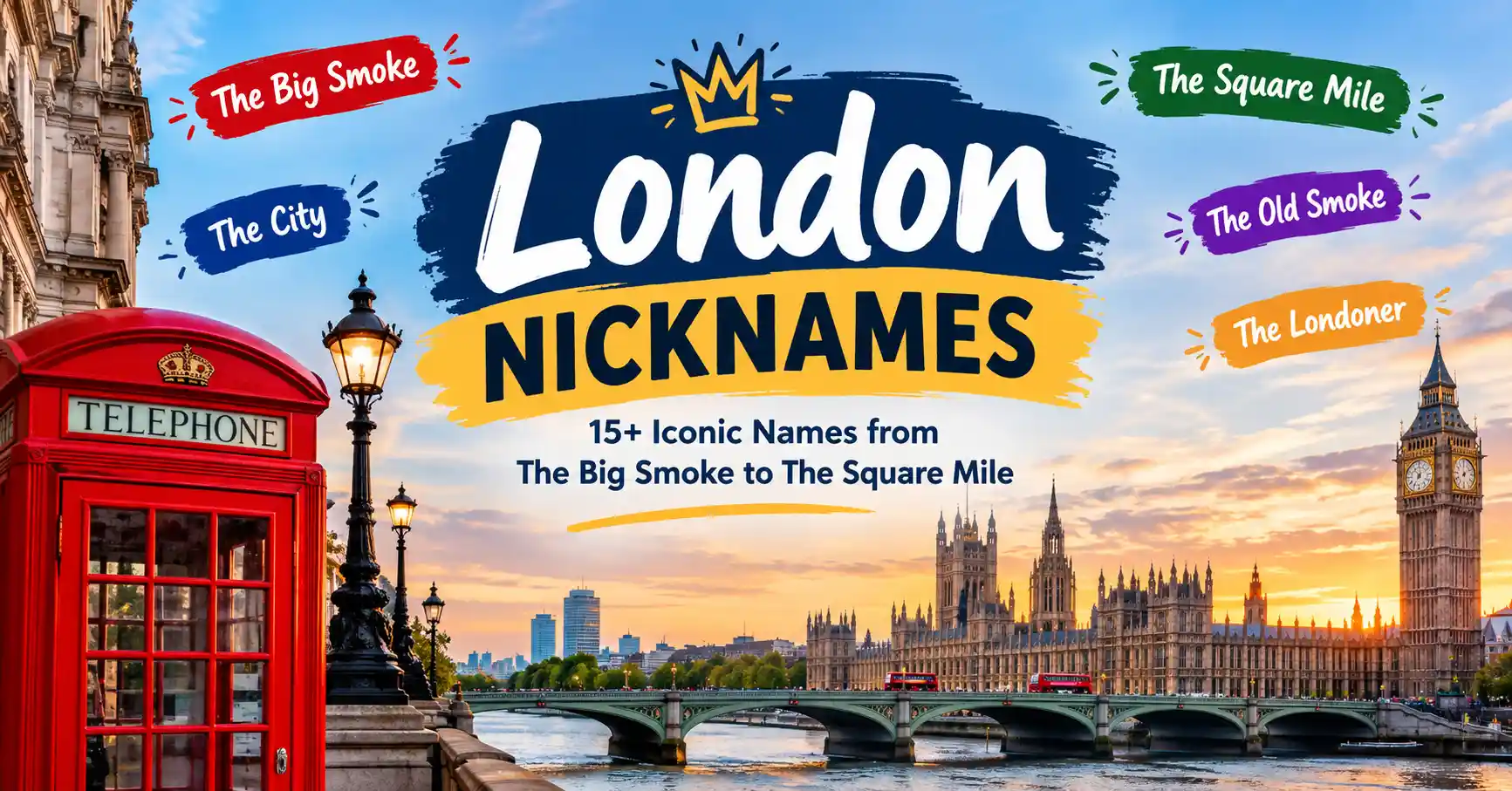
London is a city of layers—Roman walls under glass towers, royal parks beside financial trading floors, and a vocabulary of nicknames as rich as its history. Its London Nicknames range from smoky 19th-century slang to Roman-era titles and modern global branding.
Some of these names describe the weather, some describe the money, and some describe the sheer scale of a capital that has been one of the world’s largest cities for two centuries. Here’s the full picture.
🏆 What Are the London Nicknames?
London carries more nicknames than almost any city on Earth, and they come from very different eras and perspectives. Some were affectionate, some were insults that stuck, and some are still used every day by Londoners and outsiders alike.
💡 Quick Answer: The most famous nickname for London is “The Big Smoke.” Other well-known London nicknames include “The Square Mile,” “The Great Wen,” “Londinium,” and “Swinging London.”and “The Metropolis,” capture specific chapters of the city’s story. London has no single officially adopted nickname.
📊 Quick Facts Table: London at a Glance
📜 Official Nickname of London
London has no legally designated official nickname. The closest thing to an “official” name is the City of London, which refers specifically to the historic one-square-mile financial district governed by the City of London Corporation—not to Greater London as a whole. “The Square Mile” is therefore an official-adjacent label for that district, while “The Big Smoke” and “The Great Wen” are entirely unofficial, historical, and colloquial.
🗺️ What Are the Nicknames of London?
London’s nicknames fall into a few clear groups: atmospheric names tied to smoke and fog, geographic names tied to the City’s boundaries, historical and literary names, and pop-culture labels from the 1960s onward. Together they show how differently people have seen London across 2,000 years.
- Atmospheric nicknames — The Big Smoke, The Smoke, The Old Smoke, Foggy London Town
- Geographic nicknames — The Square Mile, The City, The Metropolis
- Historical & literary nicknames — Londinium, Troynovant, The Great Wen, Modern Babylon
- Pop-culture nicknames — Swinging London, The Capital of Cool
- Global identity nicknames — The Capital of the World, The Cockney Capital
🗂️ Complete List of London Nicknames
🔥 Most Popular Nicknames of London
The two names you’ll hear most often today are “The Big Smoke” and “The Square Mile.” The first is atmospheric and historical, rooted in the coal fires that once blanketed the city in soot. The second is precise and financial, referring to the small district that punches far above its weight in global banking and insurance.
“The Great Wen” survives as a literary curiosity, while “Swinging London” is forever tied to the 1960s. “Londinium” endures in branding, museum exhibits, and Roman history tours.
📖 Main Nicknames Explained
🌫️ The Big Smoke
Meaning: A nickname describing London as a vast, smoky metropolis, historically blanketed in coal smoke and thick fog.
Short Origin Story: As London industrialized in the 1800s, thousands of coal fires and factories filled the air with soot. Visitors and writers described the city as a giant cloud of smoke.
Historical Background: The term “The Smoke” appeared in early 19th-century slang, later expanding to “The Big Smoke” and “The Old Smoke.” The catastrophic Great Smog of December 1952, which led to the Clean Air Act of 1956, gave the nickname lasting weight.
Modern Usage: Still the most widely used London nickname worldwide. It appears in sports coverage, travel writing, and everyday conversation.
Cultural Impact: The nickname shaped how the world pictures London—grey, mysterious, and enormous.
Interesting Fact: “Big smoke” is also used in Australia and New Zealand to mean any large city, but London is the original.
💷 The Square Mile
Meaning: The City of London, the historic financial district at the city’s center.
Short Origin Story: The City of London covers roughly 1.12 square miles (2.9 km²), and the phrase “the Square Mile” became shorthand for that exact boundary.
Historical Background: The City’s medieval limits survived centuries of urban expansion, keeping their own government, Lord Mayor, and police force even as Greater London grew around them.
Modern Usage: Journalists and bankers say “the Square Mile” when they mean UK finance. Headlines like “jobs in the Square Mile” are common.
Cultural Impact: It separates London’s ancient core from its modern sprawl—an important distinction locally.
Interesting Fact: Only around 8,600 people live in the Square Mile, but hundreds of thousands commute into it daily.
🩹 The Great Wen
Meaning: “Wen” means a cyst or boil—so the nickname calls London an ugly, unhealthy swelling on the country.
Short Origin Story: The radical writer and farmer William Cobbett coined it in the 1820s to attack London’s runaway growth and its drain on rural England.
Historical Background: Cobbett’s criticism captured genuine anxieties about urbanization, poverty, and overcrowding during the Industrial Revolution.
Modern Usage: Rare in daily speech, but popular with historians, authors, and essayists.
Cultural Impact: It remains the classic shorthand for anti-metropolitan sentiment in British writing.
Interesting Fact: Cobbett loved the countryside and hated what he saw as London’s corrupting influence—yet his insult became one of the city’s most quoted nicknames.
🏛️ Londinium
Meaning: The Roman name for the settlement on the River Thames.
Short Origin Story: Romans established Londinium around AD 47–50 after invading Britain, building a bridge and a trading port.
Historical Background: Londinium grew into the capital of Roman Britain, was destroyed by Boudicca’s revolt around AD 60, and was rebuilt. In the 4th century it was renamed Augusta.
Modern Usage: Used constantly in tourism, archaeology, museum branding, and Roman-themed walking tours.
Cultural Impact: It roots London in antiquity and connects the modern city to its Roman infrastructure, some of which is still visible.
Interesting Fact: Roman walls and foundations survive in the City of London, and a Roman amphitheatre sits beneath the Guildhall Art Gallery.
🎸 Swinging London
Meaning: London as the global epicenter of 1960s youth culture—music, fashion, film, and rebellion.
Short Origin Story: Time magazine’s April 1966 cover story, “London: The Swinging City,” helped cement the phrase worldwide.
Historical Background: The Beatles, the Rolling Stones, Carnaby Street, the King’s Road, and Mary Quant all made London feel like the most exciting city on Earth.
Modern Usage: Used nostalgically in documentaries, fashion retrospectives, and travel features about the 1960s.
Cultural Impact: It permanently linked London with youth-driven cultural influence.
Interesting Fact: The 1960s label turned London into a cultural export rivaling Hollywood.
🌟 Which Nickname Is Most Famous?
“The Big Smoke” is the most famous London nickname. It’s immediately recognizable, easy to say, and tied to the city’s most iconic imagery—fog, chimneys, and Victorian streets. “The Square Mile” is arguably more useful in modern contexts, but “The Big Smoke” carries the stronger cultural and emotional pull.
🏗️ How London Got Its Nicknames
London’s nicknames grew from three forces: environment, geography, and culture. Industrial-era coal smoke produced the “Smoke” family of names. The City of London’s tiny, stubbornly preserved boundaries produced “The Square Mile” and “The City.” And London’s outsized role in empire, literature, and pop culture produced “The Metropolis,” “Modern Babylon,” and “Swinging London.” Add its Roman origin name, and you get one of the richest nickname collections of any city in the world.
📝 Other Nicknames at a Glance
- The Old Smoke — a nostalgic, affectionate variant of The Big Smoke
- The Capital of the World — a boastful label tied to empire and global finance
- The Metropolis — Victorian shorthand for London’s dominance
- The Pool — from the historic Pool of London shipping area
- Lud’s Town — from the legendary King Lud, linked to Ludgate
- Blighty — technically a nickname for Britain, often used loosely for London by soldiers
- Londonistan — a politically charged term used in commentary and debate, not by locals
🎉 Fun Facts About London
- The London Underground opened in 1863 and is the world’s first underground railway.
- Big Ben is actually the bell; the tower is called Elizabeth Tower.
- More than 300 languages are spoken across Greater London.
- The City of London has its own police force and its own Lord Mayor.
- London has hosted the Summer Olympics three times: 1908, 1948, and 2012.
- There are eight Royal Parks in London, including Hyde Park and Richmond Park.
- The Great Smog of 1952 led directly to the Clean Air Act of 1956.
- Black cab drivers must pass “The Knowledge,” memorizing 25,000+ streets.
- London has more than 170 museums, many of them free to enter.
- The Tower of London has housed a royal menagerie, a mint, and a prison.
🎡 Famous Attractions in London
- Big Ben & the Houses of Parliament — the city’s most photographed landmark
- Tower of London & Tower Bridge — medieval fortress meets Victorian engineering
- Buckingham Palace — the official royal residence
- The British Museum — world-class collections, free admission
- The London Eye — a slow-spinning view over the Thames
- Westminster Abbey — coronation church for nearly a thousand years
- St Paul’s Cathedral — Wren’s masterpiece in the Square Mile
- Trafalgar Square & the National Gallery — art and civic life combined
- Borough Market — one of the oldest food markets in the world
- Greenwich — home of the Cutty Sark and the Prime Meridian
⚖️ Nickname Comparison: London vs. New York City
🧭 Related Cities and Their Nicknames
The Big Apple · Gotham · The City That Never Sleeps
The Windy City · The Second City
The City of Light · The City of Love
Auld Reekie · Athens of the North
Sin City · Neon Capital of the World
❓ Frequently Asked Questions About London Nicknames
What is the official nickname of London?
London has no officially adopted nickname. “The City of London” is the formal name of the historic Square Mile district, but that is a place name rather than a nickname for the whole capital.
Why is London called The Big Smoke?
The nickname comes from the thick coal smoke and fog that covered London during the Industrial Revolution. Thousands of domestic fires and factories produced soot and “pea souper” fogs, and the label stuck long after the air cleared.
Who gave London the nickname The Great Wen?
The English writer and political reformer William Cobbett coined “The Great Wen” in the 1820s. He used it to criticize London’s unchecked growth and its impact on rural life.
When did Swinging London become popular?
The phrase took off in the mid-1960s, especially after Time magazine’s April 1966 cover story titled “London: The Swinging City.” It captured the city’s music, fashion, and youth-culture boom.
Do locals actually use these nicknames?
Yes, but selectively. “The Big Smoke” and “The Square Mile” are common in media and conversation. “The Great Wen” is mostly literary, and “Swinging London” is used nostalgically about the 1960s.
🏁 Conclusion
From the soot-stained “Big Smoke” to the moneyed “Square Mile,” the London Nicknames tell the story of a city that has been an industrial giant, a financial powerhouse, a Roman outpost, and a cultural trendsetter. Each label captures a different era, and together they explain why London remains one of the most studied and visited cities on the planet.
For deeper context on the city’s history, explore the official resources at Museum of London, then browse more nickname guides on CityNicknames.com.