
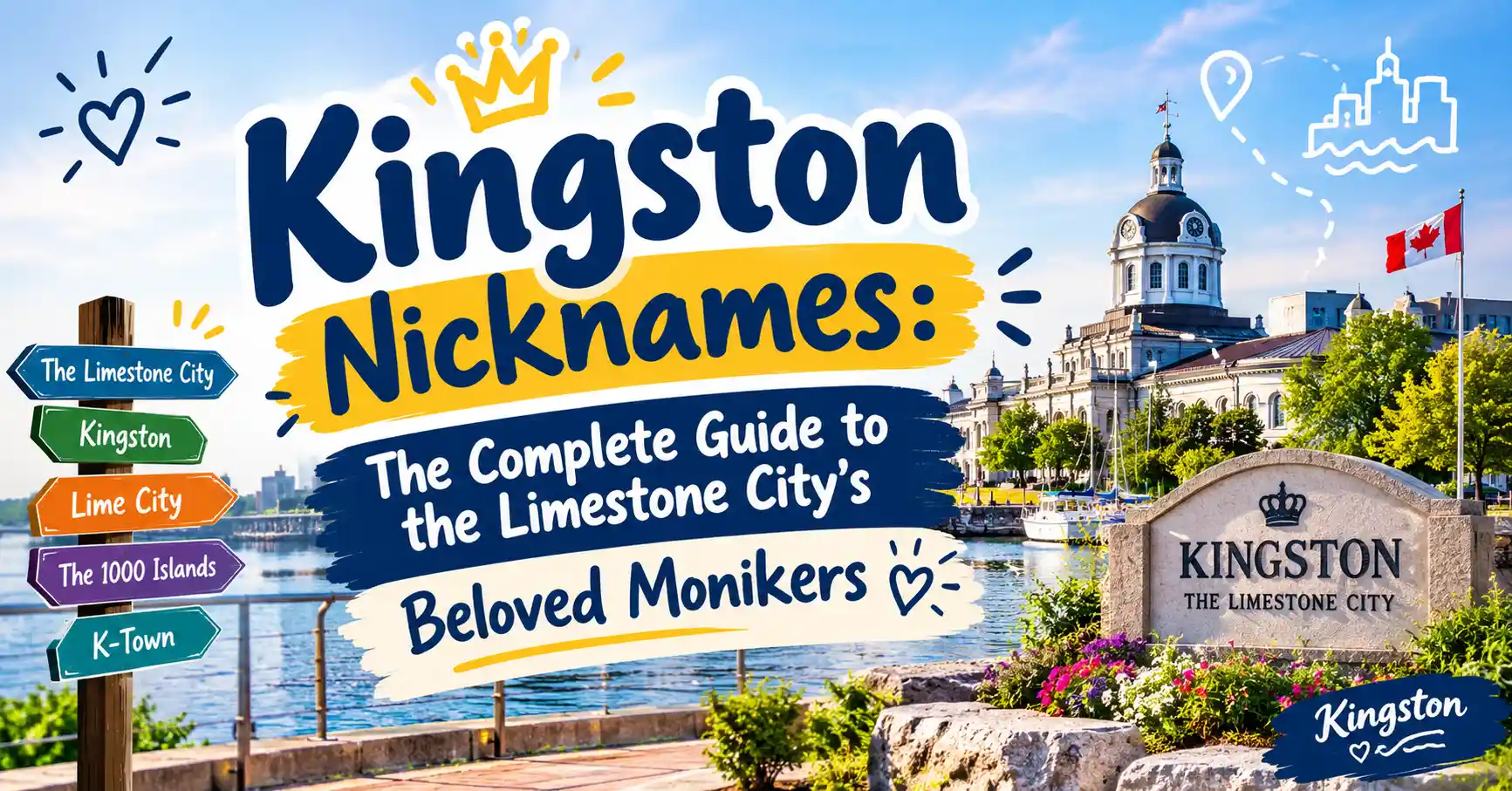
Kingston, Ontario, is a city steeped in history, charm, and character. As one of Canada’s oldest settlements, it has earned several affectionate nicknames that reflect its unique identity. From its limestone architecture to its pivotal role in Canadian history, Kingston nicknames capture the essence of this remarkable city on Lake Ontario’s shores.
Locals and visitors alike know Kingston by names that tell its story—a former capital, a limestone treasure, and a vibrant university town. This guide explores every nickname, their origins, and what they reveal about this fascinating Canadian city.
🔍 Quick Answer Box
What Is Kingston’s Most Famous Nickname?
The most famous nickname of Kingston is “The Limestone City.” Other well-known nicknames include “K-Town,” “The King’s Town,” and “The First Capital of Canada.”
📊 Quick Facts Table
| 📌 Fact | ℹ️ Details |
|---|---|
| City | Kingston |
| Province | Ontario, Canada |
| Official Nickname | None officially designated |
| Most Famous Nickname | “The Limestone City” |
| Population | Approximately 132,000 (2021 Census) |
| Founded | 1673 (as Fort Frontenac) |
| Known For | Limestone architecture, Queen’s University, historic waterfront, former capital of Canada |
| Location | Eastern Ontario, at the eastern end of Lake Ontario |
🏛️ Official Nickname of Kingston
Kingston does not have an officially designated municipal nickname. However, “The Limestone City” functions as a de facto official nickname, widely used in tourism marketing, local branding, and civic promotions. This nickname is commonly recognized and embraced by residents, businesses, and government agencies alike.
The city’s official motto, “For God and King,” reflects its royalist heritage but doesn’t serve as a nickname. While no formal designation exists, “The Limestone City” has become the standard shorthand for Kingston in both local and national contexts.
📝 What Are the Nicknames of Kingston?
Kingston nicknames fall into several categories, each reflecting different aspects of the city’s identity. Some honor its architectural heritage, others reference its historical significance, and a few are simply terms of endearment from locals.
Understanding these nicknames provides insight into how Kingston sees itself and how others perceive this historic Canadian city. From its limestone roots to its modern identity as a university town, each nickname tells part of Kingston’s story.
Categories of Kingston Nicknames
- Architectural Nicknames: Names inspired by the city’s distinctive limestone buildings and visual character
- Historical Nicknames: Monikers referencing Kingston’s role in Canadian history, particularly as the first capital
- Colloquial Nicknames: Informal names used by locals, students, and visitors in everyday conversation
- Geographic Nicknames: Names derived from Kingston’s location on Lake Ontario and the St. Lawrence River
📋 Complete List of Kingston Nicknames
| 🏷️ Nickname | 💡 Meaning | 📜 Origin | ⭐ Popularity |
|---|---|---|---|
| The Limestone City | References the city’s abundant limestone architecture | 19th century; from local building materials | ⭐⭐⭐⭐⭐ Very High |
| K-Town | Informal shorthand for Kingston | Late 20th century; local slang | ⭐⭐⭐⭐ High |
| The King’s Town | Named in honor of King George III | 1788; original town naming | ⭐⭐⭐ Moderate |
| The First Capital | Kingston was the first capital of united Canada | 1841-1844; historical reference | ⭐⭐⭐⭐ High |
| The Freshwater Sailing Capital | Recognizes Kingston’s premier sailing location | 20th century; from sailing community | ⭐⭐⭐ Moderate |
| The Penitentiary City | Home to Canada’s first penitentiary | 1835; from Kingston Penitentiary | ⭐⭐ Limited |
| Queen’s City | Reference to Queen’s University’s prominence | 20th century; university influence | ⭐⭐ Limited |
🌟 Most Popular Nicknames of Kingston
While Kingston has accumulated various nicknames over its long history, a few stand out as the most recognized and frequently used. These primary nicknames appear in tourism materials, local media, and everyday conversation among residents.
The most popular Kingston nicknames reflect the city’s strongest identity markers: its distinctive limestone architecture and its significant role in Canadian history. These names have endured because they capture something essential about Kingston’s character.
📖 Main Nicknames Explained
🏰 The Limestone City
Meaning: This nickname directly references Kingston’s most distinctive architectural feature—the abundance of limestone buildings that define its historic downtown and waterfront.
Short Origin Story: When Kingston was established as a town in the late 18th century, local builders discovered abundant limestone deposits in the surrounding area. This readily available building material became the foundation for the city’s distinctive architecture.
Historical Background: The limestone was quarried from local deposits and used to construct everything from grand public buildings to modest homes. Many of these structures still stand today, giving Kingston its unique visual character.
Modern Usage: “The Limestone City” appears prominently in tourism marketing, city branding, and local business names. It’s the go-to nickname for promotional materials and is widely recognized across Ontario and Canada.
Cultural Impact: This nickname has become synonymous with Kingston’s identity. It evokes images of historic architecture, permanence, and the city’s role as a living museum of Canadian history.
Interesting Fact: Kingston’s City Hall, constructed from local limestone between 1843 and 1844, is one of the finest examples of this architectural heritage and remains a National Historic Site.
🎓 K-Town
Meaning: A casual, abbreviated nickname that locals and students use in everyday conversation.
Short Origin Story: This nickname emerged organically from the local community, particularly among Queen’s University students who shortened “Kingston” to “K-Town” for convenience and familiarity.
Historical Background: The nickname gained popularity in the late 20th century as university culture embraced shortened, informal place names. It follows a pattern seen in other cities like “K-Town” for Kitchener and various neighborhoods worldwide.
Modern Usage: “K-Town” is commonly used in social media posts, student conversations, and local slang. It appears in hashtags, event names, and casual references to the city.
Cultural Impact: This nickname represents Kingston’s modern, youthful side—a contrast to its historic image. It’s particularly associated with the student population and nightlife scene.
Interesting Fact: The “K-Town” nickname creates occasional confusion with Kitchener, Ontario, which also uses the same shorthand among locals.
👑 The King’s Town
Meaning: A direct reference to Kingston’s original name, which honored King George III of Britain.
Short Origin Story: When the settlement was renamed from Fort Frontenac to Kingston in 1788, the name literally meant “the King’s town” or “King’s Town,” reflecting loyalty to the British Crown.
Historical Background: The naming occurred during a period of significant Loyalist settlement following the American Revolution. The name symbolized the community’s allegiance to Britain and its rejection of American independence.
Modern Usage: This nickname appears less frequently in casual conversation but is used in historical contexts, tourism materials, and civic ceremonies. It emphasizes Kingston’s royalist heritage.
Cultural Impact: “The King’s Town” connects Kingston to its colonial past and Loyalist roots. It’s a reminder of the city’s role as a haven for United Empire Loyalists.
Interesting Fact: The original name “King’s Town” was eventually combined into the single word “Kingston,” but the royal connection remains central to the city’s identity.
🏛️ The First Capital
Meaning: This nickname highlights Kingston’s role as the first capital of the united Province of Canada from 1841 to 1844.
Short Origin Story: When Upper and Lower Canada were united in 1841, Kingston was chosen as the capital due to its central location, military significance, and Loyalist heritage.
Historical Background: The capital moved to Montreal in 1844, then alternated between Toronto and Quebec City before finally settling in Ottawa in 1857. Kingston’s brief tenure as capital left a lasting legacy of impressive public buildings.
Modern Usage: “The First Capital” appears in tourism materials and historical references. It’s a point of civic pride and a significant draw for heritage tourism.
Cultural Impact: This nickname positions Kingston as a foundational city in Canadian history. It attracts visitors interested in the nation’s political origins.
Interesting Fact: During its time as capital, Kingston hosted the first meeting of the united Parliament of Canada in 1841.
⛵ The Freshwater Sailing Capital
Meaning: This nickname recognizes Kingston’s exceptional sailing conditions and its status as a premier destination for freshwater sailing in North America.
Short Origin Story: Kingston’s location at the eastern end of Lake Ontario, where it meets the St. Lawrence River and the Thousand Islands, creates ideal sailing conditions that have attracted sailors for generations.
Historical Background: The city hosted sailing events during the 1976 Montreal Olympics and has been a center for competitive and recreational sailing for over a century.
Modern Usage: This nickname is used by the sailing community, tourism operators, and in promotional materials targeting outdoor enthusiasts.
Cultural Impact: It positions Kingston as an active, outdoor-oriented city and supports the local marine industry and tourism sector.
Interesting Fact: The Kingston Yacht Club, founded in 1896, is one of the oldest yacht clubs in Canada and remains a vibrant part of the city’s sailing culture.
🏢 The Penitentiary City
Meaning: A reference to Kingston’s association with Canada’s federal prison system, particularly the historic Kingston Penitentiary.
Short Origin Story: Kingston Penitentiary, opened in 1835, was Canada’s first penitentiary and operated for over 178 years before closing in 2013.
Historical Background: The prison was a significant employer and a defining institution in Kingston for generations. Its presence shaped the city’s economy and identity in complex ways.
Modern Usage: This nickname is used less frequently today, partly because the penitentiary closed in 2013. It sometimes appears in historical contexts or true-crime tourism materials.
Cultural Impact: The penitentiary’s legacy includes both pride in its historical significance and sensitivity about its darker aspects. Tours of the former prison are now a popular attraction.
Interesting Fact: Kingston Penitentiary was designated a National Historic Site in 1990, recognizing its role in Canadian penal history.
👸 Queen’s City
Meaning: A nickname derived from Queen’s University’s prominent presence in Kingston.
Short Origin Story: Queen’s University, founded in 1841, has been a central institution in Kingston for over 180 years. The nickname reflects the university’s influence on the city’s character.
Historical Background: The university’s growth paralleled Kingston’s development, and today students make up a significant portion of the city’s population during academic terms.
Modern Usage: “Queen’s City” appears occasionally in local media and university-related contexts. It’s more common among those affiliated with the university.
Cultural Impact: This nickname highlights the town-and-gown relationship that defines much of Kingston’s daily life and culture.
Interesting Fact: Queen’s University was named after Queen Victoria, who granted the institution its royal charter in 1841.
🏆 Which Nickname Is Most Famous?
“The Limestone City” is unquestionably Kingston’s most famous nickname. This moniker has achieved widespread recognition for several reasons:
Official Adoption: While not legally official, “The Limestone City” is used by the City of Kingston in tourism materials, on municipal websites, and in promotional campaigns. This semi-official status has cemented its prominence.
Descriptive Accuracy: The nickname perfectly captures Kingston’s most distinctive visual characteristic. Visitors immediately understand the reference when they see the city’s historic limestone buildings.
Marketing Power: Tourism Kingston and other organizations have successfully branded the city around this nickname, making it the primary identifier in travel and tourism contexts.
Local Pride: Residents embrace “The Limestone City” as a point of civic pride, associating it with the city’s beauty, history, and architectural heritage.
Media Usage: National and international media consistently refer to Kingston as “The Limestone City” in travel articles, news stories, and feature pieces.
While “K-Town” is popular among students and younger residents, and “The First Capital” carries historical weight, “The Limestone City” remains the nickname most Canadians associate with Kingston.
🗺️ How Kingston Got Its Nicknames
Kingston’s nicknames emerged from different aspects of the city’s geography, history, and culture. The most enduring ones reflect observable features—like the limestone buildings—or significant historical facts—like the city’s role as the first capital of united Canada.
The process of nickname creation in Kingston follows patterns seen in cities worldwide. Some names are adopted for marketing purposes, others emerge organically from local speech, and still others are bestowed by outsiders based on what they observe. The most successful nicknames combine accuracy, memorability, and emotional resonance.
Kingston’s limestone nickname grew from the physical reality of the city’s construction materials. The capital nickname emerged from historical documentation. The colloquial “K-Town” developed from linguistic convenience. Each origin story adds depth to understanding Kingston’s identity.
📍 Other Nicknames at a Glance
- The City of a Thousand Islands – References the nearby Thousand Islands region
- The University City – Acknowledges Queen’s University and Royal Military College
- The Prison Town – Informal reference to the federal penitentiaries
- The Frontenac City – Named after Fort Frontenac, the original settlement
- The Gateway to the Thousand Islands – Tourism-focused nickname
- The Old Capital – Alternative to “The First Capital”
- The Cataraqui City – From the original Indigenous name for the area
🎉 Fun Facts About Kingston
- First Capital: Kingston served as the capital of the Province of Canada from 1841 to 1844, making it the only city to hold this distinction before Ottawa.
- UNESCO Recognition: The Rideau Canal, which begins in Kingston, is a UNESCO World Heritage Site and the oldest continuously operated canal system in North America.
- Hockey History: The first organized hockey game played under modern rules may have occurred in Kingston in 1886, though this claim is debated with other Canadian cities.
- Sir John A. Macdonald: Canada’s first Prime Minister practiced law in Kingston and represented the city in Parliament for decades.
- Limestone Legacy: Over 1,000 buildings in Kingston’s downtown core are constructed from local limestone, creating one of the most cohesive historic districts in Canada.
- Royal Military College: Established in 1876, RMC is the only federal university in Canada and has trained generations of military officers.
- Prison Museum: The former Kingston Penitentiary now operates as a museum, offering tours that explore its 178-year history.
- Confederation Connection: Kingston was represented at the 1864 Charlottetown and Quebec Conferences that led to Canadian Confederation.
- Belle Island: The city’s location at the confluence of Lake Ontario and the St. Lawrence River creates unique sailing conditions praised by enthusiasts worldwide.
- Oldest Continuous Settlement: Kingston is one of the oldest continuously inhabited European settlements in Canada, predated only by a few others.
🏛️ Famous Attractions in Kingston
Kingston’s attractions reflect its rich history and waterfront location. Visitors can explore Fort Henry National Historic Site, a restored 19th-century British military fortress that offers stunning views of the city and lake. The Kingston Penitentiary Tours provide a fascinating—if sometimes unsettling—look at Canada’s penal history.
Bellevue House, once home to Sir John A. Macdonald, offers insight into Victorian life and Canada’s founding era. City Park and the waterfront area provide recreational opportunities and beautiful views of Lake Ontario.
The Kingston Waterfront Pathway connects many of these attractions, allowing visitors to walk or cycle along the lake. Downtown Kingston’s limestone architecture, boutique shops, and restaurants make it a charming destination for strolling and exploring.
⚖️ Nickname Comparison: Kingston vs Ottawa
Both Kingston and Ottawa share the distinction of having served as capitals of Canada, though Ottawa’s tenure has been permanent since 1857. Kingston’s nicknames emphasize its physical beauty and historical significance, while Ottawa’s focus on its political role. Explore more capital city nicknames and their stories on our homepage.
🔗 Related Cities and Their Nicknames
Toronto Nicknames
The 6ix, Hogtown, T-Dot
Ottawa Nicknames
Bytown, The Nation’s Capital
Montreal Nicknames
The City of Saints, La Belle Province
Vancouver Nicknames
Hollywood North, Rain City
USA City Nicknames
Explore American city monikers
❓ Frequently Asked Questions
What is the official nickname of Kingston?
Kingston does not have an officially designated municipal nickname. However, “The Limestone City” functions as a de facto official nickname, widely used in tourism marketing and civic branding. It is the most recognized and embraced nickname for the city.
Why is Kingston called “The Limestone City”?
Kingston is called “The Limestone City” because of its abundant limestone architecture. When the city was established in the late 18th century, local limestone deposits provided readily available building material. Today, over 1,000 buildings in downtown Kingston are constructed from this distinctive stone, creating a cohesive historic character.
Who gave Kingston its nickname “The Limestone City”?
The nickname emerged organically over time rather than being attributed to a single person. As visitors and residents recognized the distinctive limestone architecture that defined the city, the name became a natural descriptor. It gained widespread usage in the 19th and 20th centuries as Kingston’s heritage became a point of civic pride.
When did the nickname “The Limestone City” become popular?
The nickname gained popularity throughout the 20th century as Kingston’s historic architecture became recognized as a significant cultural asset. Tourism marketing in the late 20th and early 21st centuries solidified “The Limestone City” as the primary nickname in public consciousness.
What are other nicknames of Kingston?
Other Kingston nicknames include “K-Town” (popular among students and locals), “The King’s Town” (referencing the original name honoring King George III), “The First Capital” (for its role as capital of united Canada from 1841-1844), “The Freshwater Sailing Capital” (for its premier sailing conditions), and “The Penitentiary City” (referencing the historic Kingston Penitentiary).
🏁 Conclusion
Kingston’s nicknames tell the story of a city that has played an outsized role in Canadian history. From “The Limestone City” to “K-Town,” these monikers capture different facets of Kingston’s identity—its architectural beauty, its historical significance, and its modern vitality. Whether you know it as the first capital, a sailing paradise, or simply K-Town, Kingston nicknames reflect a community proud of its past and confident in its future. For more information about Kingston’s history and attractions, visit the official Tourism Kingston website. Explore more city nicknames and their fascinating stories at CityOfKingston.