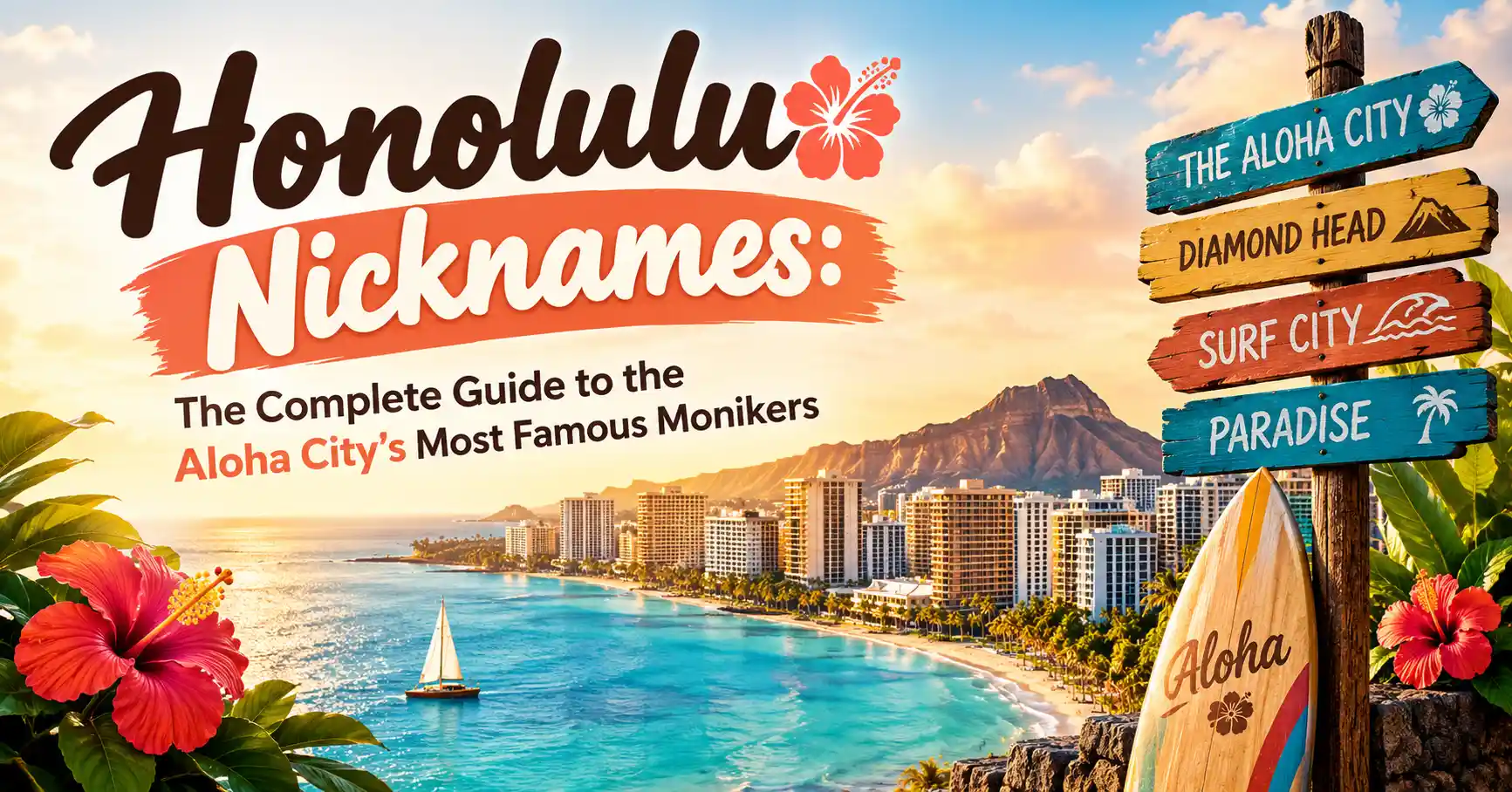
Honolulu, the vibrant capital of Hawaii, is a city where tropical beauty meets rich Polynesian culture and American modernity. Beyond its stunning beaches and volcanic landscapes, this Pacific island metropolis has earned several memorable nicknames that capture its unique spirit, history, and allure. From “The Aloha City” to “The Crossroads of the Pacific,” Honolulu nicknames tell the story of a place that serves as both a tropical paradise and a vital global hub.
Quick Facts Table
| Fact | Details |
|---|---|
| City | Honolulu |
| State/Country | Hawaii, United States |
| Official Nickname | None officially designated |
| Most Famous Nickname | The Aloha City |
| Population | Approximately 350,000 (city); 1 million+ (metro) |
| Founded | 1800s as a major settlement; ancient Hawaiian origins |
| Known For | Waikiki Beach, Pearl Harbor, Diamond Head, aloha spirit |
| Time Zone | Hawaii-Aleutian (HST) |
Official Nickname of Honolulu
Honolulu does not have an officially designated nickname by any governmental body. However, “The Aloha City” is widely recognized and used in tourism marketing, cultural contexts, and local pride campaigns. The nickname is considered unofficial but commonly recognized, functioning as a de facto official title in many contexts.
The term “Aloha” itself carries deep meaning in Hawaiian culture, representing love, peace, compassion, and mutual respect. When applied to Honolulu, it encapsulates the city’s reputation for warmth and hospitality that draws millions of visitors annually.
Other nicknames like “The Crossroads of the Pacific” are historical and geographical in nature, reflecting Honolulu’s strategic position as a mid-Pacific waypoint for ships and aircraft. “Paradise of the Pacific” is a romanticized title popularized in the late 19th and early 20th centuries by writers and marketers promoting Hawaii as a tropical getaway.
What Are the Nicknames of Honolulu?
Honolulu’s nicknames fall into several categories, each reflecting different aspects of the city’s identity. Understanding these categories helps explain why this island capital has accumulated so many monikers over the years.
Geographic and Strategic Nicknames
These nicknames emphasize Honolulu’s location and role in Pacific commerce and travel. The city sits at the crossroads of major shipping lanes and air routes, making it a natural meeting point for cultures, goods, and ideas.
- The Crossroads of the Pacific – Highlights Honolulu’s central Pacific location
- Gateway to the Pacific – Emphasizes its role as an entry point to Asia and Oceania
- The Pacific Hub – Reflects its importance in regional transportation and commerce
Cultural and Emotional Nicknames
These nicknames capture the spirit and atmosphere of Honolulu, focusing on the aloha spirit and island lifestyle.
- The Aloha City – Represents Hawaiian hospitality and warmth
- Paradise of the Pacific – Evokes tropical beauty and idyllic living
- The Heart of Hawaii – Acknowledges its role as the state’s cultural and economic center
Playful and Popular Nicknames
These nicknames are more informal and often used in popular culture, tourism, and casual conversation.
- The Big Pineapple – A humorous parallel to New York’s “Big Apple”
- The 808 – A reference to Hawaii’s area code, popular among locals and youth culture
- HNL – The airport code turned nickname, used affectionately by travelers and locals
Complete List of Honolulu Nicknames
| Nickname | Meaning | Origin | Popularity |
|---|---|---|---|
| The Aloha City | Represents Hawaiian hospitality and spirit | Tourism marketing, 20th century | Very High |
| The Crossroads of the Pacific | Central Pacific location for travel and trade | Mid-20th century, aviation era | High |
| Paradise of the Pacific | Tropical beauty and idyllic island life | Late 19th century promotional literature | High |
| The Big Pineapple | Playful reference to pineapple industry and “Big Apple” | Popular culture, 20th century | Medium |
| The Heart of Hawaii | Cultural and economic center of the state | General usage, modern | Medium |
| The 808 | Reference to Hawaii’s telephone area code | Local slang, contemporary | Medium |
| Gateway to the Pacific | Entry point to Asia-Pacific region | Strategic/military context | Medium |
| HNL | Daniel K. Inouye International Airport code | Aviation/travel culture | Niche |
Most Popular Nicknames of Honolulu
Among the many nicknames associated with Honolulu, three stand out as the most widely recognized and used: “The Aloha City,” “The Crossroads of the Pacific,” and “Paradise of the Pacific.” These nicknames appear frequently in tourism materials, news articles, and popular culture references.
“The Aloha City” has become particularly prominent in recent decades as Hawaii’s tourism industry has emphasized the concept of aloha spirit as a defining characteristic of the islands. The nickname resonates with visitors and locals alike because it captures something intangible yet essential about Honolulu’s character.
“The Crossroads of the Pacific” carries historical weight, reminding residents and visitors of Honolulu’s strategic importance during the 20th century, particularly during World War II and the subsequent decades of Pacific Rim commerce and travel.
“Paradise of the Pacific” appeals to the romantic imagination, evoking images of palm trees, pristine beaches, and endless summer. This nickname has been used in promotional materials since the late 1800s when Hawaii first began attracting mainland American tourists.
Main Nicknames Explained
The Aloha City
Meaning: This nickname embodies the Hawaiian concept of aloha, which encompasses love, peace, compassion, and mutual respect. It positions Honolulu as a place where visitors are welcomed with genuine warmth and where the spirit of hospitality pervades daily life.
Short Origin Story: The nickname emerged organically from Hawaii’s tourism industry in the mid-to-late 20th century. As the state became a major vacation destination, marketers and writers began using “The Aloha City” to distinguish Honolulu from other tropical destinations.
Historical Background: While “aloha” has been central to Hawaiian culture for centuries, its application as a city nickname is relatively modern. The term gained widespread use after Hawaii became a state in 1959, when mainland Americans developed a growing fascination with island culture.
Modern Usage: Today, “The Aloha City” appears in tourism campaigns, travel guides, and casual conversation. It is less commonly used by longtime locals, who often simply say “town” when referring to Honolulu.
Cultural Impact: The nickname has helped establish Honolulu’s brand as a friendly, welcoming destination. It also serves as a reminder of the importance of aloha spirit in Hawaiian culture.
Interesting Fact: The word “aloha” has multiple meanings in Hawaiian, including hello, goodbye, love, and affection. Its use in the city’s nickname reflects this versatility and depth.
The Crossroads of the Pacific
Meaning: This nickname highlights Honolulu’s geographic position at the center of the Pacific Ocean, roughly equidistant between North America and Asia. It emphasizes the city’s role as a meeting point for cultures, commerce, and transportation.
Short Origin Story: The nickname gained popularity during the mid-20th century when air travel and shipping routes made Honolulu a natural stopping point for transpacific journeys.
Historical Background: Honolulu’s strategic location made it critically important during World War II, when it served as a major military hub. Pearl Harbor, located near Honolulu, became synonymous with American military presence in the Pacific.
Modern Usage: While less commonly used in everyday conversation, “The Crossroads of the Pacific” still appears in historical contexts, business publications, and discussions of geopolitics.
Cultural Impact: This nickname acknowledges Honolulu’s global significance beyond tourism, recognizing its role in international relations and commerce.
Interesting Fact: Honolulu is one of the most isolated major cities in the world, located over 2,000 miles from the nearest continental landmass.
Paradise of the Pacific
Meaning: This nickname evokes images of tropical beauty, tranquility, and escape from the ordinary. It positions Honolulu as an idyllic destination where visitors can experience a taste of paradise.
Short Origin Story: The phrase emerged in the late 19th century when writers and promoters began describing Hawaii as a tropical utopia. It was popularized in travel literature and advertisements.
Historical Background: American missionaries, writers, and businessmen in the 1800s often portrayed Hawaii as a paradise, though this romanticized view sometimes obscured the complex realities of Hawaiian history and culture.
Modern Usage: “Paradise of the Pacific” remains popular in tourism marketing and continues to appear in travel articles and promotional materials.
Cultural Impact: The nickname has contributed to Honolulu’s image as an ultimate vacation destination, though some critics argue it oversimplifies the city’s character.
Interesting Fact: The concept of Hawaii as paradise has influenced everything from Hollywood films to mainland American perceptions of island life.
The Big Pineapple
Meaning: This playful nickname draws a parallel between Honolulu and New York City’s “Big Apple.” It references Hawaii’s association with pineapple production and suggests Honolulu’s status as a major city.
Short Origin Story: The nickname likely emerged in the 20th century as a humorous response to New York’s famous moniker. It gained some traction in popular culture and casual usage.
Historical Background: Pineapple has been associated with Hawaii since the early 1900s when James Dole established large-scale pineapple plantations on the islands. While production has declined significantly, the fruit remains an iconic symbol of Hawaii.
Modern Usage: “The Big Pineapple” is used informally and often with a touch of humor. It appears occasionally in media and casual conversation but is not as widespread as other nicknames.
Cultural Impact: The nickname reflects Hawaii’s agricultural history and its ongoing association with tropical fruit production.
Interesting Fact: Hawaii was once the world’s largest producer of pineapples, though competition from other regions has reduced its market share.
The 808
Meaning: This nickname references Hawaii’s telephone area code, 808. It has become a shorthand way for locals to identify themselves and their home state.
Short Origin Story: The nickname emerged in the late 20th and early 21st centuries as area codes became cultural identifiers. It is particularly popular among younger generations and in social media.
Historical Background: The 808 area code has covered all of Hawaii since 1957. As mobile phones and social media became ubiquitous, the number took on new cultural significance.
Modern Usage: “The 808” is commonly used in music, social media, and casual conversation. It appears in song lyrics, clothing designs, and online handles.
Cultural Impact: The nickname has become a symbol of local identity and pride, particularly among Hawaii residents and the diaspora.
Interesting Fact: The 808 area code is one of the most recognizable in the United States, thanks in part to its association with Hawaii.
Which Nickname Is Most Famous?
“The Aloha City” is widely considered the most famous nickname for Honolulu. Its popularity stems from several factors: it aligns perfectly with Hawaii’s tourism branding, it captures the essence of Hawaiian culture, and it is easy to remember and pronounce.
The nickname benefits from Hawaii’s overall reputation as a welcoming, beautiful destination. When people think of Honolulu, they often think of aloha spirit, and “The Aloha City” directly connects the city to this concept.
Additionally, the nickname has been reinforced through decades of marketing, media coverage, and word-of-mouth promotion. It appears in travel brochures, airline advertisements, and countless articles about Hawaii.
While “The Crossroads of the Pacific” and “Paradise of the Pacific” are also well-known, “The Aloha City” has achieved broader recognition and is more commonly used in everyday contexts.
How Honolulu Got Its Nicknames
Honolulu’s nicknames developed over more than a century, reflecting the city’s evolution from a Hawaiian royal capital to a modern American metropolis. The process was organic rather than official, with each nickname emerging from different historical circumstances.
The earliest nicknames, like “Paradise of the Pacific,” came from 19th-century writers and promoters who sought to attract visitors to the islands. These romanticized descriptions helped establish Hawaii’s image as a tropical wonderland.
During the 20th century, Honolulu’s strategic importance during World War II and the subsequent Cold War led to nicknames like “The Crossroads of the Pacific.” These names emphasized the city’s geopolitical significance rather than its natural beauty.
The rise of mass tourism after Hawaii became a state in 1959 brought new nicknames focused on the visitor experience. “The Aloha City” emerged during this period as a way to brand Honolulu as a friendly, welcoming destination.
More recently, nicknames like “The 808” have emerged from local culture, reflecting a growing sense of pride and identity among Hawaii residents.
Other Nicknames at a Glance
- The Heart of Hawaii – Acknowledges Honolulu’s role as the state’s cultural and economic center
- Gateway to the Pacific – Emphasizes the city’s role as an entry point to Asia and Oceania
- The Pacific Hub – Reflects Honolulu’s importance in regional transportation
- HNL – The airport code used affectionately by travelers and locals
- The Gathering Place – A translation of “Honolulu” itself, which means “sheltered harbor” or “calm port”
- City of Palms – References the abundant palm trees throughout the city
- The Beach City – Highlights Honolulu’s famous beaches, particularly Waikiki
Fun Facts About Honolulu
- Honolulu means “sheltered harbor” in Hawaiian, referring to the protected waters that made the city a natural port.
- Waikiki Beach is world-famous but was once a playground for Hawaiian royalty before becoming a tourist destination.
- Honolulu is the most remote major city in the world, located over 2,000 miles from the nearest continent.
- Diamond Head , the iconic volcanic crater overlooking Waikiki, was named by British sailors who mistook calcite crystals for diamonds.
- Iolani Palace in Honolulu is the only royal palace on American soil.
- Honolulu has its own time zone , Hawaii-Aleutian Standard Time, which does not observe daylight saving time.
- The city is home to the largest concentration of Hawaiian culture , including hula, music, and traditional arts.
- Pearl Harbor , located near Honolulu, is the site of the USS Arizona Memorial and a major historical attraction.
- Honolulu’s population is incredibly diverse , with significant Asian, Pacific Islander, and mixed-race communities.
- The city has been a major filming location for movies and TV shows, from “Hawaii Five-O” to “Jurassic Park.”
Famous Attractions in Honolulu
Honolulu offers a wealth of attractions that draw millions of visitors each year. Waikiki Beach remains the most iconic destination, with its golden sands and gentle waves perfect for swimming and surfing. Diamond Head provides breathtaking views of the city and ocean from its summit trail.
Pearl Harbor offers a sobering look at World War II history, including the USS Arizona Memorial and Battleship Missouri. Iolani Palace showcases Hawaiian royal history and architecture.
The Bishop Museum houses extensive collections of Hawaiian and Polynesian artifacts and natural history specimens. Hanauma Bay offers exceptional snorkeling in a protected marine preserve.
Chinatown provides a vibrant cultural experience with markets, restaurants, and galleries. The Honolulu Museum of Art features significant Asian and Pacific art collections.
Nickname Comparison
Related Cities and Their Nicknames
Explore more city nicknames from across the United States and beyond:
Frequently Asked Questions
What is the official nickname of Honolulu?
Honolulu does not have an officially designated nickname. However, “The Aloha City” is widely recognized and commonly used in tourism and cultural contexts.
Why is Honolulu called “The Aloha City”?
Honolulu is called “The Aloha City” because it embodies the Hawaiian concept of aloha, which represents love, peace, and hospitality. The nickname reflects the warm welcome visitors receive and the friendly spirit of the local culture.
Who gave Honolulu its nickname?
No single person or organization gave Honolulu its nicknames. They developed organically over time through tourism marketing, media coverage, and popular usage.
When did the nickname “Crossroads of the Pacific” become popular?
“The Crossroads of the Pacific” became popular during the mid-20th century, particularly during and after World War II when Honolulu’s strategic location made it a vital military and transportation hub.
Do locals use these nicknames?
Locals typically use informal nicknames like “town” or “The 808” rather than tourism-oriented names like “The Aloha City.” However, most residents are familiar with all the nicknames and understand their cultural significance.
Conclusion
Honolulu’s nicknames offer a fascinating window into the city’s identity as a tropical paradise, cultural crossroads, and welcoming island community. From “The Aloha City” to “The Crossroads of the Pacific,” each nickname captures a different facet of this unique American city. Whether you’re a first-time visitor or a longtime resident, understanding these nicknames helps illuminate what makes Honolulu special.
For more comprehensive information about Hawaii’s capital and its rich history, visit the Hawaii Tourism Authority, the official tourism site for the Aloha State.