Hamilton, Ontario, is a city of contrasts—a proud industrial powerhouse turned cultural renaissance hub, nestled between the Niagara Escarpment and the western edge of Lake Ontario. While its official name honors George Hamilton, this vibrant Canadian city has earned a remarkable collection of Hamilton nicknames that capture its industrial heritage, geographic character, and evolving identity.
📌 Quick Answer Box
Quick Answer
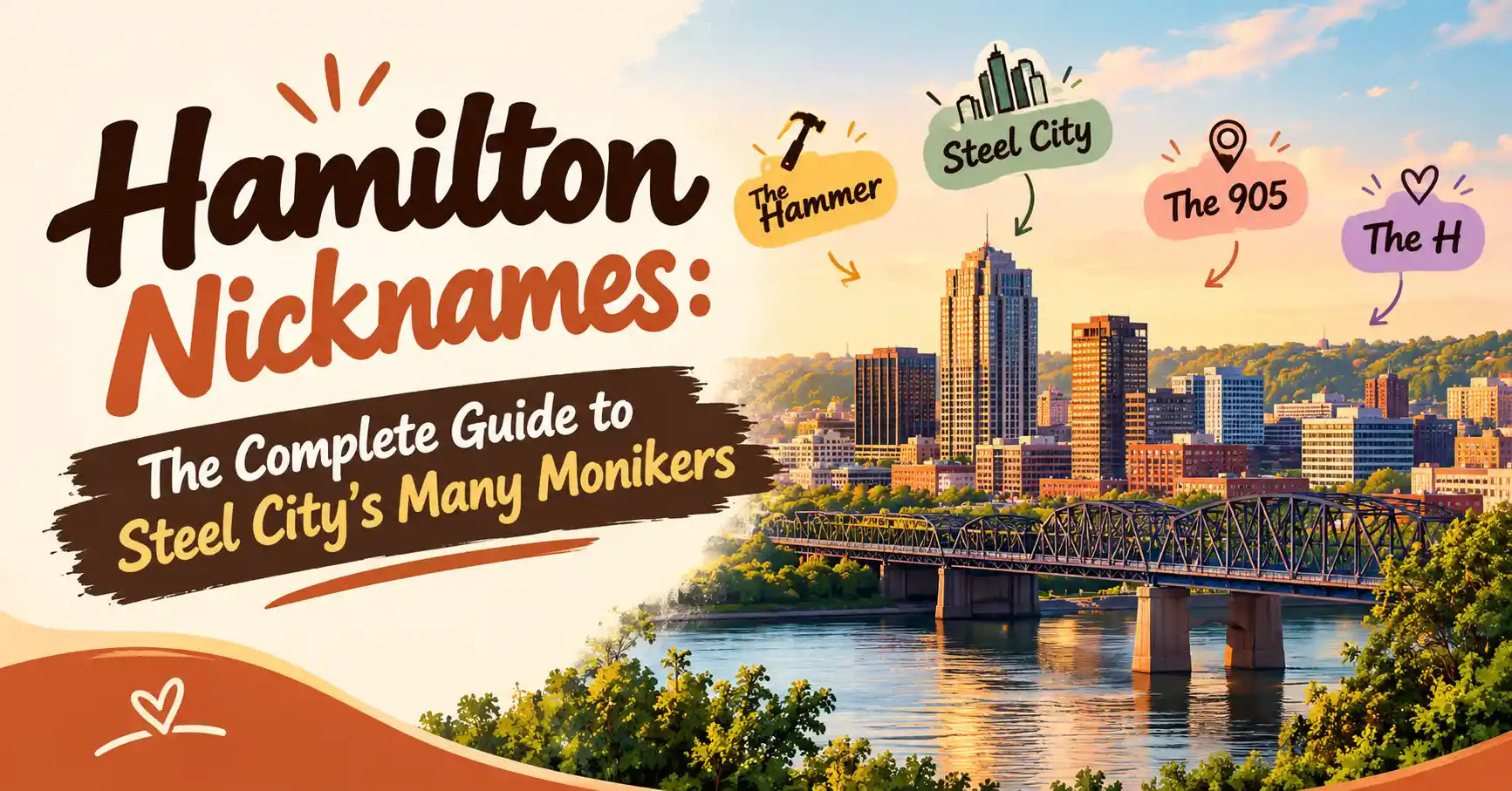
The most famous nickname of Hamilton is “Steel City” or “The Hammer.” Other well-known nicknames include “Ambitious City,” “Tiger Town,” and “The Electric City.” These nicknames reflect Hamilton’s industrial heritage, particularly its steel manufacturing history.
📊 Quick Facts Table
| Attribute | Details |
|---|---|
| City | Hamilton |
| Province/Country | Ontario, Canada |
| Official Nickname | None officially designated |
| Most Famous Nickname | Steel City / The Hammer |
| Population | Approximately 580,000 (2021 Census) |
| Founded | June 9, 1846 |
| Known For | Steel production, waterfalls, Bruce Trail, arts scene |
| Region | Golden Horseshoe, Southern Ontario |
| Time Zone | Eastern (EST/EDT) |
🏛️ Official Nickname of Hamilton
Hamilton does not have an officially designated nickname by municipal charter or government proclamation. However, “Steel City” functions as a de facto official nickname due to its widespread use in local media, tourism materials, and civic branding.
The nickname is commonly recognized rather than legally official. It emerged organically from the city’s industrial identity and has been embraced by residents, businesses, and cultural institutions. The Hamilton Chamber of Commerce and Tourism Hamilton frequently reference the city’s steel heritage in promotional materials, reinforcing the “Steel City” identity.
It’s worth noting that while “Steel City” dominates, “The Hammer” has gained significant traction in recent decades, particularly among younger residents and in social media contexts. This nickname represents a more contemporary, hip identity that balances the city’s industrial past with its emerging arts and culture scene.
📖 What Are the Nicknames of Hamilton?
Hamilton’s nicknames reflect multiple dimensions of its identity—industrial, geographic, cultural, and historical. The city’s location on the Niagara Escarpment, its role in Canadian manufacturing, and its spirited local culture have all contributed to the rich collection of monikers.
The following categories capture the main types of Hamilton nicknames:
- Industrial Heritage Nicknames — Names referencing steel production and manufacturing
- Geographic Nicknames — Names inspired by location and natural features
- Cultural/Sports Nicknames — Names tied to local teams and cultural identity
- Historical Nicknames — Names from earlier eras of the city’s development
Industrial Heritage Nicknames
Hamilton’s identity as a manufacturing powerhouse produced several enduring nicknames:
- Steel City — Direct reference to Hamilton’s massive steel industry
- The Birmingham of Canada — Comparison to England’s industrial heartland
- The Pittsburgh of Canada — Parallel to the American steel capital
- The Electric City — Reference to early hydroelectric power generation
- The Ambitious City — Captured the city’s rapid 19th-century growth
Geographic Nicknames
The city’s unique topography inspired nature-focused nicknames:
- The City of Waterfalls — Hamilton has over 100 waterfalls within city limits
- The Hammer — A shortened, affectionate term for Hamilton
- The Mountain — Local reference to the Niagara Escarpment
- Bay City — Reference to Hamilton Harbour
Sports and Cultural Nicknames
Local sports teams and cultural movements created additional nicknames:
- Tiger Town — From the Hamilton Tiger-Cats CFL team
- The Ticats’ Town — Another sports-derived nickname
- The Arts City — Reflecting the growing cultural scene
- The Hammer — Also popular in arts and music communities
📋 Complete List of Hamilton Nicknames
| Nickname | Meaning | Origin | Popularity |
|---|---|---|---|
| Steel City | Reference to steel manufacturing | Early 20th century | ⭐⭐⭐⭐⭐ Very High |
| The Hammer | Shortened form of Hamilton | Late 20th century | ⭐⭐⭐⭐⭐ Very High |
| Ambitious City | Rapid growth and ambition | Mid-19th century | ⭐⭐⭐⭐ High |
| Tiger Town | Hamilton Tiger-Cats sports team | Mid-20th century | ⭐⭐⭐⭐ High |
| The Electric City | Early hydroelectric power | Late 19th century | ⭐⭐⭐ Moderate |
| City of Waterfalls | Over 100 local waterfalls | Late 20th century | ⭐⭐⭐⭐ High |
| Birmingham of Canada | Industrial comparison | Late 19th century | ⭐⭐⭐ Moderate |
| Pittsburgh of Canada | Steel industry parallel | Early 20th century | ⭐⭐⭐ Moderate |
| Bay City | Hamilton Harbour location | 19th century | ⭐⭐ Lesser Known |
⭐ Most Popular Nicknames of Hamilton
Among the many Hamilton nicknames, two stand above the rest in recognition and usage: “Steel City” and “The Hammer.”
Steel City remains the most internationally recognized nickname, instantly communicating Hamilton’s industrial heritage to anyone familiar with Canadian geography or manufacturing history. It appears in news headlines, tourism campaigns, and casual conversation across the province.
The Hammer has experienced a remarkable surge in popularity over the past two decades. Originally used informally by locals, it has been embraced by the city’s growing arts community, young professionals, and social media users. The nickname’s brevity and edgy tone perfectly capture Hamilton’s transformation from industrial town to cultural destination.
These two nicknames coexist comfortably, with “Steel City” representing historical identity and “The Hammer” embodying contemporary civic pride.
🔍 Main Nicknames Explained
Steel City
Meaning: A direct reference to Hamilton’s massive steel manufacturing industry, which dominated the local economy for over a century.
Short Origin Story: The nickname emerged in the early 20th century as Hamilton became home to Stelco and Dofasco, two of Canada’s largest steel producers. The city’s skyline was defined by blast furnaces and smokestacks, making the association inevitable.
Historical Background: At its peak, Hamilton produced more steel than any other Canadian city, earning its place as the nation’s steel capital. The industry employed tens of thousands of residents and shaped the city’s physical and social landscape.
Modern Usage: Despite the decline of traditional steel manufacturing, “Steel City” remains widely used in local media, business names, and civic branding. It honors the city’s industrial roots while acknowledging its ongoing evolution.
Cultural Impact: The nickname has been embraced by local sports teams, businesses, and cultural organizations. It represents resilience and hard work—values associated with steelworkers.
Interesting Fact: Hamilton’s steel industry produced materials used in iconic structures like the CN Tower and the original World Trade Center.
The Hammer
Meaning: A shortened, affectionate form of “Hamilton” that has evolved into a distinct identity.
Short Origin Story: The nickname likely originated in the late 20th century as informal slang among locals. Its rise coincided with Hamilton’s cultural renaissance and growing arts scene.
Historical Background: While “The Hammer” has roots in casual local usage, it gained mainstream traction through music, sports, and social media. Artists and athletes from Hamilton helped popularize the term.
Modern Usage: “The Hammer” is now ubiquitous in Hamilton and beyond. It appears on merchandise, in marketing campaigns, and in everyday conversation. The city’s NBA G League team was even named the Hamilton Honey Badgers, playing on the “Hammer” identity.
Cultural Impact: The nickname represents a more contemporary, diverse, and confident Hamilton. It bridges the city’s industrial past with its creative present.
Interesting Fact: The Hammer has become a popular hashtag on social media, used by residents and visitors alike to showcase the city’s attractions.
Ambitious City
Meaning: A nickname celebrating Hamilton’s rapid growth and bold aspirations during the 19th century.
Short Origin Story: The term emerged in the mid-1800s as Hamilton grew from a small settlement into a major urban center. Its rapid population growth and industrial development impressed observers.
Historical Background: Hamilton’s strategic location at the head of Lake Ontario and its early adoption of railways fueled explosive growth. By the late 1800s, it was one of Canada’s largest cities.
Modern Usage: While less common today, “Ambitious City” appears in historical contexts and occasional civic rhetoric. It reminds residents of the city’s pioneering spirit.
Cultural Impact: The nickname captures the optimism and drive that characterized Hamilton’s early development. It’s often invoked when discussing the city’s potential for renewal.
Interesting Fact: Hamilton was briefly considered as a potential capital of Canada due to its strategic location and rapid growth.
Tiger Town
Meaning: A sports-inspired nickname derived from the Hamilton Tiger-Cats, the city’s beloved CFL team.
Short Origin Story: The Tiger-Cats formed in 1950 through a merger of the Hamilton Tigers and Hamilton Wildcats. The team’s success and passionate fan base made “Tiger Town” a natural extension.
Historical Background: The Tiger-Cats have won eight Grey Cup championships, making them one of the CFL’s most successful franchises. Their games at Tim Hortons Field are community events.
Modern Usage: “Tiger Town” appears in sports coverage, fan merchandise, and local pride campaigns. It’s particularly popular during football season.
Cultural Impact: The nickname represents Hamilton’s strong sports culture and community spirit. The Tiger-Cats remain a unifying force in the city.
Interesting Fact: The Tiger-Cats’ rivalry with the Toronto Argonauts is one of the oldest and most intense in Canadian sports.
The Electric City
Meaning: A reference to Hamilton’s pioneering role in hydroelectric power generation.
Short Origin Story: In the late 19th century, Hamilton harnessed the power of Niagara Falls through the DeCew Falls generating station, becoming one of the first cities in Canada with widespread electric power.
Historical Background: The availability of cheap electricity attracted industries and helped fuel Hamilton’s industrial expansion. The city’s electric streetcars were among the earliest in Canada.
Modern Usage: “The Electric City” is less commonly used today but appears in historical contexts and occasional branding. It highlights Hamilton’s innovative past.
Cultural Impact: The nickname celebrates Hamilton’s role as a technological pioneer and its contribution to Canada’s electrification.
Interesting Fact: Hamilton’s electric streetcar system began operating in 1892, making it one of the first in North America.
City of Waterfalls
Meaning: A nickname highlighting Hamilton’s remarkable concentration of waterfalls within its city limits.
Short Origin Story: Hamilton’s location on the Niagara Escarpment creates ideal conditions for waterfalls. Over 100 waterfalls have been documented within the city’s boundaries.
Historical Background: While the waterfalls have existed for millennia, their recognition as a civic asset grew in the late 20th century as conservation and tourism efforts increased.
Modern Usage: “City of Waterfalls” is frequently used in tourism marketing and outdoor recreation promotion. It attracts visitors from across Ontario and beyond.
Cultural Impact: The nickname positions Hamilton as a nature destination, balancing its industrial image with environmental beauty.
Interesting Fact: Webster’s Falls and Tew’s Falls are among the most spectacular, with Tew’s Falls taller than Niagara Falls.
🏆 Which Nickname Is Most Famous?
“Steel City” is undoubtedly Hamilton’s most famous nickname. It has achieved recognition far beyond the city’s borders and is immediately understood by Canadians and international audiences alike. The nickname’s staying power comes from its direct connection to Hamilton’s most defining historical characteristic—steel production.
However, “The Hammer” has rapidly gained ground and may soon rival “Steel City” in popularity, particularly among younger demographics and in digital spaces. Its concise, memorable quality makes it ideal for social media and casual usage.
For official and tourism purposes, “Steel City” remains the go-to nickname, while “The Hammer” dominates informal and cultural contexts.
📜 How Hamilton Got Its Nicknames
Hamilton’s nicknames emerged organically over nearly two centuries, reflecting the city’s evolution from a small settlement to an industrial powerhouse and now a cultural destination.
The earliest nicknames, like “Ambitious City,” arose during the 19th century when Hamilton’s rapid growth impressed observers. The city’s strategic location and entrepreneurial spirit fueled this reputation.
Industrial nicknames like “Steel City,” “Birmingham of Canada,” and “Pittsburgh of Canada” emerged in the early-to-mid 20th century as Hamilton became a manufacturing giant. These names acknowledged the city’s role in Canadian industry.
Sports nicknames like “Tiger Town” developed in the mid-20th century alongside the success of local teams.
More recent nicknames like “The Hammer” and “City of Waterfalls” reflect Hamilton’s contemporary identity—a city embracing its cultural assets and natural beauty while honoring its past.
📝 Other Nicknames at a Glance
- The Ticats’ Town — Another sports-derived nickname
- The Mountain City — Reference to the Niagara Escarpment
- The Bay Area — Sometimes used for the Hamilton Harbour region
- Lancaster’s Legacy — Historical reference to early settlement
- The Gateway to Niagara — Geographic positioning nickname
- The Renaissance City — Reflecting urban renewal
- The Art City — Acknowledging the growing arts scene
- The Music City — Recognizing Hamilton’s musical heritage
🎉 Fun Facts About Hamilton
- More Waterfalls Than Any City — Hamilton has over 100 waterfalls within its municipal boundaries, more than any other city in the world relative to its size.
- The Bruce Trail Starts Here — The Bruce Trail, Canada’s oldest and longest marked hiking trail, begins in Hamilton and extends 900 kilometers to Tobermory.
- Steel for Iconic Structures — Hamilton steel was used in the construction of the CN Tower, the original World Trade Center, and countless other landmarks.
- A UNESCO Biosphere — The Niagara Escarpment, which runs through Hamilton, is a UNESCO World Biosphere Reserve.
- Birthplace of Canadian Football — The Hamilton Tiger-Cats are one of the oldest professional sports teams in North America, with roots dating to the 1860s.
- The First Tim Hortons — While not in Hamilton, the first Tim Hortons opened nearby in 1964, and Hamilton has been a stronghold of the chain ever since.
- A Literary Connection — Author Margaret Atwood lived in Hamilton during her childhood, and the city appears in several of her works.
- Film Industry Hub — Hamilton has become a popular filming location, standing in for New York, Chicago, and other cities in numerous films and TV shows.
- The Royal Botanical Gardens — Canada’s largest botanical garden is located in Hamilton, spanning over 2,700 acres.
- A Musical Legacy — Hamilton has produced numerous notable musicians, including Neil Peart of Rush, who grew up in the city.
🎯 Famous Attractions in Hamilton
Hamilton offers a diverse range of attractions that showcase its unique character:
Natural Attractions:
- Webster’s Falls and Tew’s Falls
- The Bruce Trail
- Royal Botanical Gardens
- Hamilton Conservation Areas
Cultural Attractions:
- Art Gallery of Hamilton
- Canadian Warplane Heritage Museum
- Dundurn Castle
- Whitehern Historic House
Sports and Entertainment:
- Tim Hortons Field (home of the Tiger-Cats)
- FirstOntario Centre
- Bayfront Park
Urban Experiences:
- James Street North Art Crawl
- Hamilton Farmers’ Market
- Locke Street Shopping District
⚖️ Nickname Comparison: Hamilton vs. Chicago
| Aspect | Hamilton | Chicago |
|---|---|---|
| Most Famous Nickname | Steel City | The Windy City |
| Secondary Nickname | The Hammer | The Second City |
| Nickname Origin | Steel industry | Weather/politics rivalry |
| Total Nicknames | 8+ documented | 15+ documented |
| Industrial Identity | Steel manufacturing | Meatpacking, manufacturing |
Both Hamilton and Chicago share industrial heritage and a strong sense of civic pride. While Chicago’s nicknames often reference its weather and political history, Hamilton’s nicknames focus more on its steel industry and natural features.
For more city nickname comparisons and guides, explore our related articles below.
🔗 Related Cities and Their Nicknames
🍁 Toronto Nicknames
The 6ix, Hogtown, T-Dot
🏙️ Chicago Nicknames
Windy City, Second City, Chi-Town
🚗 Detroit Nicknames
Motor City, Motown, Hockeytown
🎸 Cleveland Nicknames
The Land, Rock City, Forest City
🍁 Ontario City Nicknames
Explore nicknames across Ontario
❓ Frequently Asked Questions
What is the official nickname of Hamilton?
Hamilton does not have an officially designated nickname. However, “Steel City” functions as a de facto official nickname due to its widespread recognition and use in civic contexts.
Why is Hamilton called Steel City?
Hamilton is called Steel City because of its historical role as Canada’s steel manufacturing capital. Companies like Stelco and Dofasco made Hamilton the center of Canadian steel production for much of the 20th century.
Who gave Hamilton the nickname “The Hammer”?
The exact origin of “The Hammer” is unclear, but it emerged organically from local slang. It gained popularity in the late 20th and early 21st centuries, particularly among younger residents and the arts community.
When did Hamilton’s nicknames become popular?
Different nicknames emerged at different times. “Ambitious City” dates to the mid-1800s, “Steel City” to the early 1900s, “Tiger Town” to the 1950s, and “The Hammer” to the late 1900s and 2000s.
What are other nicknames of Hamilton?
Other Hamilton nicknames include “Ambitious City,” “Tiger Town,” “The Electric City,” “City of Waterfalls,” “Birmingham of Canada,” and “Pittsburgh of Canada.”
Do locals use these nicknames?
Yes, locals regularly use “Steel City” and “The Hammer” in everyday conversation. “Tiger Town” is popular among sports fans, while other nicknames appear more in historical or promotional contexts.
Is Hamilton’s nickname officially recognized?
No Hamilton nickname has official government designation, but “Steel City” is widely recognized and used in tourism and civic branding.
🎬 Conclusion
Hamilton’s nicknames tell the story of a city that has continually reinvented itself while honoring its past. From the industrial might of “Steel City” to the contemporary swagger of “The Hammer,” these monikers capture different chapters of Hamilton’s ongoing narrative.
Whether you know it as the Ambitious City, Tiger Town, or the City of Waterfalls, Hamilton remains a place of remarkable character and resilience. The city’s nicknames are more than labels—they’re badges of identity worn with pride by generations of residents.
For those interested in exploring more about Canadian cities and their fascinating nicknames, the Canadian Encyclopedia offers excellent historical context on communities across the country. Whether you’re a history buff, a travel enthusiast, or simply curious about what makes cities unique, Hamilton’s nicknames provide a window into the soul of one of Canada’s most interesting urban centers.