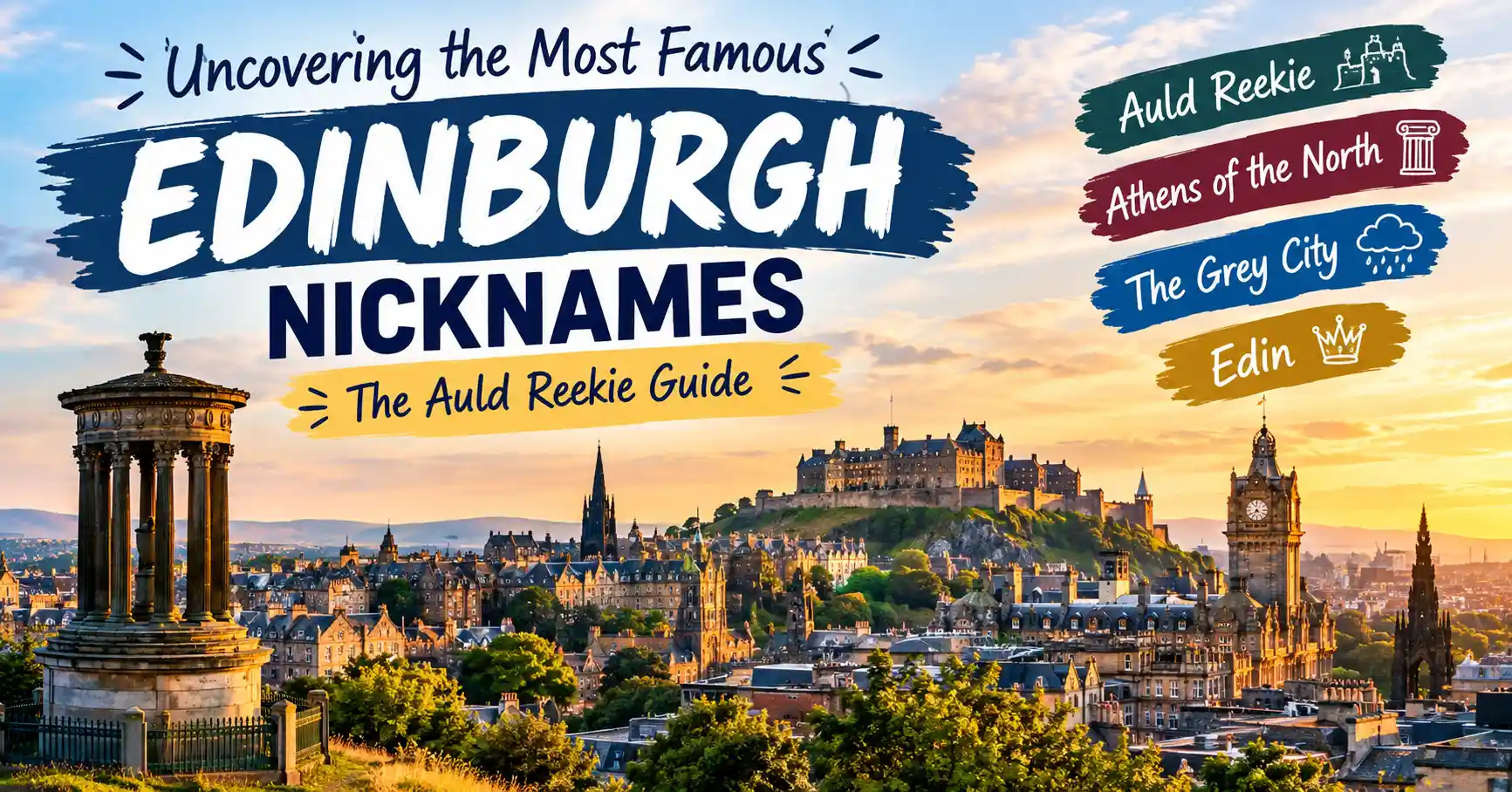
Edinburgh is a city of dramatic contrasts, where medieval cobblestone streets meet Georgian elegance and a dormant volcano looms over the city center. As Scotland’s historic capital, it has inspired writers, poets, and travelers for centuries. This rich history has birthed a fascinating collection of Edinburgh nicknames, ranging from the affectionate to the poetic, each revealing a different facet of the city’s personality.
What is Edinburgh’s most famous nickname?
The most famous nickname for Edinburgh is “Auld Reekie” (Old Smoky), a nod to the coal smoke that once blanketed the Old Town. Other well-known nicknames include “The Athens of the North,” “The Festival City,” and the ancient Gaelic name “Dunedin.”
📊 Edinburgh Quick Facts
| City | Edinburgh |
|---|---|
| Country | Scotland, United Kingdom |
| Official Nickname | None (nicknames are unofficial) |
| Most Famous Nickname | Auld Reekie |
| Population | Approx. 506,520 (City of Edinburgh) |
| Founded | 7th century AD (approx.) |
| Gaelic Name | Dùn Èideann |
| Known For | Edinburgh Castle, the Royal Mile, the Festival Fringe, UNESCO World Heritage status |
| UNESCO Status | World Heritage Site (Old & New Towns) and City of Literature |
🏛️ Official Nickname of Edinburgh
Unlike some American cities that have adopted official municipal slogans, Edinburgh does not have a legally designated “official” nickname. However, “Auld Reekie” serves as the de facto historical nickname, recognized universally by locals and historians. While it is not printed on government documents, it is the most culturally significant identifier for the city.
📜 What Are the Nicknames of Edinburgh?
Edinburgh is a city of many names. Because of its unique topography—built on seven hills—and its volatile weather, residents have developed various monikers over the centuries. These names generally fall into three categories: historical descriptions, architectural comparisons, and cultural accolades. Understanding these categories helps visitors grasp the city’s dual identity as both a gritty, ancient capital and a center of enlightenment.
Categories of Edinburgh Nicknames:
- Topographical/Historical: These nicknames refer to the physical appearance or the atmosphere of the city. Examples: Auld Reekie, The Old Town.
- Intellectual/Architectural: These refer to the city’s reputation for learning and its distinctive buildings. Examples: Athens of the North, Modern Athens.
- Cultural/Event-Based: These highlight the city’s global status in the arts. Examples: The Festival City, The Capital.
📝 Complete List of Edinburgh Nicknames
📝 Complete List of Edinburgh Nicknames
| Nickname | Meaning | Origin | Popularity |
|---|---|---|---|
| Auld Reekie | “Old Smoky” — a nod to coal-fire haze | 18th–19th century | Very High |
| Athens of the North | An intellectual and architectural hub | 18th century (Enlightenment) | High |
| The Festival City | Global capital of the performing arts | 20th century (post-1947) | High |
| Dunedin | Gaelic for “fort on the slope” | Ancient / Gaelic roots | High (local) |
| Edina | Poetic, Latinized form of the city’s name | 18th–19th century literature | Low–Medium |
| City of Seven Hills | Built across seven volcanic hills | Historical / topographical | Medium |
| The Capital | Political heart of Scotland | 15th century onward | High |
| The Castle City | Dominated by Edinburgh Castle on its rock | Descriptive / modern tourism | Medium |
⭐ Most Popular Nicknames of Edinburgh
1. Auld Reekie
- Meaning: “Old Smoky” or “Old Reeky.”
- Origin Story: Coined during the 18th and 19th centuries when the city was notorious for the thick smoke rising from thousands of coal fires and chimneys.
- Historical Background: In the days before clean air acts, the “reek” (smoke) hung over the Old Town like a blanket. It was originally used by rural Scots coming into the city but was eventually embraced affectionately by locals.
- Modern Usage: Locals still refer to their city as “Auld Reekie” with a sense of pride and nostalgia.
- Cultural Impact: It symbolizes the warmth of the city despite the grime of its industrial past.
- Interesting Fact: Robert Burns famously used the term in his poetry, cementing its place in Scottish literature.
2. Athens of the North
- Meaning: A comparison to Athens, Greece, implying a center of wisdom and classical beauty.
- Origin Story: Popularized during the Scottish Enlightenment in the 18th century.
- Historical Background: Edinburgh was home to giants of philosophy, science, and economics like David Hume and Adam Smith. The architecture of the New Town was designed to mimic the classical grandeur of ancient Greece.
- Modern Usage: Still used to highlight the city’s university prestige and architectural beauty.
- Cultural Impact: It positions Edinburgh as the intellectual rival to London.
- Interesting Fact: The city even features a monument to Dugald Stewart that mimics ancient Greek structures, and the Royal High School was designed to look like the Parthenon.
3. The Festival City
- Meaning: The global capital of arts and culture.
- Origin Story: Emerged after the establishment of the Edinburgh International Festival and the Fringe in 1947.
- Historical Background: Designed to heal post-war divisions through culture, the festivals grew into the largest arts event in the world.
- Modern Usage: Used heavily in tourism marketing.
- Cultural Impact: Every August, the city’s population doubles, transforming it into a stage for the world.
4. Dunedin
- Meaning: Derived from the Gaelic Dùn Èideann, meaning “fort on the slope” or “Edwin’s Fort.”
- Origin Story: The ancient name of the settlement.
- Historical Background: It refers to the hillfort that once stood on Castle Rock.
- Modern Usage: Used in poetry and formal Scottish contexts; also the name of the city in New Zealand founded by Scots.
- Interesting Fact: The name likely refers to King Edwin of Northumbria, who may have occupied the rock in the 7th century.
🏆 Which Nickname Is Most Famous?
“Auld Reekie” is undeniably the most famous nickname. While “Athens of the North” is flattering and intellectual, “Auld Reekie” is visceral and emotional. It captures the sensory experience of the city—the cold, the fog, the smoke, and the enduring spirit of the people who lived there. It is the nickname you will see on pub signs, hear in folk songs, and read in classic Scottish novels.
🗺️ How Edinburgh Got Its Nicknames
Edinburgh’s nicknames were born from a mix of sensory experience and intellectual ambition. The “smoky” moniker arose from environmental reality; the city sits in a bowl (formed by extinct volcanoes), and prior to modern regulations, smoke from coal fires would get trapped in the valley, creating a “reek.” The “Athens” moniker arose from ambition; during the Enlightenment, Edinburgh wanted to be seen as the intellectual equal of Europe’s greatest ancient cities.
🔍 Other Nicknames at a Glance
- The Old Town: Referring specifically to the medieval heart of the city.
- The New Town: The Georgian expansion (a UNESCO site itself).
- Edina: A poetic name used by writers like Sir Walter Scott.
- The Castle City: A reference to the dominating Edinburgh Castle.
- The Windy City: While famously associated with Chicago, Edinburgh is also incredibly windy due to its hilltop position, though this nickname is less common.
🎉 Fun Facts About Edinburgh
- J.K. Rowling wrote much of Harry Potter here. The city’s spires and alleys inspired Diagon Alley and Hogwarts.
- It’s built on seven hills. Just like Rome and Athens, contributing to the “Athens of the North” comparison.
- The world’s first flushing toilet? Not quite, but Edinburgh had some of the earliest high-rise tenements in the world (11 stories high in the 18th century).
- The One O’Clock Gun. Every day (except Sunday), a gun fires from the Castle. It was originally to help ships set their clocks.
- The Elephant House. A café that claims to be the “birthplace” of Harry Potter.
- UNESCO City of Literature. It was the first city in the world to be designated this.
- The Stone of Destiny. The ancient coronation stone of Scotland is kept at Edinburgh Castle.
- Greyfriars Bobby. The city has a statue for a Skye Terrier who guarded his master’s grave for 14 years.
🎡 Famous Attractions in Edinburgh
- Edinburgh Castle: Dominates the skyline from Castle Rock.
- The Royal Mile: The historic heart of the Old Town.
- Arthur’s Seat: An extinct volcano offering panoramic views.
- The Palace of Holyroodhouse: The official residence of the British monarch in Scotland.
- The Scottish Parliament: A striking modern building at the foot of the Royal Mile.
⚖️ Nickname Comparison: Edinburgh vs. Chicago
Both cities share a “Windy” reputation, but their nicknames reflect different histories.
⚖️ Edinburgh vs. Chicago Nicknames
- Primary NicknameAuld Reekie
- Meaning“Old Smoky” — chimney haze
- Secondary NicknameAthens of the North
- Core IdentityHistory & intellectualism
- VibeAncient, literary, mysterious
- Primary NicknameThe Windy City
- MeaningWeather — or political “windbagging”
- Secondary NicknameThe Second City
- Core IdentityIndustry & resilience
- VibeModern, bold, architectural
❓ Frequently Asked Questions
What is the official nickname of Edinburgh?
Edinburgh has no legally official nickname, but “Auld Reekie” is the most historically recognized and culturally significant one.
Why is Edinburgh called Auld Reekie?
The name comes from the 18th and 19th centuries when the city was covered in a haze of smoke (“reek”) from coal fires, earning it the title “Old Smoky.”
Who gave Edinburgh its nickname?
The nickname “Auld Reekie” evolved naturally among the local population and rural visitors. “Athens of the North” was popularized by writers and intellectuals during the Enlightenment.
When did the nickname become popular?
“Auld Reekie” became popular in the 18th century. “Athens of the North” gained traction in the mid-to-late 18th century.
What does Dunedin mean?
Dunedin is the Anglicized form of the Gaelic Dùn Èideann, which translates to “Fort on the Slope” or “Edwin’s Fort,” referring to the ancient hillfort on Castle Rock.
🏁 Conclusion
From the smoky chimneys of the Old Town to the intellectual rigor of the Enlightenment, Edinburgh nicknames tell the story of a city that has reinvented itself while holding onto its ancient roots.
Whether you call it Auld Reekie or the Athens of the North, Edinburgh remains a captivating destination. For more information on the city’s history and heritage, visit the official UNESCO World Heritage Centre page for Edinburgh.