
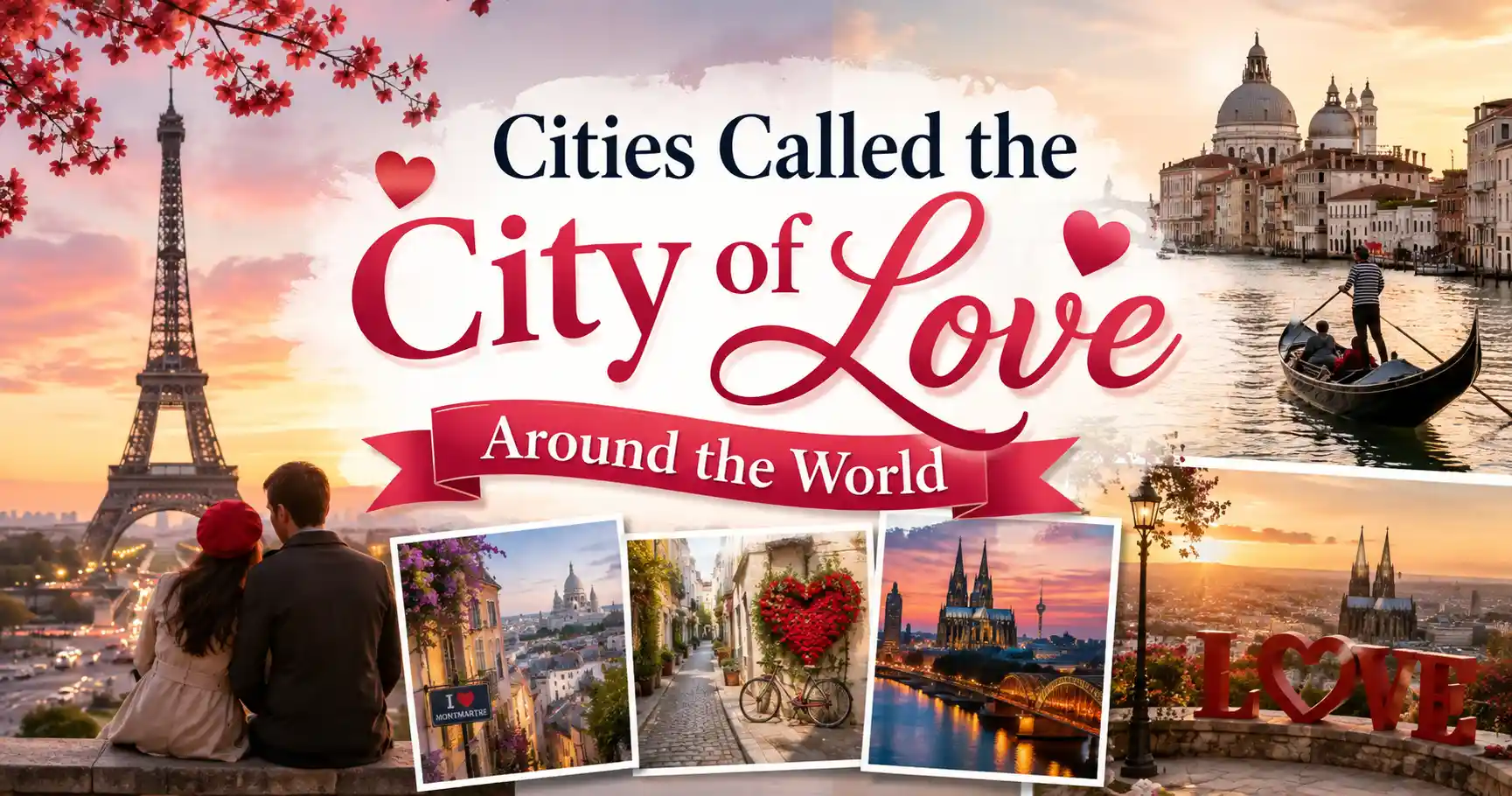
Paris may be the first city that comes to mind when you hear “City of Love,” but it’s far from the only place that wears the romantic crown. Several cities around the world have earned this affectionate nickname, each for a different blend of history, literature, art, and atmosphere. While no central authority hands out official love-themed titles, the moniker “City of Love” has attached itself to destinations where romance feels woven into the streets, canals, and stories. In this guide, we’ll explore the most famous cities called the City of Love, uncover why they share the nickname, and trace how each one built its reputation as a haven for lovers.
⭐ Quick Answer Box
The nickname “City of Love” is used by several cities, most famously Paris, Venice, and Verona. Paris earned the title through centuries of art, literature, and cinematic romance; Venice became a symbol of intimate, watery seclusion; and Verona claims the name as the setting of Shakespeare’s Romeo and Juliet. Other cities, from Bruges to Prague, are also occasionally called the City of Love in travel and tourism contexts.
📊 Quick Facts Table
What Does “City of Love” Mean?
The phrase “City of Love” is not an official municipal designation but a powerful cultural label. It describes a place that, through landscape, architecture, stories, or emotional atmosphere, has become a global shorthand for romantic love. The nickname draws on everything from poetic cityscapes to centuries of literature that turned urban settings into characters in love stories.
The origin of the expression isn’t pinned to a single moment. The idea of a city embodying love gained traction during the 19th century, when Romanticism in art and literature elevated emotion, beauty, and individual experience. Paris, already the continent’s cultural capital, absorbed these ideals and emerged as the archetypal love city. Meanwhile, Venice had long been a honeymoon stop on the Grand Tour, and Verona’s romantic identity grew from a 16th-century play. The nickname expanded organically as travel, cinema, and modern tourism marketing reinforced it.
Why Do So Many Cities Share This Nickname?
Multiple cities lay claim to the “City of Love” title because romance is a universal theme and cities provide the perfect stage for it. Several forces multiply the nickname:
- Literature and legend: Stories set in real cities can permanently tint their identity, as Romeo and Juliet did for Verona.
- Tourism marketing: Destinations actively brand themselves as romantic getaways, and the phrase “City of Love” is an irresistible tourism magnet.
- Architecture and scenery: Cobblestone lanes, candlelit bridges, and meandering canals naturally evoke intimacy — Venice, Bruges, and Prague all benefit from this.
- Cinema: Movies filmed on location can solidify a city’s romantic image globally; Paris has been the backdrop of countless love stories on screen.
- Cultural cachet: The local culture of wine, art, music, and leisurely dining reinforces a reputation for romance.
- Love rituals: Traditions like attaching a love lock to a bridge or leaving a note at Juliet’s house create participatory romance that keeps the nickname alive.
Thus, while Paris is the heavyweight champion, Venice and Verona share the title with deep historical legitimacy, and a constellation of other cities flirt with the label.
🌍 Cities That Use This Nickname
Other cities occasionally referred to as the “City of Love” in travel writing include Bruges (for its fairytale canals), Prague (for its old-world charm), and Buenos Aires (for tango’s passionate embrace). However, Paris, Venice, and Verona remain the strongest, most historically rooted associations.
Top Cities Explained
Paris: The Archetypal City of Love
When people speak of the “City of Love,” Paris is almost always the first name on their lips. The connection isn’t official — the city government doesn’t use it as a formal slogan — but it is so deeply embedded in global culture that Paris and romance are virtually synonymous.
History and origin
Paris’s love affair with romance began to take shape in the 19th century. During the Belle Époque (roughly 1871–1914), the city became a magnet for artists, writers, and bohemians who celebrated beauty, passion, and emotional freedom. Wide boulevards, gaslit bridges, and intimate café terraces created a built environment that felt designed for lovers. Painters like Renoir and writers like Victor Hugo infused the city with a sensual, romantic aura.
The 20th century amplified this reputation through film. From classic black-and-white cinema to modern rom-coms, Paris provided the ultimate backdrop for on-screen love. The proliferation of the “love lock” tradition on the Pont des Arts (now discouraged due to structural weight) and the global popularity of phrases like “Paris is always a good idea” sealed the nickname’s dominance.
Meaning and current usage
Today, the Paris Convention and Visitors Bureau actively markets the city’s romantic experiences — candlelit dinners, sunset Seine cruises, and proposals beneath the Eiffel Tower. The official tourism site parisjetaime.com (“Paris loves you”) playfully leans into the love theme. While the city has many other nicknames — most notably the “City of Light” — its status as the world’s romance capital remains unrivalled.
Interesting fact
Montmartre, the hilltop neighborhood where artists once lived and worked, is sometimes called the most romantic village in Paris. Its small vineyard, the Clos Montmartre, still produces wine in the heart of the city — a quiet toast to love and history.
Venice: The Floating City of Romance
Venice conjures up a different shade of love: dreamy, mysterious, and suspended on water. The city’s labyrinth of canals, absence of cars, and fading palazzos create a stage where everyday life feels cinematic and intimate.
History and origin
Venice’s romantic identity has roots in the Grand Tour era of the 17th and 18th centuries, when wealthy Europeans traveled to Italy to absorb art and culture. Young aristocrats often visited Venice as a final, hedonistic stop, and the city’s masquerade balls, gondolas, and operas earned it a reputation for seduction and intrigue. Writers like Lord Byron and Henry James later reinforced this image with tales of passion set in Venetian salons and misty canals.
The nickname “City of Love” became more explicitly attached to Venice in the 20th century as mass tourism grew and the gondola ride — complete with a serenading gondolier — became the ultimate romantic gesture. Unlike Paris, Venice’s romance is quieter, more secretive, fed by hidden alleyways and the gentle lap of water against stone.
Meaning and current usage
Venice’s official tourism portal, Venezia Unica, promotes romantic itineraries under headings like “Venice for Lovers.” The city remains one of the world’s top honeymoon destinations. While it also carries nicknames like “La Serenissima” (the Most Serene) and “City of Canals,” the romantic label is central to its modern identity.
Interesting fact
The Bridge of Sighs, a covered limestone bridge connecting the Doge’s Palace to the prison, has become a romantic symbol — but not for the reason many think. According to local legend, lovers who kiss under the bridge at sunset will enjoy eternal love. In reality, the bridge earned its name from the sighs of prisoners glimpsing their last view of Venice.
Verona: Love Written in Stone
If Paris is the city where love is lived and Venice is the city where love drifts, Verona is the city where love is immortalized in ink and marble. This northern Italian city owes its romantic crown entirely to literature — specifically, the world’s most famous love story.
History and origin
William Shakespeare set his tragedy Romeo and Juliet in Verona, though he likely never visited. The play, published in the 1590s, drew on earlier Italian tales, but it cemented Verona’s name in the geography of love. Over time, Verona embraced the connection with enthusiasm and no small amount of entrepreneurial spirit.
A 13th-century house on Via Cappello, once belonging to the Cappelletti family (whose name resembles “Capulet”), was retroactively declared Juliet’s residence in the early 20th century. A balcony was added to the building in the 1930s to satisfy tourists’ expectations, and the site now draws lovers from around the world.
Meaning and current usage
Today, the City of Verona’s official tourism body, Turismo Verona, explicitly brands the destination as the “city of love.” Visitors can stand beneath Juliet’s balcony, touch the bronze statue of Juliet (a ritual believed to bring luck in love), and even write letters to Juliet — a tradition so robust that a team of volunteers, the “Juliet Club,” answers thousands of letters each year.
Interesting fact
Verona’s love credentials have received a contemporary boost from the 2010 film Letters to Juliet, which sparked renewed global interest in the city’s romantic mythology. The love-letter tradition, however, dates back much further — some historians trace it to the early 20th century, when travelers began leaving notes tucked into the courtyard walls.
🗓 Historical Timeline: How Cities Became Known as the City of Love
🌎 Countries Where This Nickname Is Used
The “City of Love” nickname appears most prominently in two countries — France and Italy — but its soft power extends across Europe and beyond.
- France: Paris is the undisputed global icon.
- Italy: Venice and Verona share the title, each with a distinct romantic identity. Florence and Rome are sometimes called romantic cities, but “City of Love” is more tightly held by Venice and Verona.
- Belgium: Bruges, with its medieval canals and cobbled lanes, frequently earns the label in travel magazines, though less officially.
- Czech Republic: Prague’s old town and Charles Bridge are often described in guides as one of Europe’s most romantic spots, occasionally using the love-city phrase.
- Argentina: Buenos Aires, birthplace of tango, occasionally stakes a claim to the nickname, framing love as passionate and dance-driven.
The nickname is overwhelmingly an Italian and French cultural export, but it’s repeated wherever canals, balconies, and beautiful streetscapes stir the heart.
⭐ Fun Facts
- The tradition of attaching love locks to bridges began in Europe in the early 2000s and exploded in Paris, where the Pont des Arts groaned under the weight of over 700,000 padlocks before the city removed the panels in 2015 for safety.
- Venice has no single “love bridge” but offers gondola rides that often include a traditional serenade — a practice that emerged in the 19th century as a tourist experience.
- The Juliet Club in Verona has been answering letters addressed to “Juliet, Verona” since the 1930s, with a team of volunteer secretaries who write personal replies in multiple languages.
- In cinema, Paris starred as the romantic backdrop in films from An American in Paris (1951) to Midnight in Paris (2011), constantly renewing its love-city credentials.
- The Eiffel Tower, once considered an eyesore by many Parisians, now hosts thousands of marriage proposals each year and is illuminated with twinkling lights every evening, creating one of the most recognized romantic silhouettes on earth.
📊 Comparison Table: Paris vs. Venice vs. Verona
Which city is most strongly associated with the nickname? Paris remains the definitive “City of Love” in the global imagination, with Venice and Verona claiming strong, historically rich second and third places. Verona, however, is the most deliberate in officially embracing the label as part of its civic identity.
🤔 Common Misconceptions
❓ Frequently Asked Questions
Which city is the original City of Love?
There is no single original city; the nickname evolved separately. Paris’s romantic reputation dates to the 19th century, while Verona’s literary association began with Shakespeare in the 1590s. Venice’s love-city image developed from the 17th-century Grand Tour.
How many cities are called the City of Love?
Three cities are most consistently referred to by the nickname: Paris, Venice, and Verona. Several others, including Bruges, Prague, and Buenos Aires, are sometimes called the City of Love in travel writing but lack the same historical weight.
Is “City of Love” an official nickname for any city?
No city government formally declares “City of Love” as an official title. Verona comes closest, with its tourism board actively using the phrase in official marketing and branding campaigns.
Why is Paris called the City of Love?
Paris earned the nickname through its Belle Époque cultural bloom, its status as a haven for artists and lovers, and its extensive portrayal in romantic films and literature. Iconic landmarks, intimate café life, and the river Seine all reinforce its love-city image.
Why is Venice called the City of Love?
Venice’s car-free canals, gondola serenades, and history as a Grand Tour romantic stop transformed it into a honeymoon capital. Its secluded bridges and mysterious alleyways create an atmosphere strongly associated with intimate, escapist romance.
Why is Verona called the City of Love?
Shakespeare set Romeo and Juliet in Verona, and the city has since embraced the love theme wholeheartedly. Juliet’s balcony, the love-letter tradition, and official tourism branding all reinforce Verona’s identity as a city of love.
Which City of Love is the most famous?
Paris is by far the most famous city called the City of Love, recognized globally as the ultimate romantic destination. Venice and Verona follow, each with dedicated followings.
🔗 Explore More City Nickname Guides
🎸 Music City Attractions
From the Ryman to Broadway – experience the vibrant live music scene that defines Music City.
Explore →🚗 Motor City (Detroit)
Learn how Detroit became the Motor City – the birthplace of the American automobile industry.
Explore →Conclusion
The “City of Love” is not a single place but a shared title carried by cities whose streets, stories, and spirit have become entwined with romance. Paris remains the world’s favorite, a city that has spent more than a century perfecting its love affair with lovers. Venice offers a quieter, more mysterious kind of romance, built on water and whispered legend. Verona, the literary underdog, has turned a tragic 16th-century play into one of tourism’s most enduring love pilgrimages. Understanding why these cities share the nickname reveals how deeply culture, art, and a little marketing can shape the way we experience a place. If you’re planning a romantic journey or simply curious about urban identity, exploring each City of Love is a study in how love itself can become geography.
Sources & References
- Paris je t’aime — Official Tourist Office of Paris — “Romantic Paris”
https://www.parisjetaime.com/eng/romantic-paris/ - Venezia Unica — Official Tourism Website of Venice — “Romantic Venice”
https://www.veneziaunica.it/en/content/romantic-venice - Turismo Verona — Official Verona Tourism — “Verona: The City of Love”
https://www.turismoverona.eu/en/verona-city-of-love - Encyclopaedia Britannica — “Romeo and Juliet”
https://www.britannica.com/topic/Romeo-and-Juliet - Comune di Verona — Juliet’s House and the Love Letter Tradition (archival tourism materials)
https://www.comune.verona.it