
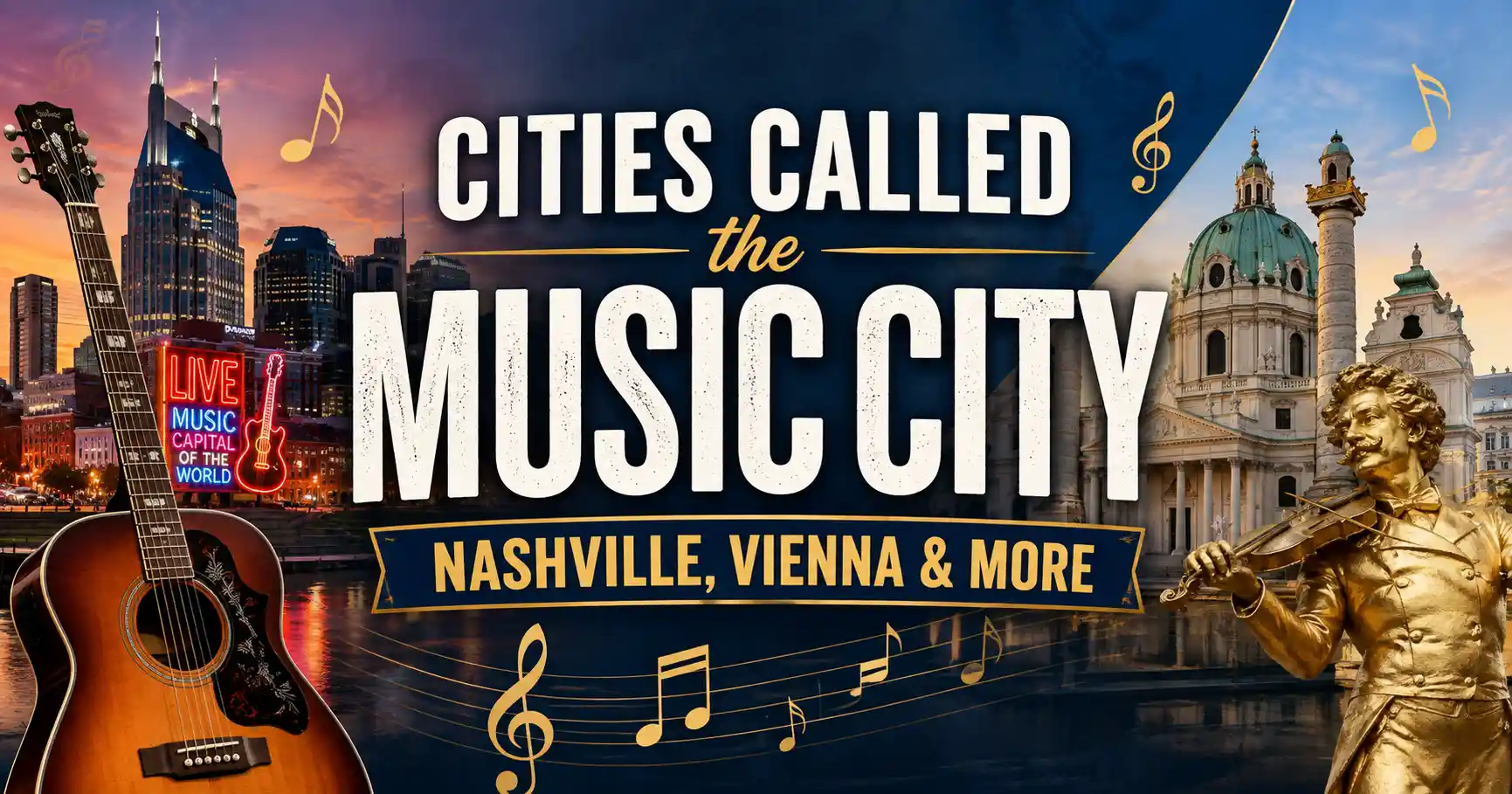
Few nicknames evoke as much emotion as “Music City.” While Nashville, Tennessee, is the undisputed modern bearer of the title, it is far from the only place to claim it. Around the world, a handful of cities have earned the right to be called a “Music City” or its direct translation, “City of Music.” Each one earned the label for a distinct reason—be it classical mastery, instrument manufacturing, or the global rise of country music. This article explores the cities that share this melodic moniker, the verified history behind each, and the myths that still linger.
⭐ Quick Answer Box
Quick Answer
The nickname “Music City” is most famously used by Nashville, Tennessee. Other cities bearing the exact moniker or its direct translation “City of Music” include Vienna, Austria, and Hamamatsu, Japan. Each city earned the title through a unique musical legacy—country music recording, classical composition, or global instrument production.
📊 Quick Facts Table
What Does “Music City” Mean?
At its heart, “Music City” describes a place where music is not just entertainment but identity. The nickname is reserved for urban centers whose history, economy, or cultural output is fundamentally shaped by music. Whether it’s the recording studios of Nashville, the concert halls of Vienna, or the instrument factories of Hamamatsu, a true Music City lives and breathes melody.
The English phrase “Music City” and its German counterpart Stadt der Musik or Japanese Ongaku no Miyako all carry the same weight: the city is recognized internationally as a capital of musical creation and performance.
Why Do Several Cities Share This Nickname?
No single musical tradition could define the world. Different cities earned the nickname for entirely separate reasons, yet all share a deep-rooted musical DNA:
- Recording industry dominance – Nashville became the global center of country music production.
- Classical music heritage – Vienna was home to Mozart, Beethoven, Haydn, and Schubert.
- Instrument manufacturing – Hamamatsu produces a staggering share of the world’s pianos, synthesizers, and wind instruments.
Geography, royal patronage, commercial innovation, and cultural pride each played a role. None of these cities borrowed the title from another; they earned it independently through their own contributions to music history.
🌍 Cities That Use This Nickname
Top Cities Explained
Nashville, Tennessee – The Official Music City
Nashville’s identity is inseparable from its nickname. The city is not simply a place where music happens; it is arguably the most concentrated music recording and publishing hub in the United States outside of New York and Los Angeles. The story of how Nashville became “Music City” is a blend of radio history, entrepreneurial spirit, and a legendary (if unproven) royal compliment.
Origin of the Nickname
The first documented use of “Music City” in reference to Nashville came in 1950. WSM radio announcer David Cobb, during a broadcast, referred to Nashville as “Music City, USA.” The phrase stuck. According to the Nashville Convention & Visitors Corp, Cobb later said the name just naturally rolled off his tongue because Nashville was already overflowing with music.
A widely circulated tale claims that Queen Victoria gave Nashville the title in the 1870s after hearing the Fisk Jubilee Singers perform, allegedly declaring they must come from a “city of music.” However, no period documentation supports this story. The Fisk Jubilee Singers did perform for Queen Victoria in 1873, but historians at the Library of Congress and Fisk University have found no evidence she made that remark. The legend persists in popular imagination, but the verified origin remains firmly with David Cobb and WSM radio.
Meaning and Significance
The nickname reflects Nashville’s role as the epicenter of country music, the home of the Grand Ole Opry, and the base of Music Row—a district housing hundreds of recording studios, record labels, and publishing houses. By the 1960s, the city had become a magnet for session musicians, songwriters, and producers across multiple genres.
Current Official Status
Since 1998, “Music City” has been the city’s official brand, and the phrase is a registered trademark of the Nashville Convention & Visitors Corp. It appears on municipal signage, welcome banners, and all major tourism campaigns.
Vienna, Austria – The City of Music
Long before the steel guitar, there was the symphony. Vienna’s claim to the title “City of Music” rests on an unparalleled concentration of classical genius that shaped Western music more than any other city.
Historical Origins
During the 18th and 19th centuries, Vienna served as the musical capital of the Habsburg Empire. Joseph Haydn, Wolfgang Amadeus Mozart, Ludwig van Beethoven, Franz Schubert, and the Strauss family all lived and composed there. The city was not merely a residence for these composers; it was the cultural ecosystem that nurtured their masterpieces. The Viennese Classical period—roughly 1750 to 1820—is named after the city itself.
Unlike Nashville, no single person coined the nickname. It grew organically through European art criticism and aristocratic commentary. By the early 19th century, travel writers were already calling Vienna the “City of Music” (Stadt der Musik). The Vienna Philharmonic, founded in 1842, cemented that reputation.
Cultural Significance Today
Vienna remains a titan of classical music performance. The Vienna State Opera, Musikverein concert hall, and the city’s annual New Year’s Concert are world-renowned. According to the Vienna Tourist Board, the city hosts over 15,000 musical events each year, drawing millions of visitors.
Hamamatsu, Japan – The City of Music Built by Instruments
If you have ever touched a Yamaha piano, a Kawai keyboard, or a Roland synthesizer, you have encountered the legacy of Hamamatsu. This unassuming city on Japan’s Pacific coast transformed itself into a global manufacturing powerhouse for musical instruments—and in doing so, earned the title “City of Music.”
Origin of the Nickname
Hamamatsu’s musical journey began in the late 19th century when Torakusu Yamaha, a watchmaker, repaired a reed organ and then built his first harmonium in 1887. That moment birthed the Yamaha Corporation, today the largest musical instrument manufacturer in the world. Other companies followed: Kawai Musical Instruments was founded in Hamamatsu in 1927, and Roland Corporation was established there in 1972.
The Japanese phrase Ongaku no Miyako (音楽の都), translating to “Music City” or “City of Music,” became associated with Hamamatsu as the city’s industrial output came to dominate global markets. In 2014, UNESCO officially designated Hamamatsu a Creative City of Music, recognizing both its manufacturing prowess and its vibrant music education and festival culture.
Why It Matters
While Hamamatsu does not claim the compositional fame of Vienna or the recording industry of Nashville, its influence on global music is tangible. The instruments built there shape the sound of modern music across all genres. The city’s Museum of Musical Instruments and the Hamamatsu International Piano Competition further underscore its cultural commitment.
🗓 Historical Timeline
🌎 Countries Where This Nickname Is Used
- United States – Nashville alone holds the official “Music City” trademark, though the term is sometimes applied informally to other music hubs like Austin or Memphis in tourism contexts.
- Austria – Vienna is historically and popularly known as the Stadt der Musik.
- Japan – Hamamatsu is recognized nationally and by UNESCO as Ongaku no Miyako (City of Music).
A few other cities occasionally brand themselves as a “Music City” for cultural events—Glasgow (UNESCO City of Music) and Seville, for instance—but they generally use descriptive phrases rather than “Music City” as a standalone nickname.
⭐ Fun Facts
- Nashville’s “Music City” nickname was so powerful that by 1958, the term was already being used in national publications like Billboard magazine.
- The myth of Queen Victoria calling Nashville a “music city” became so entrenched that the state of Tennessee included it on an official historical marker for years before correcting the record.
- Vienna’s Central Cemetery contains a special section for composers, including the graves of Beethoven, Brahms, and Schubert.
- Hamamatsu is home to the world’s first museum entirely dedicated to musical instruments, with over 1,300 items spanning centuries and continents.
📊 Comparison Table
Which city is most strongly associated with the nickname?
Without question, Nashville. The phrase “Music City” is so tightly woven into Nashville’s identity that it appears on municipal signs, tourism material, and is legally protected. While Vienna and Hamamatsu hold equally legitimate claims to their respective versions, the English term “Music City” as a proper noun overwhelmingly points to Nashville.
🤔 Common Misconceptions
❓ Frequently Asked Questions
Which city is the original Music City?
If we trace the concept, Vienna was called the “City of Music” in the 18th century, making it the earliest bearer of the idea. In English, Nashville was the first to be called “Music City” with a recorded broadcast in 1950.
How many cities are officially called the Music City?
Nashville holds the official trademarked nickname “Music City.” Hamamatsu is officially designated a UNESCO Creative City of Music. Vienna’s title is historical and popularly recognized but not trademarked. In the strictest sense, only Nashville uses the exact English phrase as an official moniker.
Is Music City an official nickname for Nashville?
Yes. Nashville officially adopted the nickname in 1998, and it is now a registered trademark of the Nashville Convention & Visitors Corp.
Why do multiple cities share the nickname Music City?
Different musical traditions evolved in separate places. Vienna’s classical dominance, Nashville’s recording industry, and Hamamatsu’s instrument manufacturing each made the city a musical capital in its own right.
Which Music City is the most famous?
Globally, Nashville is the most famous “Music City” today due to its branding, tourism, and widespread media recognition. Vienna is the most famous City of Music in classical music circles.
Did the Fisk Jubilee Singers inspire the nickname?
Their 1873 performance for Queen Victoria is a cherished story, but there is no contemporary evidence linking the queen to the phrase “Music City.” The myth likely arose in the mid-20th century to give the nickname a royal pedigree.
Are there other cities nicknamed Music City?
A few cities, such as Glasgow and Seville, hold UNESCO City of Music status, but they do not commonly refer to themselves simply as “Music City.” The phrase remains overwhelmingly tied to Nashville in English usage.
🔗 Explore More
🌉 Cities Called the River City
Explore cities around the world that share the River City nickname.
Read More →🏙️ Cities Called the Queen City
From Cincinnati to Charlotte, learn the royal history behind the Queen City.
Read More →Conclusion
The title “Music City” is a rare and powerful distinction. It cannot be self-declared casually; it must be earned through generations of musical contribution. Nashville, Vienna, and Hamamatsu each embody this truth in profoundly different ways—through broadcasting and recording, through classical genius, and through the very instruments that make music possible. The next time you hear “Music City,” you’ll know there is more than one place that can rightfully carry the tune.
For deeper explorations, consider reading about why Charlotte is called the Queen City or how other American cities earned their lasting nicknames.
Sources & References
- Nashville Convention & Visitors Corp — “Why Is Nashville Called Music City?”
https://www.visitmusiccity.com/media/why-nashville-called-music-city - UNESCO Creative Cities Network — “Hamamatsu”
https://en.unesco.org/creative-cities/hamamatsu - Vienna Tourist Board — “Vienna – The City of Music”
https://www.wien.info/en/music-stage-shows/city-of-music - Library of Congress — “Fisk Jubilee Singers” historical resource
https://www.loc.gov/item/ihas.200197423/ - Yamaha Corporation — “History: The Beginning”
https://www.yamaha.com/en/about/history/