Cincinnati sits on the north bank of the Ohio River in southwestern Ohio, a city of roughly 309,000 people that anchors a metro area of more than 2.2 million. Founded in 1788 as Losantiville and renamed in 1790, it grew into the largest city west of the Appalachian Mountains and one of the great industrial and cultural centers of 19th-century America.
Few American cities carry as many names as Cincinnati. Its Cincinnati nicknames range from royal to porky to purely practical — a reflection of a river town that became a meatpacking giant, a German immigrant stronghold, a hilltop city, and a corporate headquarters hub. Here’s what each name means, where it came from, and why locals still use it today.
⚡ Quick Answer
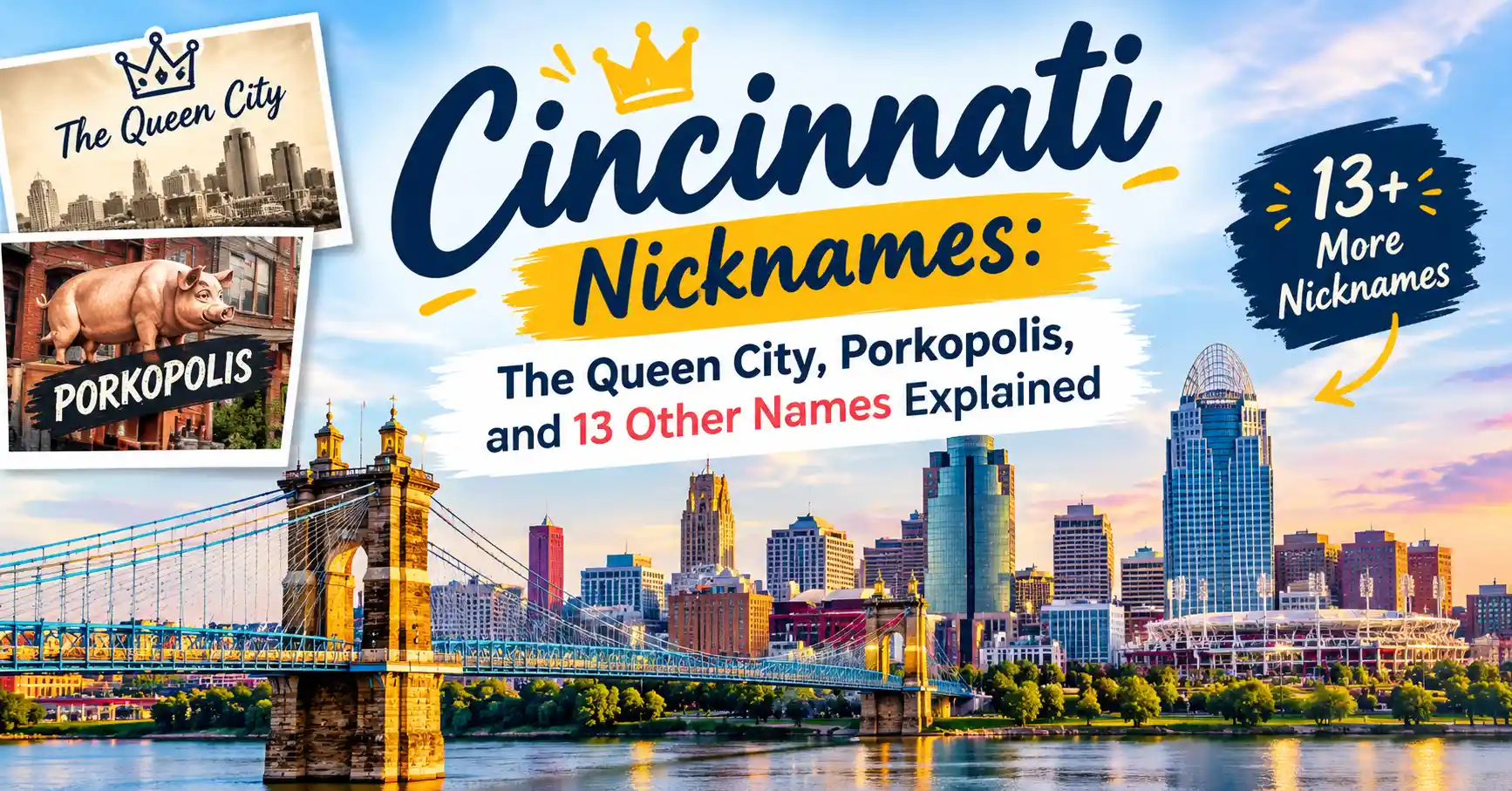
The most famous nickname of Cincinnati is “The Queen City,” popularized by Henry Wadsworth Longfellow’s 1854 poem Catawba Wine. Other well-known Cincinnati nicknames include “Porkopolis,” “The Blue Chip City,” “The City of Seven Hills,” “The ‘Nati,” and “Zinzinnati.”
📊 Quick Facts About Cincinnati
| Detail | Information |
|---|---|
| City | Cincinnati |
| State / Country | Ohio, United States |
| County | Hamilton County |
| Official Nickname | None legally designated; “The Queen City” is the recognized favorite |
| Most Famous Nickname | The Queen City |
| Population | ≈309,000 (city); ≈2.2 million (metro) |
| Founded | 1788 (as Losantiville); renamed Cincinnati in 1790 |
| Named After | The Society of the Cincinnati |
| Known For | Cincinnati chili, the Reds, German heritage, riverfront, hillside neighborhoods |
| Region | Midwest / Ohio River Valley |
🏛️ What Are the Cincinnati Nicknames?
Cincinnati has accumulated more than a dozen nicknames over two centuries, and each one captures a different era of the city’s life. River commerce gave it royal status. The pork industry gave it a nickname that stuck for decades. German immigration shaped both its culture and its spelling. Even a 1980s marketing campaign left a permanent mark.
Most of these names fall into four loose categories:
- Royal and grand names — “The Queen City,” “Queen of the West,” “Paris of America,” and “Athens of the West,” all reflecting Cincinnati’s 19th-century confidence as the leading city of the American interior.
- Industry and labor names — “Porkopolis,” “Chili Capital of the World,” and “The Blue Chip City,” tied to meatpacking, food culture, and corporate power.
- Geography names — “The City of Seven Hills,” a nod to the steep ridges that shape the city’s skyline and street grid.
- Everyday local slang — “Cincy,” “The ‘Nati,” “Cin City,” and “Zinzinnati,” the names residents actually use in conversation.
📜 Is There an Official Nickname for Cincinnati?
Strictly speaking, no. Cincinnati has never passed an ordinance or resolution declaring a legal, official nickname. The city does have an official seal and a Latin motto — Juncta Juvant, meaning “things joined together help one another” — but no formal nickname.
That said, “The Queen City” functions as a de facto official nickname. It appears on city marketing, in local media, and in the names of businesses and institutions across the region. The U.S. Conference of Mayors and travel publications routinely refer to Cincinnati as the Queen City without qualification. In practical terms, it is the recognized nickname; legally, it is a tradition rather than a designation.
⭐ Most Popular Nicknames of Cincinnati
Of the many names attached to Cincinnati, five show up constantly in local speech, national media, and tourism writing: The Queen City, Porkopolis, The City of Seven Hills, The ‘Nati, and Zinzinnati. The first two carry the deepest historical weight; the last three reflect how people actually talk about the city today.
🔍 Main Cincinnati Nicknames Explained
👑 The Queen City
Meaning: Cincinnati as the preeminent city of the American West.
Short Origin Story: Poet Henry Wadsworth Longfellow helped cement the name in his 1854 poem Catawba Wine, which saluted “the Queen of the West, in her garlands dressed, on the banks of the Beautiful River.”
Historical Background: By the 1850s Cincinnati was the largest city west of the Appalachians — a river port, meatpacking center, and publishing hub. Calling it a “queen” was simply an acknowledgment of rank.
Modern Usage: The default shorthand. It shows up in the names of local businesses, the regional airport’s branding, and countless civic campaigns.
Cultural Impact: It gave Cincinnati a dignified identity that outlasted the riverboat economy that created it.
Interesting Fact: Cincinnati used “Queen City” well before Charlotte, North Carolina, adopted the same nickname — which is why both cities claim it today.
🐖 Porkopolis
Meaning: “Pork city” — a play on metropolis built from the city’s signature industry.
Short Origin Story: In the 1830s and 1840s Cincinnati slaughtered and packed more hogs than any other city in the world. Writers coined “Porkopolis” as a slightly mocking tribute.
Historical Background: At its peak, Cincinnati processed a staggering share of the nation’s pork. Hogs were driven through downtown streets, and the city’s economy revolved around packing houses along the river.
Modern Usage: Mostly affectionate now. The name survives in the Flying Pig Marathon, Flying Pig statues near Fountain Square, and local food branding.
Cultural Impact: It turned an unglamorous industry into a beloved piece of local identity.
Interesting Fact: Charles Dickens visited Cincinnati in 1842 and wrote about the pigs roaming the streets in American Notes — helping spread the Porkopolis image to readers on both sides of the Atlantic.
💼 The Blue Chip City
Meaning: A city as reliable and valuable as a blue-chip stock.
Short Origin Story: The Greater Cincinnati Chamber of Commerce promoted the phrase in the 1980s to highlight the region’s concentration of stable, nationally known corporate headquarters.
Historical Background: Cincinnati has long been home to major consumer and industrial companies, giving the metro area one of the highest Fortune 500 concentrations per capita in the United States.
Modern Usage: Rarely spoken by residents, but still appears in business journalism and economic development material.
Cultural Impact: It repositioned Cincinnati from “old river town” to “solid business address.”
Interesting Fact: Unlike most nicknames on this list, the Blue Chip City was deliberately invented by marketers — and it still stuck.
⛰️ The City of Seven Hills
Meaning: Cincinnati was built on seven hills, much like Rome.
Short Origin Story: The comparison dates to the early 1800s, when residents noticed their city’s resemblance to the Italian capital.
Historical Background: The traditional seven are Mount Adams, Walnut Hills, Mount Auburn, Vine Street Hill, College Hill, Fairmount, and Mount Harrison — though lists vary.
Modern Usage: “Seven Hills” appears in school names, neighborhood associations, and local businesses across the region.
Cultural Impact: It explains Cincinnati’s steep streets, staircase neighborhoods, and layered skyline.
Interesting Fact: Cincinnati actually has far more than seven hills — some counts push past twenty — but the classical number stuck for its Roman echo.
🎤 The ‘Nati
Meaning: A slang shortening of Cincinnati.
Short Origin Story: Popularized in the late 20th century through local hip-hop, sports culture, and streetwear.
Historical Background: As “Cincy” became the standard informal form, “The ‘Nati” emerged as a younger, sharper alternative.
Modern Usage: T-shirts, hats, murals, and social media captions. You’ll hear it at Bengals and Reds games constantly.
Cultural Impact: It gave the city a modern, homegrown identity that isn’t tied to the 19th century.
Interesting Fact: Pronounced “NAT-ee,” it’s often confused with “Natti” — the two are used interchangeably.
🥨 Zinzinnati
Meaning: Cincinnati spelled the way it sounds with a German accent.
Short Origin Story: German immigrants made up a huge share of Cincinnati’s 19th-century population, and the phonetic spelling became a badge of that heritage.
Historical Background: German newcomers shaped the city’s brewing, baking, music, and architecture — particularly in the Over-the-Rhine neighborhood.
Modern Usage: Most visible in Oktoberfest Zinzinnati, held downtown each September.
Cultural Impact: It keeps Cincinnati’s German roots in the public eye more than 150 years later.
Interesting Fact: Oktoberfest Zinzinnati is regularly billed as the largest Oktoberfest celebration in the United States.
🗼 The Paris of America
Meaning: A city of refined architecture, art, and culture.
Short Origin Story: Mid-19th-century visitors and boosters used the comparison to praise Cincinnati’s handsome buildings and thriving arts scene.
Historical Background: The city founded a May Festival, an art academy, and one of the first purpose-built art museums in the country.
Modern Usage: Mostly historical, though it resurfaces in architecture writing and heritage tourism.
Cultural Impact: A related label, “Athens of the West,” honored Cincinnati’s literary and educational institutions.
Interesting Fact: The Roebling Suspension Bridge, completed in 1866, was the longest suspension bridge in the world at the time and served as a prototype for the Brooklyn Bridge.
🏆 Which Nickname Is Most Famous?
“The Queen City” is unquestionably the most famous. Three factors explain why: it has the longest continuous use, it comes with a literary origin story courtesy of Longfellow, and it flatters rather than mocks — which made it easy for civic leaders and businesses to adopt. “Porkopolis” may be more colorful, and “The ‘Nati” may be more current, but the Queen City remains the name most Americans recognize.
🗺️ How Cincinnati Got Its Nicknames
Cincinnati’s nicknames track the city’s history almost step by step. A river port on the Ohio made it the West’s leading city, producing royal names like Queen City and Queen of the West. A massive pork industry produced Porkopolis. German immigration produced Zinzinnati. Steep terrain produced the City of Seven Hills. A corporate boom produced the Blue Chip City. And local slang produced Cincy and The ‘Nati. Together they form a compact biography of the city.
📝 Other Nicknames at a Glance
- Queen of the West — the original Longfellow phrasing, still used in formal writing.
- Cincy — the most common everyday shortening.
- Cin City — informal, sports-and-music flavored variant.
- Gateway to the South — reflects Cincinnati’s position as a cultural border between Midwest and South.
- Chili Capital of the World — home of Cincinnati chili, a Greek-Macedonian immigrant invention.
- The Flying Pig City — a playful nod to Porkopolis and the Flying Pig Marathon.
- Birthplace of Professional Baseball — the 1869 Cincinnati Red Stockings were the first fully professional team.
- The City That Sings — honors the city’s choral tradition and the May Festival.
- Brewery City — a nod to Cincinnati’s 19th-century brewing boom and today’s craft scene.
- Losantiville — the city’s original 1788 name, still invoked by history buffs.
🎉 Fun Facts About Cincinnati
- The Cincinnati Zoo & Botanical Garden, opened in 1875, is the second-oldest zoo in the United States.
- The Cincinnati Red Stockings of 1869 were the first openly professional baseball team — and they went undefeated.
- Cincinnati chili was created by Macedonian immigrants in the 1920s and is served over spaghetti with finely shredded cheese.
- The Ingalls Building, completed in 1903, is widely recognized as the world’s first reinforced concrete skyscraper.
- The Roebling Suspension Bridge was a direct inspiration for the Brooklyn Bridge.
- Cincinnati’s Union Terminal is a National Historic Landmark and one of the finest Art Deco buildings in America.
- Findlay Market, opened in 1852, is Ohio’s oldest continuously operating public market.
- Beneath the city sits an abandoned subway system, partially built in the 1920s and never completed.
- Jerry Springer served as mayor of Cincinnati from 1977 to 1978.
- Cincinnati’s name contains three N’s — a detail that trips up nearly every visitor.
🎡 Famous Attractions in Cincinnati
Visitors usually start at Fountain Square and the Tyler Davidson Fountain, the city’s symbol since 1871. From there, the Roebling Suspension Bridge leads to the riverfront parks, while the Cincinnati Museum Center at Union Terminal anchors the west side. The Cincinnati Art Museum and Krohn Conservatory sit in Eden Park, and the National Underground Railroad Freedom Center tells a crucial chapter of American history on the riverbank. Sports fans head to Great American Ball Park for the Reds and Paycor Stadium for the Bengals, and food lovers make the pilgrimage to Camp Washington and Skyline for chili.
⚔️ Nickname Comparison: Cincinnati vs Chicago
| Nickname | City | Origin | Tone |
|---|---|---|---|
| The Queen City | Cincinnati | Longfellow’s 1854 poem | Regal, proud |
| Porkopolis | Cincinnati | 1830s pork-packing boom | Industrial, cheeky |
| The City of Seven Hills | Cincinnati | Hilltop topography | Classical |
| The Windy City | Chicago | Late 1800s; weather and booster rhetoric | Bold, brash |
| The Second City | Chicago | Mid-20th-century revival | Self-aware |
| The City of Big Shoulders | Chicago | Carl Sandburg’s 1916 poem | Working-class, muscular |
Both cities earned their names the same way: through industry, self-promotion, and a little literary help. Cincinnati got a poet’s blessing from Longfellow; Chicago got one from Carl Sandburg. If you enjoy comparing how American cities name themselves, see our guide to Chicago Nicknames and New York City Nicknames.
🔗 Related Cities and Their Nicknames
Pittsburgh is the Steel City, Louisville is the Derby City, Indianapolis is the Circle City, and Nashville is Music City. Cincinnati sits right in the middle of that cluster of river-and-industrial towns, and its Queen City title is the oldest of the bunch.
❓ Frequently Asked Questions
What is the official nickname of Cincinnati?
Cincinnati has no legally official nickname. “The Queen City” is the widely recognized favorite and functions as an unofficial official name in media, marketing, and everyday speech.
Why is Cincinnati called the Queen City?
The name was popularized by Henry Wadsworth Longfellow’s 1854 poem Catawba Wine, which called Cincinnati “the Queen of the West.” At the time, it was the largest and most influential city west of the Appalachian Mountains.
Why was Cincinnati called Porkopolis?
In the 1830s and 1840s Cincinnati packed more pork than any other city in the world. The nickname was a humorous twist on the word metropolis that eventually became a point of local pride.
Who gave Cincinnati its nickname?
Longfellow is the most credited source for the Queen City. “Porkopolis” emerged from journalists and travelers in the 1830s, while “The Blue Chip City” was created by the local chamber of commerce in the 1980s.
Do locals actually use these nicknames?
Yes — “Cincy” and “The ‘Nati” are everyday terms. “The Queen City” is used more formally, and “Zinzinnati” shows up every September during Oktoberfest.
🏁 Conclusion
Cincinnati nicknames tell the story of a city that reinvented itself again and again. A river port became a pork capital, a pork capital became an industrial powerhouse, and an industrial powerhouse became a corporate and cultural center — and each chapter left a name behind. The Queen City remains the headline, but Porkopolis, Zinzinnati, and The ‘Nati keep the city’s rougher, warmer, more human history alive in everyday conversation. For a deeper look at Cincinnati’s civic history and current institutions, the official City of Cincinnati website is an excellent authoritative starting point.