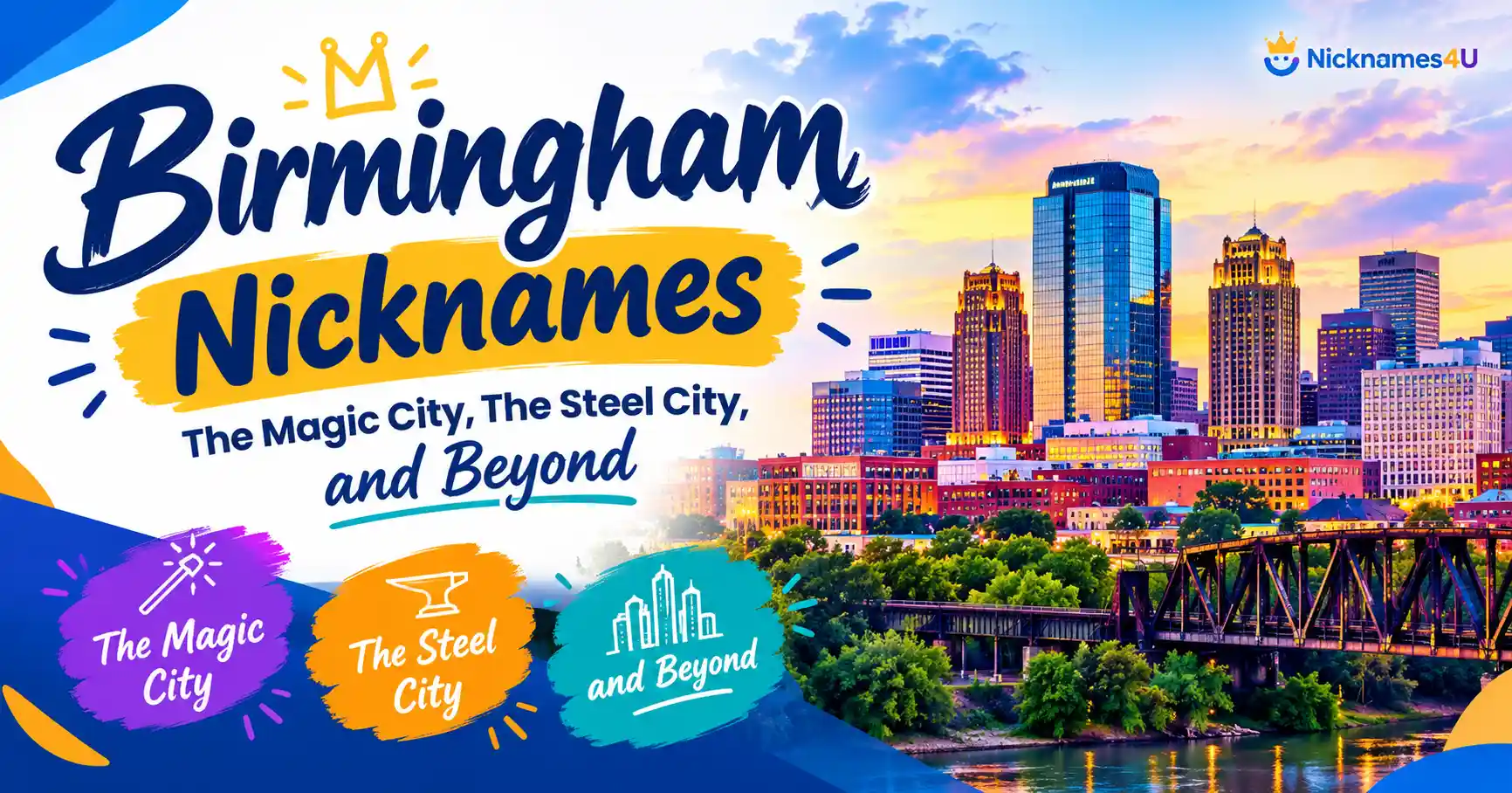
Birmingham, Alabama, stands as a testament to American resilience and reinvention. From its explosive industrial origins to its vibrant cultural present, this Southern metropolis has earned a fascinating collection of monikers that tell its story. Understanding Birmingham nicknames reveals not just what the city is called, but why those names matter.
These Birmingham nicknames capture the essence of a city that rose from a cornfield to become an industrial powerhouse, then transformed into a modern cultural and medical hub. Each nickname represents a chapter in the city’s remarkable journey.
⚡ Quick Answer Box
🏙️ What Is Birmingham’s Most Famous Nickname?
“The Magic City” is Birmingham’s most famous nickname, earned during its rapid late-19th-century growth when it seemed to appear overnight. Other prominent nicknames include “The Steel City” for its iron and steel industry, and “The Pittsburgh of the South” for its industrial parallels.
📊 Quick Facts Table
🏛️ Official Nickname of Birmingham
Birmingham does not have an officially designated nickname by city ordinance or government proclamation. However, “The Magic City” has served as the city’s de facto official nickname for over a century. It appears on city promotional materials, business names, and cultural references throughout the region.
The nickname is considered historical and commonly recognized rather than legally official. Local organizations, businesses, and residents embrace “The Magic City” as the primary identifier, while “The Steel City” remains historically significant.
📝 What Are the Nicknames of Birmingham?
Birmingham’s nicknames reflect its dramatic history, industrial heritage, and cultural evolution. The city has accumulated numerous monikers over its nearly 150-year existence, each capturing a different facet of its identity.
Industrial & Growth Nicknames
These nicknames emerged during Birmingham’s explosive late-19th and early-20th century development:
- The Magic City – Referenced its seemingly magical overnight growth
- The Steel City – Highlighted its iron and steel production dominance
- The Pittsburgh of the South – Drew parallels to Pennsylvania’s industrial giant
- The Industrial City – Emphasized its manufacturing foundation
Cultural & Modern Nicknames
These reflect Birmingham’s contemporary identity:
- The Ham – Affectionate local shorthand
- B’ham – Common abbreviated form
- The City of a Thousand Smokestacks – Historical reference to industrial era
- The Diverse City – Acknowledges its rich cultural makeup
📋 Complete List of Birmingham Nicknames
⭐ Most Popular Nicknames of Birmingham
The most recognized Birmingham nicknames are “The Magic City” and “The Steel City.” These two monikers dominate local and national references, appearing in news articles, business names, and cultural discussions about the city.
“The Magic City” resonates because it captures Birmingham’s extraordinary origin story—a city that literally rose from a crossroads in a cornfield to become Alabama’s largest metropolis within decades. “The Steel City” honors the industrial backbone that built Birmingham’s early fortune.
🔍 Main Nicknames Explained
The Magic City
Meaning: A city that experienced such rapid, dramatic growth that it seemed to appear by magic.
Short Origin Story: In the 1870s and 1880s, Birmingham transformed from a rural railroad crossing into a bustling industrial city almost overnight. Observers marveled at how quickly the city materialized, comparing its growth to a magical phenomenon.
Historical Background: The term gained popularity during the 1880s when Birmingham’s population exploded due to the discovery of iron ore, coal, and limestone—the three essential ingredients for steel production—all found within proximity.
Modern Usage: “The Magic City” remains Birmingham’s primary nickname. It appears in the city’s official branding, business names like Magic City Classic (a major HBCU football game), and countless local references.
Cultural Impact: The nickname symbolizes Birmingham’s resilience and ability to reinvent itself, from industrial powerhouse to modern medical and cultural center.
Interesting Fact: The Magic City Classic, held annually in Birmingham, is one of the largest HBCU football games in the nation, drawing over 60,000 fans.
The Steel City
Meaning: A city defined by its iron and steel production.
Short Origin Story: Birmingham’s abundant natural resources—iron ore, coal, and limestone—made it a natural center for steel production. By the early 1900s, the city rivaled Pittsburgh in output.
Historical Background: The Tennessee Coal, Iron and Railroad Company (TCI) and later U.S. Steel dominated Birmingham’s industrial landscape, employing thousands and shaping the city’s economy for generations.
Modern Usage: While heavy industry has declined, “The Steel City” still appears in historical contexts and civic pride references. The Vulcan statue, a 56-foot iron figure overlooking the city, stands as a permanent tribute to this heritage.
Cultural Impact: The nickname represents the hardworking spirit of Birmingham’s residents and the city’s foundational role in American industry.
Interesting Fact: Birmingham’s Vulcan statue is the largest cast-iron statue in the world and was originally created for the 1904 St. Louis World’s Fair.
The Pittsburgh of the South
Meaning: A Southern city that mirrors Pittsburgh’s industrial might and economic role.
Short Origin Story: As Birmingham’s steel industry grew in the early 20th century, journalists and industrialists began comparing it to Pittsburgh, Pennsylvania—America’s steel capital.
Historical Background: The comparison was both complimentary and strategic, positioning Birmingham as the South’s answer to Northern industrial power.
Modern Usage: The nickname is less common today but still appears in historical discussions and comparisons of American industrial cities.
Cultural Impact: It acknowledged Birmingham’s national significance while highlighting regional pride in Southern industrial achievement.
Interesting Fact: At its peak, Birmingham’s steel production was so significant that the city was considered essential to national defense during both World Wars.
The Ham
Meaning: A casual, affectionate abbreviation of Birmingham.
Short Origin Story: This nickname evolved naturally from local speech patterns, shortening the city’s name in everyday conversation.
Historical Background: Informal abbreviations have long been part of Southern vernacular, and “The Ham” fits this tradition.
Modern Usage: Popular among younger residents and in social media, “The Ham” conveys local pride with a casual, friendly tone.
Cultural Impact: It represents the modern, relaxed identity of Birmingham’s growing creative and tech communities.
Interesting Fact: Local businesses and events increasingly use “The Ham” in branding to appeal to younger demographics.
🏆 Which Nickname Is Most Famous?
“The Magic City” is Birmingham’s most famous nickname by a significant margin. Its popularity stems from several factors:
- Historical Accuracy: It perfectly describes Birmingham’s actual origin story
- Positive Connotation: “Magic” suggests wonder, possibility, and transformation
- Versatility: It works in formal and casual contexts
- Civic Adoption: The city and its institutions have embraced it for over a century
While “The Steel City” remains important, “The Magic City” captures something more enduring—the spirit of a place that defied expectations and continues to reinvent itself.
📖 How Birmingham Got Its Nicknames
Birmingham’s nicknames emerged from its unique historical circumstances. The city was founded in 1871 at the intersection of two railroad lines, in an area rich with the natural resources needed for steel production.
When industrialists realized the potential of the region’s iron ore, coal, and limestone deposits, Birmingham experienced explosive growth. The city’s population grew from fewer than 4,000 in 1880 to over 130,000 by 1910—one of the fastest growth rates in American history.
This rapid transformation earned the “Magic City” moniker, while the industrial foundation created “The Steel City” and “The Pittsburgh of the South.” Later, local affection produced “The Ham,” and cultural evolution added “The Diverse City.”
🗂️ Other Nicknames at a Glance
- Bombingham – A painful historical reference to civil rights era bombings
- The Birmingham of the North – Rarely used, referenced English Birmingham connections
- City of the Hills – References the city’s location in the foothills of the Appalachians
- The Magic Metro – Occasional modern variation
- Steel Magnolia – Poetic combination of industrial and Southern identity
- The Iron City – Alternative to “The Steel City”
- The Vulcan City – Reference to the iconic Vulcan statue
- The Civil Rights City – Acknowledges Birmingham’s pivotal role in the movement
- The Medical City – Highlights modern healthcare and research prominence
- The Food City – Recognizes the acclaimed culinary scene
🎉 Fun Facts About Birmingham
- Vulcan’s Legacy: The Vulcan statue, completed in 1904, is the world’s largest cast-iron statue at 56 feet tall.
- Musical Heritage: Birmingham produced legendary musicians including Sun Ra, Lionel Richie, and the jazz great Erskine Hawkins.
- Civil Rights History: The 1963 Birmingham Campaign, led by Dr. Martin Luther King Jr., was pivotal to the Civil Rights Movement.
- Medical Innovation: UAB (University of Alabama at Birmingham) is one of the nation’s leading medical research institutions.
- Food Scene Fame: Birmingham’s restaurant scene has earned national acclaim, with James Beard Award-winning chefs and famous hot dog spots like Sneaky Pete’s.
- Red Mountain: The iron ore in Red Mountain literally colored the earth red, giving the landmark its name.
- Sloss Furnaces: This historic blast furnace is now a National Historic Landmark and popular concert venue.
- Literary Connection: Birmingham native Harper Lee wrote “To Kill a Mockingbird,” a Pulitzer Prize-winning novel.
- Birmingham Bowl: The city hosts annual college football bowl games at Legion Field and Protective Stadium.
- Green Spaces: Despite its industrial past, Birmingham boasts over 100 parks and the extensive Ruffner Mountain Nature Preserve.
🎯 Famous Attractions in Birmingham
Birmingham offers visitors a rich mix of historical, cultural, and recreational attractions:
- Vulcan Park and Museum – Home to the iconic Vulcan statue with panoramic city views
- Birmingham Civil Rights Institute – A powerful museum documenting the struggle for equality
- 16th Street Baptist Church – A National Historic Landmark and civil rights memorial site
- Sloss Furnaces National Historic Landmark – Preserved industrial site and event venue
- Birmingham Museum of Art – Features an impressive collection including Asian and European works
- McWane Science Center – Interactive science museum popular with families
- Barber Vintage Motorsports Museum – World’s largest motorcycle museum
- Birmingham Botanical Gardens – 67 acres of stunning gardens and greenhouses
- Regions Field – Home of the Birmingham Barons minor league baseball team
- Five Points South – Historic entertainment district with restaurants and nightlife
⚖️ Nickname Comparison
🏙️ Birmingham vs. Chicago: City Nickname Showdown
Both cities earned their nicknames during periods of explosive growth, but the meanings differ significantly. Chicago’s “Windy City” originally referred to boastful politicians rather than weather, while Birmingham’s “Magic City” celebrated genuine rapid development.
🔗 Related Cities and Their Nicknames
🌬️ Chicago Nicknames
The Windy City, Second City, and the stories behind them.
🗽 New York City Nicknames
The Big Apple, Gotham, and the city that never sleeps.
🎸 Nashville Nicknames
Music City, Athens of the South, and more.
🍑 Atlanta Nicknames
The ATL, Hotlanta, and the Empire City of the South.
🎺 New Orleans Nicknames
The Big Easy, Crescent City, and NOLA.
❓ Frequently Asked Questions
What is the official nickname of Birmingham?
Birmingham does not have an officially designated nickname by law. However, “The Magic City” functions as the de facto official nickname, appearing in civic branding and widely recognized by residents and visitors alike.
Why is Birmingham called “The Magic City”?
Birmingham earned “The Magic City” nickname because of its extraordinarily rapid growth in the late 1800s. The city transformed from a small railroad crossing to a major industrial center in just a few decades, making its development seem almost magical to contemporary observers.
Who gave Birmingham its nickname?
The “Magic City” nickname emerged organically from journalists and visitors who witnessed Birmingham’s explosive growth in the 1880s. No single person is credited with coining the term, but it was popularized through newspaper coverage of the city’s development.
When did Birmingham’s nicknames become popular?
“The Magic City” gained widespread use during the 1880s and 1890s as Birmingham’s population and industry exploded. “The Steel City” became prominent in the early 1900s as the city’s steel production reached its peak. “The Ham” emerged more recently as a casual local shorthand.
Do locals actually use these nicknames?
Yes, locals commonly use “The Magic City” in formal contexts and “The Ham” in casual conversation. “B’ham” is also widely used in text and social media. “The Steel City” is more often used historically or in reference to the city’s heritage.
🎬 Conclusion
Birmingham nicknames are more than colorful labels—they trace the city’s leap from a railroad crossroads to an industrial giant and a modern Southern hub. From “The Magic City” to “The Steel City,” each name reflects a different chapter of that transformation. For a deeper, historically grounded look at the city’s rise, see the Encyclopedia of Alabama’s authoritative history of Birmingham.
Whether you call it The Magic City, The Steel City, or simply The Ham, Birmingham nicknames remain a powerful shorthand for a place that has continually reinvented itself.