
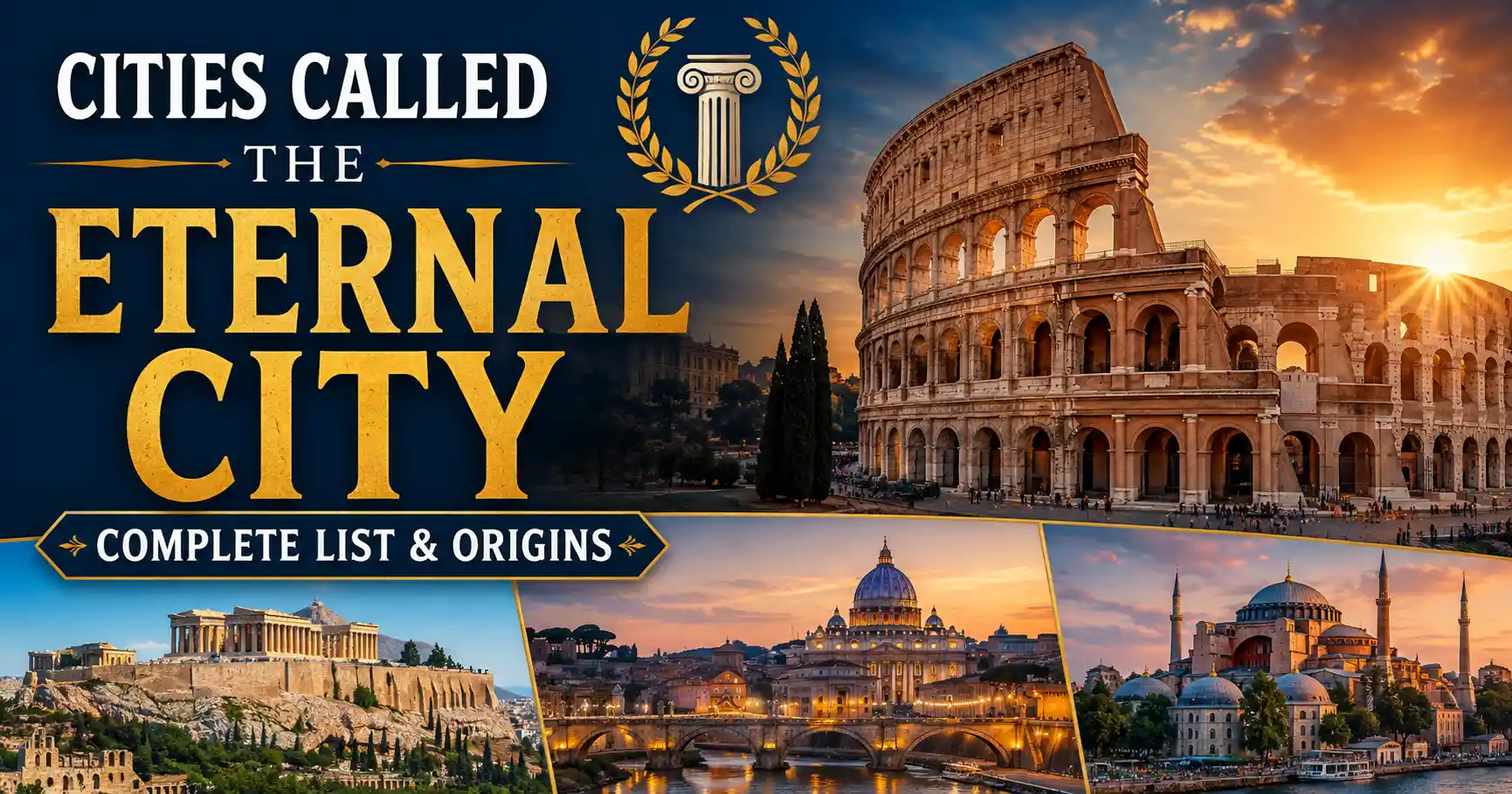
For centuries, “the Eternal City” has evoked an image of a place that defies time—immortal, unshaken, forever at the center of a culture or faith. The phrase is overwhelmingly tied to one capital, but a handful of other ancient settlements have also been described as eternal in spiritual, literary, or tourism contexts. This article separates the legendary nickname from the poetic metaphor, examining why multiple cities have laid claim to timelessness, and which truly own the title.
⭐ Quick Answer Box
The nickname “Eternal City” is famously used by Rome, Italy. A few other cities—most notably Jerusalem (Israel) and Varanasi (India)—are occasionally called eternal cities because of their profound religious significance and antiquity, but none share the title as broadly, officially, or historically as Rome.
📊 Quick Facts Table
What Does “Eternal City” Mean?
The concept rests on the idea that certain places are so central to civilization, faith, or empire that they are perceived as existing beyond the normal passage of centuries. In Latin, Urbs Aeterna literally means “the Eternal City,” and it was first applied to Rome by poets who saw the city as the unending capital of the world. Over time the phrase broadened, and different cultures have attached it to cities they consider spiritually indestructible—though, historically, the original and most authoritative bearer is Rome.
Why Do So Few Cities Share This Nickname?
Unlike descriptive titles such as “Queen City” or “River City,” which are used by many places due to geography, royalty, or trade, “Eternal City” is unusually restrictive. It requires a combination of extreme age, uninterrupted prominence, and a deeply ingrained cultural belief that the city will never fall. For Rome, that belief was grounded in imperial ideology. For Jerusalem and Varanasi, it grew from millennia of religious centrality. The nickname rarely appears on municipal seals or official documents outside Rome; elsewhere it lives mainly in travel writing, sacred texts, and branding.
🌍 Cities That Use This Nickname
Rome: The Original Eternal City
Rome’s claim to eternity is embedded in the Latin language itself. The phrase Urbs Aeterna appears in the elegies of Albius Tibullus (c. 55–19 BCE), and was later repeated by Ovid, Livy, and other classical writers who believed the Roman state would never end. The epithet was not merely poetic—it was a political statement. As the capital of an empire that spanned three continents, Rome was deliberately mythologized as the fixed center of the world. Coins struck under Hadrian in the 2nd century CE bore the legend ROMA AETERNA, cementing the nickname in everyday consciousness.
Today, the city of Rome’s tourism board, Roma Capitale, and virtually all official promotional materials use “the Eternal City” as the default descriptor. It is not a casual slogan; it is the city’s deepest identity. Tourists encounter the phrase on everything from airport banners to museum tickets, and it remains the most universally recognized city nickname on Earth.
Jerusalem: The Spiritual Eternal City
Jerusalem’s association with eternity comes from faith, not empire. For Jews, the city is the site of the ancient Temple and the eternal capital promised in scripture. The phrase “eternal city” appears throughout Jewish and Christian devotional literature of the 19th and 20th centuries, often reflecting a longing for a heavenly Jerusalem. In contemporary discourse, Israeli leaders and Jewish organizations frequently refer to “Jerusalem, the eternal and undivided capital.” The Jewish Virtual Library has an entire section titled “Jerusalem: The Eternal City,” tracing the concept through the Hebrew Bible to modern politics.
While the municipality of Jerusalem does not officially nickname itself “the Eternal City” in the way Rome does, the phrase is deeply woven into Israeli national identity and is commonly used by pilgrims and religious tourists. It represents a city that, despite destruction and conquest, has never lost its sacred status.
Varanasi: The Timeless City on the Ganges
Varanasi (also known as Kashi or Banaras) is one of the oldest continuously inhabited urban centers in the world. Archaeological evidence suggests settlement dating back to at least 1800 BCE, and Hindu tradition holds that the city is the eternal abode of Lord Shiva. Mark Twain famously wrote that Varanasi is “older than history, older than tradition, older even than legend and looks twice as old as all of them put together.” That sentiment has been adopted by Indian tourism authorities, who often brand Varanasi as “the eternal city.”
The Incredible India campaign and Uttar Pradesh Tourism regularly describe Varanasi as a place where life and death merge on the ghats, reinforcing the idea of spiritual timelessness. Unlike Rome’s imperial eternity, Varanasi’s is mystical—a cycle of rebirth, prayer, and purification that Hindus believe has no beginning and no end. It is not an official municipal nickname, but it dominates how the city is presented to the world.
🗓 Historical Timeline
📊 Comparison Table: Rome vs Jerusalem vs Varanasi
Rome remains the city most strongly associated with the nickname “Eternal City” worldwide due to its direct Latin roots, uninterrupted use for over two millennia, and official institutional recognition.
🤔 Common Misconceptions
❓ Frequently Asked Questions
Which city is the original Eternal City?
Rome. The Latin phrase Urbs Aeterna was applied to Rome as early as the 1st century BCE by the poet Tibullus, making it the undisputed originator.
How many cities are called the Eternal City?
One city—Rome—holds the nickname officially. Two others, Jerusalem and Varanasi, are frequently referred to as eternal cities in religious, literary, or tourism contexts.
Is “Eternal City” an official nickname for Rome?
Yes. Rome’s city government and tourism authorities consistently use it as the city’s primary descriptor, and it appears on Roman coinage from antiquity to the present.
Why is Jerusalem called the Eternal City?
Because of its central role in the Hebrew Bible and later Jewish and Christian theology, Jerusalem has been spoken of as an eternal, divinely chosen city for centuries. It is not an official municipal designation, but a powerful religious and political metaphor.
Is Varanasi really called the Eternal City?
Indian tourism bodies and international travel publications often use “eternal city” to describe Varanasi due to its extreme antiquity and continuous spiritual importance. It is a popular nickname, not an official one.
Which city is the most famous Eternal City?
Rome, by a significant margin. Its version of the nickname is embedded in Western art, literature, politics, and education, making it the globally recognized “Eternal City.”
Does any American city call itself the Eternal City?
Towns named Rome exist in the United States (e.g., Rome, Georgia), but they do not officially claim the title “Eternal City.” Their nicknames typically reference the seven hills or local geography, not eternity.
🔗 Explore More
💕 City of Love (Paris)
Discover why Paris has been crowned the ultimate City of Love and romance.
Read more →⛪ America’s Holy City
Learn why Charleston, SC, is reverently called the Holy City, plus other sacred monikers.
Read more →Conclusion
The phrase “Eternal City” has traveled from a pagan poet’s quill to modern tourism billboards, yet it has never really multiplied. Rome remains the singular municipality where the nickname is not a metaphor but an identity. When Jerusalem and Varanasi borrow the language, they borrow something Rome never fully relinquished: the idea that a city can be the center of a world that has no end. For further reading, browse our guides on American city nicknames or the stories behind the world’s most famous place names.
Sources & References
- Encyclopaedia Britannica — “Rome”
https://www.britannica.com/place/Rome - Turismo Roma — Official Tourism Website of Rome
https://www.turismoroma.it/en - Jewish Virtual Library — “Jerusalem: The Eternal City”
https://www.jewishvirtuallibrary.org/jerusalem-the-eternal-city - Incredible India, Ministry of Tourism — “Varanasi”
https://www.incredibleindia.org/content/incredible-india-v2/en/destinations/varanasi.html