
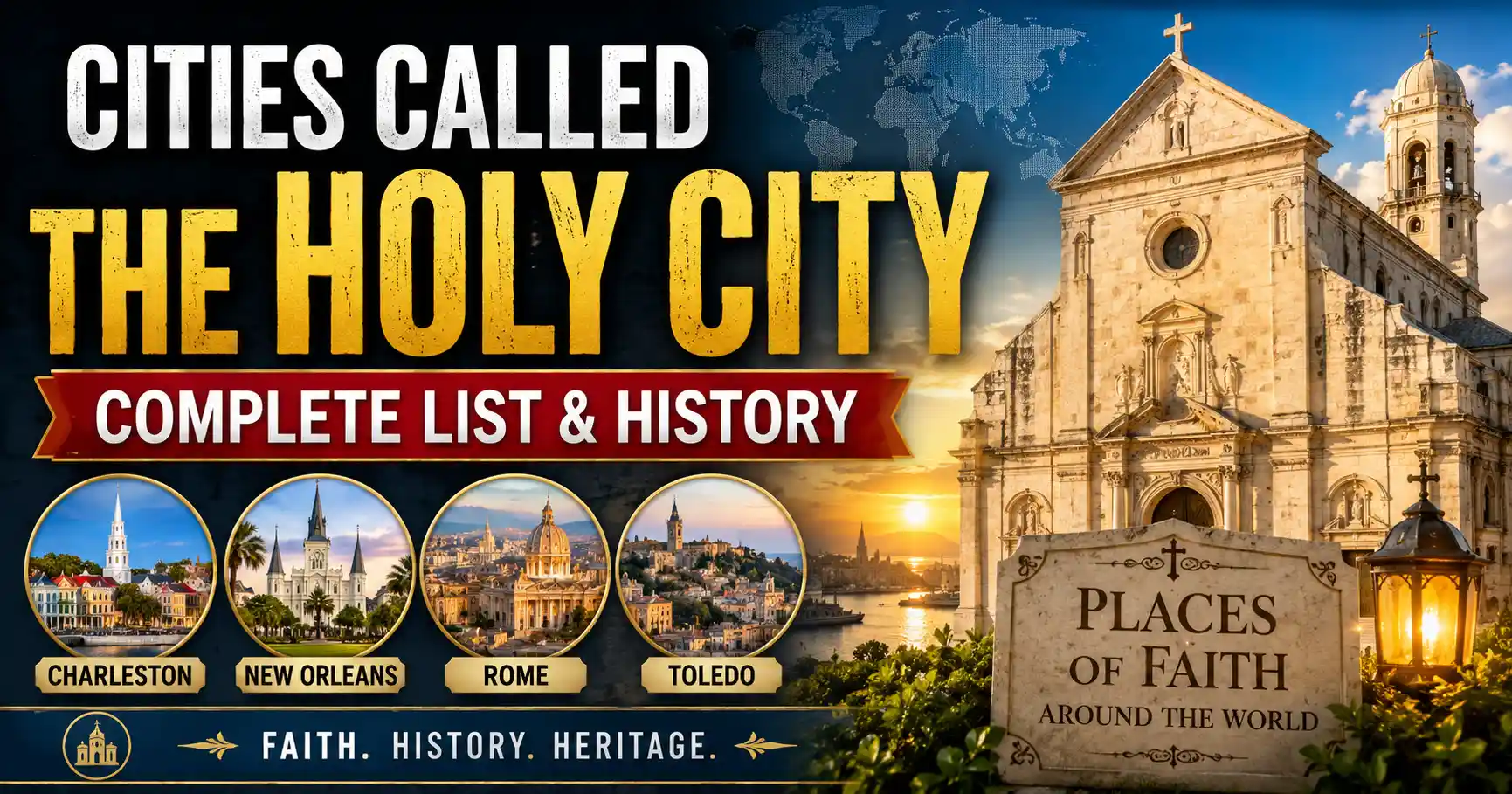
The phrase “Holy City” instantly stirs images of ancient stone streets, soaring spires, and timeless rituals. While many travelers immediately think of Charleston, South Carolina, the truth is more layered: a select group of cities across the globe share this reverent nickname. Each “Holy City” earned its title through a unique blend of spiritual importance, centuries of religious freedom, or a skyline dominated by places of worship.
In this guide, we explore every notable city called the Holy City, unpack the origins of the nickname, and examine why this designation carries so much weight.
Quick Answer: The nickname “Holy City” is most famously associated with Charleston, South Carolina, and Jerusalem. Charleston earned its moniker from a skyline filled with church steeples and a history of religious tolerance, while Jerusalem has been called the Holy City for millennia as a sacred center of Judaism, Christianity, and Islam. Other cities such as Mecca, Varanasi, and Vatican City are also widely referred to as holy cities.
📊 Quick Facts
What Does “Holy City” Mean?
The expression “Holy City” generally describes an urban center set apart by profound religious importance. For Jerusalem, the term appears in the Hebrew Bible (Nehemiah 11:1) and carries millennia of reverence in Jewish, Christian, and Islamic traditions. In a different context, Charleston’s version of the nickname emerged as an organic local description tied to its remarkable number of historic churches and its early reputation as a colony where people of various faiths could worship freely. While the spiritual weight behind each city differs, all places that carry this title reflect a powerful sense of sacred identity, whether rooted in scripture, architecture, or a culture of inclusion.
Why Do So Many Cities Share This Nickname?
Multiple cities can lay claim to the “Holy City” label because the reasons behind the nickname are rarely identical. Some destinations earned it through scriptural centrality — for example, Jerusalem is the setting for pivotal events in three major religions. Others, like Charleston, gained the title because their physical landscape became synonymous with religious architecture, prompting visitors to remark on the countless steeples. Still others, such as Mecca and Varanasi, have functioned as pilgrimage epicenters for centuries, making them irreplaceable holy sites in the eyes of billions. Tourism bureaus, local storytellers, and even poets have reinforced these nicknames, turning them into lasting civic identities.
🌍 Cities That Use the Holy City Nickname
Top Cities Explained
Charleston — The Holy City of the American South
Charleston’s identity as the Holy City is woven deeply into its streets and skyline. Long before the moniker became a tourism tagline, early residents and visitors marveled at the sheer density of churches rising above the low-rise city. The nickname didn’t originate from a single event, but rather from a centuries-long accumulation of religious architecture and a remarkably tolerant colonial charter.
The city’s Church Act of 1704, enacted during South Carolina’s proprietary period, granted freedom of worship to a broad range of Christian denominations — a rare legal framework for the time. This attracted French Huguenots, Scottish Presbyterians, Quakers, and Jews, each group building houses of worship whose steeples eventually came to define Charleston’s silhouette. By the 1820s and 1840s, travelers frequently noted the “holy” character of the city, and local newspapers began using the term. The Charleston Area Convention & Visitors Bureau officially embraces the nickname today, and welcome signs to the historic district declare “Welcome to the Holy City.”
Interesting fact: Even after the devastating earthquake of 1886 toppled many spires, the city rebuilt its churches in the same prominent style, preserving its skyline identity.
Jerusalem — The Original Holy City
Long before any American city earned the title, Jerusalem was called “the holy city” in sacred texts. The phrase appears in the Book of Nehemiah (11:1) and resonates across millennia of Jewish history. For Christians, Jerusalem is the site of Jesus’ crucifixion and resurrection. In Islamic tradition, it is the place of the Prophet Muhammad’s Night Journey to heaven. The city’s very name in Arabic, Al-Quds, literally means “The Holy.”
Unlike Charleston’s architectural nickname, Jerusalem’s status springs directly from its role as the geographical heart of three world religions. The Western Wall, the Church of the Holy Sepulchre, and the Dome of the Rock all stand within its ancient walls, making the “Holy City” label a lived, continuous reality rather than a 19th-century invention. While it is not an official municipal nickname in the modern administrative sense, it remains the most universally recognized Holy City on Earth.
Mecca — Islam’s Holiest City
In Islamic tradition, Mecca is known simply as “the Holy City” (al-Balad al-Amin). It is the birthplace of the Prophet Muhammad and the site of the Kaaba, the cube-shaped structure toward which all Muslims pray. Each year, millions perform the Hajj pilgrimage to Mecca, fulfilling one of the Five Pillars of Islam. Non-Muslims are not permitted to enter the city, a rule that has preserved its exclusive spiritual character for over 1,400 years. While the nickname “Holy City” is a translation of a revered Islamic epithet, its worldwide recognition makes it an essential part of any global list.
Varanasi — The Eternal Holy City of India
Hindus have called Varanasi the “holy city” for thousands of years. Also known as Kashi (“the luminous one”), it is believed to be the abode of Lord Shiva. Varanasi’s sacred geography along the Ganges River is central to Hindu beliefs about death and liberation. The city is also significant to Buddhists — Buddha gave his first sermon nearby at Sarnath — and to Jains. While “Holy City” is an English translation of its spiritual identity, the phrase appears across countless travelogues, scholarly works, and guidebooks, making it one of the world’s most frequently named holy cities.
Vatican City — The Holy See
Vatican City is both the world’s smallest sovereign state and the epicenter of the Roman Catholic Church. It functions as the Holy See, the ecclesiastical jurisdiction of the Pope, and is often referred to in official documents and media as the “Holy City” of Catholicism. Within its walls stand St. Peter’s Basilica, the Sistine Chapel, and the Apostolic Palace. While its role as a holy city is institutional rather than architectural, the city-state’s entire existence is defined by its sacred mission.
🗓 Historical Timeline
📊 Comparison: Charleston vs. Jerusalem
When asked which city is most strongly associated with the phrase, context matters. In the United States, Charleston is the undisputed Holy City. Globally, Jerusalem has carried the title for thousands of years and resonates across cultures and continents.
🤔 Common Misconceptions
❓ Frequently Asked Questions
Which city is the original Holy City? +
Jerusalem. The term appears in the Hebrew Bible and has been used continuously for over 2,500 years to describe the city’s unique spiritual status.
How many cities are called the Holy City? +
At least five internationally recognized cities are commonly referred to as the Holy City in English: Charleston, Jerusalem, Mecca, Varanasi, and Vatican City. Several others, including Medina, Amritsar, and Karbala, are also widely called holy cities in their respective traditions.
Is Holy City an official nickname? +
Yes, for Charleston it is an official and widely marketed municipal nickname. Vatican City uses the designation in an ecclesiastical sense as the Holy See. For Jerusalem, Mecca, and Varanasi, it is a popular and historical epithet rather than a formal municipal nickname.
Why do multiple cities share the same nickname? +
The reasons vary: some gained it through sacred texts and prophetic history, others through a physical concentration of religious buildings or a founding legacy of religious freedom. The common thread is that each city projects a strong identity tied to faith, architecture, or pilgrimage.
Which Holy City is the most famous in the United States? +
Charleston, South Carolina, is the only U.S. city that officially holds the nickname and has consistently embraced it for nearly two centuries.
Are there other holy cities besides the ones listed? +
Absolutely. Cities such as Medina, Karbala, Lhasa, and Amritsar all hold deep sacred significance and are often referred to as holy cities within their religious communities, even if the exact English phrase “Holy City” is not as consistently used.
🌍 Countries Where This Nickname Is Used
The “Holy City” designation crosses continents and cultures. In the United States, it is synonymous with Charleston and the American South’s spiritual architectural heritage. In the Middle East, Jerusalem and Mecca dominate as the spiritual anchors of the Abrahamic faiths. India’s Varanasi represents the ancient Hindu and Buddhist holy city tradition, while the microstate of Vatican City serves as the institutional holy city for over a billion Catholics worldwide. Though the origins of the nickname differ dramatically — from biblical poetry to colonial charters — each place demonstrates how geography and belief intertwine to create a city the world calls holy.
⭐ Fun Facts
- Charleston’s skyline protection: The city’s strict zoning laws prevent tall buildings in the historic district, ensuring that church steeples still tower over the peninsula much as they did in the 1800s.
- Jerusalem’s tiny Old City: The 0.35-square-mile walled area contains over 220 historic monuments, including the Dome of the Rock, the Western Wall, and the Church of the Holy Sepulchre.
- Mecca’s restriction: Non-Muslims have been prohibited from entering Mecca for centuries, a rare modern example of a city whose sacred borders are legally enforced.
- Varanasi’s antiquity: Mark Twain once wrote that Varanasi is “older than history, older than tradition, older even than legend,” reflecting its continuous habitation for over 3,000 years.
- Vatican City’s uniqueness: It is the only entire country designated as a UNESCO World Heritage site, and its economy is fully supported by donations and tourism related to its holy status.
🔗 Explore More
Cities Called the Queen City
Discover why Cincinnati, Charlotte, and Buffalo all claim the crown.
Read More →Cities Called the Emerald City
Seattle isn’t the only one — learn about other Emerald Cities worldwide.
Read More →Cities Called the Steel City
Pittsburgh, Jamshedpur, and others share a metallic industrial heritage.
Read More →Conclusion
From the cobblestone alleys of Charleston to the ancient walls of Jerusalem, the nickname “Holy City” carries a weight that few civic monikers can match. It reflects not merely a cluster of religious buildings but a profound identity shaped by faith, history, and human belief.
Whether you’re standing before a white steeple in South Carolina or facing the Western Wall at dusk, you’re experiencing a city that generations have called holy. To continue uncovering the stories behind famous city nicknames, explore our guides on the Queen City, the River City, and the Emerald City — each with their own surprising heritage.
For deeper dives, read about Charleston’s other nicknames, the full story behind why Jerusalem is sacred to three religions, or the complete USA city nickname index.
Sources & References
- Charleston Area Convention & Visitors Bureau — “Why Charleston Is Called the Holy City”
https://www.charlestoncvb.com/blog/why-is-charleston-called-the-holy-city/ - Encyclopaedia Britannica — “Jerusalem”
https://www.britannica.com/place/Jerusalem - Encyclopaedia Britannica — “Mecca”
https://www.britannica.com/place/Mecca - Encyclopaedia Britannica — “Varanasi”
https://www.britannica.com/place/Varanasi - Vatican City State — “Vatican City State”
https://www.vaticanstate.va/