
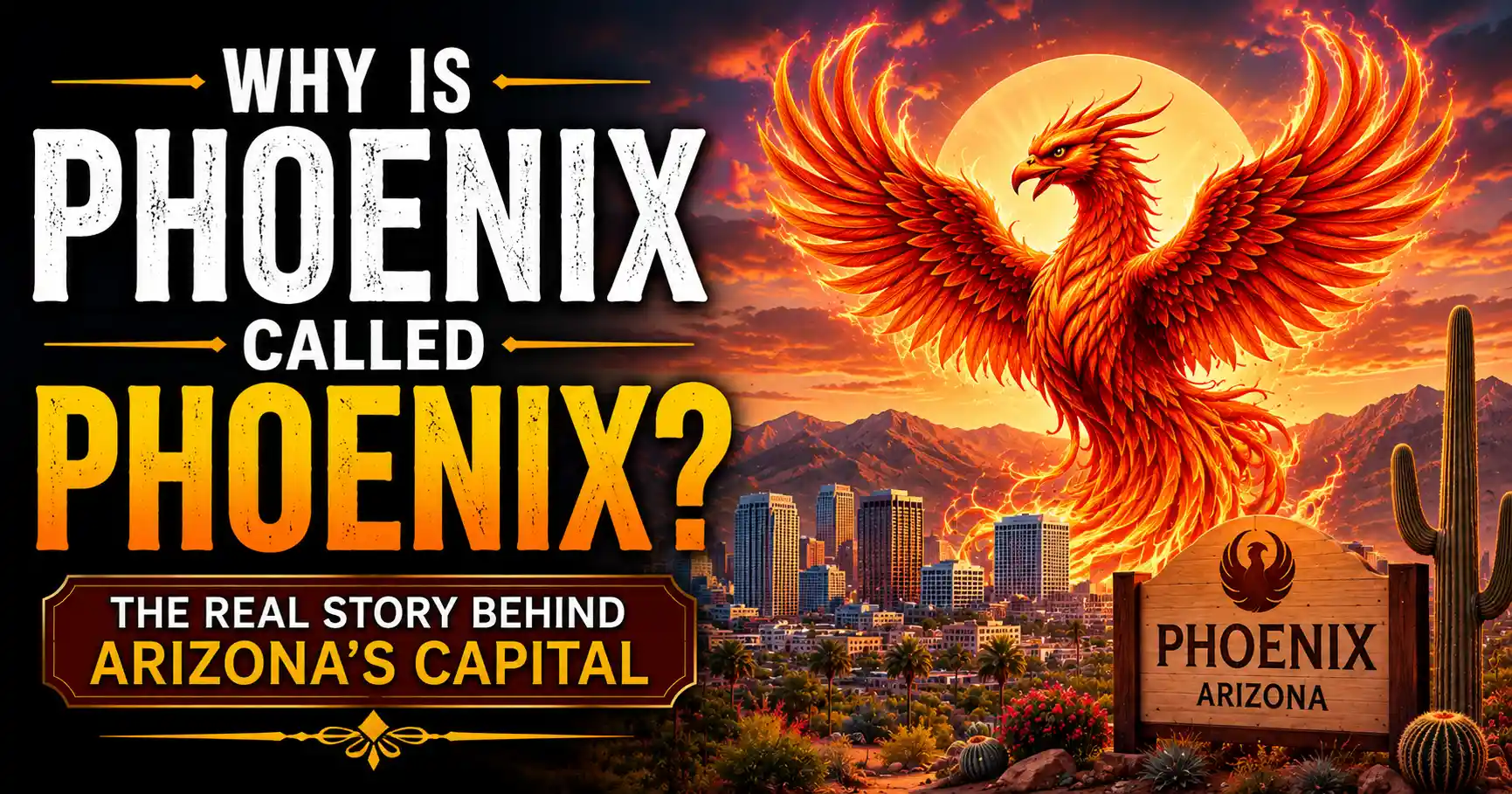
Imagine walking through a dry desert valley and finding the ruins of an ancient city. The people who lived there are long gone. Their stone canals still cut across the land. Then imagine deciding to build a brand-new town right on top of those old ruins.
What would you call that new town?
That is exactly the situation early settlers faced in Arizona’s Salt River Valley in the late 1860s. They discovered the remains of a forgotten civilization called the Hohokam. These ancient people had built hundreds of miles of irrigation canals. Then they vanished centuries ago.
When the new settlers rebuilt those canals and started a fresh community, they needed a name. One man suggested a name that told the whole story perfectly: Phoenix.
Today, Phoenix is the fifth-largest city in the United States. It is also the only state capital with more than one million residents. But the story behind why is Phoenix called Phoenix starts with ancient ruins and a mythical fire bird.
Short Answer
Phoenix, Arizona, got its name in 1868 from early settler “Lord” Darrell Duppa. He suggested the name because the new town was rising on the ruins of the ancient Hohokam civilization. It matched the myth of the phoenix bird, which rises from its own ashes.
Quick Facts Table
| Fact | Details |
|---|---|
| City | Phoenix |
| State/Country | Arizona, United States |
| City Name Meaning | A mythical bird that rises from ashes |
| Named By | “Lord” Darrell Duppa |
| Year Named | 1868 |
| Named After | Ruins of the ancient Hohokam civilization |
| First Incorporated | February 25, 1881 |
| Known For | Desert climate, golf, spring training, fifth-largest U.S. city |
What Does “Phoenix” Mean?
The word “phoenix” comes from Greek mythology. It refers to a special bird that lives for hundreds of years. When the bird grows old, it builds a nest. The nest catches fire. The bird burns up completely. Then a new, young phoenix rises from the ashes.
Ancient Egyptians told a similar story about a bird called the Bennu. The Bennu was a heron-like bird connected to the sun god Ra. It also stood for rebirth and renewal.
So the word “phoenix” means rebirth, renewal, and rising from destruction. That is a powerful meaning for a city name. And it fits Phoenix, Arizona perfectly.
According to Encyclopaedia Britannica, the phoenix myth appears in both Greek and Egyptian traditions. Each version shares the same core idea: something new rises from something destroyed.
Why Is Phoenix Called “Phoenix”?
The story starts long before the city existed. For more than 1,000 years, a Native American civilization called the Hohokam lived in the Salt River Valley. They were incredible engineers. They built more than 500 miles of irrigation canals to carry river water to their crops. They grew corn, beans, squash, and cotton in the desert.
By around 1450, the Hohokam were gone. Historians and archaeologists still debate why they left. Leading theories include a long drought, severe flooding, and social changes within the civilization. According to the National Park Service, the Hohokam may not have “disappeared” all at once. They may have gradually migrated to other areas over time.
What they left behind were their canals. The desert slowly covered them with dirt. But the outlines remained.
Fast forward to 1867. A former Confederate soldier named Jack Swilling arrived in the Salt River Valley. He saw the old canal beds and immediately understood their purpose. The land was rich. With water, it could support farms again. Swilling started the Swilling Irrigation and Canal Company. Workers cleaned out the ancient Hohokam canals and brought water back to the fields.
A small settlement grew around the canal work. Settlers built homes and planted crops. By 1868, the town needed a name.
Several names came up. Some settlers wanted to call the town “Stonewall” after Confederate General Stonewall Jackson. Others suggested “Salina” because of the salt in the nearby river. There was even a joke name floating around: “Pumpkinville.” Wild pumpkins reportedly grew near the canal.
Then Darrell Duppa spoke up. Duppa was an Englishman with a classical education. People called him “Lord” Duppa because of his refined manners. He knew the Greek myth of the phoenix bird. He looked at the ancient Hohokam ruins and the new town rising beside them. He suggested the name “Phoenix.”
According to the City of Phoenix’s official history, Duppa said the new city would “rise phoenix-like upon the ruins of a former civilization.” The name stuck.
Origin of the Name
Phoenix is a little different from other city nicknames. It is not a nickname at all. It is the official city name. But the story behind why Phoenix is called Phoenix is what makes it special.
Early records from the Arizona Territory show the name “Phoenix” was in use by 1868. The first post office in the settlement opened on May 4, 1868, under the name Phoenix. This is the earliest documented official use of the name.
Historians have not found a formal written record of the exact moment Duppa suggested the name. The story comes from oral histories and later recollections by early settlers. Multiple historical accounts agree that Duppa proposed the name. But the exact details of that meeting are not preserved in official documents.
This is common with frontier settlements. People were busy building homes and digging canals. They did not always keep detailed meeting minutes.
Who Coined the Name?
Most historians credit “Lord” Darrell Duppa with naming Phoenix.
Duppa was born in England in 1832. His full name was Phillip Darrell Duppa. He came to the American West in the 1850s and eventually settled in Arizona Territory.
People called him “Lord” Duppa, but he was not actually a lord. He earned the nickname because of his aristocratic manners and educated background. He could read Greek and Latin. This classical education meant he knew the myth of the phoenix bird.
According to the Arizona Historical Society, Duppa was one of the original settlers who helped establish the town. When the community needed a name, he drew on his knowledge of mythology. His suggestion of “Phoenix” perfectly described what was happening: a new civilization rising from the ruins of an old one.
It is worth noting that Jack Swilling is sometimes called the “Father of Phoenix.” He founded the settlement and built the first modern canal. But he did not name the city. Duppa did.
History Behind the Name
To really understand why Phoenix is called Phoenix, you need to know more about the Hohokam.
The Hohokam lived in the Salt River Valley from about 300 to 1450 CE. They were one of the most advanced irrigation societies in North America. Their canal system stretched for more than 500 miles. Some canals were up to 30 feet wide and 10 feet deep. These canals carried water from the Salt River to farms across the valley.
The Hohokam also built platform mounds, ball courts, and large villages. At their peak, they supported a population that may have reached 40,000 people. That made them one of the largest civilizations in the ancient Southwest.
Then something changed. By around 1450, the major Hohokam settlements were abandoned. Archaeologists and historians still debate what happened. The leading theories include:
- A long drought that made farming impossible
- Severe flooding that damaged the canals
- Social or political problems within the civilization
- A combination of these factors
The National Park Service notes that the Hohokam may have gradually migrated to other areas rather than disappearing suddenly. Their descendants may include the O’odham people who still live in Arizona today.
When Jack Swilling arrived in 1867, he found the old canal beds. He recognized their purpose immediately. The Hohokam had already solved the problem of farming the desert. Swilling simply rebuilt their system.
This is the key to the name Phoenix. The new town was not built in an empty desert. It was built on the foundation of an ancient civilization that had vanished. The new settlers were literally rising from the ruins of the Hohokam.
Duppa saw the poetry in this situation. The mythical phoenix bird dies and is reborn from its own ashes. The new town was being reborn from the ashes of the Hohokam civilization.
Timeline
| Year | Event |
|---|---|
| c. 300 CE | Hohokam people begin living in the Salt River Valley |
| c. 1450 CE | Hohokam civilization abandons the area, leaving canals behind |
| 1867 | Jack Swilling arrives and starts rebuilding the ancient canals |
| 1868 | Settlement is named “Phoenix” by Darrell Duppa |
| May 4, 1868 | First post office opens under the name Phoenix |
| February 25, 1881 | Phoenix is officially incorporated as a city |
| 1889 | Phoenix becomes the capital of Arizona Territory |
| February 14, 1912 | Phoenix becomes the state capital when Arizona joins the Union |
How the Name Became Popular
The name Phoenix did not need much help becoming popular. It was the official name of the town from the start. Every map, letter, and document used it.
But the name did help the city grow. Early promoters used the phoenix imagery to attract new residents. They told people about a city rising from ancient ruins. It was a compelling story. It made Phoenix sound like a place of destiny.
As the city grew, the phoenix bird became its official symbol. The city seal features a phoenix rising from flames. This image appears on official documents, city buildings, and government materials.
Sports teams also embraced the name. The Phoenix Suns play in the NBA. The Phoenix Mercury play in the WNBA. Both teams carry the city name into national and international conversations every season.
Local businesses also use the name constantly. You can find Phoenix Realty, Phoenix Printing, Phoenix Plumbing, and hundreds of other companies with the city name. The name has become a brand.
If you want to explore other famous city nicknames across the United States, check out our complete guide to Famous City Nicknames.
Myths vs Facts
| Myth | Reality |
|---|---|
| Jack Swilling named Phoenix | Swilling founded the settlement, but Darrell Duppa suggested the name |
| The Hohokam disappeared instantly due to one disaster | Scholars debate the cause. Drought, floods, and social factors all likely played a role |
| Phoenix was always the planned name | Several other names were suggested, including Stonewall and Salina |
| “Lord” Duppa was actual British nobility | He earned the nickname for his refined manners, not a real title |
| The city was named after a real bird | The name comes from the mythical phoenix bird, not a real species |
Is the Name Still Used Today?
Yes. Absolutely. Phoenix is more than just the official city name. It is a brand, a symbol, and a source of local pride.
Locals use the name constantly. They say “I live in Phoenix” without thinking twice. The name appears on government buildings, police cars, public works, and every official document.
Tourism marketers lean into the mythology. Visit Phoenix, the city’s official tourism organization, uses the phoenix bird imagery to promote the city as a place of renewal and transformation.
The city’s official seal shows a phoenix rising from flames. This seal is used on official documents and city communications. It is a daily reminder of the story behind the name.
To learn more about Phoenix’s other nicknames and local identity, visit our Phoenix Nicknames page.
Cultural Impact
The name Phoenix has shaped the city’s identity in many ways.
The phoenix bird appears in public art, murals, and sculptures throughout the city. It has become a visual shorthand for the city itself. When people see a rising bird in flames, they think of Phoenix.
The idea of rising from ashes resonates deeply with residents. Phoenix has faced economic booms and busts. After the 2008 housing crash hit the city hard, local media and civic leaders often used phoenix imagery to talk about recovery. The name became a source of hope.
Music and pop culture have embraced the name too. Countless songs mention Phoenix. The city has appeared as a setting in movies and TV shows, from the classic film “Psycho” to the comedy “Raising Arizona.”
The name also influences how the city thinks about itself. Phoenix is a young city in historical terms. It grew rapidly in the 20th century. The phoenix story reinforces a sense that Phoenix is a city that can overcome anything.
If you are curious about other Arizona city nicknames, explore our full guide to Arizona City Nicknames.
Interesting Facts
- Phoenix is the only state capital in the United States with more than one million residents.
- The city seal of Phoenix features a phoenix bird rising from a nest of flames.
- The Hohokam canal system was so well built that some of the original canals still form the basis of the modern irrigation system managed by the Salt River Project.
- Phoenix is the fifth-most-populous city in the United States, behind only New York, Los Angeles, Chicago, and Houston.
- The first recorded use of the name “Phoenix” was when the first post office opened on May 4, 1868.
- Phoenix is one of the hottest major cities in the United States. Summer temperatures often exceed 110°F.
- The mythical phoenix appears in both Greek and Egyptian mythology. The Egyptian version was called the Bennu bird.
- “Lord” Darrell Duppa also helped settle the nearby town of Tempe. Local tradition says he suggested the name Tempe after the Vale of Tempe in Greece.
- Jack Swilling, the founder of Phoenix, died in 1878 while under investigation for crimes he likely did not commit. He never saw the city grow into a major metropolis.
- Phoenix became the capital of Arizona Territory in 1889, replacing Prescott. It has remained the capital ever since.
Other Nicknames of Phoenix
Phoenix has a few other nicknames worth knowing. The most popular one is “The Valley of the Sun.” That is because the city sits in the Salt River Valley and gets more than 300 sunny days per year.
Some people simply call it “The Valley.” Locals use this term all the time. When someone says they live in “The Valley,” they usually mean the Phoenix metropolitan area.
These nicknames are interesting, but they do not have the same depth of story as the name Phoenix itself.
Related City Nicknames
Comparison: Phoenix vs. Los Angeles
Phoenix vs. Los Angeles: Two Cities, Two Stories
| Aspect | Phoenix | Los Angeles |
|---|---|---|
| Name Origin | Greek mythology | Spanish religious phrase |
| Meaning | Mythical bird that rises from ashes | “The City of Angels” |
| Named By | “Lord” Darrell Duppa, an English settler | Spanish missionaries |
| Year Named | 1868 | 1781 |
| Story | A new city rising from ancient Hohokam ruins | A religious mission named for the Virgin Mary |
Frequently Asked Questions
Frequently Asked Questions
Why is Phoenix called Phoenix?
Phoenix is called Phoenix because early settler Darrell Duppa suggested the name in 1868. The new town was rising on the ruins of the ancient Hohokam civilization. This reminded Duppa of the mythical phoenix bird, which rises from its own ashes.
Who named Phoenix, Arizona?
“Lord” Darrell Duppa named Phoenix. He was an English-born settler with a classical education. People called him “Lord” because of his refined manners. He suggested the name at a community meeting around 1868.
What does the word “phoenix” mean?
The word “phoenix” comes from Greek mythology. It refers to a magical bird that lives for hundreds of years, burns up in a nest of fire, and is reborn from the ashes. The word symbolizes rebirth, renewal, and rising from destruction.
When did Phoenix get its name?
Phoenix got its name around 1868. The first documented official use of the name was when the first post office opened on May 4, 1868, under the name Phoenix.
Is Phoenix named after the mythical bird?
Yes. The city is named after the mythical phoenix bird. Darrell Duppa chose the name because the new town was rising from the ruins of an ancient Hohokam civilization, just like the mythical bird rises from ashes.
What was Phoenix almost called?
Several other names were suggested before Phoenix. Some settlers wanted to call the town “Stonewall” after Confederate General Stonewall Jackson. Others suggested “Salina” because of the salt in the nearby river. There was even a joke name, “Pumpkinville,” because wild pumpkins grew near the canal.
Who were the Hohokam people?
The Hohokam were an ancient Native American civilization that lived in the Salt River Valley from about 300 to 1450 CE. They built more than 500 miles of irrigation canals. Their abandoned ruins and canals inspired the name Phoenix.
Is Phoenix the largest capital city in the U.S.?
Yes. Phoenix is the only state capital in the United States with more than one million residents. It is also the fifth-largest city in the country overall.
Does the city of Phoenix use the phoenix bird as a symbol?
Yes. The official city seal features a phoenix bird rising from flames. The symbol appears on official documents, city buildings, and government materials throughout Phoenix.
What are other nicknames for Phoenix?
Phoenix is also known as “The Valley of the Sun.” Locals often simply call the metropolitan area “The Valley.” These nicknames reflect the city’s sunny desert location in the Salt River Valley.
Explore More
Explore More
Conclusion
Phoenix is called Phoenix because it rose from the ruins of an ancient civilization. Early settler “Lord” Darrell Duppa saw the poetry in this situation. The Hohokam had vanished centuries earlier, leaving their canals behind. When Jack Swilling and his workers rebuilt those canals and started a new town, it was like a rebirth.
Duppa knew the myth of the phoenix bird. He suggested the name, and it stuck. Today, the name Phoenix stands for resilience, renewal, and transformation. It is more than just a city name. It is a symbol that has shaped the city’s identity for more than 150 years.
When people ask why is Phoenix called Phoenix, the answer is simple. It is a city named for a fire bird. But the deeper story is about human ingenuity, ancient history, and the belief that something new can always rise from what came before.