
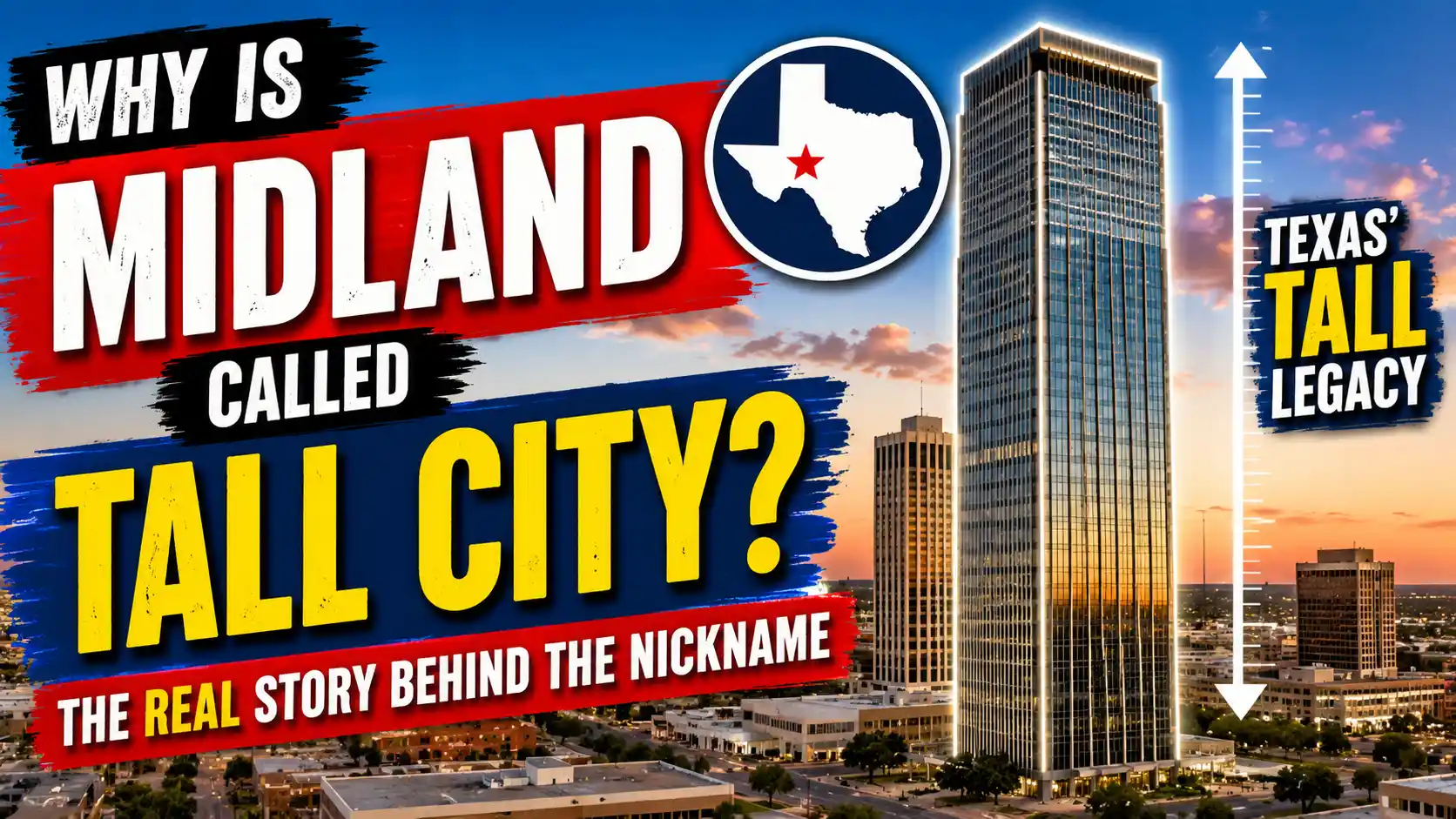
If you want to know about “Why Is Midland Called the Tall City”? Midland, Texas, is called the Tall City because its early 20th‑century oil boom produced a sudden cluster of high‑rise office buildings that towered above the flat West Texas plains. The nickname was coined in the late 1920s by an out‑of‑town journalist who was struck by the improbable skyline, and it was quickly adopted by locals and boosters as a badge of civic pride.
What Does “Tall City” Mean?
The nickname “Tall City” is a literal compliment to Midland’s vertical reach. It does not refer to elevation—Midland sits on a flat plain at about 2,780 feet above sea level—but to the man‑made height of its downtown buildings. For a mid‑sized city in the sprawling, horizon‑hugging landscape of West Texas, the sudden cluster of 10‑ to 20‑story towers makes the skyline feel dramatically out of scale, almost like a mirage of a much larger metropolis. That visual punch is the heart of the nickname.
Why Is Midland Called “Tall City”?
Midland earned the “Tall City” label because its early oil wealth created a building boom that stacked high‑rises atop the pancake‑flat prairie. During the 1920s and 1930s, the discovery of massive crude reserves in the Permian Basin transformed a quiet railroad stop into a fast‑growing energy capital. Banks, oil companies, and landmen rushed to build headquarters, and the quickest way to signal success was to build up. The result was a skyline that became visible for miles across the treeless plains, leaving visitors and locals alike to remark that Midland looked like a real “tall city” where none belonged.
The Origin of the Nickname
The nickname first appeared in print during the late 1920s, right at the peak of Midland’s initial oil‑fueled construction frenzy. In 1927, a journalist from Lubbock’s Morning Avalanche (later the Lubbock Avalanche-Journal) visited Midland to report on the region’s gushing wells. Staring at the improbable collection of multistory buildings standing alone on the sea of shortgrass prairie, he wrote that Midland was becoming “the Tall City of the Plains.”
The phrase was poetic, instantly visual, and perfectly captured the town’s self‑image. Within a few years, the Midland Reporter-Telegram and the Chamber of Commerce had adopted it as a permanent piece of civic vocabulary.
Who Coined the Nickname?
No single person holds a verified copyright on “Tall City.” The most widely accepted origin traces the phrase to a now‑anonymous reporter at the Lubbock Morning Avalanche in 1927. Midland lore sometimes credits a sportswriter or a traveling salesmen’s remark, but the paper trail starts with that Lubbock dispatch.
A secondary, less‑documented theory suggests that a Midland real estate promoter first used the term in a 1928 sales brochure. Regardless of the exact mouth, the nickname’s power came from its immediate, widespread adoption by ordinary Midlanders who recognized it as the perfect caption for their new hometown.
History Behind the Nickname
Understanding why a West Texas town started calling itself “Tall City” requires zooming out to the oil fields. Before 1923, Midland was a small agricultural and railroad hub with a handful of two‑story brick buildings. Then, on May 28, 1923, the Santa Rita No. 1 well blew in on University of Texas land in Reagan County, unleashing the Permian Basin oil boom. While the actual drilling happened to the southwest, Midland positioned itself as the white‑collar nerve center—a place to sign leases, exchange royalties, and make deals.
By 1928, the 10‑story Hogan Building had opened, and in 1929 the 14‑story Petroleum Building was completed, instantly becoming the tallest structure between Fort Worth and El Paso. Another dozen commercial towers rose in the following decade. For travelers on the Texas & Pacific Railway, the sight of Midland’s skyline jutting abruptly from the endless plain was unforgettable. Newspapers from Amarillo to San Angelo ran photos with captions like “The Tall City of the Oil Fields.” The name not only stuck but became a kind of civic challenge: Midland kept building taller, determined to live up to its nickname.
Timeline of the Nickname
How the Nickname Became Popular
Media was the original megaphone. Regional newspapers, especially in Lubbock, Amarillo, and San Angelo, reprinted the “Tall City” phrasing whenever they covered Midland’s wildcatter economy. Before long, national wire services picked it up in stories about the West Texas oil fields, and travel writers used it to add color. Locally, the Midland Reporter-Telegram ran front‑page features calling Midland “the Tall City” so routinely that the phrase became background noise—comfortable, expected, true.
Tourism and business promotion sealed the deal. The Midland Chamber of Commerce began putting “Tall City” on everything from letterhead to highway billboards by the 1930s. When the city needed a memorable hook to attract conventions and corporate relocations in the 1950s and ’60s, “Tall City” was the obvious choice—short, unique, and wrapped in an image of prosperity.
Politically, mayors and city council members dropped it into speeches to reinforce a sense of ambition. Culturally, it became a point of hometown pride: wearing a “Tall City” T‑shirt or sipping a Tall City beer (brewed by local craft breweries) was a statement that you belonged.
Myths vs Facts
Is the Nickname Still Used Today?
Absolutely. “Tall City” remains Midland’s go‑to identity. It appears on the city’s official visitor website, in tourism brochures, on public art, and in the names of annual events like the Tall City Blues Fest and the Tall City Brew Fest. Local businesses—restaurants, gyms, real estate agencies—routinely adopt “Tall City” in their names. While younger generations may casually shorten it to just “Midland,” the nickname is deeply embedded in the city’s DNA and shows no signs of fading.
Cultural Impact of the Nickname
Local identity is the biggest winner. In a state already famous for big things, being the “Tall City” gives Midlanders a unique, visual calling card that sets them apart from rival Odessa next door or larger cities like Lubbock. It shapes tourism branding: the Midland Convention & Visitors Bureau leans hard into skyline imagery, promoting rooftop bars, high‑rise hotel views, and downtown architectural tours.
Local sports teams from high school squads to the minor‑league Midland RockHounds incorporate “Tall City” into cheers and merchandise. In popular culture, the nickname pops up in country songs, Texas literature, and even oil‑field documentaries, always symbolizing ambition and vertical success.
Interesting Facts About the Nickname
- Long‑distance visibility – On a clear day, the Midland skyline can be seen from over 20 miles away on the flat plains, which directly inspired the “Tall City” label.
- Petroleum Building’s role – When the 14‑story Petroleum Building opened in 1929, it was the tallest structure between Fort Worth and El Paso, essentially creating the nickname overnight.
- Movie star connection – During a 1950s visit, actor James Dean reportedly called Midland “the little Tall City,” adding a Hollywood twist to local lore.
- Tall City Brewing – Midland’s craft brewery, Tall City Brewing Co., uses the nickname to brand its beers, with labels featuring the downtown skyline.
- Postage stamp cameo – In 1993, a U.S. Postal Service commemorative stamp series on American architecture included a photograph of Midland’s Wilco Building, captioned “Tall City skyline.”
- A rival’s envy – Residents of nearby Odessa have jokingly claimed the nickname should be theirs, but Midland’s taller buildings have historically kept the title secure.
- Skyline code – Midland’s building codes were historically lax to encourage height, reflecting the community’s desire to keep growing taller.
- License plates – You can spot “TALLCTY” and “TALCITY” vanity plates on vehicles around the Permian Basin.
- Guinness recognition – While not an official record, Guinness World Records once noted Midland’s “most skyscrapers per capita” for a U.S. city its size in a 1974 edition.
- Name‑your‑street – “Tall City Avenue” is a real street name in a modern Midland subdivision, cementing the nickname in everyday geography.
Other Nicknames of Midland
Midland wears a few other hats. It’s often called “The Permian Basin Capital” or simply “The Hub of the Permian Basin” for its role as the region’s corporate headquarters. Because of its historical ties to ranching and oil, you’ll occasionally hear “City of Petroleum” or “The Oil Capital of West Texas.” And thanks to its upscale neighborhoods and comfortable executive culture, some have nicknamed it “The Dallas of the Permian Basin.” Each of these tells a different chapter of Midland’s story, but none has the visual stickiness of “Tall City.” (Explore our complete guide to Midland nicknames for the full breakdown.)
Positioned at the crossroads of the South Plains, the regional importance shines through when you discover why Lubbock is called Hub City.
Comparison Section: Tall City vs. Magic City
Tall City (Midland) vs. Magic City (Miami)
🟦 Tall City — Midland, TX
Meaning: Skyline that towers above flat plains
Origin: 1927 newspaper article; oil boom construction
Driving force: Permian Basin oil wealth
Skyline vibe: Corporate high‑rises in a horizontal landscape
Cultural mark: Oil‑patch pride, business ambition
🟧 Magic City — Miami, FL
Meaning: City that seemed to appear magically fast
Origin: 1896 railroad expansion; rapid population surge
Driving force: Tourism, real estate, Latin American gateway
Skyline vibe: Beachfront high‑rises, pastel Deco
Cultural mark: Glitz, speed, multicultural glamour
Both nicknames capture the astonishment of sudden transformation—one vertical, one almost overnight urban growth—proving that a city’s image is often born in the moment someone sees it and says, “How did that get here?”
Related City Nicknames
Related City Nicknames
Explore More
Explore More Nicknames
Frequently Asked Questions
Frequently Asked Questions
What does the nickname “Tall City” mean?
It describes Midland’s downtown skyline, which rises tall above the surrounding flat West Texas terrain, creating the illusion of a much larger city.
Who came up with the name Tall City for Midland?
A reporter for the Lubbock Morning Avalanche is believed to have coined the phrase in 1927 after seeing Midland’s skyline during an oil boom visit.
When did Midland get the nickname Tall City?
The nickname first appeared in print in 1927 and became widely popular by the early 1930s as downtown skyscrapers multiplied.
Is Tall City an official nickname?
Yes, it is the city’s most recognized and promoted moniker, used by the city government, tourism board, and local businesses as a semi‑official brand.
Do people in Midland still call it the Tall City?
Absolutely. It is used daily in conversation, marketing, and media, and is a core part of local identity.
What building started the Tall City nickname?
The 14‑story Petroleum Building (completed 1929) is the landmark most associated with the nickname’s early days. The earlier Hogan Building also contributed to the skyline.
Is Midland the only city called the Tall City?
Midland is the only city widely known by that exact nickname. Other cities may have height‑related nicknames (Mile High City, City of Skyscrapers), but “The Tall City” is uniquely Midland’s.
Why does Midland have so many tall buildings for its size?
Oil companies historically wanted prestigious downtown office space, and land on the flat prairie was cheap, so building up was a way to project success and efficiency.
What is the tallest building in Midland today?
The Wilco Building, a 22‑story office tower completed in 1962, remains the tallest building in Midland and a modern symbol of the Tall City skyline.
How did the oil industry influence the Tall City nickname?
Oil money funded the construction of high‑rises, and the resulting skyline directly inspired the nickname. The boom’s economic energy made “Tall City” a metaphor for ambition.
Has the Tall City nickname ever been trademarked?
Midland has secured trademarks for “Tall City” on specific merchandise and events, but the nickname itself is considered a public civic identifier.
What other nicknames does Midland have?
Midland is also called the Permian Basin Capital, the Hub of the Permian, and the Oil Capital of West Texas. “Tall City” remains the most iconic.
Are there festivals that use the Tall City name?
Yes, the Tall City Blues Fest and Tall City Brew Fest are annual events that celebrate music and craft beer under the Tall City banner.
Does the Tall City nickname appear on Midland’s welcome signs?
Yes, visitors are greeted with “Welcome to Midland — The Tall City” on major entry points, reinforcing the identity from the moment you arrive.
Conclusion
“Tall City” isn’t a random tourism tagline; it’s a nickname that was forged in the fire of an oil boom, stamped onto the West Texas prairie by a journalist’s keen eye, and kept alive by a century of civic pride. Every time you see Midland’s buildings rise improbably from the flat horizon, you’re looking at the exact same sight that gave the city its name—a vertical promise carved out of a horizontal land.