
| Detail | Information |
|---|---|
| City | Gainesville |
| State / Country | Florida, USA |
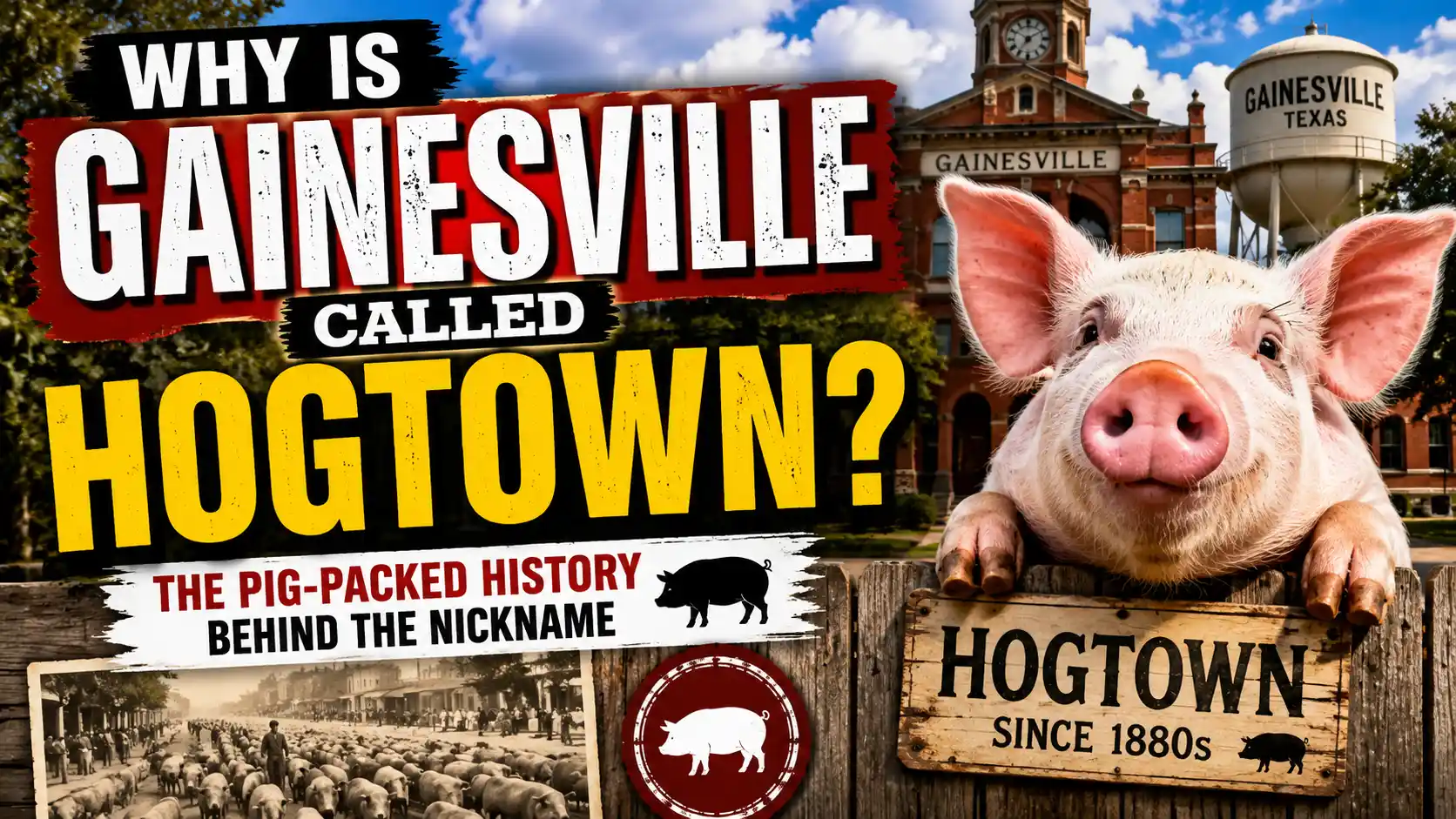
| Nickname | Hogtown |
| Meaning | A reference to the original settlement where wild hogs were abundant |
| First Known Usage | Early 1820s (as a place name) |
| Popularized By | Frontier settlers, local folklore, and later counterculture |
| Known For | Hogtown Creek, historic pioneer roots, craft beer, and Gator football |
What Does “Hogtown” Mean?
The literal meaning of “Hogtown” is exactly what it sounds like — a town of hogs. On the Florida frontier, wild pigs were everywhere. Spanish explorers had brought domestic swine to the New World, and over centuries many escaped, bred, and formed massive feral populations. When American settlers reached present‑day Alachua County in the early 1800s, they found the woods and creeks so full of hogs that the name “Hogtown” came naturally. The settlement took its name from Hogtown Creek, a winding waterway that still cuts through northwest Gainesville.
Why Is Gainesville Called “Hogtown”?
Gainesville owes its pork‑scented nickname to a small frontier village that existed before the city was even a thought. In the 1820s a trading post and a handful of cabins sprang up beside a creek where wild hogs gathered. That tiny community was called Hogtown. When the Florida Railroad planned its route in the 1850s, it bypassed the old village by about two miles.
A new town was laid out on the rail line and named Gainesville to honor General Edmund P. Gaines. The original Hogtown gradually faded, but the name refused to die. Today the whole city proudly wears “Hogtown” as a vintage, authentic nickname that links modern Gainesville to its scruffy pioneer beginnings.
The Origin of the Nickname
Long before high‑rise dorms and football stadiums, the area that would become Gainesville was a remote, swampy patch of Alachua County. Spanish hogs, let loose during the mission period, had thrived in the subtropical brush. By the time American settlers pushed south after the Adams‑Onís Treaty (1819), the hogs were so numerous that a creek crossing near a natural ford became known as Hogtown Creek.
A tiny settlement grew there — a few families, a trading post, and a rough‑hewn tavern. The village itself adopted the creek’s name. During the Second Seminole War (1835–1842), U.S. Army maps labeled the spot “Hog Town,” giving it a semi‑official status. Soldiers, sutlers, and passing travelers spread the word. By the 1840s Hogtown was a recognized, if unincorporated, stop in Florida’s interior.
Then came the railroad. In 1853 the Florida Railroad Company surveyed a line from Fernandina to Cedar Key. The tracks would miss Hogtown by about two miles. Sensing opportunity, local landowners donated land for a depot and a new town plat. In 1854 that new town was officially named Gainesville, after General Edmund P. Gaines, a hero of the War of 1812 and the Seminole Wars.
The old Hogtown settlement slowly emptied, and its buildings were cannibalized or abandoned. Yet the name “Hogtown” had already burrowed into local consciousness. It became an affectionate, slightly irreverent nickname for the growing city that replaced it.
Who Coined the Nickname?
No single person can claim credit. “Hogtown” emerged organically from the observations of early settlers who simply described what they saw. The first written records are mundane — land grants, military dispatches, and surveyors’ notes from the 1820s and 1830s that refer to “Hogtown Creek” and “the settlement at Hogtown.” One of the earliest cartographic mentions appears on an 1839 map of Florida produced during the Second Seminole War, where “Hog Town” is marked as a small dot west of the future Gainesville. The nickname, therefore, belongs to the collective voice of the frontier, not to a single person, newspaper, or organization.
History Behind the Nickname
The story of Hogtown is really the story of Florida’s transformation from a wild Spanish borderland into an American state. When the United States acquired Florida in 1821, the interior was sparsely populated. Alachua County was organized in 1824, and settlers began trickling in from Georgia and the Carolinas. They found a landscape dense with longleaf pine, live oak, and free‑roaming livestock.
Wild hogs were both a nuisance and a resource. They rooted up fields, yet they provided a ready supply of pork. The creek that drained into what is now Possum Creek was so popular with the animals that people started calling it Hogtown Creek. The settlement that took the same name was never large — maybe a few dozen residents at its peak. It did, however, sit along an early transportation corridor used by the Seminole Indians and later by the U.S. military.
When the railroad arrived, the decision to bypass Hogtown was purely economic. The new town needed level ground and a central location for a depot. Gainesville was incorporated in 1869 and grew rapidly, absorbing the remnants of Hogtown. Over time the original village site became a working‑class neighborhood, and later part of northwest Gainesville. The nickname never disappeared, though; it lived on in newspaper columns, folk tales, and eventually in the city’s self‑image.
Timeline of the Nickname
| Year | Event |
|---|---|
| 1500s | Spanish explorers introduce domestic pigs to Florida; escaped animals form feral populations. |
| 1820s | A small trading‑post settlement emerges beside a creek known for its wild hogs, and residents begin calling it Hogtown. |
| 1835–1842 | “Hog Town” appears on U.S. Army maps during the Second Seminole War, giving the name wider recognition. |
| 1853 | The Florida Railroad surveys a route that bypasses the old Hogtown settlement by two miles. |
| 1854 | Gainesville is founded and named after General Edmund P. Gaines; the original Hogtown slowly fades. |
| Late 1800s | Hogtown settlement is absorbed into Gainesville, but the name lingers in creek names and oral history. |
| Mid‑1900s | Local newspapers and old‑timers revive “Hogtown” as a nostalgic, earthy nickname for the city. |
| 1970s | Gainesville’s counterculture and music scene embrace “Hogtown” as a symbol of authenticity and rebellion. |
| 1990s–present | Local breweries, businesses, and festivals popularize the name; “Hogtown” appears on beer labels, T‑shirts, and murals. |
How the Nickname Became Popular
The popularity of “Hogtown” didn’t happen overnight. It grew in layers:
Oral tradition and local media. From the late 1800s onward, the Gainesville Sun and other newspapers occasionally used “Hogtown” in columns that romanticized the pioneer era. Older residents passed down stories of the original settlement, keeping the name alive.
Cultural upheaval in the 1960s and 1970s. As the University of Florida expanded and a youthful counterculture took root, “Hogtown” was adopted by artists, musicians, and activists who saw it as a grittier, more honest label than the staid “Gainesville.” Bands playing in downtown bars proudly declared they were “from Hogtown,” and the name acquired a cool, underground cachet.
Tourism and branding. In recent decades, the nickname has been stamped on craft beer (Swamp Head Brewery’s “Hogtown” series), restaurants, coffee shops, and even a popular annual Hogtown Craft Beer Festival. The Hogtown Creek Greenway, a sprawling nature trail system, draws hikers and bikers who want to touch the wild landscape that started it all.
Local identity. Many lifelong residents wear “Hogtown” as a badge of belonging. It’s an inside term that separates townies from transplants — a simple way to say “I know the real Gainesville, not just the university.”
Myths vs Facts
| Myth | Reality |
|---|---|
| Gainesville was originally named Hogtown. | False. The city of Gainesville was never officially called Hogtown. Hogtown was a separate, older settlement nearby. Gainesville was founded with its current name in 1854. |
| The nickname comes from the University of Florida’s Gator mascot. | False. The Hogtown nickname predates the University of Florida by decades. UF was founded in Gainesville in 1906, but Hogtown was already on maps in the 1830s. |
| “Hogtown” is an insult. | False. Locals embrace the term with pride. It’s a playful, historical identifier, not a slur. |
| The original Hogtown was a large town. | False. At its peak it was a tiny frontier hamlet of a few dozen people. It was never incorporated. |
| There are no physical traces of Hogtown left. | False. Hogtown Creek and the surrounding greenway still exist, and a historic marker near NW 8th Avenue commemorates the settlement. |
Is the Nickname Still Used Today?
Absolutely. “Hogtown” is alive and well in 2026 Gainesville. You’ll see it on shop signs, in brewery names, on bumper stickers that read “Keep Gainesville Hogtown,” and in the titles of local podcasts and blogs. The City of Gainesville itself occasionally uses the moniker in heritage tourism materials. In daily conversation, a longtime resident might say “I grew up in Hogtown” to mean they’ve been here since before the last big development wave. The nickname is an unofficial but deeply felt second name that helps define the city’s character.
Cultural Impact of the Nickname
Local identity. Hogtown provides a counterbalance to the buttoned‑down, academic image of the University of Florida. It suggests something older, rougher, and more authentic — a place of live oaks, creeks, and blue‑collar roots.
Tourism branding. The Alachua County Visitors Bureau has leaned into the Hogtown lore. Heritage trails, farm‑to‑table tours, and the annual Hogtown Craft Beer Festival all trade on the nickname to attract visitors who want a taste of Old Florida.
Sports and school spirit. While the Gators dominate, the Hogtown nickname gives Gainesville a second rallying cry. Student organizations, underground music venues, and intramural sports teams frequently invoke “Hogtown” to show city pride beyond the Swamp.
Media and the arts. Tom Petty, Gainesville’s most famous musical son, occasionally referenced the Hogtown identity in early interviews. Indie films and local documentaries, such as the 2008 documentary Hogtown, have explored the city’s layered identity. Wall murals in the downtown area blend gator and hog imagery.
Interesting Facts About the Nickname
- Hogtown Creek still flows through Gainesville and anchors a 1,200‑acre greenway popular with hikers, bikers, and birdwatchers.
- The oldest known map reference dates to an 1839 U.S. Army map that marks “Hog Town” west of present‑day downtown.
- Gainesville is not the only Hogtown. Toronto, Canada, was also nicknamed Hogtown in the 19th century, due to its huge pork‑packing industry. The two cities share the moniker by coincidence, not connection.
- A Hogtown historic marker stands near the corner of NW 8th Avenue and 34th Street, telling the story of the original settlement.
- Swamp Head Brewery once brewed a “Hogtown IPA,” and the nickname regularly appears on seasonal craft beers around town.
- “Hogtown” was nearly the city’s official name. When the railroad came, some promoters suggested keeping the name Hogtown, but civic leaders chose Gainesville to honor the military hero.
- The counterculture revival of the 1970s saved the nickname from obscurity; before that it was mainly used by old‑timers and historians.
- You can still find wild hogs in the woods around Alachua County today, a living reminder of the landscape the first settlers encountered.
- The Hogtown settlement may have had a Seminole predecessor. Some historians believe a Native trading site existed near the creek before the American village.
- “Hogtown” appears in the lyrics of several local punk and folk bands, keeping the name current in Gainesville’s music scene.
Other Nicknames of Gainesville
Gainesville wears more than one hat. It’s also known as “The Gator City” (thanks to the University of Florida), “TitleTown” (for its national championships in multiple sports), and “Gainesville Green” (a nod to its cannabis culture and lush natural surroundings). Each nickname tells a different chapter of the city’s story. To dig deeper, check out the full Gainesville Nicknames pillar page.
Not many cities embrace an explosive past, but the nuclear heritage makes perfect sense once you explore why Amarillo is called Bomb City.
Related City Nicknames
Comparison Section: Hogtown vs. Porkopolis
How does Gainesville’s pig‑themed nickname stack up against another famous pork‑loving city? Both carry pork‑y pride, but the stories behind them are miles apart.
| Aspect | Hogtown (Gainesville, FL) | Porkopolis (Cincinnati, OH) |
|---|---|---|
| Origin | Named after a creek settlement teeming with feral hogs; wild pigs from Spanish stock. | Dubbed Porkopolis in the 1830s–1860s due to its massive pork‑packing industry. |
| Historical context | Frontier Florida before major development; settlement predates the railroad and the city itself. | Cincinnati was the world’s leading pork processor, earning the nickname “Porkopolis” from its slaughterhouses and packing plants. |
| Meaning | A rustic, land‑based nickname tied to wild animals and pioneer life. | An industrial, urban nickname reflecting economic might and food production. |
| Modern usage | Nostalgic and cultural — appears on beer labels, merchandise, and greenway trails. | Mostly historical; occasionally revived in festivals, the “Flying Pig Marathon,” and local branding. |
| Vibe | Earthy, rebellious, and deeply local. | Gritty, industrious, and nostalgic for a bygone era. |
Frequently Asked Questions
- 1. What does Hogtown mean in Gainesville?
- It refers to the original settlement that was full of wild hogs. The name was taken from Hogtown Creek and later became a nickname for the city of Gainesville.
- 2. Why did they name it Hogtown?
- Early settlers simply described what they saw — a creek area overrun with feral pigs. The name was practical and descriptive, not ceremonial.
- 3. Was Gainesville originally called Hogtown?
- No. The city of Gainesville was never officially called Hogtown. A separate, older settlement named Hogtown existed nearby. When Gainesville was founded in 1854, it was named after General Edmund P. Gaines.
- 4. When did Gainesville stop being Hogtown?
- Gainesville was never Hogtown, but the old Hogtown settlement faded after the 1850s. By the early 1900s it had been completely absorbed. The nickname never stopped being used.
- 5. Is Hogtown still a neighborhood in Gainesville?
- There is a loosely defined Hogtown area in northwest Gainesville, and the Hogtown Creek Greenway runs through it, but it’s not an official city neighborhood.
- 6. Who named Gainesville?
- The town was named by its founders in 1854 to honor General Edmund P. Gaines, a prominent military figure in early American and Florida history.
- 7. Why is the creek called Hogtown Creek?
- Because of the large number of wild hogs that congregated along its banks when the first American settlers arrived.
- 8. Is Hogtown an official nickname?
- No, it has never been adopted officially by the city government. It remains a popular folk nickname.
- 9. What is the connection between Hogtown and the University of Florida?
- None, historically. The university arrived long after the nickname. Today, students and alumni often use “Hogtown” as a term of affection for the city beyond campus.
- 10. Do locals call Gainesville Hogtown?
- Yes, especially long‑time residents, artists, and anyone who wants to emphasize the city’s pre‑university, blue‑collar roots.
- 11. What other cities are called Hogtown?
- Toronto, Canada, was historically called Hogtown because of its pork‑processing industry. It’s a completely independent origin.
- 12. Is Hogtown related to pigs?
- Directly. The name stems from the wild pigs (feral hogs) that roamed the area and gave Hogtown Creek its name.
- 13. Are there any Hogtown festivals?
- The Hogtown Craft Beer Festival is an annual event that celebrates local brews and the city’s heritage.
- 14. What is the Hogtown Brewers?
- It’s a term loosely applied to the network of craft breweries in Gainesville that often use the Hogtown theme on their labels and taproom walls.
- 15. How can I explore Hogtown history?
- Visit the Hogtown Creek Greenway, look for the historic marker on NW 8th Avenue, or stop by the Matheson History Museum in downtown Gainesville.
Explore More
Conclusion
Gainesville’s “Hogtown” nickname is a time capsule. Long before the university, before the railroad, before the city itself, a muddy creek and a handful of hardy settlers carved a name out of the Florida wilderness. That name survived the birth of a new town, the rise of a major university, and waves of change.
Today “Hogtown” is more than a quirky relic — it’s an identity. It reminds everyone that underneath the modern college town beats the heart of an old frontier settlement where wild hogs ruled the woods and people called the place exactly what they saw. The next time you walk the Hogtown Creek Greenway or sip a Hogtown‑labeled brew, you’re tapping into nearly two centuries of unvarnished Florida history.