
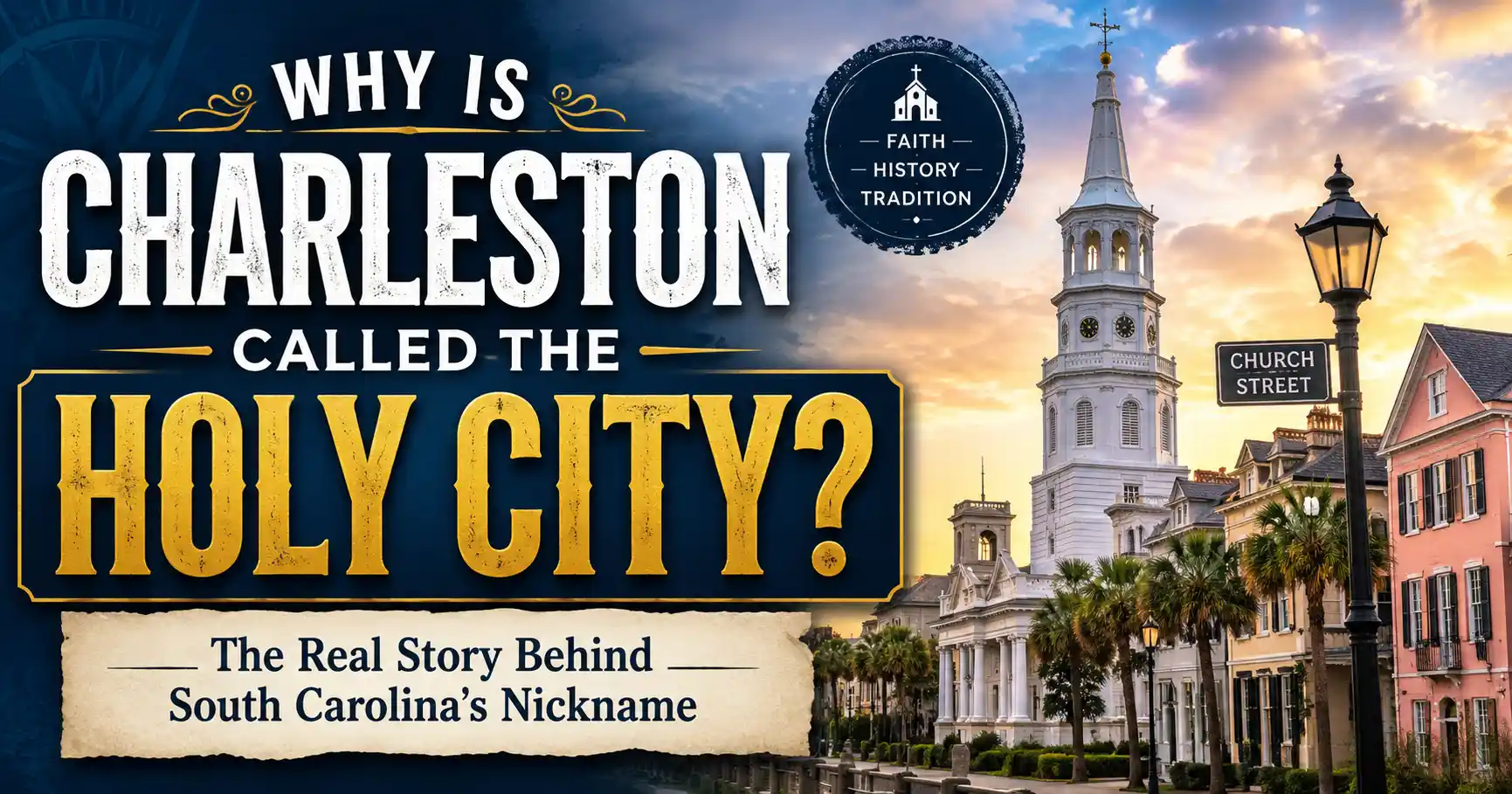
Charleston, South Carolina, is famous for its cobblestone streets, pastel-colored houses, and warm Southern charm. But when visitors arrive, they quickly notice something else — church steeples seem to rise from every corner of the old city. That’s why people have called it the Holy City for more than a century. If you’ve ever wondered why is Charleston called the Holy City, you’re about to learn the real story, the history, and the myths behind one of America’s most beloved city nicknames.
Quick Answer
Charleston is called the Holy City because its skyline is filled with historic church steeples and it has a long history of welcoming different religions. When ships approached the harbor in the 1800s, the city looked like a holy place of worship. The nickname stuck and has been used proudly ever since.
| Fact | Detail |
|---|---|
| City | Charleston, South Carolina |
| Nickname | The Holy City |
| Literal Meaning | A city that feels sacred or set apart because of its many churches |
| First Known Usage | Late 19th century, around the 1880s |
| Popularized By | Travel writers, newspapers, and tourism boosters |
| Known For | Stunning church architecture, religious diversity, and a skyline of steeples |
What Does “The Holy City” Mean?
The phrase “Holy City” simply describes a place that feels spiritually special or filled with places of worship. For Charleston, it’s not an official religious title. Instead, it’s a visual and cultural nickname. When you see the city from across the harbor or walk its streets, the sheer number of churches makes it feel set apart — almost like a city built for faith.
Why Is Charleston Called the Holy City?
The nickname comes from a mix of history, geography, and deep-rooted traditions. There isn’t one single reason, but several that blend together beautifully.
First, Charleston’s skyline has always been dominated by church steeples. In the 18th and 19th centuries, the city was one of the wealthiest in America. Many different religious groups built grand churches, and their tall steeples reached toward the sky. When sailors, traders, and travelers approached by boat, the first things they saw were not government buildings or warehouses — they saw dozens of steeples piercing the horizon. It looked like a city of worship. That’s the image that planted the nickname in people’s minds.
Second, Charleston was unusually open to religious diversity from its very beginning. While other colonies often had one official church, early Charleston welcomed groups that faced persecution elsewhere. According to the Library of Congress, the colony’s Fundamental Constitutions of 1669 promised freedom of conscience to settlers, attracting a wide variety of faiths. By the early 1700s, you could find Anglicans, French Huguenots, Quakers, Baptists, Presbyterians, and one of the oldest Jewish congregations in America all worshiping within a few blocks of each other. That mix was rare at the time and earned Charleston a reputation as a place where religion was central to daily life.
So why do people keep asking why is Charleston called the Holy City? Because the nickname seems almost too perfect to be true. It’s a city where you can still walk from St. Michael’s to St. Philip’s to the Circular Congregational Church and feel like you’re traveling through a living museum of faith.
Origin of the Nickname
The exact moment the nickname was born is hard to pin down. Historians haven’t found a single letter or diary that says, “I hereby name this place the Holy City.” Instead, the phrase grew slowly.
The earliest known print references to Charleston as the Holy City date from the 1880s. Newspapers and travel journals began using the term to describe the city’s skyline and religious character. The Charleston Area Convention & Visitors Bureau notes that the nickname became especially popular as more tourists started visiting by steamship. From the water, the sight of so many steeples was truly striking, and the phrase seemed to capture that first impression perfectly.
By the early 20th century, the name was appearing on postcards, in guidebooks, and in promotional materials. It had moved from a casual description to an official-sounding nickname.
Who Coined the Nickname?
You might expect a famous poet or a mayor to have invented the nickname. But honestly, no one knows exactly who said it first.
A popular story says that a traveler arriving by ship in the 1800s saw all the church steeples and called the city “holy.” Sometimes the story mentions a British admiral or a visiting clergyman. While those tales are charming, there’s no solid proof for any single person. What we do know is that the nickname appeared more and more in writing during the late 1800s, which suggests it was already in common use by then. It likely grew out of everyday conversation among visitors and locals, not from one big announcement.
History Behind the Nickname
To really understand the nickname, you need to know a little about Charleston’s past.
Charles Towne was founded in 1670. Right from the start, the colony’s leaders promised religious freedom to attract settlers. That promise worked. French Huguenots fleeing Catholic persecution came here. So did Scottish Presbyterians, German Lutherans, and Sephardic Jews. By 1749, Charleston had so many different denominations that the city earned the nickname “Little London” among some British visitors.
The churches themselves were architectural marvels. St. Michael’s Anglican Church, completed in 1761, has a towering white steeple that still watches over the city today. St. Philip’s, whose steeple was added in the mid-1800s, rises high above Church Street. The Circular Congregational Church and the French Huguenot Church added their own unique shapes to the skyline. From the harbor, all these steeples seemed to blend into one breathtaking view of faith.
By the late 1800s, Charleston had more than 20 churches within the small peninsula, which is only a few square miles. That’s an astonishing density. It’s no wonder the Holy City nickname felt so natural.
| Year | Event |
|---|---|
| 1670 | Charles Towne founded; religious tolerance draws diverse settlers. |
| 1680s | Quakers, Huguenots, and Jewish settlers establish congregations. |
| 1761 | St. Michael’s Church completed; its steeple becomes a landmark. |
| c. 1835–1850 | St. Philip’s steeple added; skyline of steeples becomes more dramatic. |
| c. 1880s | Earliest known printed references to Charleston as “the Holy City” appear. |
| Early 1900s | Postcards and tourism materials regularly use the nickname. |
| Present Day | The Holy City nickname is widely used in branding, tourism, and local pride. |
How the Nickname Became Popular
The Holy City nickname spread the old-fashioned way — through travel and storytelling.
In the late 19th and early 20th centuries, Charleston became a winter destination for wealthy Northerners. Guidebooks and newspaper travel columns described the city’s charm. Writers looking for a catchy phrase latched onto “Holy City” because it summed up what they saw. Tourists brought the name home, and it started appearing on souvenir postcards. Even today, the official tourism website uses the nickname proudly, and you’ll see it on everything from restaurant menus to local T-shirts.
Myths vs Facts
| Myth | Reality |
|---|---|
| A famous British admiral coined the nickname after seeing the steeples. | This is a fun story, but there’s no historical document that confirms it. |
| The nickname comes from a pirate like Blackbeard. | No records connect Blackbeard or any pirate to the nickname. |
| Charleston was officially declared a holy city by a church leader. | The nickname is completely informal and grew from common use, not an official decree. |
Is the Nickname Still Used Today?
Absolutely. Walk through downtown Charleston and you’ll hear it all the time. Locals use it naturally. Tour guides build entire tours around the city’s historic churches. Restaurants name themselves after the phrase. The tourism board even runs campaigns with the slogan “Explore the Holy City.” It’s a living nickname, not just a dusty old history fact.
Cultural Impact
The Holy City nickname has shaped how Charleston presents itself to the world. Tourists come specifically to see the famous church steeples and to learn about the city’s religious heritage. You’ll find the nickname in books about Charleston history, in travel documentaries, and in countless Instagram captions. Local sports teams don’t use the Holy City name officially, but you’ll often hear sportscasters mention it when showing shots of the skyline during broadcasts. In music, artists have sung about the Holy City’s quiet beauty, and it remains a symbol of southern grace.
Interesting Facts
- The skyline is so protected that city ordinances keep new buildings from rising taller than the tallest church steeple — so the view that created the nickname is preserved by law.
- Charleston’s Circular Congregational Church is one of the oldest continuously worshiping congregations in the South, dating to 1681.
- St. Michael’s bells have rung for services since the American Revolution and are mentioned in the diary of a British officer.
- The French Huguenot Church on Church Street is one of the only independent Huguenot churches still active in the United States.
- Kahal Kadosh Beth Elohim, founded in 1749, is the fourth-oldest Jewish congregation in America.
- Despite the nickname, Charleston didn’t have a Catholic cathedral until the Cathedral of St. John the Baptist was built in the 19th century; it now adds to the skyline.
- The density of churches on the peninsula is so high that on a single block you can sometimes spot three different denominations.
Other Nicknames of Charleston
The Holy City might be the most famous nickname, but Charleston has a few others. You’ll sometimes hear it called “Chucktown” by locals, or the “Palmetto City” because of the many palm trees. It’s also known as the “Cradle of Secession” due to its Civil War history. To explore all of these and more, check out the complete list of Charleston nicknames.
Related City Nicknames
A nickname tied to the city’s relaxed vibe and musical soul.
Read the storyA name that means “The Angels” in Spanish, with deep religious roots.
Read the storyBrooklyn earned this name from its own beautiful skyline of steeples.
Read the storyComparison: The Holy City vs The City of Angels
| Feature | Charleston — The Holy City | Los Angeles — City of Angels |
|---|---|---|
| Origin | Inspired by the sight of church steeples and religious diversity. | Derived from the Spanish name “Los Ángeles,” meaning “The Angels.” |
| Religious tie | Directly linked to the physical presence of many churches. | Rooted in Catholic mission history, but now mostly symbolic. |
| Visual impact | Skyline of steeples you can still see today. | Nickname is not tied to a specific skyline view. |
Both nicknames connect to faith, but Charleston’s feels immediate and visual, while Los Angeles’ is more historical and linguistic. You can learn more about how these two famous nicknames stack up by exploring the full Holy City vs City of Angels comparison.
Frequently Asked Questions
What does the nickname “Holy City” mean?
It means Charleston is known for its many churches and its skyline full of steeples. The name describes the city’s visual and spiritual character, not an official religious title.
Who created the nickname for Charleston?
No single person is known to have coined it. The nickname grew naturally in the late 1800s as more people saw the skyline and started calling Charleston the Holy City.
Is the nickname official?
No, it’s not an official government designation. It’s a widely loved informal nickname used by locals, visitors, and businesses.
Do locals still call it the Holy City?
Yes. Locals use the nickname often, and it appears on everything from restaurant signs to tourism campaigns. It’s a core part of Charleston’s identity.
What are other nicknames for Charleston?
Charleston is also known as Chucktown, the Palmetto City, and historically the Cradle of Secession. You can discover them all on the Charleston nicknames page.
Why is the nickname famous?
It’s famous because the image of countless steeples rising above a historic city is so unique in the United States. The nickname perfectly captures that unforgettable first impression.
Is the nickname historically accurate?
Yes, in the sense that Charleston truly had an unusually high number of churches and a long history of religious tolerance. The nickname honestly reflects that heritage.
When did people start calling it the Holy City?
The nickname first appeared in writing around the 1880s. It likely was used in conversation even earlier, as steamship travelers marveled at the skyline.
Does the nickname relate to any single church?
No. It’s the collection of many churches — Anglican, Congregational, Huguenot, Catholic, and more — that gives the city its holy feel. No single church claims the title.
How does Charleston’s Holy City nickname compare to other religious city nicknames?
It’s one of the most direct. While “City of Angels” is a translation and “City of Churches” is descriptive, Charleston’s name feels like a living postcard of faith.
Explore More
All the nicknames of the Holy City in one place.
Explore Charleston NicknamesDiscover nicknames from Columbia, Greenville, and beyond.
Browse SC NicknamesWhy is Chicago the Windy City? What’s the Big Apple? Find out.
See Famous NicknamesConclusion
Charleston’s nickname isn’t just a pretty phrase. It’s a window into more than 300 years of history, architecture, and open-hearted religious life. When you ask why is Charleston called the Holy City, the answer lives in every steeple that rises above the old rooftops and in every quiet churchyard downtown. Next time you visit, stand on the Battery and look back at the skyline. You’ll understand exactly what those 19th-century travelers saw — a city that truly feels holy.
Sources & References
- Charleston Area Convention & Visitors Bureau — “Why Charleston is Called the Holy City”
https://www.charlestoncvb.com/blog/why-charleston-is-called-the-holy-city/ - Library of Congress, Religion and the Founding of the American Republic — “Religion in Eighteenth-Century Charleston”
https://www.loc.gov/collections/religion-and-the-founding-of-the-american-republic/articles-and-essays/religion-in-eighteenth-century-america/religion-in-eighteenth-century-charleston/ - City of Charleston Official Website — “History of Charleston”
https://www.charleston-sc.gov/1455/History-of-Charleston