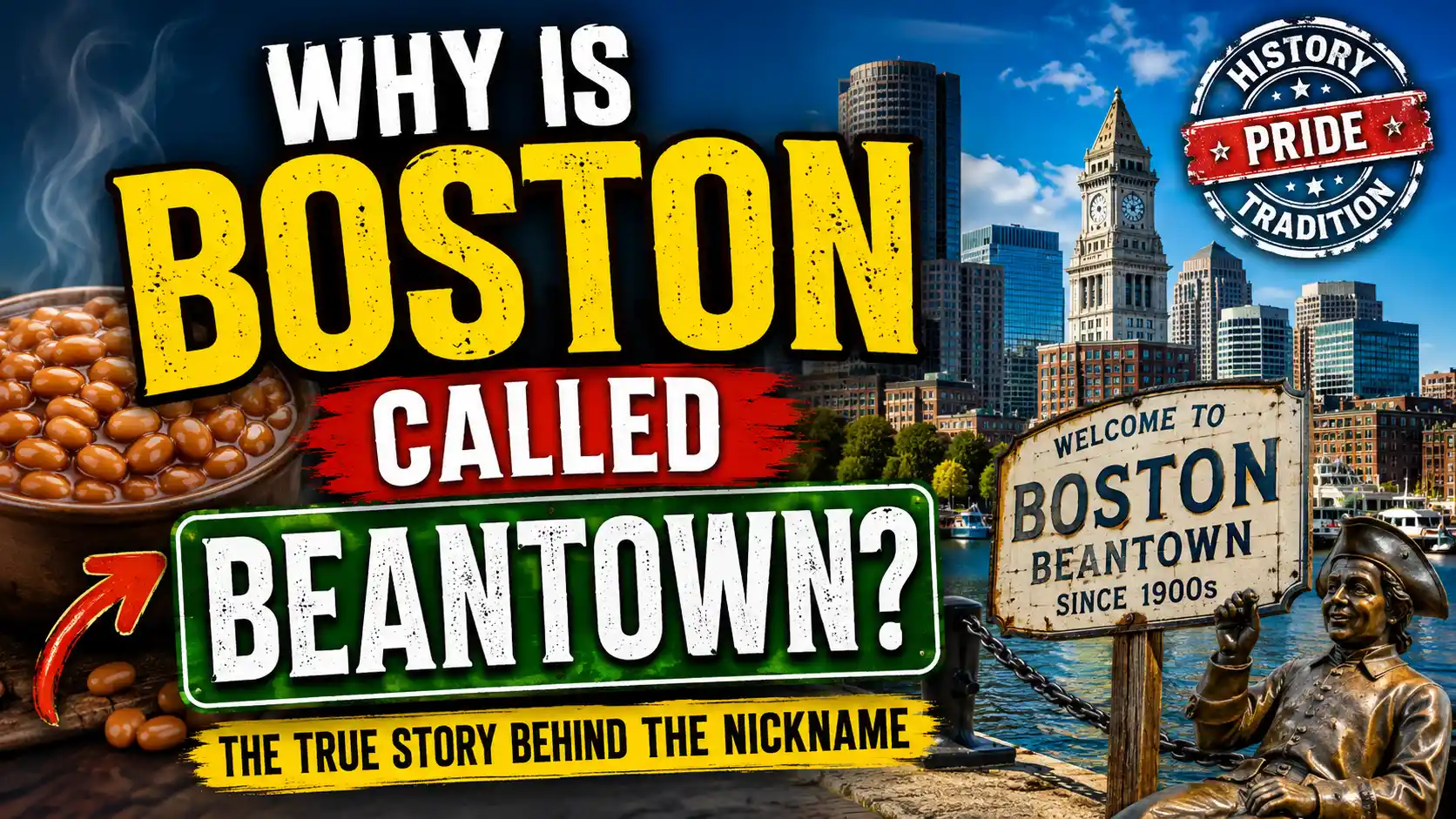
If you want to know about “Why Is Boston Called Beantown?” Here is a Ans below
Short Answer
Boston is called Beantown because of its deep-rooted history with baked beans. In Colonial times, Puritans slow-cooked beans with molasses on Saturdays and ate them on Sundays. The city became so famous for the dish that visitors began calling it “Beantown” — a playful nickname that first appeared in print around 1907 and stuck despite mixed feelings from locals.
Quick Facts Table
What Does “Beantown” Mean?
“Beantown” literally means “Bean Town.” It’s a cheerful, informal nickname that calls Boston the city of beans — specifically, slow-baked navy beans swimming in a sweet, dark molasses sauce. The term has nothing to do with coffee beans, jelly beans, or string beans. It’s about one dish and one dish only: Boston baked beans.
For centuries, that single pot of beans symbolized the city’s Puritan work ethic, its role in the triangular trade, and a Saturday-night kitchen ritual that filled the cobblestone streets with a sweet, smoky aroma. So when someone calls Boston “Beantown,” they’re winking at a delicious piece of culinary history that most Americans recognize instantly.
Why Is Boston Called “Beantown”?
The short answer: because the city became inseparable from baked beans. For more than 300 years, Boston was the undisputed baked-bean capital of the United States. Out-of-towners saw beans on every boardinghouse menu, smelled them through open kitchen windows, and heard locals talk about “bean suppers” the way other cities discuss pizza or barbecue. It didn’t take long before someone started calling the place Beantown, and the label proved so sticky that it outlasted the very potbellied stoves that baked the beans.
But the full story — the one that explains exactly how a humble legume came to define a world-class city — is a tale of religion, ocean trade, Saturday traditions, and a famous candy that had nothing to do with vegetables.
The Origin of the Nickname
Who Created It?
Nobody knows exactly who first said “Beantown” aloud. Unlike nicknames that can be traced to a specific columnist or mayor, “Beantown” bubbled up organically from the same visitors and sailors who walked Boston’s wharves in the 19th century. These travelers were often stunned by how much beans mattered to the locals. Some found it charming; others found it funny. Either way, they took the nickname home with them.
Where It Originated
The nickname was born right on Boston’s historic waterfront and in its dense North End and West End neighborhoods, where the smell of molasses and baking beans was a near-constant companion. By the late 1800s, the term was floating around in railroad cars, stagecoaches, and newspaper columns written by outsiders covering the city.
Historical Context
To understand why beans became Boston’s culinary mascot, you have to rewind to the 1600s. Massachusetts Bay Colony Puritans observed a strict Sabbath that began at sundown on Saturday. Cooking was forbidden on Sunday, but the family still needed a hot, hearty meal. The solution was brilliant: on Saturday, housewives would layer dried navy beans, salt pork, onions, mustard, and a generous pour of molasses into a large earthenware pot. The pot would go into the residual heat of the family’s brick oven and slow-cook overnight. By Sunday morning the beans were tender, caramelized, and ready to eat — no work required on the day of rest.
Molasses was the key ingredient that set Boston baked beans apart from other Colonial bean dishes. And Boston had molasses in astonishing quantities because of its central role in the “triangular trade.” Ships carried rum to Africa, traded it for enslaved people (a brutal historical reality), brought sugarcane products like molasses from the Caribbean to Boston, and then distilled more rum. So much molasses poured into Boston that by the 18th century the city was literally awash in the sticky syrup.
Earliest References
The earliest known print appearance of “Beantown” shows up around 1907, in sports pages and travel sketches. A 1907 edition of the Boston Globe, for example, used “Beantown” in a baseball dispatch. The nickname then started cropping up on postcards with slogans like “Boston — The Home of the Bean and the Cod.” That postcard tagline — bean for land, cod for sea — neatly summed up Boston’s dual identity.
Who Coined the Nickname?
There is no single person, newspaper, or organization credited with coining “Beantown.” The leading theory among historians is that the nickname was tossed around by travelers, railroad workers, and early sportswriters in the late 19th century, then gradually adopted by local journalists who needed a casual, recognizable shorthand for the city. It was never an official municipal branding effort; quite the opposite — city officials generally ignored it, and many Bostonians winced at it.
Some trace its wider circulation to the early 20th-century craze for “city nicknames” promoted by railroad advertising. If Chicago was the Windy City and New York was the Big Apple, Boston needed a moniker that was catchy, and “Beantown” was already waiting in the wings.
History Behind the Nickname
The Pilgrims and Puritans who settled Boston brought a British fondness for dried legumes, but the technique of baking beans in a sweet sauce was heavily influenced by Native American cooking. Indigenous people in New England had long slow-cooked beans with maple sugar and bear fat. Colonists swapped in molasses (cheaper than maple sugar for much of the year) and salt pork, creating the hybrid dish we now call Boston baked beans.
By the early 1700s, Boston was the largest molasses importer in the Thirteen Colonies. The syrup was so integral to daily life that one 18th-century commentator joked you could smell it before you saw the city skyline. The Great Molasses Flood of 1919, when a towering storage tank burst in the North End, tragically reinforced the city’s connection to the sticky stuff and is often recalled alongside bean-lore, though the nickname had already existed for more than a decade by then.
Throughout the 1800s, charitable “bean suppers” were a staple of church and community life in Boston. They were so predictable that visiting merchants would mark their calendars around them. The sheer ubiquity of beans — breakfast, lunch, or supper — gave outsiders the impression that Bostonians couldn’t go a day without them.
Timeline of the Nickname
How the Nickname Became Popular
Media Influence
Turn-of-the-century sportswriters found “Beantown” to be a perfect column-inch saver. A headline like “Beantown Nine Triumphs” was shorter and snappier than “Boston Baseball Club Wins Again.” The nickname appeared regularly in the baseball pages of East Coast newspapers, which helped cement it in the national consciousness.
Tourism Influence
By the 1920s, railroad companies and early tourism boards began packaging city identities. Boston may not have loved “Beantown,” but it was undeniably memorable. The “Home of the Bean and the Cod” postcards turned the phrase into a tangible souvenir that visitors could mail back to Dubuque or Denver, seeding the name far beyond New England.
Political Influence
Politicians largely kept their distance from the nickname. A Boston mayor was far more likely to call the city the “Hub of the Universe” (borrowing from Oliver Wendell Holmes) than to utter “Beantown” in a speech. Still, the quiet avoidance didn’t dampen the public’s affection for the term.
Cultural Influence
The single most impactful force behind the nickname’s longevity may have been candy. In the 1930s, the Chicago-based Ferrara Pan Candy Company rolled out “Boston Baked Beans” — a confection of peanuts coated in a sweet, crunchy shell. The box featured a cartoon of a beanpot and the word “Boston.” For millions of American kids, the candy was the only association they had with the city, and “Beantown” became a national household word because of a product that had nothing to do with actual beans.
Myths vs Facts
Is the Nickname Still Used Today?
Yes — everywhere except, often, by Bostonians themselves. You’ll see “Beantown” plastered across T-shirts at Faneuil Hall, in the names of local pubs, in nationwide headlines during the Boston Marathon, and on the sides of food trucks. National broadcasters toss it out when the Red Sox or Celtics play a big game. Yet walk into a Dorchester diner and call the city “Beantown,” and you may get a patient smile or a gentle eye roll. It remains the kind of nickname that belongs more to visitors and the media than to the people who actually call the city home.
Cultural Impact of the Nickname
Local Identity
For many locals, “Beantown” has a complicated identity. It’s recognized as a historical badge, but it can also feel like a cartoon version of a sophisticated, modern city. Still, the nickname has become an inescapable part of Boston’s brand, showing up at everything from the Beantown Jazz Festival to the local term “Beanpot,” which now names both the college hockey tournament and countless neighborhood establishments.
Tourism Branding
The Greater Boston Convention & Visitors Bureau may not lead with “Beantown,” but it cleverly accommodates the term. Souvenir shops bank on it, culinary tours teach it, and cruise-ship excursions use it as a friendly shorthand. It’s a soft, nostalgic nickname that instantly telegraphs history, comfort food, and East Coast charm.
Sports Teams
Sportscasters occasionally refer to “Beantown battles” when the Red Sox face the Yankees or the Celtics meet the Lakers. The college hockey Beanpot Tournament — while not named after the city directly — reinforces the bean connection every February when Boston’s universities compete for the cherished Beanpot trophy.
Media References
From Cheers to Good Will Hunting, screenwriters have dropped “Beantown” into dialogue as a quick way to place a story. The character of Frasier Crane once joked about returning to “Beantown and baked beans,” while travel shows regularly use the nickname as episode titles.
Popular Culture
The very existence of the candy “Boston Baked Beans” in movie concession stands, vending machines, and old-fashioned candy shops keeps the nickname alive in a sugary, pop-culture orbit that has nothing to do with a pot of simmering legumes.
Interesting Facts About the Nickname
- Massachusetts has an official state bean. In 1993, the legislature designated the baked navy bean as the official state bean — a direct nod to Boston’s long bean heritage.
- The Great Molasses Flood of 1919 killed 21 people and unleashed a wave of syrup up to 25 feet high. While the nickname was already in use, the disaster permanently seared the molasses-bean link into Boston’s story.
- “Boston Baked Beans” candy was invented in Chicago, not Boston. The Ferrara Pan Candy Company created the sweet-coated peanuts and marketed the bean connection nationwide.
- The “Home of the Bean and the Cod” slogan was so ubiquitous on early 20th-century postcards that collectors still seek them out today.
- Durgin-Park, a historic Faneuil Hall restaurant (now closed), served Boston baked beans in traditional bean pots for over 180 years, often alongside Indian pudding.
- John F. Kennedy’s favorite meal was reportedly Boston baked beans and brown bread, underscoring the dish’s status as a New England staple.
- The Beanpot hockey tournament started in 1952 and is one of the oldest collegiate hockey tournaments in the country, forever tying beans to Boston’s sports culture.
- The nickname occasionally baffles international visitors. Tourism officials have noted that explaining the bean connection is one of the most common conversations at the city’s visitor centers.
- A “Beantown Pub” has existed in various forms since the 1990s, proving that at least one business is happy to lean into the moniker.
- Oliver Wendell Holmes Sr. once called Boston the “Hub of the Solar System,” which gave rise to “The Hub” — a far more popular nickname among locals that competes with Beantown for mindshare.
Other Nicknames of Boston
Boston wears many hats beyond “Beantown.” It’s often called The Hub (short for “Hub of the Universe”), The Athens of America for its intellectual and cultural legacy, The Cradle of Liberty for its role in the American Revolution, and City on a Hill from John Winthrop’s famous sermon. In sports circles, fans sometimes declare it Titletown when championship trophies pile up. Each nickname tells a different chapter of the same city, and you can explore them all in depth on our full Boston Nicknames page.
Related City Nicknames
🌬️ The Windy City
Chicago, IL
🍎 The Big Apple
New York, NY
🌲 The Emerald City
Seattle, WA
✨ The Magic City
Miami, FL
👼 City of Angels
Los Angeles, CA
Surrounded by evergreen forests and glistening waters, it’s easy to appreciate the lush inspiration behind Seattle’s Emerald City nickname.
Comparison Section: Beantown vs. The Big Apple
🍲 Beantown (Boston)
- Origin: Culinary tradition of Boston baked beans and molasses trade.
- Earliest print: ~1907
- Tone: Homey, historical, a bit old-fashioned.
- Local acceptance: Mixed — many Bostonians politely sidestep it.
- Pop culture boost: Candy, postcards, and sports shorthand.
🍎 The Big Apple (New York City)
- Origin: Horse-racing slang revived by a tourism campaign in the 1970s.
- Earliest print: 1920s, but widely popularized in 1971.
- Tone: Bold, aspirational, fast-paced.
- Local acceptance: Embraced and officially promoted.
- Pop culture boost: Marketing blitz, music, and sports merchandising.
Both nicknames were originally outsider terms that grew into international brands, but while New York eagerly adopted “The Big Apple,” Boston still keeps “Beantown” at a charming arm’s length.
Frequently Asked Questions
What does “Beantown” mean?
It’s a nickname for Boston that references the city’s historic association with baked beans. The term literally means “Bean Town.”
Who created the nickname “Beantown”?
No single person is credited. It emerged from travelers, sailors, and sportswriters in the late 19th and early 20th centuries who observed Boston’s bean-eating culture.
When did “Beantown” become popular?
It began appearing in newspapers around 1907, gained momentum with postcards in the 1910s, and achieved national recognition after the “Boston Baked Beans” candy debuted in the 1930s.
Is “Beantown” an official nickname?
No. Boston has no legally designated nickname. “Beantown” is entirely informal and is not used in any official city documents.
Do locals actually use the nickname “Beantown”?
Many Bostonians avoid it in everyday conversation. It’s considered more of a tourist phrase than a genuine local term of endearment.
What are other nicknames for Boston?
Popular alternatives include The Hub (Hub of the Universe), The Athens of America, The Cradle of Liberty, and City on a Hill.
Is “Beantown” still used today?
Absolutely. It appears in tourism marketing, sports commentary, and popular culture, even if locals don’t always embrace it.
Did the Boston Baked Beans candy create the nickname?
No. The candy was introduced in the 1930s, but printed references to “Beantown” date back to approximately 1907. The candy did, however, hugely popularize the term.
Why are beans so closely tied to Boston’s history?
Puritan Sabbath traditions required a no-cook Sunday, so families baked beans on Saturday. The city’s massive molasses imports made Boston baked beans uniquely sweet and famous.
Is there a connection between “Beantown” and the Great Molasses Flood?
The flood didn’t inspire the nickname, but it reinforced the city’s molasses-soaked image and is often mentioned alongside the bean story.
How do I pronounce “Beantown”?
Exactly as it looks: Bean-town, with equal stress on both syllables.
What state has a baked bean as an official symbol?
Massachusetts made the baked navy bean its official state bean in 1993, honoring the same tradition that gave Boston its nickname.
Is Boston the only city with a food-based nickname?
No, though food-based city nicknames are rare. New York’s “Big Apple” is another famous example, though its origin is more metaphorical than culinary.
Where can I try authentic Boston baked beans?
Historic restaurants and taverns around Faneuil Hall and the North End still serve traditional recipes. Saturday-night bean suppers also occasionally pop up at New England community events.
Will Boston ever officially adopt “Beantown”?
There’s no movement to make it official. The city tends to prefer its loftier historical nicknames, leaving “Beantown” as an affectionate, unofficial label for the rest of the world to enjoy.
Explore More
🏙️ Boston Nicknames
The full story behind every Boston nickname.
” style=”text-decoration: none; flex: 1 1 200px; background: #2e4053; color: white; border-radius: 12px; padding: 20px; box-shadow: 0 4px 10px rgba(0,0,0,0.08);”>📚 Massachusetts City Nicknames
Explore nicknames from Worcester to Springfield.
” style=”text-decoration: none; flex: 1 1 200px; background: #2e4053; color: white; border-radius: 12px; padding: 20px; box-shadow: 0 4px 10px rgba(0,0,0,0.08);”>🇺🇸 USA City Nicknames
A coast-to-coast collection of American city monikers.
Conclusion
“Beantown” may have started as a tourist’s offhand joke, but it has grown into one of the most recognizable city nicknames in the United States. Beneath the lighthearted label lies a fascinating swirl of Puritan Sabbath cooking, international molasses commerce, Native American culinary wisdom, and a 20th-century candy that took the bean far beyond the kitchen. Boston’s relationship with the nickname remains complicated — a classic case of a name the world loves and the city politely tolerates. But whether you hear it in a sports broadcast, on a souvenir hat, or in a history book, Beantown will always mean one thing first: Boston, a city that once smelled like molasses and tasted like home.