
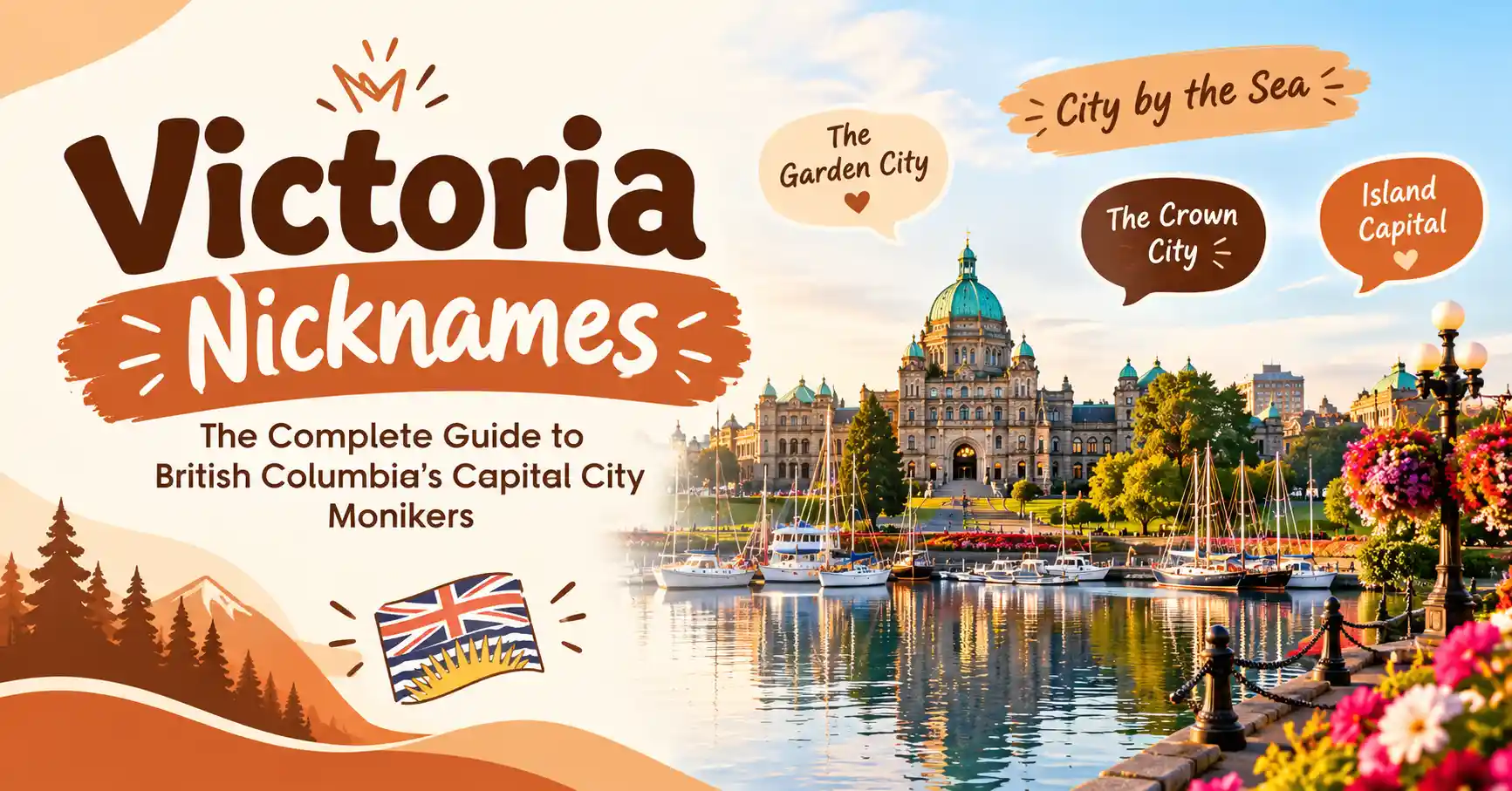
Victoria, British Columbia, sits gracefully on the southern tip of Vancouver Island, serving as the capital of Canada’s westernmost province. This charming city has earned several affectionate Victoria nicknames throughout its storied history, each reflecting a unique facet of its character, from its English heritage to its stunning floral displays.
The most famous nickname for Victoria is “The Garden City” due to its spectacular floral displays and mild climate. Other popular nicknames include “City of Gardens,” “The Most English City in Canada,” and “Retirement Capital of Canada.”
Quick Facts Table 📊
| Attribute | Details |
|---|---|
| City | Victoria |
| Province/Country | British Columbia, Canada |
| Official Nickname | None officially designated |
| Most Famous Nickname | The Garden City |
| Population | Approximately 92,000 (city proper); 400,000+ (metro) |
| Founded | 1843 (as Fort Victoria) |
| Incorporated | 1862 (City of Victoria) |
| Known For | Butchart Gardens, British colonial architecture, whale watching, mild climate |
| Provincial Capital | Yes, capital of British Columbia since 1871 |
Official Nickname of Victoria
Victoria does not have an officially designated nickname by any governmental body or municipal charter. However, “The Garden City” has achieved near-official status through decades of common usage, tourism marketing, and civic pride. The nickname is frequently used in official city publications, tourism materials from Destination Greater Victoria, and by locals themselves.
Unlike some cities that have passed resolutions or proclamations establishing official monikers, Victoria’s nicknames have evolved organically through public sentiment and historical circumstance. This organic development makes them arguably more authentic, as they reflect genuine public perception rather than bureaucratic designation.
What Are the Nicknames of Victoria? 🌺
Victoria’s nicknames fall into several distinct categories, each capturing different aspects of the city’s identity and character. Understanding these categories helps visitors and newcomers appreciate the full scope of what makes Victoria unique among Canadian cities.
Geographic and Natural Feature Nicknames
These nicknames draw from Victoria’s physical setting and natural attributes:
- The Garden City – References the city’s abundance of gardens, flower baskets, and year-round blooming plants
- City of Gardens – A variation emphasizing the diversity and quality of horticultural displays
- The Island City – Highlights its location on Vancouver Island, separate from mainland British Columbia
Cultural and Heritage Nicknames
These nicknames reflect Victoria’s British colonial roots and cultural character:
- The Most English City in Canada – Acknowledges the strong British influence on architecture, culture, and traditions
- Little England – An affectionate term for the city’s British character
- The Britannia of the Pacific – A historical reference to British naval influence
Lifestyle and Demographic Nicknames
These nicknames describe the city’s appeal to certain demographics:
- Retirement Capital of Canada – References the large retiree population drawn by mild climate and amenities
- The Garden of Eden – An idealized reference to the city’s beauty and pleasant living conditions
Historical and Functional Nicknames
These nicknames relate to Victoria’s historical role:
- The Provincial Capital – A functional descriptor of its governmental role
- The City of Newlyweds and Nearly-Deads – A humorous historical nickname referencing the city’s demographics
Complete List of Victoria Nicknames
| Nickname | Meaning | Origin | Popularity |
|---|---|---|---|
| The Garden City | City renowned for gardens and flowers | Early 1900s tourism promotion | Very High |
| City of Gardens | Emphasizes horticultural diversity | Tourism marketing evolution | Very High |
| Most English City in Canada | Strong British cultural influence | Historical observation, 20th century | High |
| Retirement Capital of Canada | Popular destination for retirees | Demographic observation, mid-1900s | High |
| Little England | British character and atmosphere | Early settlement period | Moderate |
| The Island City | Located on Vancouver Island | Geographic descriptor | Moderate |
| City of Newlyweds and Nearly-Deads | Humorous demographic observation | Mid-20th century colloquialism | Moderate |
| The Britannia of the Pacific | British naval and colonial heritage | 19th century British Empire era | Low |
| The Garden of Eden | Idealized paradise reference | Promotional literature | Low |
Most Popular Nicknames of Victoria
Among Victoria’s many nicknames, three stand out as most widely recognized and frequently used: “The Garden City,” “City of Gardens,” and “The Most English City in Canada.” These three capture the essence of Victoria’s identity and appear most frequently in tourism materials, local media, and casual conversation.
The Garden City and City of Gardens are often used interchangeably, though some locals distinguish between them. “The Garden City” tends to refer to the overall aesthetic and atmosphere of Victoria, while “City of Gardens” emphasizes the specific horticultural attractions and displays that draw visitors from around the world.
Main Nicknames Explained
The Garden City 🌷
Meaning: Victoria’s most celebrated nickname references its abundant gardens, flower displays, and year-round blooming vegetation. The city’s mild climate allows flowers to bloom throughout most of the year, creating a perpetual garden atmosphere.
Short Origin Story: The nickname emerged in the early 20th century as tourism promoters sought to distinguish Victoria from other Canadian cities. The city’s natural beauty, enhanced by deliberate horticultural planning, made “Garden City” a natural fit.
Historical Background: Victoria’s climate, one of the mildest in Canada, has always supported lush vegetation. Early settlers brought English gardening traditions, and the city’s parks department began extensive flower plantings in the late 1800s. By the 1920s, the nickname was firmly established.
Modern Usage: Today, “The Garden City” appears in tourism marketing, city publications, and everyday conversation. The City of Victoria maintains extensive flower baskets downtown, continuing the tradition that earned the nickname.
Cultural Impact: The nickname has shaped Victoria’s identity as a beautiful, peaceful destination. It influences everything from urban planning to tourism development, with the city investing significantly in maintaining its garden reputation.
Interesting Fact: Victoria maintains over 1,000 hanging flower baskets throughout downtown during summer months, requiring daily watering by a dedicated city crew.
City of Gardens 🏡
Meaning: Similar to “The Garden City,” this variation specifically emphasizes the diversity and quality of Victoria’s gardens, both public and private.
Short Origin Story: This nickname evolved alongside “The Garden City” as tourism marketing emphasized specific garden attractions like Butchart Gardens, Beacon Hill Park, and Government House Gardens.
Historical Background: The establishment of Butchart Gardens in 1904 transformed a depleted quarry into one of the world’s premier gardens, cementing Victoria’s garden reputation. Other significant gardens followed, creating a network of horticultural attractions.
Modern Usage: “City of Gardens” appears frequently in tourism materials and is often used to promote specific garden attractions. It emphasizes the variety of garden experiences available to visitors.
Cultural Impact: This nickname supports Victoria’s tourism economy by highlighting specific attractions. It also influences local pride in gardening and horticultural excellence.
Interesting Fact: Butchart Gardens alone receives over one million visitors annually and has been designated a National Historic Site of Canada.
The Most English City in Canada 🇬🇧
Meaning: This nickname acknowledges Victoria’s strong British cultural heritage, visible in its architecture, traditions, and institutions.
Short Origin Story: The nickname emerged from observations by visitors and writers who noted Victoria’s distinctly British character compared to other Canadian cities.
Historical Background: Victoria was established as a British colonial outpost in 1843 and served as the capital of the Colony of Vancouver Island. British settlers brought their customs, architecture, and institutions, creating a distinctly English atmosphere that persisted long after Canadian Confederation.
Modern Usage: The nickname remains common in tourism materials and is often used to describe the city’s character to potential visitors. Afternoon tea at the Fairmont Empress Hotel exemplifies this British tradition.
Cultural Impact: This nickname positions Victoria as a unique Canadian destination offering a taste of England without crossing the Atlantic. It influences tourism marketing and local cultural events.
Interesting Fact: The Fairmont Empress Hotel’s afternoon tea service has served over 5 million guests since 1908, making it one of Victoria’s most enduring British traditions.
Retirement Capital of Canada 👴
Meaning: This nickname references Victoria’s popularity as a retirement destination, drawn by its mild climate, beautiful surroundings, and high quality of life.
Short Origin Story: The nickname developed in the mid-20th century as retirees from across Canada, particularly from colder provinces, began relocating to Victoria.
Historical Background: Victoria’s mild climate, with rarely freezing temperatures and minimal snow, made it attractive to retirees seeking comfortable year-round living. The city’s amenities, including healthcare facilities and cultural attractions, reinforced its appeal.
Modern Usage: While sometimes used humorously, the nickname accurately reflects Victoria’s demographics. The city has a higher-than-average median age and significant retiree population.
Cultural Impact: This nickname has influenced everything from housing markets to healthcare services in Victoria. It has also created some tension, as younger residents sometimes struggle with housing costs driven partly by retiree demand.
Interesting Fact: Victoria’s median age is approximately 43 years, significantly higher than the Canadian average of about 41 years, though the gap has narrowed in recent years.
The Island City 🏝️
Meaning: This straightforward nickname references Victoria’s location on Vancouver Island, separated from mainland British Columbia by the Strait of Georgia.
Short Origin Story: The nickname emerged as a simple geographic descriptor, helping distinguish Victoria from mainland cities like Vancouver.
Historical Background: Victoria’s island location shaped its development significantly, requiring ferry and air connections to the mainland. This isolation contributed to the city’s unique character and slower pace of life.
Modern Usage: “The Island City” is used both descriptively and affectionately, capturing the sense of separation and uniqueness that island living creates.
Cultural Impact: The nickname reinforces Victoria’s identity as distinct from mainland British Columbia, with its own culture, pace, and priorities.
Interesting Fact: BC Ferries’ Swartz Bay terminal, serving Victoria, is one of the busiest ferry terminals in the world, handling millions of passengers annually.
Which Nickname Is Most Famous?
“The Garden City” stands as Victoria’s most famous nickname, recognized both nationally and internationally. Several factors explain its prominence:
Tourism Marketing: The nickname has been central to Victoria’s tourism branding for over a century, appearing in countless promotional materials, travel articles, and guidebooks.
Visual Confirmation: Visitors immediately understand the nickname upon arriving in Victoria, as the city’s gardens and flowers are visible everywhere. This creates a satisfying connection between expectation and reality.
Media Usage: Journalists and travel writers consistently use “The Garden City” when describing Victoria, reinforcing its association with the city.
Local Adoption: Victorians themselves embrace the nickname, using it with pride and incorporating it into local business names and marketing.
International Recognition: Unlike some nicknames that resonate primarily locally, “The Garden City” has achieved international recognition, helping position Victoria in the global tourism market.
How Victoria Got Its Nicknames
Victoria’s nicknames developed organically over more than a century, reflecting the city’s evolution from a British colonial outpost to a modern Canadian capital.
The earliest nicknames emerged from Victoria’s role as a colonial capital and naval base, with references to British character and imperial connections. As the city grew and developed its famous gardens, horticultural nicknames gained prominence. Tourism marketing in the early 20th century cemented these nicknames in public consciousness.
Demographic changes in the mid-20th century gave rise to lifestyle nicknames like “Retirement Capital of Canada.” These nicknames reflected observable social patterns rather than deliberate marketing efforts.
Today, Victoria’s nicknames coexist, each capturing different aspects of the city’s complex identity. Together, they paint a comprehensive picture of a city that is simultaneously British and Canadian, historic and modern, beautiful and livable.
Other Nicknames at a Glance
- The Provincial Capital – Functional reference to Victoria’s governmental role
- The City of Newlyweds and Nearly-Deads – Historical humorous nickname
- The Britannia of the Pacific – Victorian-era reference to British naval power
- The Garden of Eden – Idealized promotional nickname
- Chinatown’s Gateway – Reference to Victoria’s historic Chinatown, the oldest in Canada
- The Cycling Capital of Canada – Modern nickname referencing cycling infrastructure
- The Craft Beer Capital – Contemporary nickname for Victoria’s brewing scene
Fun Facts About Victoria 🎯
- Oldest Chinatown in Canada: Victoria’s Chinatown is the oldest in Canada and the second oldest in North America, established during the 1858 gold rush.
- Mile Zero: Victoria marks Mile Zero of the Trans-Canada Highway, which stretches over 7,800 kilometers to St. John’s, Newfoundland.
- Float Home Community: Victoria is home to one of North America’s largest float home communities, with hundreds of homes floating in its harbors.
- Mildest Climate in Canada: Victoria has the mildest climate of any Canadian city, with average winter temperatures rarely dropping below freezing.
- Historic Architecture: Victoria has more historic buildings per capita than any other Canadian city, with over 3,000 designated heritage properties.
- Cruise Ship Destination: Victoria is a popular cruise ship stop, with over 200 ship visits annually bringing more than 500,000 passengers.
- Government Street: This historic street has been a shopping destination since the 1850s and remains one of Canada’s most charming retail districts.
- Craigdarroch Castle: This Victorian-era mansion, completed in 1890, is one of Canada’s most visited historic homes.
- Beacon Hill Park: Established in 1882, this 75-hectare park is one of the oldest in Canada and home to free-roaming peacocks.
- Bastion Square: This historic square was the site of Victoria’s first courthouse and now hosts a popular summer market.
Famous Attractions in Victoria 🎡
Butchart Gardens: This world-renowned 55-acre garden attracts over one million visitors annually and features stunning displays across themed gardens, including the Sunken Garden, Rose Garden, and Japanese Garden.
Fairmont Empress Hotel: This iconic château-style hotel, opened in 1908, dominates Victoria’s Inner Harbour and is famous for its traditional afternoon tea service.
British Columbia Parliament Buildings: Completed in 1897, these grand buildings feature free guided tours and evening illumination with over 3,000 light bulbs.
Royal BC Museum: This world-class museum explores British Columbia’s natural and human history, including a compelling First Peoples gallery.
Beacon Hill Park: This 75-hectare park offers gardens, walking trails, playgrounds, and spectacular views of the Strait of Juan de Fuca.
Craigdarroch Castle: This historic mansion offers a glimpse into Victorian-era life with original furnishings and stunning woodwork.
Victoria Inner Harbour: The city’s picturesque harbor features street performers, water taxis, and stunning views of the Parliament Buildings and Empress Hotel.
Chinatown: Canada’s oldest Chinatown features the narrowest street in Canada (Fan Tan Alley), historic buildings, and excellent restaurants.
Nickname Comparison: Victoria vs Vancouver
🌹 Victoria Nicknames
- The Garden City – Floral beauty
- City of Gardens – Horticultural diversity
- Most English City – British heritage
- Retirement Capital – Demographics
- The Island City – Geographic location
🏔️ Vancouver Nicknames
- Hollywood North – Film industry
- Rain City – Weather patterns
- VanCity – Casual abbreviation
- Terminal City – Railway history
- Lotusland – Idealized reference
While Victoria and Vancouver are both major British Columbia cities, their nicknames reflect vastly different characteristics. Victoria’s nicknames emphasize beauty, heritage, and lifestyle, while Vancouver’s nicknames often reference its film industry, weather, and role as a transportation hub.
The comparison highlights how nicknames capture essential aspects of civic identity. Victoria’s “Garden City” emphasizes aesthetic beauty and quality of life, while Vancouver’s “Hollywood North” emphasizes economic activity and modern relevance. Together, they showcase the diversity of British Columbia’s urban centers.
Related Cities and Their Nicknames
🌲 Vancouver Nicknames
Hollywood North, Rain City, Terminal City
🏙️ Toronto Nicknames
The Six, Hogtown, T-Dot
☕ Seattle Nicknames
Emerald City, Jet City, Rain City
🌹 Portland Nicknames
Rose City, Bridgetown, Stumptown
🤠 Calgary Nicknames
Cowtown, Stampede City, Heart of the New West
🇺🇸 USA City Nicknames
Complete guide to American city nicknames
Frequently Asked Questions
What is the official nickname of Victoria, BC?
Victoria does not have an officially designated nickname. However, “The Garden City” has achieved near-official status through widespread usage in tourism marketing, city publications, and local conversation. It is the nickname most commonly associated with Victoria both locally and internationally.
Why is Victoria called “The Garden City”?
Victoria earned this nickname due to its abundance of gardens, flower displays, and year-round blooming vegetation. The city’s mild climate allows flowers to bloom throughout most of the year, and deliberate horticultural planning has created a garden-like atmosphere throughout the city. The nickname emerged in the early 20th century as tourism promoters highlighted Victoria’s natural beauty.
Who gave Victoria its nickname “The Garden City”?
The nickname developed organically rather than being attributed to a specific person. Early tourism promoters and journalists in the late 19th and early 20th centuries began using the term to describe Victoria’s beautiful surroundings. The nickname gained traction through tourism marketing and eventually became the city’s most recognized moniker.
When did Victoria’s nicknames become popular?
Most of Victoria’s nicknames emerged during the late 19th and early 20th centuries. “The Garden City” and “City of Gardens” became popular through tourism marketing in the early 1900s. “The Most English City in Canada” developed as visitors noted the city’s British character. “Retirement Capital of Canada” emerged in the mid-20th century as demographic patterns became apparent.
Do locals actually use these nicknames?
Yes, Victorians use these nicknames regularly, particularly “The Garden City” and “City of Gardens.” Local businesses incorporate the nicknames into their names and marketing. “The Most English City in Canada” is used with pride by many residents. “Retirement Capital of Canada” is sometimes used humorously, though it accurately reflects local demographics.
Conclusion
Victoria’s nicknames capture the essence of one of Canada’s most distinctive cities. From “The Garden City” to “The Most English City in Canada,” these monikers reflect Victoria’s natural beauty, British heritage, and unique character. Understanding these nicknames provides insight into what makes Victoria special among Canadian cities.
Whether you’re planning a visit or simply curious about this charming provincial capital, Victoria’s nicknames offer a window into its soul. The city’s commitment to maintaining its garden reputation, preserving its heritage, and offering an exceptional quality of life ensures these nicknames will remain relevant for generations to come.
For more information about Victoria’s history and attractions, visit Tourism Victoria, the official destination marketing organization for Greater Victoria.