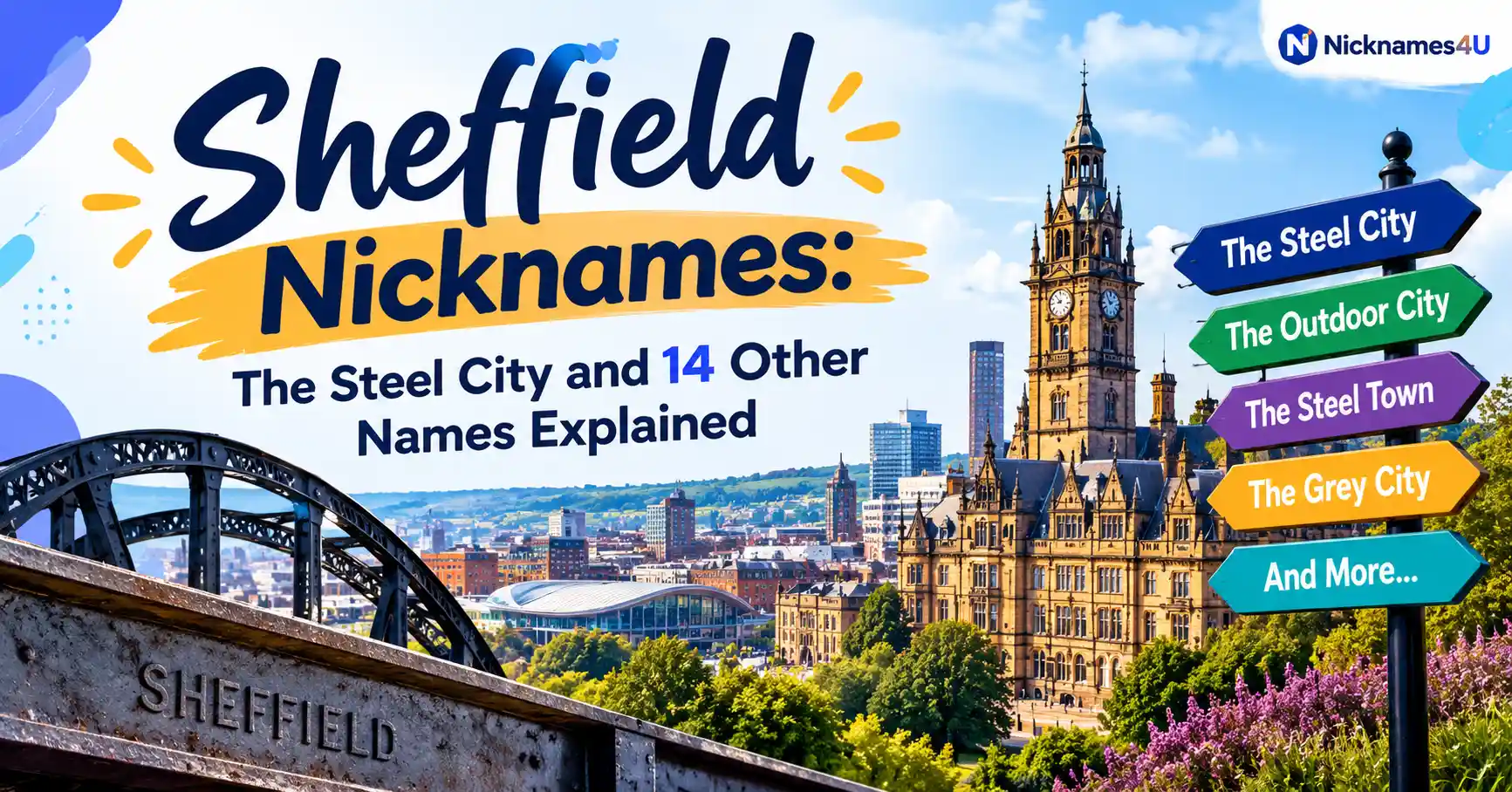
Sheffield is a city in South Yorkshire, England, built where five rivers meet and the Peak District begins. Forged by cutlery, steel, and a stubborn independent streak, it has collected a remarkable set of nicknames — some industrial, some geographic, and some proudly political.
Sheffield nicknames tell the story of a place that armed the world with knives and railway rails, then reinvented itself as England’s adventure capital. This guide draws on local history, council records, and long-standing civic usage to separate official names from affectionate ones — and to explain what each really means.
📊 Quick Facts About Sheffield
| Fact | Details |
|---|---|
| City | Sheffield |
| Region / Country | South Yorkshire, England, United Kingdom |
| Official Nickname | “The Outdoor City” (official city brand since 2015) |
| Most Famous Nickname | “The Steel City” |
| Population | Approx. 556,500 (2021 Census) |
| Founded | Recorded as Escafeld in the Domesday Book (1086); market charter 1297; city status 1893 |
| Area | About 142 sq mi (368 km²) |
| Known For | Steel and cutlery, stainless steel, Sheffield FC, snooker, the Peak District |
| Rivers | Five: Don, Sheaf, Rivelin, Loxley and Porter |
| Football Clubs | Sheffield United (The Blades) and Sheffield Wednesday (The Owls) |
| Sister “Steel City” | Pittsburgh, Pennsylvania, USA |
🔍 What Are the Sheffield Nicknames?
Sheffield has earned its names the slow way — through geography, industry, politics and sport. Most fall into four loose families: industrial names born of steel and cutlery, geographic names inspired by hills, rivers and green space, political names coined during the city’s radical council era, and sporting names tied to the world’s oldest football club and the Crucible Theatre.
🏛️ Official Nickname of Sheffield
Strictly speaking, Sheffield has no royal or statutory nickname. The closest thing to an official title is “The Outdoor City,” adopted by Sheffield City Council in 2015 as the city’s destination brand. It is a marketing identity rather than a legal designation.
Everything else — including “The Steel City” — is unofficial but widely recognised. Historians treat “The Steel City” as a historical and cultural nickname, while “The People’s Republic of Sheffield” is a political and satirical one. Locals use all of them freely, and few Sheffielders would argue that any single name captures the whole place.
🗂️ Categories of Sheffield Nicknames
- Industrial nicknames — The Steel City, City of Steel, Cutlery Capital of the World
- Geographic nicknames — The City of Seven Hills, City of Trees, England’s Greenest City
- Political nicknames — The People’s Republic of Sheffield, The Socialist Republic of South Yorkshire
- Sporting and cultural nicknames — The Home of Football, Snooker City, The Real Ale Capital
📋 Complete List of Sheffield Nicknames
| Nickname | Meaning | Origin | Popularity |
|---|---|---|---|
| The Steel City | Global centre of steelmaking | 19th-century steel boom | ★★★★★ |
| The Outdoor City | Gateway to the Peak District | Official brand, 2015 | ★★★★★ |
| The City of Seven Hills | Built across seven hills | Victorian comparisons with Rome | ★★★★☆ |
| The People’s Republic of Sheffield | Left-wing political identity | 1970s–80s council era | ★★★★☆ |
| The Socialist Republic of South Yorkshire | Radical municipal socialism | Rate-capping rebellion, 1985 | ★★★☆☆ |
| Cutlery Capital of the World | World leader in blade-making | 17th–19th century trade | ★★★★☆ |
| City of Trees | Exceptional tree cover | Civic planting and surveys | ★★★☆☆ |
| England’s Greenest City | Green space and national park access | Modern environmental branding | ★★★☆☆ |
| The Home of Football | Birthplace of club football | Sheffield FC founded 1857 | ★★★☆☆ |
| Snooker City | Home of the World Championship | Crucible Theatre, since 1977 | ★★★☆☆ |
| The Real Ale Capital | Legendary pub and brewery scene | 20th-century brewing culture | ★★☆☆☆ |
| City of Sanctuary | Welcome for refugees and migrants | Sanctuary status awarded 2007 | ★★☆☆☆ |
⭐ Most Popular Nicknames of Sheffield
Of all the Sheffield nicknames in circulation, a handful do most of the work. “The Steel City” dominates headlines, sports coverage and business names. “The Outdoor City” is now the name residents see on council campaigns and tourism boards. “The City of Seven Hills” remains a favourite in local writing, while the political nicknames survive as a badge of civic pride.
🔧 Main Sheffield Nicknames Explained
⚙️ The Steel City
Meaning: Sheffield as the beating heart of the global steel industry.
Short origin story: The name grew naturally in the 19th century, when the city’s crucible furnaces and Bessemer converters produced steel at a scale unmatched anywhere in the world.
Historical background: By the 1850s Sheffield was one of the most important steel-producing centres on earth. In 1913, metallurgist Harry Brearley developed stainless steel here, changing manufacturing forever.
Modern usage: Still the default nickname in media, sport and business — including the “Steel City derby” between Sheffield United and Sheffield Wednesday.
Cultural impact: It shapes the city’s self-image and its regeneration story, from Kelham Island to the Advanced Manufacturing Research Centre.
Interesting fact: Sheffield and Pittsburgh are sister “Steel Cities,” linked by a shared industrial heritage on opposite sides of the Atlantic.
🥾 The Outdoor City
Meaning: Sheffield as the UK’s most accessible city for outdoor adventure.
Short origin story: Sheffield City Council launched “The Outdoor City” as an official brand in 2015 to reposition the city after deindustrialisation.
Historical background: Roughly a third of Sheffield lies inside the Peak District National Park — a rarity for any European city.
Modern usage: Used across tourism campaigns, trail guides and cycling events.
Cultural impact: It reframed Sheffield from a fading industrial town to a destination for climbing, running, cycling and hiking.
Interesting fact: Around 60% of Sheffield is green space, and the city has more trees per person than any other in the UK.
⛰️ The City of Seven Hills
Meaning: Sheffield’s dramatic hilly terrain.
Short origin story: Victorian writers, struck by the city’s steep ridges and valleys, compared it to Rome.
Historical background: The settlement grew along the valleys of the Don, Sheaf, Porter, Rivelin and Loxley, climbing the slopes between them.
Modern usage: Common in local journalism, poetry and tourism copy.
Cultural impact: It explains Sheffield’s distinctive look — streets that tilt, views that open suddenly, and a skyline that never sits flat.
Interesting fact: Local lists of the “seven hills” vary, but Wincobank, Park Hill, Crookes and Gleadless are frequently named.
🚩 The People’s Republic of Sheffield
Meaning: A wry nod to the city’s fiercely left-wing politics.
Short origin story: Coined in the 1970s and 1980s, when Sheffield City Council pursued radical municipal socialist policies.
Historical background: Under leader David Blunkett, the council defied central government over rate capping in 1985 and declared Sheffield a Nuclear Free Zone in 1980 — the first UK city to do so.
Modern usage: Used affectionately by locals and satirically by national newspapers.
Cultural impact: It became shorthand for a city that does things its own way.
Interesting fact: The related phrase “Socialist Republic of South Yorkshire” was often used by critics — and cheerfully adopted by residents.
🌳 City of Trees
Meaning: Sheffield’s extraordinary tree cover.
Short origin story: Decades of civic planting, plus the city’s position in a wooded river valley, gave Sheffield one of Europe’s densest urban canopies.
Historical background: Estimates put Sheffield’s tree count at over two million — more trees per person than any other UK city.
Modern usage: Widely used by environmental groups and local campaigns.
Cultural impact: The city’s street-tree controversy of 2016–2018 turned the nickname into a rallying cry for residents.
Interesting fact: Sheffield has more woodland within its boundaries than any other English city.
🔪 Cutlery Capital of the World
Meaning: Sheffield’s historic dominance in blade and cutlery manufacturing.
Short origin story: The Company of Cutlers in Hallamshire was founded in 1624 to regulate the trade, and by the 19th century Sheffield tools were exported worldwide.
Historical background: The phrase “Made in Sheffield” became a globally recognised mark of quality.
Modern usage: Still used by heritage brands and the city’s cutlery museums.
Cultural impact: It explains why Sheffield’s identity is bound up with craft, precision and metalwork.
Interesting fact: The “Made in Sheffield” trademark is one of the oldest protected product marks in the world.
⚽ The Home of Football
Meaning: Sheffield as the birthplace of organised club football.
Short origin story: Sheffield FC was founded in 1857 and is recognised as the world’s oldest football club.
Historical background: The “Sheffield Rules” shaped the modern game, and Bramall Lane is the world’s oldest major football stadium still in use.
Modern usage: Promoted by Sheffield FC and local heritage campaigns.
Cultural impact: It gives the city a genuine claim to a sport now played across the planet.
Interesting fact: Bramall Lane hosted the first floodlit football match in 1878.
🎱 Snooker City
Meaning: Sheffield as the spiritual home of professional snooker.
Short origin story: The Crucible Theatre began hosting the World Snooker Championship in 1977.
Historical background: The tournament has been staged there ever since, becoming a British sporting institution.
Modern usage: Used by broadcasters and tourism bodies every spring.
Cultural impact: For two weeks a year, Sheffield becomes the centre of the snooker world.
Interesting fact: The Crucible’s contract to host the World Championship has been extended well into the 2020s.
🏆 Which Nickname Is Most Famous?
“The Steel City” is by far the most famous. It appears in global media, sports coverage and business branding, and it is the name most non-Brits associate with Sheffield. Its strength lies in accuracy: Sheffield really did help build the modern world in steel. “The Outdoor City” is the most official, and “The City of Seven Hills” is the most poetic — but none has the reach of The Steel City.
📜 How Sheffield Got Its Nicknames
Sheffield’s nicknames arrived in waves. The industrial names came first, born from the cutlery workshops and steel mills that made the city wealthy. Geographic names followed as writers and visitors tried to capture the city’s unusual hill-and-valley shape. Political names emerged in the turbulent 1970s and 1980s, when Sheffield’s council clashed with Westminster. The most recent names — The Outdoor City and England’s Greenest City — reflect a city rebuilding its reputation around landscape and lifestyle rather than manufacturing.
📝 Other Nicknames at a Glance
- The City of Steel — a simple variant of The Steel City
- The Steel City of the North — used to distinguish it from Pittsburgh
- The Socialist Republic of Sheffield — the political nickname’s shorter cousin
- The Cutlery City — a shorthand for its blade-making past
- The Green City — a companion to England’s Greenest City
- The Walking City — an occasional outdoor-tourism label
- The People’s City — a warmer, less satirical version of the political name
🎉 Fun Facts About Sheffield
- Sheffield FC, founded in 1857, is the world’s oldest football club.
- Stainless steel was invented in Sheffield in 1913 by Harry Brearley.
- The city has roughly two million trees — more per person than any other UK city.
- Bramall Lane is the oldest major football stadium still in use anywhere in the world.
- Sheffield is built around five rivers: the Don, Sheaf, Rivelin, Loxley and Porter.
- The city’s name comes from the River Sheaf — “Sheaf field,” or open land by the water.
- Sheffield was the first UK city to declare itself a Nuclear Free Zone, in 1980.
- Around a third of the city lies within the Peak District National Park.
- The World Snooker Championship has been held at the Crucible since 1977.
- The 1997 film The Full Monty was set and filmed in Sheffield.
🎡 Famous Attractions in Sheffield
Sheffield’s attractions mirror its nicknames. For the outdoor side, there is the Peak District National Park, Stanage Edge and Endcliffe Park. For industrial heritage, visit Kelham Island Museum, the Millennium Gallery and the Winter Garden. Culture seekers head to the Crucible Theatre, Sheffield Cathedral and Sheffield City Hall, while families gravitate to Meadowhall, Weston Park Museum and Graves Park. Chatsworth House sits just beyond the city boundary in Derbyshire.
⚖️ Nickname Comparison: Sheffield vs Pittsburgh
🔴 Sheffield, England
- Primary: The Steel City
- Official: The Outdoor City
- Poetic: City of Seven Hills
- Political: People’s Republic of Sheffield
- Rivers: Five
- Signature: Peak District access
🔵 Pittsburgh, USA
- Primary: The Steel City
- Also known as: Iron City
- Famous for: City of Bridges (446)
- Sporting: City of Champions
- Rivers: Three
- Signature: Three Rivers confluence
| Shared Trait | Sheffield | Pittsburgh |
|---|---|---|
| Steel heritage | Crucible & stainless steel | Andrew Carnegie & US Steel |
| Reinvention | Outdoor & advanced manufacturing | Medicine, tech & robotics |
| Hilly terrain | City of Seven Hills | Built on steep river bluffs |
| Sports passion | Football & snooker | NFL, NHL & MLB |
🔗 Related Cities and Their Nicknames
❓ Frequently Asked Questions
What is the official nickname of Sheffield?
Sheffield has no statutory nickname. “The Outdoor City” is the closest thing to an official title, adopted by Sheffield City Council in 2015 as the city’s destination brand.
Why is Sheffield called The Steel City?
Because Sheffield was one of the world’s leading steel-producing centres in the 19th and 20th centuries. Its crucible furnaces, Bessemer converters and later stainless steel innovation made the name stick.
Who gave Sheffield the nickname The Steel City?
No single person coined it. The name emerged organically during the Industrial Revolution as journalists, traders and residents recognised the city’s dominance in steel production.
When did Sheffield nicknames become popular?
Industrial names like The Steel City took hold in the 19th century. The political names appeared in the 1970s and 1980s, and The Outdoor City arrived in 2015.
Do locals actually use these nicknames?
Yes — “The Steel City” is used constantly in sport and media, while “The People’s Republic of Sheffield” is used affectionately and ironically by residents themselves.
🏁 Conclusion
Sheffield nicknames are more than labels — they are a compressed history of a city that made cutlery for the world, forged steel for its railways, argued loudly with its own government, and then discovered that its hills, rivers and trees were an asset all along. Whether you call it The Steel City, The Outdoor City or the People’s Republic of Sheffield, each name captures a genuine part of the city’s character.
For official information on the city, its services and its heritage, visit Sheffield City Council — the most authoritative source on the city’s modern identity.