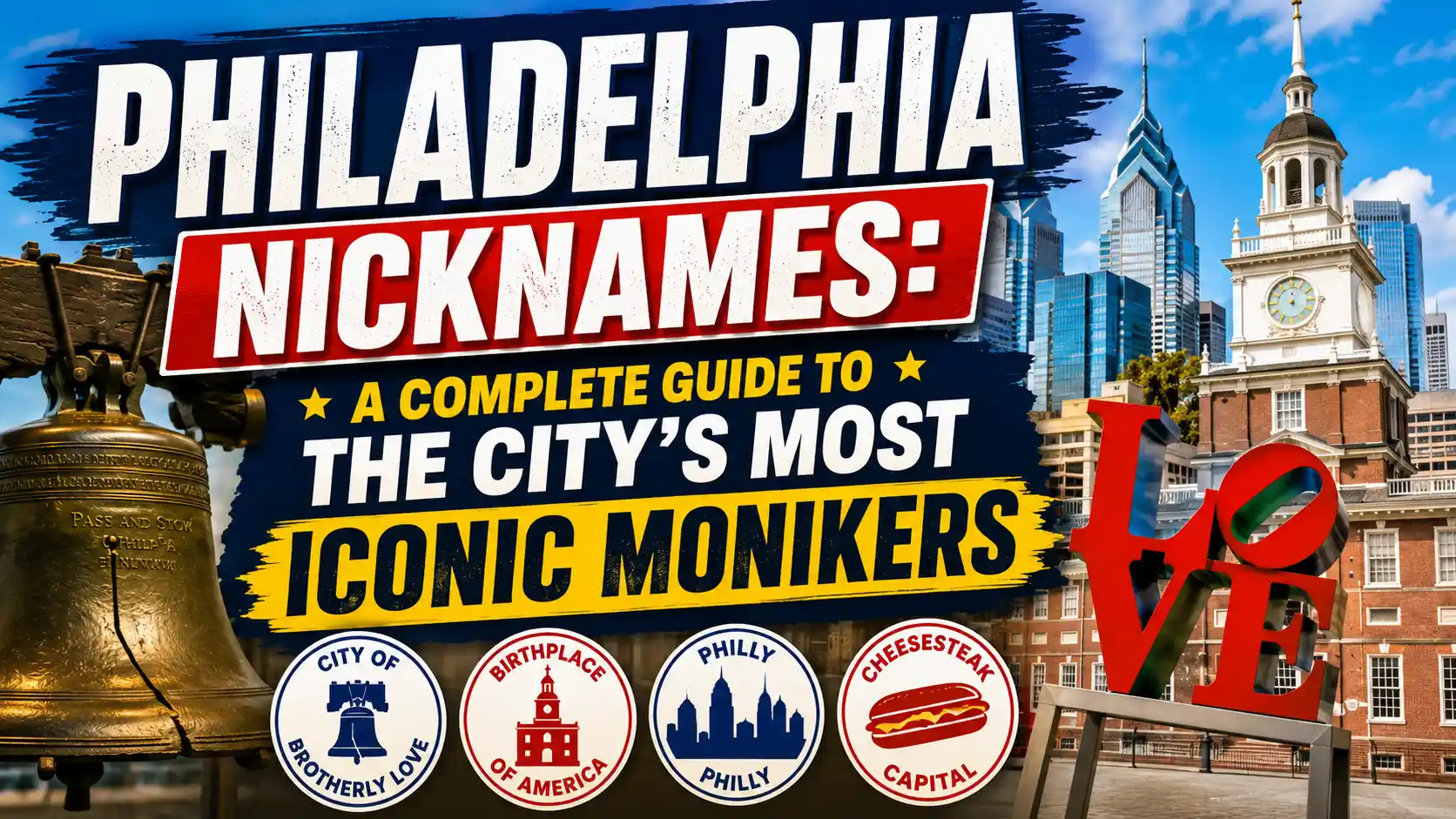
Philadelphia wears its history on its sleeve—and in its many nicknames. From the globally recognized “City of Brotherly Love” to the gritty street name “Killadelphia,” each moniker tells a piece of the city’s story. Whether you’re a traveler, a history buff, or a local looking to understand the roots of Philly’s identity, this guide unpacks every major Philadelphia nickname, its meaning, and how it came to be.
💡 Quick Answer – What Are the Most Famous Philadelphia Nicknames?
The most famous nickname of Philadelphia is “The City of Brotherly Love.” Other widely used nicknames include “Philly,” “The Quaker City,” “The Birthplace of America,” “The Cradle of Liberty,” and “The Athens of America.” Locals also use the straightforward abbreviation “Philly” more than any other name in everyday conversation.
📊 Philadelphia Quick Facts
🏛️ Official Nickname of Philadelphia
Philadelphia does not have a nickname officially codified by city ordinance or state law. However, “The City of Brotherly Love” is universally treated as the official moniker. It appears on city seals, in tourism branding, and in everyday civic language. The name is a direct translation of the Greek roots phileo (love) and adelphos (brother) that make up the city’s very name, chosen by founder William Penn. So while there’s no legal document declaring it, culturally and historically, “City of Brotherly Love” holds official status in all but paperwork.
🧭 What Are the Nicknames of Philadelphia?
Philadelphia’s nicknames span the sentimental, the historical, and the brutally honest. Some celebrate the city’s role in America’s founding; others highlight its industrial might or its neighborhood character. A few unflattering terms reflect struggles with crime or gritty urban life. Together they form a linguistic mirror of Philly’s complex personality.
🏙️ Complete List of Philadelphia Nicknames
🌟 Most Popular Philadelphia Nicknames
Among the many Philadelphia nicknames, a few dominate the conversation. “The City of Brotherly Love” is the undisputed heavyweight—instantly recognizable and tied directly to the city’s founding. “Philly” is the casual, everyday name that everyone uses. “The Quaker City” remains a dignified historical badge, while “The Birthplace of America” and “The Cradle of Liberty” are rallying cries for tourism and patriotism. The less flattering names exist in a raw, unfiltered subculture of self-deprecating local humor and outsider commentary.
🧨 Main Nicknames Explained
💕 The City of Brotherly Love
- Meaning: A direct translation of “Philadelphia” – from the Greek phileo (love) and adelphos (brother).
- Short Origin Story: Founder William Penn, a Quaker, named the city to reflect ideals of peace, tolerance, and familial love among settlers.
- Historical Background: Penn landed in 1682 and chose the name deliberately as a statement against the religious persecution he had faced in England. He envisioned a “holy experiment” where people of all faiths would live as brothers.
- Modern Usage: Pervasive in branding, sports, media, and everyday speech. “Brotherly Love” appears on tourism materials, murals, and the city’s official website.
- Cultural Impact: The nickname sets an aspirational tone. It’s woven into the city’s identity, even when reality falls short—locals often joke about the irony on aggressive sports days.
- Interesting Fact: The official city seal includes the motto “Philadelphia Maneto” (“Let brotherly love continue”), reinforcing the Greek roots.
🥨 Philly
- Meaning: Simply a shortened, affectionate form of Philadelphia.
- Short Origin Story: Emerged naturally in the 19th century as a convenient diminutive, much like “Frisco” for San Francisco.
- Historical Background: Appears in newspapers and letters by the mid-1800s. The spelling “Philly” gradually standardized.
- Modern Usage: Universally used in conversation, by sports fans (“Go Philly!”), in business names, and in pop culture.
- Cultural Impact: It’s the most intimate and democratic nickname. No one asks “Where’s the cheese steak from?” without hearing “Philly.”
- Interesting Fact: The Philadelphia Phillies baseball team intentionally chose a name that echoes the nickname, first as “Philadelphias,” then “Phillies.”
⛪ The Quaker City
- Meaning: Refers to the religious Society of Friends (Quakers) who founded and shaped early Philadelphia.
- Short Origin Story: William Penn was a prominent Quaker; the city’s early government and culture reflected Quaker principles of pacifism, simplicity, and equality.
- Historical Background: For much of the 18th and 19th centuries, Philadelphia was known nationally as the Quaker City. Writers like Charles Dickens noted it.
- Modern Usage: Still used in institutional names (e.g., Quaker City Mercantile) and historical references. It evokes an old-fashioned, ethical charm.
- Cultural Impact: The nickname underscores the city’s unique progressive roots, such as early advocacy for abolition and religious freedom.
- Interesting Fact: The “Quaker Oats” brand, though founded in Ohio, borrowed its name and iconic image from the Quaker reputation for honesty and purity associated with Philadelphia’s founders—no direct link, but culturally resonant.
🇺🇸 The Birthplace of America
- Meaning: Philadelphia is where both the Declaration of Independence (1776) and the U.S. Constitution (1787) were debated and signed.
- Short Origin Story: The Continental Congress met in Independence Hall. The foundational documents of the United States were created here.
- Historical Background: The city served as the temporary capital of the U.S. from 1790 to 1800 while Washington D.C. was being built.
- Modern Usage: Heavily promoted by heritage tourism. National Park Service sites all use the phrase “Birthplace of American Democracy.”
- Cultural Impact: It instills immense civic pride and defines much of the city’s visitor economy. Schoolchildren nationwide learn Philadelphia’s role.
- Interesting Fact: The first public reading of the Declaration of Independence happened in Philadelphia’s Independence Square on July 8, 1776.
🔔 The Cradle of Liberty
- Meaning: The city nurtured and gave life to the liberty movement that led to the American Revolution.
- Short Origin Story: Coined in the 19th century as reverence for the Revolution grew, heavily linked to the Liberty Bell.
- Historical Background: Abolitionists in the 1830s adopted the Liberty Bell as a symbol, cementing “Cradle of Liberty” for the city.
- Modern Usage: Found on monuments, plaques, and in civic speeches. Less daily usage, but instantly recognized.
- Cultural Impact: Reinforces Philadelphia’s moral authority in American history. The phrase itself is a powerful brand.
- Interesting Fact: The Liberty Bell originally cracked on its first ring in 1752 and was recast twice—yet its imperfect sound became a perfect symbol.
🏛️ The Athens of America
- Meaning: In the early United States, Philadelphia was the unrivaled center of learning, arts, and culture, akin to ancient Athens.
- Short Origin Story: Writers and visitors in the late 1700s and early 1800s marveled at the city’s institutions—the first library, first medical school, first art academy.
- Historical Background: Benjamin Franklin founded the American Philosophical Society, the University of Pennsylvania, and the Library Company. Philadelphia had the country’s first theater and first museum.
- Modern Usage: Now a proud historical footnote; occasionally used by cultural organizations.
- Cultural Impact: It reminds people that Philadelphia’s influence extends beyond politics into intellectual and artistic realms.
- Interesting Fact: Thomas Jefferson’s vast personal library, sold to the government, became the foundation of the Library of Congress, but his literary spirit was nurtured in Philadelphia’s bookshops.
🏭 The Workshop of the World
- Meaning: Philadelphia was once a massive manufacturing hub producing everything from locomotives to textiles.
- Short Origin Story: The phrase gained popularity in the late 19th and early 20th centuries, when the city’s industrial output was among the highest in the world.
- Historical Background: Companies like Baldwin Locomotive Works and Stetson Hat Company dominated global markets. Diverse, small-to-midsize factories defined neighborhoods.
- Modern Usage: Used nostalgically and in discussions about the city’s post-industrial transformation.
- Cultural Impact: It explains the blue-collar, gritty ethos that still permeates Philadelphia’s identity.
- Interesting Fact: At its peak, Philadelphia produced more textiles than any other city in the U.S., and the Baldwin works built tens of thousands of steam locomotives.
🏘️ The City of Neighborhoods
- Meaning: Philadelphia is a patchwork of over 100 distinct, close-knit neighborhoods, each with its own character.
- Short Origin Story: Urban planners and sociologists in the 20th century noted that unlike many cities, Philly’s life happens in its neighborhoods, not just downtown.
- Historical Background: Immigrant waves—Italian, Irish, Polish, African American, Puerto Rican—shaped enclaves like South Philly, Germantown, Fishtown, and Chinatown.
- Modern Usage: A source of fierce local pride; residents identify by neighborhood first.
- Cultural Impact: The nickname underscores community resilience and is used in grassroots placemaking.
- Interesting Fact: Many neighborhoods even have their own distinct accents and food specialties within Philadelphia.
💀 Killadelphia
- Meaning: A dark nickname referencing violent crime and high murder rates.
- Short Origin Story: Emerged in the late 20th century as homicide numbers spiked, and was popularized by hip-hop lyrics and local media.
- Historical Background: Homicide rates peaked during the crack epidemic of the 1990s and again in the 2020s. The term became national news.
- Modern Usage: Used critically, sometimes by locals as a gritty badge of authenticity, but often by outsiders to stigmatize.
- Cultural Impact: It’s controversial. Many Philadelphians reject it, while artists sometimes reclaim it to highlight systemic issues.
- Interesting Fact: Rapper Meek Mill’s lyrics and album titles frequently reference “Killadelphia,” embedding it in contemporary hip-hop culture.
❓ Which Nickname Is Most Famous?
Without question, “The City of Brotherly Love” is Philadelphia’s most famous nickname. It’s printed on signage, tourism brochures, sports broadcasts, and it’s the first phrase anyone learns when studying American history. The name itself is the city’s etymological DNA. While “Philly” might win for everyday usage, “City of Brotherly Love” holds the crown for recognition and symbolic weight.
📜 How Philadelphia Got Its Nicknames
Philadelphia’s nicknames stem from four main sources: its Greek name and founder’s vision, its unparalleled Revolutionary-era history, its industrial and architectural character, and its modern urban realities. William Penn’s idealism gave us the affectionate cornerstone. The pivotal events of 1776–1787 created the patriotic monikers. The sheer scale of manufacturing produced “Workshop of the World,” and the dense rows of homes created “City of Homes.” Meanwhile, street-level language—both celebratory and critical—added “Philly,” “Illadelph,” and the harsher “Killadelphia.” Together these Philadelphia nicknames form a layered, honest, and occasionally contradictory portrait of a city that has never been simple.
📋 Other Nicknames at a Glance
- City of Brotherly Shove – A sarcastic twist on the official motto, sometimes used for aggressive driving or sports.
- The Sixth Borough – A cheeky reference to its proximity to New York City and cultural overlaps.
- Phillywood – Occasionally used for the city’s film and TV production scene (e.g., “Rocky,” “Philadelphia”).
- America’s Garden Capital – Tied to the region’s public gardens and the Philadelphia Flower Show.
- The River City – Descriptive of the Delaware and Schuylkill rivers defining its geography.
🎉 Fun Facts About Philadelphia
- Philadelphia was once the second-largest city in the British Empire after London.
- The city’s Mural Arts Program has produced over 4,000 murals, making it the “Mural Capital of the World.”
- The famous “Rocky Steps” at the Philadelphia Museum of Art are exactly 72 stone steps.
- Philadelphia has the oldest continuously operating farmers’ market in the U.S., the Reading Terminal Market (since 1893).
- The first-ever daily newspaper, The Pennsylvania Packet and Daily Advertiser, was published in Philadelphia in 1784.
- The city is home to the nation’s first zoo, the Philadelphia Zoo, which opened in 1874.
- Philadelphia’s city hall was the tallest habitable building in the world from 1901 to 1908.
- The cheesesteak was invented in the 1930s by Pat Olivieri, a hot dog vendor in South Philly.
🏆 Famous Attractions in Philadelphia
- Independence National Historical Park – Home to Independence Hall and the Liberty Bell, the literal birthplace of the United States.
- Philadelphia Museum of Art & the “Rocky Steps” – A world-class collection and an iconic movie moment.
- Reading Terminal Market – A food lover’s paradise with Amish specialties, cheesesteaks, and more.
- Eastern State Penitentiary – An eerie, castle-like former prison that pioneered solitary confinement.
- Barnes Foundation – An unparalleled collection of Impressionist and Modernist art.
- Boathouse Row – A picturesque string of historic rowing clubs along the Schuylkill River, beautifully lit at night.
- Spruce Street Harbor Park – A summertime urban beach with hammocks and colorful lights.
- Franklin Institute – A hands-on science museum carrying on Benjamin Franklin’s spirit.
Rising from the Sonoran Desert, the Valley of the Sun radiates a distinct vibe captured in the Phoenix’s sun-soaked nicknames that locals wear like a badge of honor.
⚖️ Nickname Comparison: Philadelphia vs. Boston Nicknames
Both cities are cornerstones of American history, and their nicknames reflect parallel but distinct identities.
🔔 Philadelphia Nicknames
- The City of Brotherly Love
- The Birthplace of America
- The Cradle of Liberty
- The Quaker City
- Philly
- Athens of America (historical)
🍀 Boston Nicknames
- Beantown
- The Cradle of Liberty (shared)
- The Hub (Hub of the Universe)
- City on a Hill
- Athénai of America (historical)
- Titletown (sports)
While Philadelphia is defined by its founding ideals of brotherly love and its role as the literal birthplace of the nation, Boston calls itself “The Hub” and leans on its revolutionary fervor with shared “Cradle of Liberty” usage. Both cities fought over the “Athens of America” title in the early republic, but today Philadelphia’s patriotic nicknames are more tightly bound to the actual documents of independence. For more on how East Coast rival cities brand themselves, read our deep dive into Boston Nicknames.
🗺️ Related Cities and Their Nicknames
❔ Frequently Asked Questions
What is the official nickname of Philadelphia?
Philadelphia does not have a legally designated official nickname, but “The City of Brotherly Love” is universally recognized as the de facto official nickname, directly translating the city’s Greek name.
Why is Philadelphia called the City of Brotherly Love?
Founder William Penn named it after the Greek words phileo (love) and adelphos (brother) to symbolize religious tolerance and peaceful co-existence in his new colony.
Who gave Philadelphia its nickname “The Quaker City”?
The nickname emerged naturally from the city’s founding by Quaker William Penn and the early dominance of Quaker values. It was widely used in the 18th and 19th centuries by residents and visitors alike.
When did the nickname “Philly” become popular?
“Philly” began appearing in print in the 19th century and became the dominant casual shorthand by the early 20th century. Today it’s the most frequently used name for the city in everyday speech.
What are the negative nicknames of Philadelphia?
“Killadelphia” and “Filthadelphia” are negative nicknames that criticize the city’s crime rates and perceived cleanliness. They remain controversial and are often used in media or satirically by locals.
💭 Conclusion
Philadelphia’s nicknames are a fascinating collage of ideals, history, industry, and raw reality. From the lofty “City of Brotherly Love” to the unvarnished “Killadelphia,” each label reveals a layer of what this resilient city has been and continues to be. Whether you’re drawn by the patriotic echoes of “The Cradle of Liberty” or the cozy familiarity of “Philly,” understanding these Philadelphia nicknames deepens your appreciation for one of America’s most historically significant cities. For a deeper dive into the etymology and Quaker roots that started it all, the authoritative resource at the Encyclopedia of Greater Philadelphia provides extensively researched articles.