Nestled on Florida’s far western panhandle, Pensacola pairs sugar‑white sands with a past that reads like an epic novel. The city has collected a vibrant set of Pensacola nicknames over more than 460 years, each one a window into a different chapter of its soul — from Spanish conquistadors to screaming Blue Angels. If you’ve ever wondered why a single city answers to so many names, you’re in the perfect place.
Understanding the city’s nicknames is like holding a key to the Gulf Coast’s richest history. The most famous, “The City of Five Flags,” instantly tells you that Pensacola isn’t just another beach town — it’s a place where empires collided. Whether you’re a history lover, a naval aviation fan, or simply a traveler collecting stories, this definitive guide to Pensacola nicknames will take you from the official moniker to the slang only locals use.
The most famous nickname of Pensacola is “The City of Five Flags.” Other well-known Pensacola nicknames include “The Cradle of Naval Aviation,” “P-Cola,” “The Western Gate to the Sunshine State,” and “The Red Snapper Capital of the World.”
| 📍 Quick Facts | |
|---|---|
| City | Pensacola |
| State / Country | Florida, United States 🇺🇸 |
| Official Nickname | The City of Five Flags |
| Most Famous Nickname | The City of Five Flags ⭐ |
| Population (City) | ~54,000 (Metro: ~530,000) |
| Founded | 1559 (by Don Tristán de Luna) |
| Known For | Naval aviation, Blue Angels, historic districts, sugar‑sand beaches |
| More | Home to the world’s largest naval aviation museum & the Fiesta of Five Flags |
🏛️ Pensacola Nicknames: The Official “City of Five Flags”
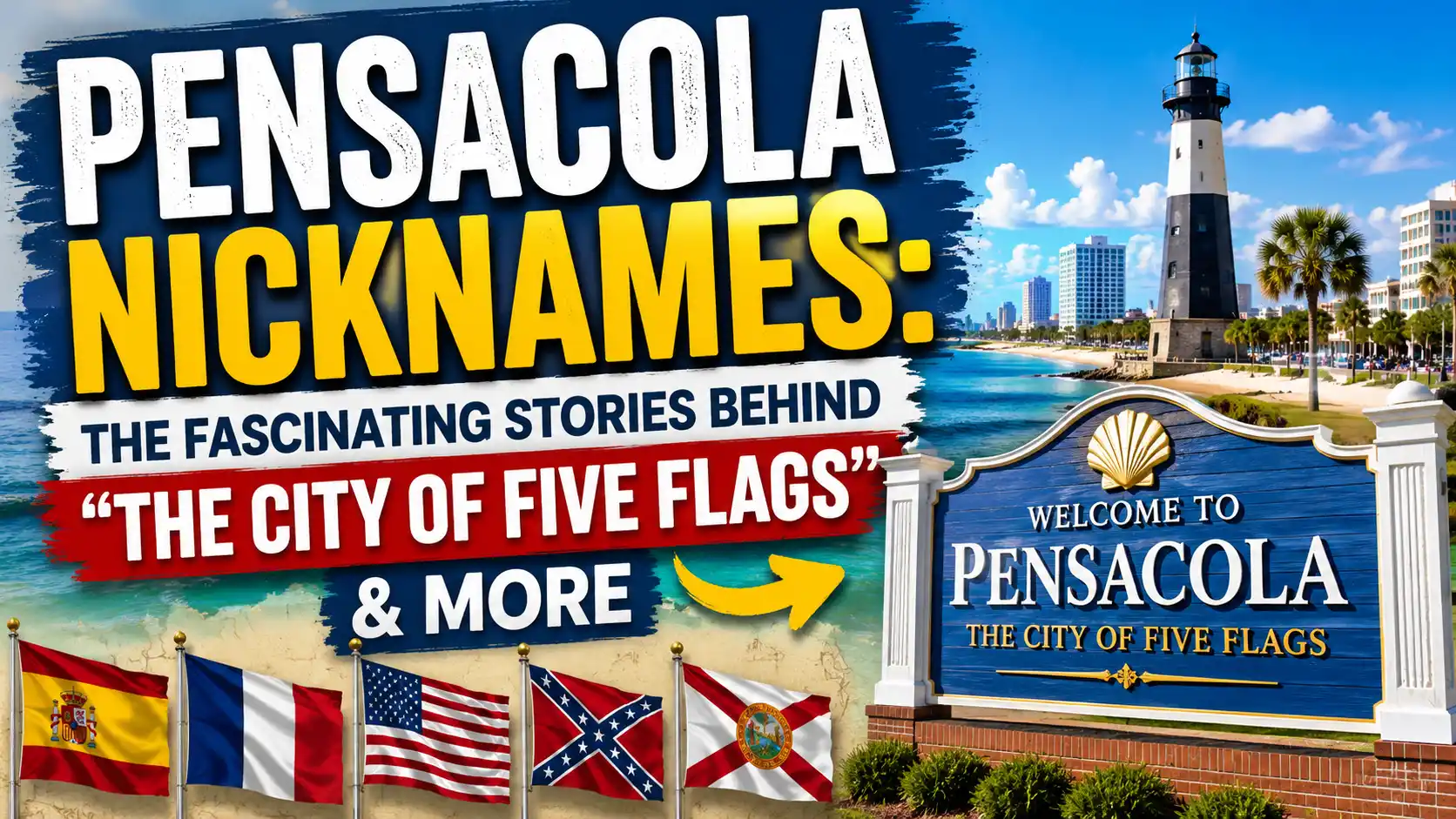
Although Pensacola wears many titles, only one holds the weight of official recognition. The City of Five Flags is the city’s formal, government‑adopted nickname — it appears on the city seal, on welcome signs, and in the branding of countless local businesses. The name was chosen to honor the five different governments that have flown their flags over Pensacola since the 16th century: Spain, France, Great Britain, the Confederate States of America, and the United States of America. (Some historical interpretations also include the short‑lived Republic of West Florida banner, but the “five” refers to the dominant sovereignties that shaped the region.)
This official nickname isn’t just decorative; it’s the foundation of Pensacola’s identity. The Fiesta of Five Flags, held annually since 1949, celebrates this layered heritage with parades, music, and a city‑wide embrace of its multicultural DNA. When you see the five flags flying together in the historic district, you’re witnessing a rare American municipality that wears its colonial scars proudly and has turned a complicated past into a unifying symbol.
📖 What Are the Nicknames of Pensacola?
The nicknames of Pensacola fall into distinct categories that mirror the city’s history, geography, military might, and relaxed coastal culture. You’ll hear everything from official titles that sound like they belong on a history plaque to local shorthand that rolls off the tongue on a hot summer day. Together, they reveal how Pensacola sees itself — and how the world sees it.
- Historical nicknames center on the city’s colonial legacy and the rare distinction of five ruling flags.
- Military‑aerospace nicknames highlight Pensacola’s unmatched role in naval flight training.
- Geographic nicknames position Pensacola as the entryway to Florida from the west.
- Colloquial & culinary nicknames reflect the city’s personality, seafood obsession, and local lingo.
Below is a complete breakdown of every major nickname you’ll encounter.
| 🏷️ Nickname | 🧠 Meaning | 📜 Origin | ⭐ Popularity |
|---|---|---|---|
| The City of Five Flags | Represents five governments that ruled Pensacola | Spain, France, Britain, Confederacy, USA | 🔴 Very High (Official) |
| The Cradle of Naval Aviation | Birthplace of U.S. naval flight training | NAS Pensacola established 1914 | 🟠 High |
| P-Cola | Affectionate, snappy abbreviation | Local slang, early 20th century | 🟠 High (Locals) |
| The Western Gate to the Sunshine State | First major Florida city when entering from Alabama | I‑10 tourism & highway branding | 🟡 Moderate |
| The Red Snapper Capital of the World | Boast of premier red snapper fishing | Long fishing heritage, Gulf Pier | 🟡 Moderate |
| America’s First Settlement (Disputed) | Claims primacy over St. Augustine | Don Tristán de Luna’s 1559 colony | 🟢 Lower / Controversial |
👑 Most Popular Nicknames of Pensacola
Among the many monikers, five stand out for their frequent use by tourists, historians, and locals alike. The popularity of each nickname depends on context — you’ll hear “City of Five Flags” at a festival, “Cradle of Naval Aviation” in documentaries, and “P‑Cola” tossed casually between friends. Together they create a layered verbal identity that instantly communicates what makes this Florida Panhandle city special.
📍 Main Nicknames Explained
🇪🇸 The City of Five Flags
- Meaning: A direct reference to the five sovereignties — Spanish, French, British, Confederate, and United States — that have governed Pensacola.
- Short Origin Story: After Don Tristán de Luna planted the Spanish flag in 1559, control of the area shifted repeatedly due to wars and treaties. Each transfer brought a new flag, and the city began actively honoring this unique pattern in the mid‑20th century.
- Historical Background: Spain founded the settlement, France briefly held it, Britain occupied it after the Seven Years’ War, Spain regained it, then the U.S. took control in 1821. The Confederate flag flew during the Civil War. Today, all five flags are flown ceremonially in the historic district.
- Modern Usage: It’s the official branding of the city, used in logos, on the website of Visit Pensacola, and as the centerpiece of the annual Fiesta of Five Flags.
- Cultural Impact: The nickname transforms Pensacola’s complex colonial past into a source of pride rather than division. The Fiesta attracts tens of thousands of visitors each June.
- Interesting Fact: The Fiesta of Five Flags originated in 1949 as a historical pageant and has grown into a 10‑day celebration with parades, masked balls, and the crowning of a Fiesta queen.
✈️ The Cradle of Naval Aviation
- Meaning: Pensacola is recognized as the birthplace of U.S. naval aviation training.
- Short Origin Story: The Navy established its first aeronautical station on the abandoned grounds of the old Pensacola Navy Yard in 1914. The warm, year‑round flying conditions made it the perfect flight school.
- Historical Background: The Pensacola Naval Air Station (NAS Pensacola) quickly became the primary training base for naval aviators, a role it still proudly fills today. Every Navy, Marine Corps, and Coast Guard aviator passes through Pensacola’s hallowed hangars.
- Modern Usage: The nickname is widely used by the military community and in tourism marketing. The base is open to visitors through the National Naval Aviation Museum.
- Cultural Impact: The Blue Angels, the Navy’s flight demonstration squadron, are headquartered here, linking the city inextricably to jet‑powered precision. Watching them practice over Pensacola Beach is a local rite of passage.
- Interesting Fact: The museum on base houses over 150 beautifully restored aircraft and is the world’s largest naval aviation museum — admission is free.
🥤 P-Cola
- Meaning: A casual, affectionate abbreviation of Pensacola, much like “Philly” for Philadelphia.
- Short Origin Story: The exact birth of “P‑Cola” is hard to date, but it became popular in the early to mid‑20th century as newspaper headlines and local radio stations sought a snappy shorthand. It stuck with younger crowds and local businesses.
- Historical Background: No grand political event, just the organic evolution of language in a tight‑knit coastal city.
- Modern Usage: You’ll see it on T‑shirts, beer koozies, Instagram hashtags, and in the name of dive bars. Saying “I’m headed to P‑Cola for the weekend” instantly marks you as someone in the know.
- Cultural Impact: It gives Pensacola a laid‑back, accessible personality that balances the grandeur of “City of Five Flags.”
- Interesting Fact: Even the local newspaper, the Pensacola News Journal, occasionally uses “P‑Cola” in feature stories, showing how the nickname has moved from slang to mainstream.
🌅 The Western Gate to the Sunshine State
- Meaning: Pensacola is the first (and westernmost) large Florida city when driving eastbound on Interstate 10 from Alabama.
- Short Origin Story: The phrase was adopted by state tourism boards and local chambers of commerce to market Pensacola as the “gateway” to Florida’s famous beaches.
- Historical Background: The city’s location near the Florida‑Alabama state line has always made it a crossroads. The nickname gained real traction after the completion of I‑10, funneling millions of road‑trippers right through Pensacola.
- Modern Usage: Used less in daily conversation and more in brochures, welcome center materials, and state‑level marketing campaigns.
- Cultural Impact: It reinforces Pensacola’s status as the anchor of the Panhandle and a starting point for travelers exploring the Gulf Coast.
- Interesting Fact: The “Sunshine State” moniker itself dates to 1970; Pensacola’s gatekeeper nickname leans into that brand while maintaining a distinct regional flavor.
🎣 The Red Snapper Capital of the World
- Meaning: A boisterous claim that Pensacola’s waters offer the best red snapper fishing on the planet.
- Short Origin Story: Generations of commercial and recreational fishermen operating out of Pensacola Bay and the Gulf of Mexico have landed enormous quantities of red snapper. The nickname was popularized by fishing tournaments, seafood festivals, and local marketing.
- Historical Background: Fishing has been integral to Pensacola’s economy since the 18th century, with the bay providing a safe harbor for fleets. The red snapper, prized for its firm white meat, became the symbol of that bounty.
- Modern Usage: You’ll spot the name on restaurant menus, charter boat services, and the Pensacola Seafood Festival. The city has a legitimate claim, even if other Gulf communities share the boast.
- Cultural Impact: It highlights Pensacola’s blue‑collar, maritime roots and its reputation as a top seafood destination.
- Interesting Fact: The Pensacola Beach Gulf Pier stretches 1,471 feet into the Gulf and is one of the longest fishing piers in Florida — snapper are caught here year‑round.
❓ Which Nickname Is Most Famous?
Without question, “The City of Five Flags” is the most famous and instantly recognizable Pensacola nickname. It’s the official answer on city documents, the name you’ll see on the “Welcome to Pensacola” signage, and the phrase that even out‑of‑state visitors tend to recall. Its uniqueness gives it incredible sticking power: very few American cities can claim such a distinct, flag‑based historical identity. When the average person hears “City of Five Flags,” Pensacola springs to mind immediately — and that’s the hallmark of a truly iconic nickname.
📜 How Pensacola Got Its Nicknames
The creation of Pensacola nicknames was rarely a single “aha” moment. Instead, the city accumulated its titles through centuries of geopolitical tug‑of‑war, pioneering military achievements, and good‑natured local color. The five flags nickname sprouted from the soil of colonization; the cradle of naval aviation grew from a strategic decision in the early 1900s to train pilots on these warm shores.
Geographically, Pensacola’s position on the Florida‑Alabama line naturally made it the western gateway, while the world‑class fishing fleet and seafood restaurants didn’t need a PR firm to start calling their hometown the Red Snapper Capital. And P‑Cola? That came from people who simply loved their city enough to give it a pet name. Each nickname sticks because it tells a true story — no myth‑making required.
📝 Other Nicknames at a Glance
- Navy Town – An informal moniker used mainly by military families to reflect the overwhelming presence of NAS Pensacola and its personnel in daily life.
- America’s First Settlement (disputed) – Some historians and local boosters call Pensacola the nation’s first European settlement, based on the 1559 Luna expedition. However, because the colony was abandoned after a hurricane, St. Augustine (founded 1565) is officially the oldest continuously inhabited city.
- Pensacola the Beautiful – Occasionally used in older tourism literature, though it never achieved widespread fame.
- The Panhandle’s Capital – An informal nod to Pensacola’s role as the largest city and cultural hub of western Florida’s panhandle.
🎉 Fun Facts About Pensacola
- Blue Angels Home Base: The U.S. Navy’s flight demonstration squadron has been stationed at NAS Pensacola since 1955, and you can watch their practice sessions from the museum’s viewing area for free.
- Sugar‑White Sand Origin: The sand on Pensacola Beach is composed of finely ground quartz that washed down from the Appalachian Mountains over millennia.
- Oldest European Multi‑Year Settlement Attempt: Don Tristán de Luna’s colony predated St. Augustine by six years, but a devastating hurricane and famine forced its abandonment in 1561.
- Ghostly Lighthouse: The Pensacola Lighthouse, built in 1859, is famous for paranormal sightings — including the spirit of a murdered wife — and offers breathtaking views from its 177 steps.
- Geronimo’s Prison: Fort Pickens on Santa Rosa Island held the legendary Apache leader Geronimo and his band as prisoners in the late 1880s.
- World’s Largest Naval Aviation Museum: Over 350,000 square feet of exhibit space display aircraft from the earliest biplanes to modern jets.
- Fiesta Tie‑In: The Fiesta of Five Flags wasn’t originally about the nicknames — it was created to unite the community and honor Pensacola’s 400th anniversary in 1959, later made annual.
- Historic Palafox Street: Named a “Great American Main Street,” Palafox is lined with 19th‑century architecture and hosts the vibrant Gallery Night street festival.
🏛️ Famous Attractions in Pensacola
- National Naval Aviation Museum — Free admission to one of the world’s premier aviation museums, where you can also catch the Blue Angels practice.
- Pensacola Lighthouse & Maritime Museum — Climb the tower and learn about the city’s nautical past.
- Fort Pickens — Explore the massive brick fortress that once held Geronimo and still guards Pensacola Bay.
- Historic Pensacola Village — A living history museum complex with 28 historic properties, including the 1805 Lavalle House.
- Pensacola Beach & Gulf Pier — Miles of powdery sand and a legendary fishing pier.
- Seville Quarter — A nightlife and dining hub housed in restored 19th‑century warehouses.
Florida’s capital holds a distinctive political and cultural gravity, reflected perfectly in the Tallahassee community’s enduring nicknames rooted in rolling hills and canopy roads.
⚖️ Nickname Showdown: Pensacola vs St. Augustine
Pensacola
“The City of Five Flags”
- ✅ Five ruling governments
- ✅ Official city nickname
- ✅ Embraced in annual Fiesta
- ✅ Diverse colonial heritage
Pensacola’s nickname highlights multiple sovereignties and a cosmopolitan past rarely seen in one city.
St. Augustine
“The Oldest City”
- ✅ Continuously occupied since 1565
- ✅ Widely recognized by historians
- ✅ Spanish colonial architecture
- ✅ Strongest claim to “first”
St. Augustine’s title centers on unbroken settlement, offering a different flavor of Florida history.
Explore St. Augustine Nicknames →Both cities claim an early piece of American history — Pensacola through the multiplicity of its flags, St. Augustine through continuity.
🧭 Related Cities and Their Nicknames
Pensacola’s monikers are part of a larger tapestry of Southern and Floridian nicknames. Here are a few nearby cities that also carry intriguing sobriquets.
“Tally” / “The Capital City”
Florida’s government hub blends Southern charm and collegiate energy.
See Tallahassee Nicknames →“Jax” / “The River City”
The sprawling metropolis where the St. Johns River meets the Atlantic.
Discover Jacksonville Nicknames →“The Azalea City” / “The Port City”
Alabama’s coastal gem and Pensacola’s historic neighbor to the west.
Mobile Nicknames →“The Big Easy”
A cultural powerhouse a few hours west, with legendary nicknames all its own.
Explore NOLA Nicknames →🙋 Frequently Asked Questions
What is the official nickname of Pensacola?
The official nickname of Pensacola is “The City of Five Flags.” It was formally adopted to represent the five governments — Spain, France, Great Britain, the Confederate States, and the United States — that have flown their flags over the city.
Why is Pensacola called the City of Five Flags?
Pensacola earned this nickname because it changed hands between five different sovereign powers throughout its history, each of which raised its flag over the settlement. This unique historical layering is celebrated today with festivals and city iconography.
Who gave Pensacola its “Cradle of Naval Aviation” nickname?
No single individual can be credited; the nickname evolved organically after the establishment of Naval Air Station Pensacola in 1914. The base quickly became the primary training center for all Navy, Marine Corps, and Coast Guard pilots, cementing the “cradle” metaphor.
When did Pensacola start using the “City of Five Flags” nickname?
The moniker became popular in the mid‑20th century and was solidified by the first Fiesta of Five Flags in 1949. The city officially adopted the name and incorporated it into its seal and branding in the following decades.
What are other nicknames of Pensacola besides the City of Five Flags?
Other common Pensacola nicknames include “The Cradle of Naval Aviation,” “P‑Cola,” “The Western Gate to the Sunshine State,” and “The Red Snapper Capital of the World.” Each reflects a different facet of the city’s heritage and culture.
🏁 Conclusion: A City of Many Banners
From the storied resilience of “The City of Five Flags” to the high‑flying legacy of “The Cradle of Naval Aviation,” Pensacola nicknames serve as a shortcut to understanding this one‑of‑a‑kind Gulf Coast city. They remind us that Pensacola is more than a pretty beach — it’s a place where history refused to sit still, where military precision collides with coastal ease, and where the past is always flying overhead, sometimes literally.
Whether you’re sharing a fresh red snapper with a local calling it P‑Cola or standing in the shadow of the five flags downtown, you’re experiencing the living layers that make this city truly unforgettable. To plan your visit and see the five flags for yourself, explore the official resources at Visit Pensacola.