
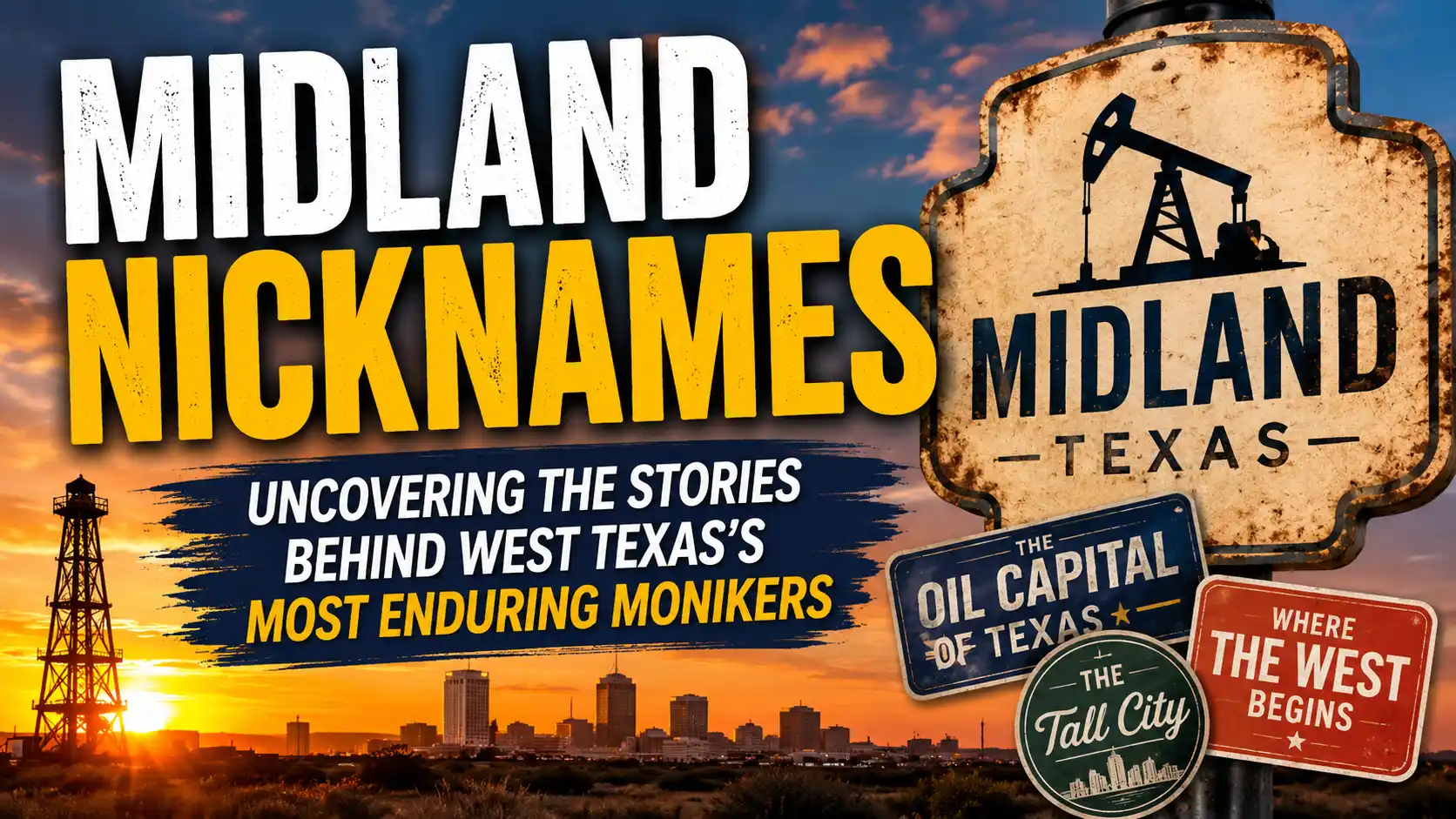
Midland, Texas, isn’t just the administrative and cultural heartbeat of the Permian Basin — it’s a city forged by oil, ambition, and an unmistakable skyline. Over more than a century, residents and visitors have given Midland a handful of nicknames that capture its larger-than-life personality. From the widely beloved “Tall City” to labels tied directly to the petroleum industry, each nickname acts as a shorthand for the city’s identity on the high plains.
This article unpacks every major Midland nicknames, traces where they came from, and shows how they are used today. Whether you’re a history lover, a traveler, or a writer researching Texas cities, you’ll leave with a deep, accurate, and all guide — just the real story of what people call Midland and why.
🏆 Quick Answer Box
Midland’s Most Famous Nickname
The most famous nickname of Midland, Texas, is “The Tall City.” Other well-known nicknames include “Hub City of the Permian Basin,” “Petroleum Building Capital,” and — in oilfield circles — simply “The Patch.”
📊 Quick Facts Table
| 📍 Fact | Details |
|---|---|
| City | Midland |
| State / Country | Texas, United States 🇺🇸 |
| Official Nickname | None legally adopted; “The Tall City” is the universally recognized unofficial nickname |
| Most Famous Nickname | The Tall City |
| Population (2020 Census) | 132,524 |
| Founded | 1881 (as Midway Station; renamed Midland in 1884) |
| Known For | Permian Basin oil & gas, George W. Bush’s childhood hometown, Midland RockHounds baseball, skyline visible for miles across the plains |
| More | Nickname coined in the early 1900s after the first skyscrapers rose above the flat West Texas landscape |
🏛️ Official Nickname of Midland
Midland does not have a legally codified “official” nickname enacted by city ordinance or state proclamation. Instead, it has an immensely powerful cultural officialdom: almost every resident, local business, and regional media outlet treats “The Tall City” as the de facto official nickname. City government materials, welcome signs, and tourism promotions use “The Tall City” prominently — so while no statute declares it, the nickname holds full official recognition in practice. It appears on public art, municipal vehicles, and the city’s own website, reinforcing its status as Midland’s signature moniker.
Other nicknames like “Hub City of the Permian Basin” are more functional and descriptive, used heavily in commerce and logistics. “Petroleum Building Capital” surfaces in architectural and historical writing but does not carry the same everyday weight. The dual identity — “Tall City” for civic pride, “Hub City” for economic geography — gives Midland a uniquely layered nickname landscape.
🤔 What Are the Nicknames of Midland?
Midland wears several hats, linguistically speaking. Its nicknames fall into three natural buckets: the skyline-inspired emblem (“The Tall City”), the regional dominance label (“Hub City of the Permian Basin”), and the petroleum-driven identifiers (“Petroleum Building Capital” and “The Patch”). Each serves a different audience — residents, businesses, oilfield workers, and tourists — but together they paint a remarkably consistent picture of a city that sprouted from the flat prairie and reached for the sky.
Below is an overview, followed by a complete breakdown of every recognized nickname.
📋 Complete List of Midland Nicknames
| 🧢 Nickname | 📖 Meaning | 🕰️ Origin | ⭐ Popularity |
|---|---|---|---|
| The Tall City | Midland’s early skyscrapers stood out dramatically on the flat West Texas plains, making the city “tall” compared to everything around it. | Coined in the 1910s–1920s after the 12-story Petroleum Building (1929) and earlier high-rises. | 🔥 Extremely popular; universal in Midland |
| Hub City of the Permian Basin | Midland is the logistical, financial, and cultural center for the entire Permian Basin oil region. | Grew out of chamber of commerce language in the mid-20th century. | ⭐ Very popular in business and regional media |
| Petroleum Building Capital | Midland boasts a concentration of historic and modern petroleum company headquarters in architecturally significant buildings. | Architectural historians and preservationists began using this term in the late 20th century. | 📚 Niche; heard in heritage circles |
| The Patch (or Oil Patch Capital) | A colloquial term for the oil fields; Midland is sometimes called the capital of “The Patch.” | Oilfield worker slang that became widespread after the 1970s boom. | 🛢️ Common among industry insiders |
| Midland, U.S.A. (sentimental) | A phrase used to evoke Midland as the all‑American heartland city, especially during George W. Bush’s presidency. | Popularized by national media profiles in the 2000s. | 📺 Moderate; nostalgic and political |
🌟 Most Popular Nicknames of Midland
While several descriptive labels float around the Permian Basin, two nicknames rise clearly above the rest: “The Tall City” and “Hub City of the Permian Basin.” The former is sewn into the city’s emotional fabric; the latter is its professional calling card. A distant third, “Petroleum Building Capital,” finds a home in architectural tours and history books. In daily conversation, though, a Midlander will almost always say, “Welcome to the Tall City.”
🏙️ Main Nicknames Explained
The Tall City
Meaning
“The Tall City” refers to Midland’s anomalous early skyline. At a time when West Texas towns were collections of low wooden structures, Midland erected multi-story office towers that could be seen from miles away on the pancake-flat prairie.
Short Origin Story
The nickname emerged organically in the 1910s and 1920s. When the 12‑story Petroleum Building (originally the Hogan Building) opened in 1929, it became the tallest building between Fort Worth and El Paso. Travelers on the Texas & Pacific Railway began pointing Midland out as “the tall city on the horizon.” The phrase stuck instantly.
Historical Background
Midland’s founding as a railroad stop in 1881 gave it a central location, but the real catalyst was the discovery of oil in the Permian Basin in the 1920s. Oil money erected high-rises, and by the 1950s the Wilco Building added to the vertical profile. Even today, downtown Midland’s towers form an abrupt silhouette against the West Texas sky, a living postcard of the nickname’s origin.
Modern Usage
You see “The Tall City” on water towers, public murals, radio station call signs, and the official convention and visitors bureau branding. It’s the name of the annual Tall City Blues Fest, Tall City Brewing Co., and countless small businesses. Locals self‑identify as “Tall City” residents without a second thought.
Cultural Impact
The nickname instills a sense of uniqueness and pride. Midland High School’s mascot may be the Bulldogs, but the community collectively embraces the tall-as-visionary metaphor. The phrase connects Midland’s oil-boom bravado to a physical reality — this is a place where ambition literally reshaped the skyline.
Interesting Fact
During World War II, the Army Air Corps used Midland’s tall buildings as navigation landmarks for trainee pilots, cementing “The Tall City” even among military personnel.
Hub City of the Permian Basin
Meaning
This nickname positions Midland as the nerve center — financial, logistical, medical, and cultural — for the entire Permian Basin, a gigantic oil-producing region spanning West Texas and southeastern New Mexico.
Short Origin Story
By the 1950s, Midland had attracted more corporate headquarters, banks, and support industries than its larger-in-population neighbor Odessa. Chambers of commerce began using “Hub City” in promotional literature to attract businesses. Regional newspapers adopted the term, and it is now standard economic development language.
Historical Background
Unlike the purely visual “Tall City,” “Hub City” is rooted in commerce. Midland’s airport, midway point on the Texas & Pacific Railway, and centralized location made it the natural choice for oil executives and service companies. Over time, Midland became the place where Permian Basin deals were made, cementing the nickname.
Modern Usage
Economic reports, regional planning documents, and Midland’s own branding strategy frequently invoke the “Hub City” concept. It appears in the tagline “Midland: Hub City of the Permian Basin” on official websites.
Cultural Impact
While less folksy than “The Tall City,” this nickname frames Midland as a serious economic player, which attracts a workforce that values career opportunity. It also fuels a friendly rivalry with Odessa, which is often seen as the blue-collar “twin city.”
Interesting Fact
Midland’s Centennial Plaza features a fountain with a map of the Permian Basin, subtly reinforcing the hub symbolism.
❓ Which Nickname Is Most Famous?
Without question, “The Tall City” is Midland’s most famous nickname. It appears on everything from souvenir T‑shirts to municipal infrastructure, and it’s the first answer any Midlander gives when asked what their city is called. “Hub City of the Permian Basin” runs a strong second, especially in business contexts, but it does not generate the same emotional resonance. The nickname’s longevity (over a century), daily local usage, and distinctive mental image give it the crown.
🧭 How Midland Got Its Nicknames
Midland’s nicknames weren’t cooked up in a marketing boardroom — they grew from the landscape and the economy. The flat prairie made any vertical structure an event, so “The Tall City” became an inevitable observation. The region’s reliance on a central city for finance and logistics birthed “Hub City of the Permian Basin.” And the sheer concentration of energy-company headquarters produced the architectural label “Petroleum Building Capital.” In short, geography, geology, and commerce collaborated to create Midland’s multiple identities.
🔎 Other Nicknames at a Glance
- The City of Modern Explorers (occasionally used by Midland, Michigan, but sometimes mistakenly applied to Midland, Texas in national media — it’s not native to Texas.)
- Bush Country (a political nickname from the George W. Bush era, referencing his Midland upbringing — used primarily by journalists.)
- The 432 (slang derived from the area code, used by younger residents on social media.)
- Tall City Town (a playful, rhyming variation used in local event names.)
🎉 Fun Facts About Midland
- ⛽ Midland sits atop the Permian Basin, the highest‑producing oil field in the United States.
- 🏗️ The Petroleum Building was the tallest structure between Fort Worth and El Paso for decades.
- 👦 George W. Bush and Laura Bush spent their childhoods in Midland; the George W. Bush Childhood Home is a museum today.
- 🌪️ Midland’s flat terrain means you can sometimes see thunderstorms over 50 miles away.
- 🏟️ The Midland RockHounds, a Double‑A affiliate of the Oakland Athletics, have won multiple Texas League championships.
- 📺 The city was featured prominently in the Friday Night Lights book and movie, capturing its passionate high school football culture.
- 💼 Midland has one of the highest concentrations of millionaires per capita in the U.S., a direct result of oil wealth.
- 🛩️ Midland International Air & Space Port was the first commercial airport in the country to host a spaceport license.
- 🎨 The Tall City Art Park and murals across downtown celebrate the city’s nickname and heritage.
- 🌵 Despite the desert image, Midland boasts a surprisingly green cityscape thanks to extensive irrigation and tree‑planting efforts.
🏛️ Famous Attractions in Midland
- Permian Basin Petroleum Museum — interactive exhibits on oil exploration and the region’s geology.
- George W. Bush Childhood Home — restored 1950s home offering a glimpse into the 43rd president’s early life.
- Wagner Noël Performing Arts Center — a world‑class venue hosting concerts, Broadway tours, and comedy shows.
- The Petroleum Building — an Art Deco skyscraper that originally defined “The Tall City.”
- Midland RockHounds at Momentum Bank Ballpark — family‑friendly Minor League Baseball with a view of the tall skyline.
- I-20 Wildlife Preserve — a 100‑acre urban playa habitat with walking trails and bird blinds.
There’s a reason music lovers flock to this North Texas gem, and the affectionate nicknames for Denton reveal its fiercely independent creative soul.
⚖️ Nickname Comparison: Midland vs. Odessa
The Tall City
Reflects the early skyline rising abruptly from flat West Texas terrain.
Hub City of the Permian Basin
White‑collar oil headquarters and financial center.
Petroleum Building Capital
Architectural legacy of the oil boom.
Jackrabbit City
Named for the black‑tailed jackrabbits that once outnumbered people on the prairie. The Odessa College mascot is the Wrangler, but the jackrabbit nickname endures in local lore.
Home of Friday Night Lights
Odessa Permian High School’s football program inspired the book, film, and TV series.
Basin’s Blue-Collar Heart
Odessa historically houses more oilfield workers and service industries.
Internal linking opportunity: Compare these nicknames with other Texas oil city nicknames like “The Hub of the Plains” (Lubbock) or “The Sun City” (El Paso).
🗺️ Related Cities and Their Nicknames
Jackrabbit City
Hub City of the Plains
The Sun City
Cowtown
The Energy Capital of the World
❓ Frequently Asked Questions
What is the official nickname of Midland, Texas?
Midland does not have a legally designated official nickname, but “The Tall City” is used by the city government, tourism board, and virtually all locals as though it were official.
Why is Midland called “The Tall City”?
In the early 1900s, Midland’s multi-story buildings were strikingly tall compared to the flat West Texas landscape. The nickname caught on as high-rises like the Petroleum Building dominated the horizon and served as navigation landmarks.
Who gave Midland its nickname?
No single person coined “The Tall City.” Railroad travelers, early settlers, and newspaper writers all independently described Midland as “the tall city on the plains,” and the phrase gradually became the city’s identity in the 1910s and 1920s.
When did the nickname “The Tall City” become popular?
It became widespread in the 1920s after the completion of several notable high-rises, especially the Petroleum Building in 1929. Local newspapers and promotional materials solidified it by the mid-20th century.
What are other nicknames of Midland?
Besides “The Tall City,” Midland is often called “Hub City of the Permian Basin” for its regional economic dominance, “Petroleum Building Capital” for its architectural legacy, and simply “The Patch” among oilfield workers. “Midland, U.S.A.” is a more nostalgic, media-driven label.
📍 Conclusion
Midland nicknames do what all great city monikers should — they tell a story you can visualize instantly. “The Tall City” conjures the image of a skyline sprouting from the endless plains, while “Hub City of the Permian Basin” maps an entire region’s economy onto one ambitious town. These names are neither relics nor marketing gimmicks; they are living language used daily in diners, boardrooms, and ballparks across West Texas.
If you drive into Midland on Interstate 20 and see the towers glint against a 360‑degree horizon, you’ll understand why these nicknames have stuck for more than a hundred years. To explore more about Midland’s oil heritage and skyline, the Permian Basin Petroleum Museum offers a deep dive into the industry that built the Tall City (visit petroleummuseum.org for educational resources).