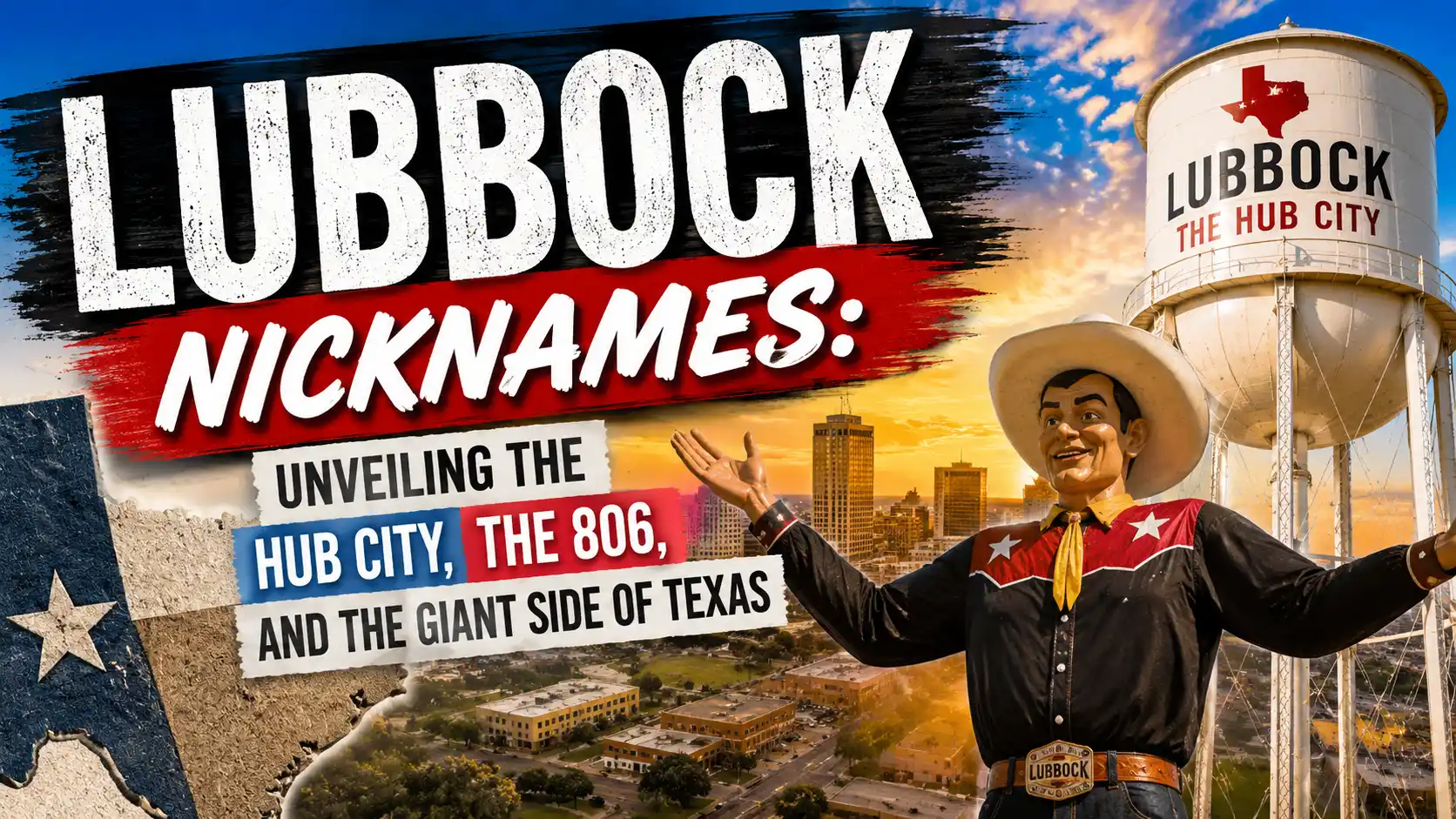
Lubbock sits high on the South Plains of West Texas, a city shaped by railroads, cotton fields, rock ’n’ roll, and a fierce independent spirit. Over the decades it has collected a handful of affectionate, hard‑earned nicknames that tell the story of its geography, economy, and culture. If you’ve ever wondered why this spot is called the “Hub City” or heard a local say “LBK” with a knowing smile, you’re about to get the full picture.
This guide unpacks every Lubbock nicknames — from the globally recognized to the deeply local — while serving up the history, fun facts, and the classic Texas pride that comes with them.
📌 Quick Answer Box
⭐ Lubbock’s Top Nicknames at a Glance
The most famous nickname of Lubbock is “The Hub City.” Other well‑known nicknames include “The LBK,” “Cotton Capital of Texas,” “Buddy Holly’s Hometown,” and “The 806.”
📊 Quick Facts Table
🏛️ Official Nickname of Lubbock
Lubbock does not have a legally designated, government‑proclaimed official nickname. The moniker “Hub City” functions as the city’s unofficial yet universally accepted nickname — it appears on everything from Chamber of Commerce materials to local business names. Because no city ordinance or state resolution has ever formalized it, “Hub City” remains a grassroots, historically grown nickname.
However, the Texas Legislature did pass a resolution in 2009 recognizing Lubbock as the “Music City of Texas,” which gives that title a semi‑official status. For all practical purposes, though, “Hub City” is the nickname you’ll see on welcome signs, event banners, and in everyday conversation.
📜 What Are the Nicknames of Lubbock?
Lubbock’s nicknames mirror its identity as a crossroads: a geographic and economic hub, a music and cultural landmark, and a place where cotton fields stretch to the horizon. While “Hub City” leads the pack, several others have grown from specific local pride points — from the area code stamped on countless bumpers to the hometown hero who changed rock and roll forever. Below you’ll find every notable nickname, how it came to be, and how it’s used today.
- Hub City (Hub of the Plains) – The premier nickname emphasizing Lubbock’s role as a regional center for commerce, education, healthcare, and transportation.
- The LBK – A slick, modern abbreviation used heavily by locals, students, and social media.
- Cotton Capital of Texas – Rooted in the fact that Lubbock County consistently leads the U.S. in cotton production.
- Buddy Holly’s Hometown – A globally recognized nickname that ties the city forever to the rock‑and‑roll pioneer.
- The 806 – The telephone area code that became a badge of regional identity and youth culture.
- Music City of Texas – The semi‑official legislative designation celebrating Lubbock’s deep musical roots.
- Lubbock or Leave It – A cheeky, self‑deprecating bumper‑sticker slogan that turned into a beloved local catchphrase.
📋 Complete List of Lubbock Nicknames
Popularity reflects usage in branding, media, and daily speech.
🔥 Most Popular Nicknames of Lubbock
Among the list, three nicknames tower above the rest in everyday use: Hub City, The LBK, and Buddy Holly’s Hometown. “Hub City” appears on official tourism material, business signs, and even the city’s own narrative about itself. “The LBK” thrives in youth culture, on Texas Tech campus, and all over Instagram. “Buddy Holly’s Hometown” is the international calling card — it puts Lubbock on the map for music lovers worldwide. The others circulate in specific contexts, but these three are the core of Lubbock’s identity.
🔍 Main Nicknames Explained
Hub City (Hub of the Plains)
- Meaning: Lubbock functions as the economic, educational, medical, and transportation hub of the vast South Plains region — a sprawling area that spans dozens of rural counties.
- Short Origin Story: When the Santa Fe and other railroads laid tracks through Lubbock in the early 1900s, the town became a natural collection and distribution point for cattle, cotton, and goods. Merchants and city promoters began calling it the “Hub of the Plains,” later shortened to “Hub City.”
- Historical Background: By the 1920s, Lubbock’s central location and rail connections had already turned it into a wholesale and retail magnet. The nickname stuck as the city added Texas Technological College (now Texas Tech University), regional medical facilities, and an expanding airport.
- Modern Usage: “Hub City” is used extensively in official branding — Hub City BBQ, Hub City Brewing, Hub City Outreach Center — and on the city’s wayfinding signage.
- Cultural Impact: It reinforces Lubbock’s self‑image as the indispensable capital of West Texas, even as bigger metro areas like Dallas/Fort Worth loom hours away.
- Interesting Fact: The term “Hub City” is so embedded that Lubbock’s National Register Historic District is sometimes called the “Hub City Historic District” in local publications.
The LBK
- Meaning: An abbreviation of “Lubbock,” pronounced “L‑B‑K,” used as a nickname that signals familiarity and local belonging.
- Short Origin Story: The airport code LBB and the area code 806 both played a role, but “LBK” emerged as a cooler, grittier shorthand among young people and social media users in the 2000s.
- Historical Background: While LBB was always the official aviation identifier, “LBK” was never an official code — it was crafted organically. By 2010, local clothing lines and hashtags like #LBK were everywhere.
- Modern Usage: You’ll see “LBK” on college gear, murals, event posters, and in the handle of many a Lubbock‑based business Instagram account. It’s a mark of insider status.
- Cultural Impact: The abbreviation has become a unifying emblem for young professionals and students who want to brand the city as modern, creative, and tight‑knit.
- Interesting Fact: “LBK” is sometimes jokingly pronounced as “el‑bee‑kay” or “Lubbock spelled sideways,” playing on the phonetic looseness.
Buddy Holly’s Hometown
- Meaning: Lubbock is forever identified as the birthplace and musical cradle of Charles Hardin “Buddy” Holley (the “e” was dropped from his stage name), the rock‑and‑roll icon.
- Short Origin Story: Holly was born in Lubbock in 1936, attended Lubbock High School, and recorded early demos here before changing music history with songs like “That’ll Be the Day.”
- Historical Background: After Holly’s tragic death in 1959, Lubbock gradually embraced his legacy. The Buddy Holly Center opened in 1999, the West Texas Walk of Fame was established, and an annual music festival attracts fans from around the world.
- Modern Usage: “Buddy Holly’s Hometown” appears on Visit Lubbock tourism materials, the city’s website, and in international travel guides. It’s the first thing many outsiders associate with the city.
- Cultural Impact: The nickname fuels pilgrimage tourism and a sense of artistic possibility — if Buddy Holly could start here, so can others.
- Interesting Fact: Buddy Holly’s glasses, recovered from the 1959 plane crash, were kept in an envelope for decades and later returned to his family; the story adds a layer of reverence to Lubbock’s connection.
Cotton Capital of Texas
- Meaning: Lubbock County is the top cotton‑producing county in the United States, making the city synonymous with the crop.
- Short Origin Story: Irrigation advances in the mid‑20th century turned the arid High Plains into one of the world’s most productive cotton belts. Lubbock became the commercial and processing center.
- Historical Background: By the 1950s, Lubbock had more cottonseed oil mills and compresses than nearly anywhere else. The nickname appeared in agricultural publications and Chamber of Commerce ads.
- Modern Usage: You’ll see “Cotton Capital” in agribusiness contexts, on local souvenirs, and at events like the annual Cotton Festival. The nickname is still worn with pride by farming families.
- Cultural Impact: It reminds Lubbock of its rural roots and the importance of agriculture even as the city grows.
- Interesting Fact: The National Cotton Council and Plains Cotton Cooperative Association are both headquartered in Lubbock.
The 806
- Meaning: The telephone area code serving Lubbock and most of the Panhandle/South Plains, transformed into a hip regional identifier.
- Short Origin Story: The 806 area code was created in 1957 as a split from 915. It remained the only code for the entire region for decades, so it became an easy shorthand.
- Historical Background: As cell phone culture grew, “the 8‑0‑6” morphed from a dialing prefix into a statement of geographic pride. Local artists, musicians, and clothing brands began printing “806” on merchandise around the early 2000s.
- Modern Usage: It’s used in hashtags (#806), boutique names, and as a rallying cry at Texas Tech sporting events. Saying “I’m from the 806” instantly identifies the speaker’s roots.
- Cultural Impact: Much like “the 512” in Austin or “the 214” in Dallas, the 806 creates a sense of tribe.
- Interesting Fact: Due to number exhaustion, area code 806 was overlaid with 806/430 in 2023, but locals still cling fiercely to the original.
Music City of Texas
- Meaning: Official state recognition of Lubbock’s outsized contribution to Texas music, from Buddy Holly to the West Texas sound.
- Short Origin Story: Texas House Concurrent Resolution No. 155, passed in 2009, designated Lubbock as the “Music City of Texas,” citing legends like Buddy Holly, Mac Davis, and the Flatlanders.
- Historical Background: The resolution was pushed by local legislators and arts advocates who wanted to cement Lubbock’s place on the state’s cultural map. The city was already home to the Buddy Holly Center, the West Texas Walk of Fame, and a lively live‑music scene.
- Modern Usage: The title appears in tourism materials and occasionally on city proclamations, though it hasn’t replaced “Hub City” in everyday speech.
- Cultural Impact: It gives Lubbock an official musical credential that rivals Austin’s “Live Music Capital of the World,” even if on a smaller scale.
- Interesting Fact: Before the resolution, Lubbock was already informally called the “Nashville of the Plains” by some country musicians.
Lubbock or Leave It
- Meaning: A tongue‑in‑cheek slogan that captures the city’s proud, unapologetic personality — love it or hit the road.
- Short Origin Story: The phrase started showing up on bumper stickers in the 1980s, likely a riff on the patriotic “America: Love It or Leave It.”
- Historical Background: During the oil boom and bust cycles, the phrase became a defiant local statement: this place isn’t for everyone, and that’s fine.
- Modern Usage: It’s not a formal nickname but functions as a cultural catchphrase, printed on T‑shirts, koozies, and local memes.
- Cultural Impact: It encapsulates the rugged, individualistic West Texas attitude and has been embraced ironically and earnestly.
- Interesting Fact: Variations like “Lubbock: Love It or Leave It” occasionally appear in local political rhetoric.
💡 Which Nickname Is Most Famous?
Without question, “The Hub City” is the most famous and enduring Lubbock nickname. It’s used in city promotions, business names, news headlines, and everyday conversation far more than any other. “Buddy Holly’s Hometown” might have greater international recognition in niche circles, but “Hub City” defines Lubbock’s core identity to Texans and outsiders alike. The nickname’s longevity — over a century old — and its direct tie to Lubbock’s geographic and economic role make it the undisputed front‑runner.
🛣️ How Lubbock Got Its Nicknames
Lubbock’s nicknames weren’t born in a marketing boardroom; they grew slowly out of the landscape and the people. The railroad convergence in the early 1900s planted the seed for “Hub City.” Cotton’s dominance in the mid‑20th century solidified the agricultural nickname. Buddy Holly’s tragic death and posthumous fame attached his name to the city forever. The area code 806 became a source of pride as regional identity strengthened in the age of mobile phones and hip‑hop shout‑outs. “LBK” followed a familiar pattern of urban abbreviation seen in other cities. Each nickname is a layer of Lubbock’s story, never forced, always organic.
👀 Other Nicknames at a Glance
While less widespread, these nicknames also pop up in local lore:
- “Titletown” – Occasionally used during Texas Tech’s championship runs (men’s basketball, track and field), though not an official nickname.
- “The Paris of the Plains” – A very rare, half‑joking reference that never took hold.
- “Tall City” – More accurately used for Midland; sometimes mistakenly applied to Lubbock due to the expansive skyline on the flat horizon.
🎉 Fun Facts About Lubbock
- 🎸 Buddy Holly recorded “That’ll Be the Day” at Norman Petty Studios in Clovis, New Mexico, but wrote it in Lubbock and often referenced his hometown in early songs.
- 🍷 Lubbock sits in the Texas High Plains AVA, one of the largest wine‑grape growing regions in the state, with over 80% of Texas wine grapes grown nearby.
- 🏫 Texas Tech University’s campus houses the National Ranching Heritage Center, a 27‑acre museum park that preserves the history of ranching and the American West.
- 🌬️ While not “The Windy City” (that’s Chicago’s title), Lubbock experiences frequent high winds; spring gusts can exceed 50 mph and are just part of life.
- 🛩️ Lubbock Preston Smith International Airport is named after a former Texas governor and features a silent movie‑themed mural that honors native‑born actress Marsha Hunt.
- 📻 The iconic radio station KDAV, which launched in the 1950s, was one of the first all‑rock‑and‑roll stations in the United States and played a key role in the early career of Buddy Holly.
- 🐎 The annual ABC Pro Rodeo in Lubbock is one of the top‑ranked indoor rodeos in the nation and draws competitors from across the country.
- 🧪 Lubbock’s Science Spectrum museum features an OMNI Theater with a four‑story dome screen — the only one of its kind in West Texas.
- 🌾 Lubbock County alone produces more cotton than the entire state of California, a staggering fact that supports the “Cotton Capital” title.
- 🎨 First Friday Art Trail turns the Lubbock Cultural District into a monthly open‑house gallery crawl, showcasing the city’s surprisingly vibrant contemporary art scene.
🏟️ Famous Attractions in Lubbock
- Buddy Holly Center & West Texas Walk of Fame – A museum, gallery, and outdoor tribute to Buddy Holly and other West Texas music legends.
- National Ranching Heritage Center – An outdoor historical park with authentic ranch buildings dating back to the 1700s.
- Texas Tech University – The Red Raiders’ campus anchors the city with museums, sports, and the stunning Public Art collection.
- Silent Wings Museum – Tells the story of World War II glider pilots, housed in a historic airport terminal.
- Prairie Dog Town – A quirky, free prairie‑dog colony in Mackenzie Park that has charmed visitors since the 1930s.
- American Windmill Museum – The largest windmill museum in the world, celebrating a technology crucial to the settlement of the Plains.
Nestled along the Brazos, this city carries a dual nature perfectly captured in the well-known nicknames for Waco, blending small-town warmth with a growing cultural heartbeat.
🔄 Nickname Comparison: Lubbock vs. Amarillo
Both Lubbock and its Panhandle neighbor Amarillo have nicknames rooted in geography and commerce, but they highlight distinct identities.
🤠 Hub City
Lubbock, Texas
Emphasizes the city’s role as the central service and transportation hub of the South Plains. A practical, economic identity built on railroads and regional dominance.
Explore Lubbock Nicknames🌹 Yellow Rose of Texas
Amarillo, Texas
A romantic, cultural nickname inspired by the popular folk song and the city’s name (Amarillo means “yellow” in Spanish). Projects a warm, musical, and Western image.
Learn Amarillo NicknamesWhile “Hub City” speaks to function and geography, “Yellow Rose of Texas” leans into myth and culture. Both are powerful Texas city brands.
🌐 Related Cities and Their Nicknames
🌇 Amarillo
The Yellow Rose of Texas
🛢️ Midland
The Tall City
🏜️ Odessa
The Permian Basin Hub
🎸 Abilene
The Key City / Storybook Capital
🎶 Austin
Live Music Capital of the World
❓ Frequently Asked Questions
What is the official nickname of Lubbock?
Lubbock does not have a legally designated official nickname. “Hub City” is the city’s unofficial yet overwhelmingly recognized nickname, used by residents, businesses, and civic organizations.
Why is Lubbock called the Hub City?
The nickname originated in the early 20th century when railroads converged on Lubbock, making it the commercial and distribution center for the surrounding South Plains. Over time, it expanded to include the city’s role as an educational, medical, and cultural hub.
Who gave Lubbock its nickname?
No single person can be credited. Early city boosters, newspaper editors, and the Chamber of Commerce began using “Hub of the Plains” and “Hub City” in promotional materials as the railroads and agricultural trade grew.
When did the nickname “Hub City” become popular?
The term was already in use by the 1920s and became widely popular after World War II as Lubbock’s regional dominance solidified with Texas Tech’s expansion and the growth of medical facilities.
What are other nicknames for Lubbock?
Beyond “Hub City,” Lubbock is often called “The LBK,” “Cotton Capital of Texas,” “Buddy Holly’s Hometown,” “The 806,” and “Music City of Texas.” Some locals also jokingly use “Lubbock or Leave It.”
🔚 Conclusion
Lubbock’s nicknames are far more than colorful labels — they’re living history. “Hub City” tells the story of railroads and regional power; “The LBK” speaks to a new generation’s pride; “Buddy Holly’s Hometown” connects West Texas to the world stage. Whether you’re driving in on Highway 84, hearing an “806” shout‑out at a Red Raiders game, or visiting the Buddy Holly Center, you’ll feel the weight and warmth of these names.
The Texas State Historical Association notes that Lubbock’s growth into the “metropolis of the South Plains” was built on exactly the kind of centralizing force that the nickname “Hub City” captures so perfectly — and that identity shows no sign of fading. For a deeper dive into the region’s character, explore the comprehensive TSHA entry on Lubbock.