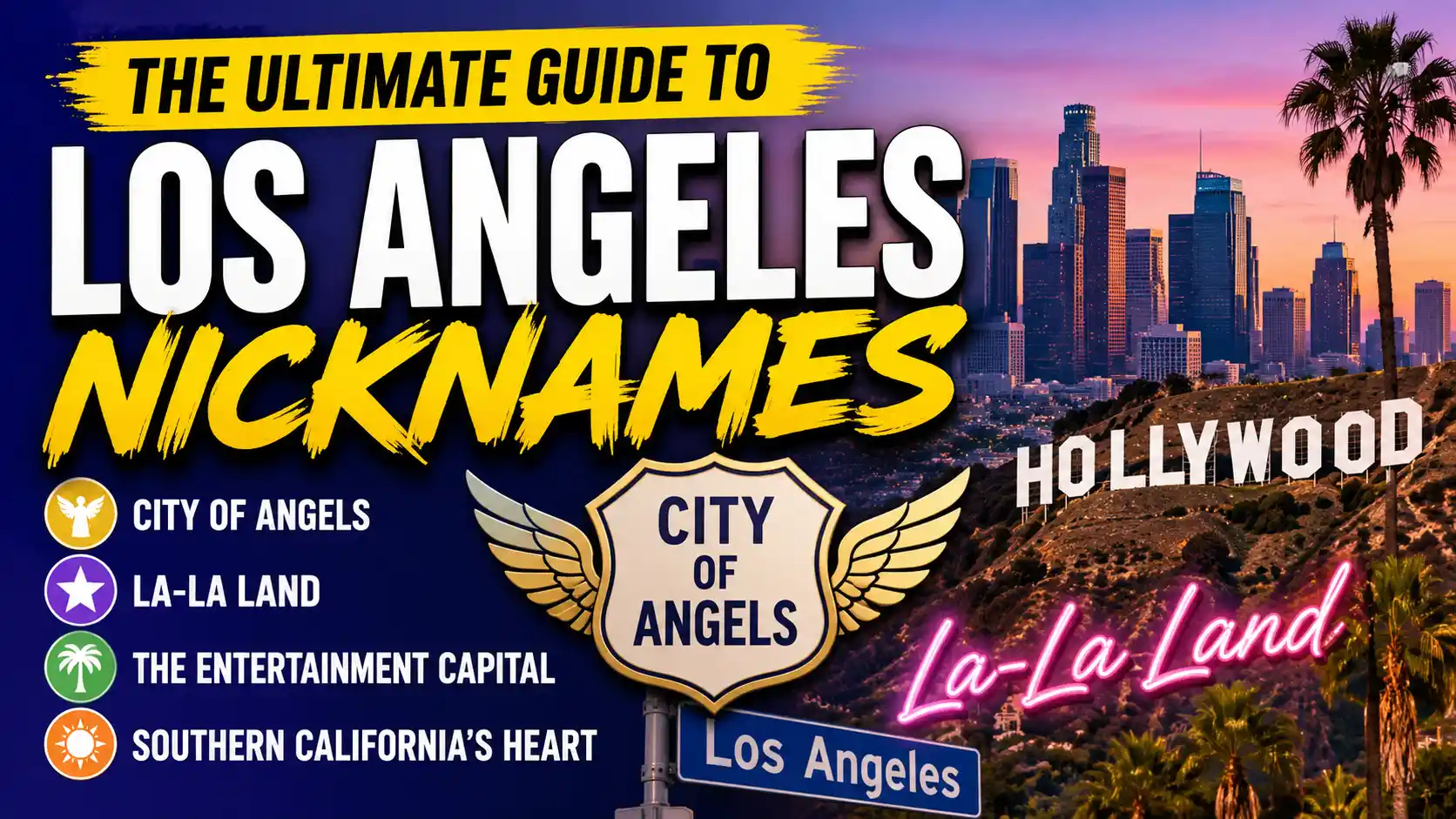
Los Angeles, a sprawling mosaic of sun, dreams, and asphalt, is a city whose identity constantly reinvents itself. Its many nicknames—some angelic, some ironic—offer a fascinating shorthand for understanding a metropolis that is at once glamorous and gritty. This deep dive into Los Angeles nicknames unpacks the stories, meanings, and cultural weight behind every moniker.
The most famous nickname of Los Angeles is “The City of Angels,” a direct translation of its original Spanish name. Other widely used nicknames include “La-La Land,” “Tinseltown,” “The Big Orange,” “L.A.,” and “The Entertainment Capital of the World,” each reflecting a different facet of this iconic city.
Official Nickname of Los Angeles
Los Angeles does not have a legally designated “official” nickname. The moniker “City of Angels” is an unofficial yet universally recognized translation of its historic full name in Spanish: El Pueblo de Nuestra Señora la Reina de los Ángeles (The Town of Our Lady the Queen of the Angels). Over time it was shortened to Los Ángeles, and the English “City of Angels” became a natural, poetic shorthand. Though never formally codified, it functions as the city’s unofficial official nickname, appearing on promotional materials, civic branding, and in everyday speech.
What Are the Nicknames of Los Angeles?
Los Angeles has accumulated an unusually large and colorful collection of nicknames, each born from a distinct era, industry, or cultural perception. Some celebrate the city’s sunny optimism, others its celluloid dreams, and a few its traffic and sprawl. The range of Los Angeles nicknames stretches from the reverent to the satirical, painting a full picture of a city that has always been larger than life.
Complete List of Los Angeles Nicknames
Most Popular Nicknames of Los Angeles
While dozens of nicknames exist, a handful have become true cultural shorthand. The most universally recognized Los Angeles nicknames are “The City of Angels,” “La-La Land,” “Tinseltown,” “L.A.,” and “The Big Orange.” These names are instantly understood by both locals and global audiences, and they appear in movies, headlines, tourism campaigns, and everyday conversation.
Main Nicknames Explained
🕊️ The City of Angels
- Meaning: A literal English translation of the Spanish Los Ángeles, referencing the Virgin Mary, Queen of the Angels.
- Short Origin Story: The city was founded in 1781 as El Pueblo de Nuestra Señora la Reina de los Ángeles de Porciúncula. Over time the lengthy name was shortened to Los Ángeles, and its angelic echo gave rise to the nickname.
- Historical Background: Spanish settlers and missionaries chose the religious name, and as the city boomed in the 20th century, “City of Angels” became the romanticized global brand.
- Modern Usage: Omnipresent in tourism, sports (Angels baseball team originally from LA), and local pride.
- Cultural Impact: The nickname infuses an almost mythic quality, suggesting protection, hope, and a touch of celestial destiny.
- Interesting Fact: The original name can be translated “The Town of Our Lady the Queen of the Angels of the Little Portion,” making it one of the longest place names in the world.
🎬 La-La Land
- Meaning: A place detached from reality, where dreams and fantasy override practicality.
- Short Origin Story: The phrase gained traction in the 1970s as a sly critique of Hollywood’s bubble and LA’s eccentric lifestyle. The Los Angeles Times and others used it to describe the city’s perceived absurdity.
- Historical Background: Long before the 2016 movie musical La La Land, the term was a half-mocking, half-affectionate label for Los Angeles. The film simply cemented it in the global imagination.
- Modern Usage: Used both by those who love the city’s creative spirit and by critics who see it as shallow.
- Cultural Impact: The nickname perfectly captures the duality of LA—a magnet for dreamers and a symbol of illusion.
- Interesting Fact: After the Oscar-winning film “La La Land,” tourism officials briefly worried that the ironic nickname would overtake “City of Angels,” but instead it reinforced the city’s cinematic allure.
✨ Tinseltown
- Meaning: A reference to the glittering, sometimes superficial surface of Hollywood.
- Short Origin Story: Coined in the early 20th century, likening the film industry’s glitz to cheap tinsel used as Christmas decoration—sparkly but insubstantial.
- Historical Background: As silent films gave way to the Golden Age of Hollywood, the term became the go-to nickname for the movie business itself, and by extension the city where it flourished.
- Modern Usage: Often used in entertainment news and commentary, specifically about Hollywood rather than all of LA.
- Cultural Impact: It’s both a celebration of showbiz and a subtle jab at its artificiality.
- Interesting Fact: Old Hollywood reporters claimed the term was first popularized by columnist Harry Carr or screenwriter Frances Marion, but no single originator is definitive.
🍊 The Big Orange
- Meaning: A sunny West Coast answer to New York’s “Big Apple.”
- Short Origin Story: Emerged in the late 19th/early 20th centuries when citrus groves blanketed the region. In the 1970s, boosters resurrected it to promote tourism and agricultural heritage.
- Historical Background: LA was once the top citrus-producing area in the U.S., and the orange became a symbol of prosperity. Marketing campaigns used the playful rivalry with NYC.
- Modern Usage: Less common in daily speech but recognized in retail, street art, and niche branding.
- Cultural Impact: It gave LA a friendly, fruit-based personality that contrasted with East Coast sophistication.
- Interesting Fact: A proposed 1970s “Big Orange” statue akin to the Statue of Liberty never materialized, but the idea still pops up in urban legend.
⚡ L.A.
- Meaning: The quintessential abbreviation of Los Angeles, reflecting casual cool.
- Short Origin Story: As the name Los Angeles was shortened in print and speech throughout the 20th century, “L.A.” became the standard shorthand.
- Historical Background: When the city’s global profile rose with Hollywood and the recording industry, “L.A.” became a brand in itself—signifying glamour, creativity, and open-road freedom.
- Modern Usage: Heard everywhere, from local weather reports to international songs.
- Cultural Impact: “L.A.” is so iconic that it rarely needs explanation; it’s the city’s minimalist signature.
- Interesting Fact: The pronunciation “el-ay” is now used worldwide to evoke sunshine and celebrity, often without even saying the full name.
Which Nickname Is Most Famous?
Without question, “The City of Angels” stands as the most famous and universally accepted Los Angeles nickname. It is historically rooted in the city’s very name, carries poetic gravitas, and appears on everything from postcards to official city communications. While “La-La Land” and “Tinseltown” are iconic, they represent specific aspects; “City of Angels” encompasses the entire identity of Los Angeles—its spiritual origin, its aspirational culture, and its global brand.
How Los Angeles Got Its Nicknames
The evolution of Los Angeles nicknames is a story of geography, industry, and media. The original Spanish name provided the angelic foundation. The explosive growth of Hollywood gave birth to Tinseltown and later La-La Land. The vast orange groves that once covered the valley inspired The Big Orange. Rapid urbanization and auto culture created less flattering labels like Smog City. Each nickname is a time capsule, revealing how the world—and Angelenos themselves—have viewed this sprawling metropolis at different moments. Today, Los Angeles nicknames continue to multiply, reflecting the city’s role as a cultural and creative capital.
Other Nicknames at a Glance
- El Pueblo – Historic heart, referencing the original pueblo.
- Lotusland – Evokes a dreamy land of lotus-eaters; used in literature and music.
- The Southland – Common in Southern California weather reports.
- Smog City – A blunt 20th-century critique of air quality.
- City of Flowers and Sunshine – Early booster nickname from real estate ads.
- The Creative Capital of the World – Modern civic branding.
- Gang Capital – Troubled 1980s/90s label, now generally avoided.
- The 213 / The 323 – Area code nicknames, especially in hip-hop culture.
Fun Facts About Los Angeles
- The full original name of the city is El Pueblo de Nuestra Señora la Reina de los Ángeles de Porciúncula—often shortened to Los Ángeles just a few years after its founding.
- LA has hosted the Summer Olympics twice (1932, 1984) and will host again in 2028, joining London as a three-time host city.
- Despite its smoggy past, Los Angeles now has some of the nation’s strictest air quality regulations and cleanest air in decades.
- The iconic Hollywood Sign originally read “Hollywoodland” and was erected in 1923 as an advertisement for a hillside real estate development.
- More than 224 languages are spoken in Los Angeles, making it one of the most linguistically diverse cities on the planet.
- LA County is home to more museums per capita than any other U.S. county, including the Getty, LACMA, and The Broad.
- The palm trees that define LA’s skyline are mostly non-native species planted en masse before the 1932 Olympics.
- The Port of Los Angeles, combined with Long Beach, is the busiest container port in the Western Hemisphere.
- LA’s Griffith Observatory is the most-visited public observatory in the world.
- The term “La-La Land” was already being used by the Los Angeles Times in the 1970s to joke about the city’s eccentricities.
Famous Attractions in Los Angeles
- Hollywood Walk of Fame – Tinseltown’s most literal landmark.
- Griffith Observatory – Stunning views and space exploration.
- Santa Monica Pier – Classic California beachfront fun.
- Venice Beach Boardwalk – Eclectic street performers and canals.
- The Getty Center – Art, architecture, and gardens with panoramic vistas.
- Universal Studios Hollywood – Working movie studio and theme park.
- Los Angeles County Museum of Art (LACMA) – Urban light installation and vast collections.
- The Broad – Contemporary art powerhouse.
- Olvera Street – The historic birthplace of Los Angeles, honoring its Mexican heritage.
- Dodger Stadium – Iconic baseball in Chavez Ravine.
Few cities on Earth command a skyline as recognizable as this one, yet the true magic lives in the enduring monikers New York City has collected across centuries of reinvention.
Nickname Comparison: Los Angeles vs. New York City
🌴 Los Angeles
- 🏙️ The City of Angels
- 🎬 La-La Land
- ✨ Tinseltown
- 🍊 The Big Orange
- ⚡ L.A.
Sunshine, showbiz, and the dream factory
🗽 New York City
- 🍎 The Big Apple
- 🌃 The City That Never Sleeps
- 🦇 Gotham
- 🏛️ The Empire City
- 🗽 The Capital of the World
Energy, ambition, and a concrete jungle where dreams are made
Both cities use nicknames that reflect their oversized personalities—one mythologizing fame and eternal sunshine, the other celebrating relentless hustle and grandeur. If you’re fascinated by how East Coast rivals brand themselves, explore our deep dive into <strong>New York City Nicknames</strong>.
Related Cities and Their Nicknames
🌉 San Francisco
The Golden City, Fog City
☀️ San Diego
America’s Finest City
🎰 Las Vegas
Sin City, The Entertainment Capital
🏰 Anaheim
The Home of Disneyland
⚓ Long Beach
The Aquatic Capital of America
Frequently Asked Questions
What is the official nickname of Los Angeles?
Los Angeles does not have a legally designated official nickname. “The City of Angels” is the de facto official moniker, directly translated from the original Spanish name and universally used in official tourism materials.
Why is Los Angeles called the City of Angels?
The name Los Angeles is Spanish for “the angels,” a shortened form of the city’s original 1781 founding name, El Pueblo de Nuestra Señora la Reina de los Ángeles. The nickname “City of Angels” simply translates that angelic root into English.
Who gave Los Angeles its nickname “La-La Land”?
There is no single individual credited. The phrase emerged organically in the 1970s as a media and local slang term poking fun at Los Angeles’s eccentric, fantasy-driven culture. It was later immortalized by the 2016 movie musical La La Land.
When did the nickname “Tinseltown” become popular?
“Tinseltown” came into wide use during Hollywood’s Golden Age in the 1920s and 1930s, describing the glossy, sometimes superficial sheen of the film industry. It remains a common metonym for Hollywood to this day.
What are some other nicknames for Los Angeles?
Besides the most famous ones, Los Angeles is also called The Big Orange, L.A., Lotusland, The Southland, Smog City (historically), The Entertainment Capital of the World, City of Flowers and Sunshine, and The Creative Capital, among others.
Conclusion
The kaleidoscope of Los Angeles nicknames—from the celestial “City of Angels” to the glittering “Tinseltown” and the whimsical “La-La Land”—tells the story of a city that refuses to be defined by just one identity. Each moniker adds a layer to our understanding of a place that is at once a sprawling concrete basin, an entertainment empire, and a sun-drenched dreamscape. Whether you’re a local or a visitor, knowing these nicknames enriches your connection to the cultural DNA of LA. For deeper historical exploration, the authoritative Los Angeles Almanac (laalmanac.com) offers a treasure trove of facts about the city’s origins and evolution.