
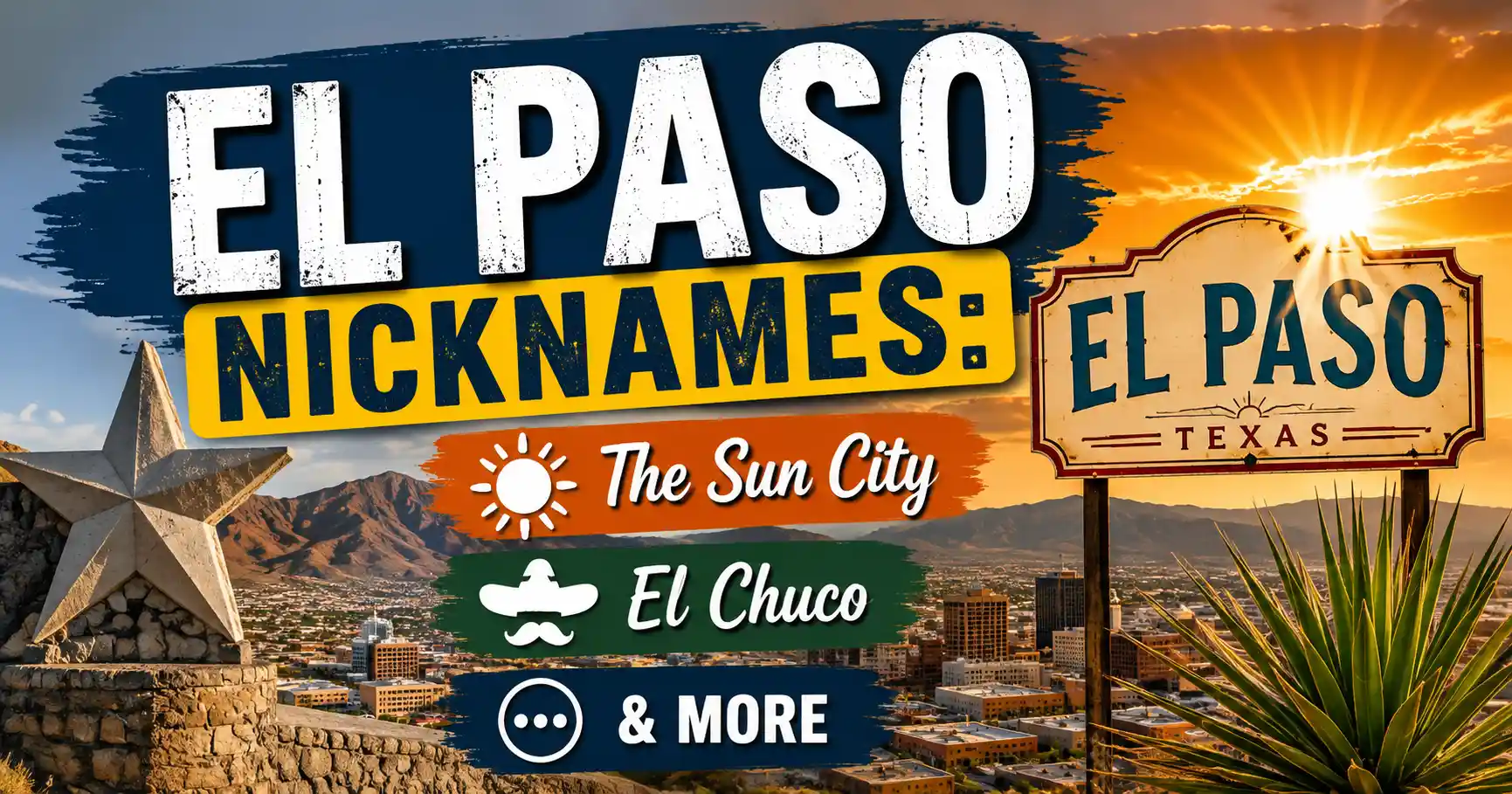
El Paso, Texas, anchors the far western edge of the Lone Star State, where the Rio Grande meets the Chihuahuan Desert and Mexico begins just across the river. Centuries of Indigenous, Spanish, Mexican, and American influences have produced a distinctive set of El Paso nicknames that capture the city’s sunny climate, mountain-pass geography, and binational character.
From the tourism-friendly “Sun City” to the proudly local “El Chuco,” these names are more than labels—they reflect how El Pasoans see home.
🌵 What Are the El Paso Nicknames?
El Paso does not have one single nickname; instead, it carries several overlapping names. The most famous is The Sun City, while locals often say El Chuco. Historical maps and records use El Paso del Norte or simply The Pass, and border-focused names such as The Border City and Gateway to Mexico are also common. Together, these El Paso nicknames reveal a city shaped by sunlight, geography, and international connection.
🌞 Quick Answer: What Is El Paso’s Most Famous Nickname?
The most famous nickname of El Paso is “The Sun City,” a nod to its 300+ days of sunshine each year. Other widely used El Paso nicknames include “El Chuco” and “The Pass.”
📊 Quick Facts About El Paso
📜 Official Nickname of El Paso
El Paso does not have a nickname written into its municipal code as an official designation. In everyday use, however, Sun City functions as El Paso’s de facto official nickname. It appears in visitor guides, civic campaigns, media coverage, and local business names.
The city’s original Spanish place name, El Paso del Norte, is not exactly a nickname but a historical descriptive name meaning “The Pass of the North.” Over centuries, the shortened English translation “The Pass” became a nickname in its own right. Other names such as El Chuco are unofficial but culturally meaningful, especially among long-time El Pasoans.
📋 Complete List of El Paso Nicknames
🔥 Most Popular Nicknames of El Paso
While the full list includes historical and promotional names, three El Paso nicknames stand out. The Sun City is the most recognizable outside the region. El Chuco is the most authentic local term, used with pride by many El Pasoans. The Pass connects the modern city to its Spanish colonial origins. In border and business contexts, The Border City and Gateway to Mexico also appear frequently.
🧭 Main El Paso Nicknames Explained
The Sun City
Meaning: A nickname that highlights El Paso’s abundant sunshine—typically more than 300 sunny days per year.
Short Origin Story: Civic and tourism promoters popularized the name in the mid-20th century to attract visitors and new residents to the favorable desert climate.
Historical Background: El Paso’s dry Chihuahuan Desert location gives it clear skies and mild winters, making “Sun City” a natural fit.
Modern Usage: It appears in local business names, media headlines, event titles, and the city’s tourism branding.
Cultural Impact: The name has become part of El Paso’s civic identity, appearing on murals, T-shirts, and local marketing.
Interesting Fact: El Paso averages around 302 sunny days per year, making it one of the sunniest large cities in the United States.
El Chuco
Meaning: A local nickname for El Paso associated with Chicano and pachuco culture.
Short Origin Story: The term likely evolved from “pachuco,” the Mexican American zoot suit subculture that flourished in the 1930s and 1940s along the border.
Historical Background: El Paso–Juárez was a center of pachuco style, music, and slang. Over time, “El Chuco” became shorthand for the El Paso side of the border.
Modern Usage: Many longtime residents, especially in Mexican American communities, still say “El Chuco” or “Chuco Town” with affection.
Cultural Impact: The nickname carries local authenticity and is used by artists, musicians, and small businesses to signal rootedness.
Interesting Fact: The pachuco origin is the most widely accepted explanation for “El Chuco,” though the word likely shifted through local Spanish pronunciation and slang.
The Pass
Meaning: The direct English translation of “El Paso,” meaning a mountain pass or passage.
Short Origin Story: Spanish explorers and settlers named the Rio Grande valley crossing “El Paso del Norte” because it provided a natural route through the mountains.
Historical Background: The pass linked Santa Fe, Chihuahua City, and points farther north and south, shaping trade, mission routes, and settlement patterns.
Modern Usage: “The Pass” appears in history books, civic references, and occasional local branding.
Cultural Impact: It reminds El Pasoans that the city’s identity began as a geographic gateway.
Interesting Fact: The original “El Paso del Norte” settlement was on the south bank of the Rio Grande—today’s Ciudad Juárez—before the U.S. side adopted the name after the 1848 border shift.
The Border City
Meaning: A nickname emphasizing El Paso’s location on the U.S.–Mexico border.
Short Origin Story: As the border became more formalized after the Treaty of Guadalupe Hidalgo and the later Chamizal settlement, El Paso’s identity as a border city grew.
Historical Background: El Paso and Ciudad Juárez form one of the largest binational metro areas in the Americas.
Modern Usage: Media and civic leaders often use the term when discussing trade, immigration, and cross-border life.
Cultural Impact: The label frames El Paso as a place of convergence rather than simply a line on a map.
Interesting Fact: The El Paso–Juárez metro area is sometimes called the Borderplex, with millions of legal crossings each year through its ports of entry.
Gateway to Mexico
Meaning: A nickname that positions El Paso as a major entry point to Mexico.
Short Origin Story: Railroads, highways, and international bridges made El Paso a key trade and travel corridor in the late 19th and 20th centuries.
Historical Background: El Paso grew as a railway and commercial hub connecting the U.S. interior to Mexico’s mining and agricultural regions.
Modern Usage: The nickname appears in economic development and tourism materials.
Cultural Impact: It highlights the city’s role in international commerce and cross-border family life.
Interesting Fact: The Ysleta–Zaragoza International Bridge and the Bridge of the Americas are among the busy crossings connecting El Paso to Juárez.
🏆 Which El Paso Nickname Is Most Famous?
Outside of El Paso, The Sun City is almost certainly the most famous nickname. It is simple, positive, and heavily used in tourism, sports media, and local business branding. Inside El Paso, El Chuco may be equally or more beloved among longtime residents, but Sun City has the broadest recognition. The name works because it is instantly connected to the region’s dominant physical reality: abundant sunshine.
🛣️ How El Paso Got Its Nicknames
El Paso’s nicknames generally come from three sources: climate, geography, and culture. Sun City and City of the Sun grew out of the area’s reliably sunny weather and early tourism promotion. The Pass and El Paso del Norte come from the mountain pass and river valley that made the area strategically important. El Chuco came from local Mexican American slang and the pachuco era, while The Border City and Gateway to Mexico reflect modern cross-border ties. In other words, the nicknames are not random—they map directly onto El Paso’s natural setting and social history.
Music is at the heart of Nashville’s identity, but Music City isn’t the only name associated with the city. Explore Nashville Nicknames to discover its other popular and historical monikers.
🔎 Other El Paso Nicknames at a Glance
- City of the Sun – vintage promotional variant of Sun City.
- El Paso del Norte – original Spanish name meaning “The Pass of the North.”
- The Boot Capital of the World – early 20th-century bootmaking reputation.
- The International City – binational business branding.
- Chuco Town – casual variant of El Chuco.
- The Borderplex – regional name, not exactly a city nickname, but often used.
🎉 Fun Facts About El Paso
- El Paso is in the Mountain Time Zone, unlike most of Texas.
- The Franklin Mountains run directly through the city, one of its most distinctive geographic features.
- El Paso and Ciudad Juárez form the second-largest binational metro area on the U.S.–Mexico border.
- The city averages more than 300 sunny days per year.
- Fort Bliss, one of the largest U.S. Army installations, calls El Paso home.
- The University of Texas at El Paso is famous for its Bhutanese-style architecture.
- El Paso has a strong cowboy boot heritage; Tony Lama was founded there in 1911.
- The city sits at an elevation of about 3,740 feet, higher than many visitors expect.
🏜️ Famous Attractions in El Paso
El Paso offers a mix of desert scenery, border history, and cultural landmarks. Franklin Mountains State Park gives visitors a chance to hike inside city limits. Scenic Drive and Murchison Rogers Park provide sweeping views of El Paso and Juárez. The El Paso Mission Trail connects Ysleta, Socorro, and San Elizario—some of the oldest mission communities in Texas. Downtown’s Plaza Theatre and the El Paso Museum of Art anchor the cultural district, while Hueco Tanks State Park offers world-class rock climbing and ancient pictographs.
🆚 Nickname Comparison: El Paso vs. Austin
El Paso, Texas
Most Famous Nickname: The Sun City
Nickname Vibe: Sunny, desert, border, mountain pass
Austin, Texas
Most Famous Nickname: Live Music Capital of the World
Nickname Vibe: Creative, musical, tech-driven, laid-back
Like Austin’s music identity, El Paso’s “Sun City” brand connects directly to the local environment and civic pride. Explore Austin Nicknames.
🌐 Related Cities and Their Nicknames
“Live Music Capital of the World” San Antonio Nicknames
“Alamo City” Dallas Nicknames
“Big D” Houston Nicknames
“Space City”
❓ Frequently Asked Questions About El Paso Nicknames
What is the official nickname of El Paso?
El Paso does not have a legally official nickname, but “The Sun City” is widely treated as the de facto official nickname.
Why is El Paso called the Sun City?
Because the city averages more than 300 days of sunshine per year. Tourism promoters popularized the name to highlight the pleasant desert climate.
Why is El Paso called El Chuco?
“El Chuco” likely comes from “pachuco,” the Mexican American zoot suit culture of the 1930s and 1940s. It became local slang for the city and is still used with pride.
Who gave El Paso its nickname?
No single person is credited. “Sun City” emerged through tourism and civic promotion, while “The Pass” came from Spanish explorers who named the area El Paso del Norte.
What are other nicknames of El Paso?
Other El Paso nicknames include The Pass, The Border City, Gateway to Mexico, The International City, City of the Sun, and the historical Boot Capital of the World.
🏁 Conclusion
El Paso nicknames are more than a list of catchy phrases—they are small windows into the city’s climate, geography, and border culture. Whether you call it the Sun City, El Chuco, or The Pass, each name captures a different layer of a place that has been a crossroads for centuries. For additional historical context, visit the Texas State Historical Association’s Handbook of Texas entry on El Paso.