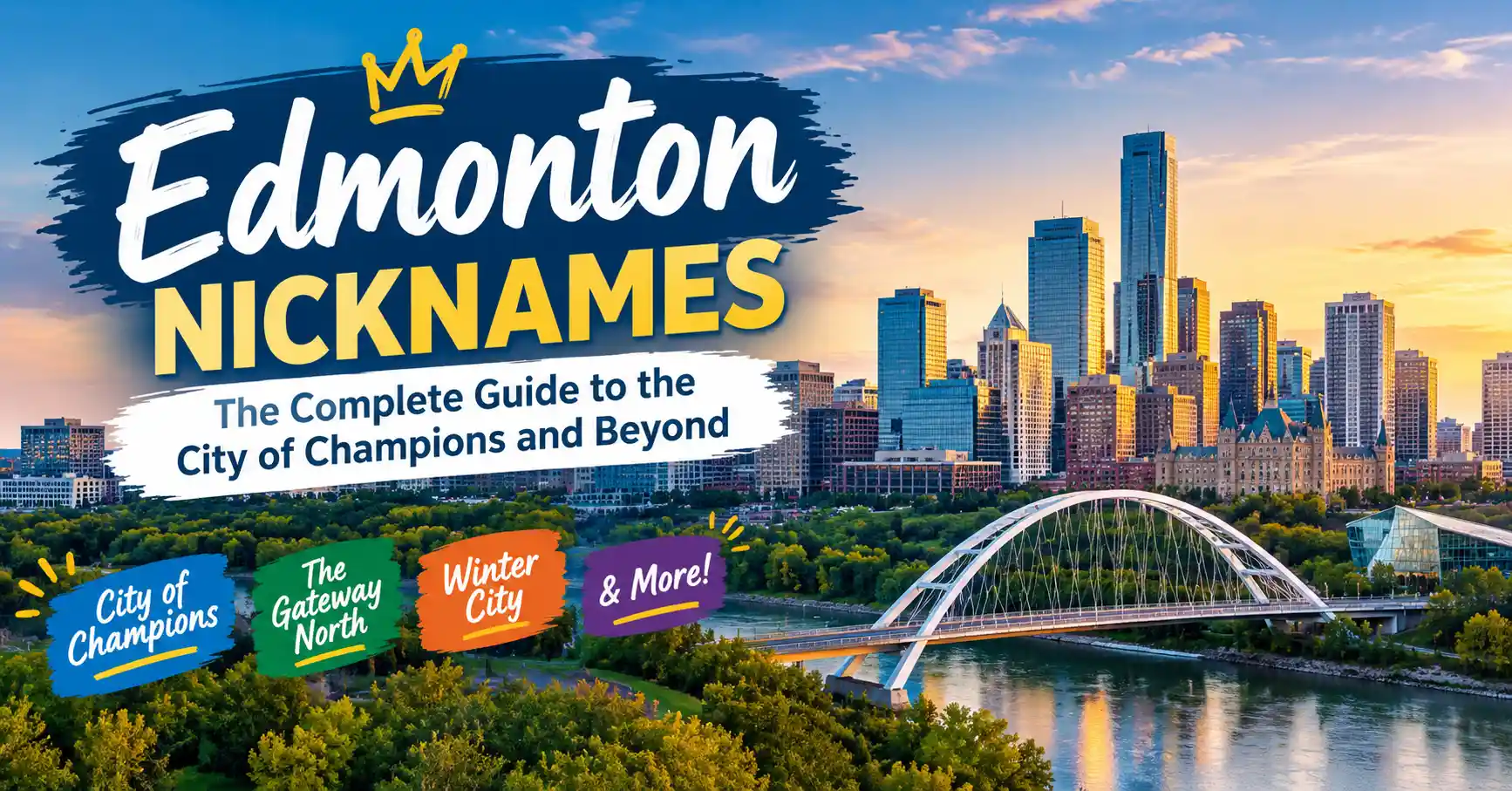
Edmonton, Alberta’s vibrant capital, sits proudly on the North Saskatchewan River in the heart of the Canadian Prairies. As one of Canada’s northernmost major cities, it has earned a fascinating collection of Edmonton nicknames that reflect its unique character, from its legendary hockey dynasty to its stunning river valley. These nicknames tell the story of a city that has evolved from a fur trading post to a thriving metropolitan hub.
Whether you know it as “The City of Champions” or “Deadmonton,” each nickname reveals a different facet of this remarkable Canadian city. Let’s explore the complete collection of Edmonton nicknames, their origins, and what they reveal about this dynamic destination.
🏒 Quick Answer Box
The most famous nickname of Edmonton is “The City of Champions.” This nickname celebrates the city’s remarkable sports legacy, particularly the Edmonton Oilers’ five Stanley Cup victories. Other well-known nicknames include “Gateway to the North” and “Festival City.”
📊 Quick Facts Table
🏆 Official Nickname of Edmonton
Edmonton does not have an officially designated nickname sanctioned by the municipal government. However, “The City of Champions” has achieved near-official status in public consciousness and is widely used in tourism marketing and civic pride campaigns.
This nickname emerged during the 1980s when Edmonton’s sports teams dominated their respective leagues. The Edmonton Oilers won five Stanley Cups between 1984 and 1990, the Edmonton Eskimos (now Elks) captured multiple Grey Cup championships, and the Edmonton Trappers baseball team also found success during this era.
While not legally official, “The City of Champions” is commonly recognized and celebrated throughout the city. It appears on signage, in promotional materials, and is embraced by locals as a symbol of Edmonton’s winning spirit.
🗺️ What Are the Nicknames of Edmonton?
Edmonton’s nicknames span multiple categories, each capturing different aspects of the city’s identity. From its role as a northern gateway to its reputation as a festival hub, these nicknames reflect Edmonton’s geographic significance, cultural vibrancy, and community spirit.
The nicknames can be categorized into:
- Geographic nicknames referencing location and climate
- Sports-related nicknames celebrating athletic achievements
- Cultural nicknames highlighting arts and festivals
- Historical nicknames reflecting the city’s past
- Colloquial nicknames used by locals and critics
📋 Complete List of Edmonton Nicknames
⭐ Most Popular Nicknames of Edmonton
The most recognized Edmonton nicknames are “The City of Champions” and “Gateway to the North.” These two nicknames capture the essence of Edmonton’s identity—its remarkable sporting achievements and its strategic position as the northernmost major city in North America.
“The City of Champions” resonates deeply with locals who remember the glory days of the 1980s when Wayne Gretzky led the Oilers to unprecedented success. Meanwhile, “Gateway to the North” reflects Edmonton’s role as the last major urban center before the vast wilderness of northern Alberta, the Northwest Territories, and the Arctic.
Other popular nicknames like “Festival City” and “Oil City” also enjoy widespread recognition, though they tend to be used in more specific contexts.
📖 Main Nicknames Explained
🏆 The City of Champions
Meaning: A celebration of Edmonton’s extraordinary athletic achievements across multiple sports.
Short Origin Story: The nickname emerged during the 1980s when Edmonton sports teams dominated their leagues simultaneously, creating an unprecedented era of championship success.
Historical Background: Between 1984 and 1990, the Edmonton Oilers won five Stanley Cups. During the same period, the Edmonton Eskimos won multiple Grey Cup championships, and other local teams enjoyed success. This concentration of victories led to the nickname becoming widely adopted.
Modern Usage: The nickname remains in active use today, appearing on city signage, in tourism materials, and in civic discourse. It received renewed attention during the Oilers’ 2024 Stanley Cup Final appearance.
Cultural Impact: The nickname has become a source of civic pride and identity, representing Edmonton’s competitive spirit and ability to excel on national and international stages.
Interesting Fact: Some critics jokingly suggest the nickname should be updated to “The City of Champions (and the Oilers)” given the team’s championship drought from 1990 to the present.
🧭 Gateway to the North
Meaning: Edmonton serves as the primary access point to northern Canada’s vast wilderness and resources.
Short Origin Story: This nickname developed naturally from Edmonton’s geographic position as the northernmost major city in Canada, making it the last stop for supplies and services before entering remote northern territories.
Historical Background: During the fur trade era, Edmonton served as a crucial staging point for expeditions heading north. This role continued through the gold rushes and later resource development in northern Alberta and the territories.
Modern Usage: The nickname is frequently used in business contexts, particularly in industries related to oil sands development, mining, and northern transportation.
Cultural Impact: “Gateway to the North” reinforces Edmonton’s identity as a frontier city with connections to Canada’s northern heritage and resource economy.
Interesting Fact: Edmonton is the northernmost city in North America with a population exceeding one million people.
🎭 Festival City
Meaning: Edmonton hosts an exceptional number of festivals relative to its population, earning recognition for its vibrant arts and culture scene.
Short Origin Story: The nickname gained traction as Edmonton’s festival calendar expanded to include world-class events like the Edmonton International Fringe Theatre Festival, the second-largest Fringe festival in the world.
Historical Background: The city’s festival culture began in earnest in the 1980s and has grown to include over 50 festivals annually, spanning theatre, music, film, and cultural celebrations.
Modern Usage: Tourism Edmonton actively promotes the city as “Canada’s Festival City,” using the nickname to attract visitors during the summer festival season.
Cultural Impact: The nickname celebrates Edmonton’s commitment to arts and culture, distinguishing it from other prairie cities.
Interesting Fact: The Edmonton International Fringe Theatre Festival is the oldest and largest Fringe festival in North America.
🛢️ Oil City
Meaning: Reference to Edmonton’s role as a major hub for Canada’s petroleum industry.
Short Origin Story: The nickname emerged during Alberta’s oil boom in the mid-20th century when Edmonton became the administrative and supply center for oil sands development.
Historical Background: The discovery of oil at Leduc in 1947, just south of Edmonton, transformed the city into an energy industry capital. This economic driver continues to define Edmonton’s economy.
Modern Usage: While less commonly used in tourism contexts, “Oil City” remains relevant in business and industry discussions about Edmonton’s economic identity.
Cultural Impact: The nickname reflects Edmonton’s prosperity while also acknowledging the environmental debates surrounding fossil fuel development.
Interesting Fact: Edmonton is home to the Alberta Legislature and serves as the headquarters for numerous energy companies.
💀 Deadmonton
Meaning: A derogatory nickname suggesting the city lacks vibrancy, excitement, or nightlife.
Short Origin Story: The nickname emerged in the 1990s as critics complained about Edmonton’s perceived lack of cultural amenities compared to cities like Toronto, Vancouver, or Montreal.
Historical Background: During economic downturns, Edmonton experienced periods of limited downtown activity and struggled to attract entertainment venues. Critics coined “Deadmonton” to express frustration.
Modern Usage: While still occasionally used, the nickname has largely fallen out of favor as Edmonton’s downtown has revitalized with the ICE District, Rogers Place arena, and expanded dining and entertainment options.
Cultural Impact: The nickname created a defensive response from locals who embraced the challenge to improve the city’s cultural offerings.
Interesting Fact: Local boosters have attempted to counter the nickname with campaigns promoting Edmonton’s actual cultural vibrancy.
🇺🇦 Edmonchuk
Meaning: A playful reference to Edmonton’s significant Ukrainian-Canadian population.
Short Origin Story: The nickname combines “Edmonton” with the Ukrainian suffix “-chuk,” which appears in many common Ukrainian surnames.
Historical Background: Edmonton has one of the largest Ukrainian communities outside Ukraine, with waves of immigration beginning in the late 19th century. This community has profoundly influenced the city’s culture, politics, and institutions.
Modern Usage: The nickname is used affectionately by locals, particularly those with Ukrainian heritage, though it may not be widely recognized outside Alberta.
Cultural Impact: “Edmonchuk” celebrates Edmonton’s multicultural identity and the contributions of Ukrainian-Canadians to the city’s development.
Interesting Fact: The Ukrainian Canadian Congress and numerous Ukrainian cultural organizations are headquartered in Edmonton.
🥇 Which Nickname Is Most Famous?
“The City of Champions” is undeniably Edmonton’s most famous nickname. This distinction stems from several factors:
- National Exposure: The Oilers’ Stanley Cup victories received extensive media coverage across North America, bringing the nickname to international attention.
- Sustained Relevance: The nickname continues to be used in news coverage, particularly when discussing Edmonton’s sports teams or when the Oilers make playoff runs.
- Civic Pride: The nickname resonates emotionally with Edmontonians, representing an era of unprecedented success and a spirit of excellence.
- Tourism Branding: The nickname appears in official city materials and tourism campaigns, reinforcing its prominence.
While “Gateway to the North” is also widely recognized, it lacks the emotional resonance and celebratory quality of “The City of Champions.”
📚 How Edmonton Got Its Nicknames
Edmonton’s nicknames developed organically over the city’s 200+ year history, reflecting its evolution from a fur trading post to a modern metropolitan center.
The earliest nicknames, like “Gateway to the North,” emerged from Edmonton’s practical role as a supply point for northern expeditions. As the city grew, new nicknames reflected different aspects of its identity—economic (Oil City), cultural (Festival City), and athletic (City of Champions).
The most colorful nickname, “Edmonchuk,” reflects the waves of immigration that transformed Edmonton’s demographic makeup. Meanwhile, critical nicknames like “Deadmonton” show how nicknames can also express dissatisfaction or serve as a catalyst for improvement.
Today, Edmonton’s nickname portfolio represents a complex, multi-faceted city that resists simple categorization.
📝 Other Nicknames at a Glance
- The Chuck — Casual short form used by locals
- River City — Reference to the North Saskatchewan River
- The Big E — Abbreviated nickname
- Winter City — Acknowledgment of cold climate
- Canada’s Festival City — Tourism-focused branding
- The Oil Capital of Canada — Economic descriptor
- City of Festivals — Alternative festival reference
- The Heart of Alberta — Central provincial location
🎉 Fun Facts About Edmonton
- Largest Urban Parkland: Edmonton’s river valley is 22 times larger than New York’s Central Park, making it the largest stretch of urban parkland in North America.
- West Edmonton Mall: For over two decades, West Edmonton Mall was the world’s largest shopping mall, featuring an indoor amusement park, water park, and ice rink.
- Fringe Festival Giant: The Edmonton International Fringe Theatre Festival is the second-largest Fringe festival globally, after Edinburgh’s.
- Northernmost Million City: Edmonton is the northernmost city in North America with a population exceeding one million.
- Wayne Gretzky’s Domain: The Great One played for the Edmonton Oilers from 1979 to 1988, leading the team to four Stanley Cups during his tenure.
- Fort Edmonton History: The city began as Fort Edmonton, a Hudson’s Bay Company trading post established in 1795.
- Oil Discovery: The Leduc oil strike of 1947, just south of Edmonton, transformed the city into an energy capital.
- Ukrainian Heritage: Edmonton has one of the largest Ukrainian populations outside of Ukraine, influencing the “Edmonchuk” nickname.
- Extreme Temperature Range: Edmonton experiences temperatures ranging from -40°C in winter to +35°C in summer.
- Legislature Location: Edmonton serves as Alberta’s capital, hosting the provincial legislature in a beautiful Beaux-Arts building overlooking the river valley.
🎯 Famous Attractions in Edmonton
Edmonton offers a diverse range of attractions that showcase its nickname as a city of champions and festivals:
- West Edmonton Mall: One of the world’s largest shopping and entertainment complexes
- Fort Edmonton Park: Canada’s largest living history museum
- Royal Alberta Museum: The province’s premier natural and human history museum
- Art Gallery of Alberta: A striking modern building housing significant art collections
- Rogers Place: Home of the Edmonton Oilers and a premier entertainment venue
- Alberta Legislature Building: Historic government building with beautiful grounds
- Muttart Conservatory: Distinctive glass pyramids housing botanical displays
- Edmonton Valley Zoo: Family-friendly attraction in the river valley
- Telus World of Science: Interactive science museum
- Elk Island National Park: Nearby park known for bison and elk conservation
⚖️ Nickname Comparison
Edmonton vs Calgary Nicknames
🏒 Edmonton Nicknames
- ✓ The City of Champions
- ✓ Gateway to the North
- ✓ Festival City
- ✓ Oil City
- ✓ Edmonchuk
- ✓ Deadmonton
Capital city • Oilers • River valley • Fringe Festival
🤠 Calgary Nicknames
- ✓ Stampede City
- ✓ Cowtown
- ✓ The Heart of the New West
- ✓ Calgary
- ✓ YYC
Oil headquarters • Flames • Stampede • Business hub
While Edmonton celebrates its sports victories and northern gateway status, Calgary embraces its cowboy heritage and corporate identity.
🔗 Related Cities and Their Nicknames
🤠 Calgary Nicknames
Stampede City, Cowtown, and more from Alberta’s other major city.
🏙️ Toronto Nicknames
The Six, Hogtown, and other nicknames from Canada’s largest city.
🌊 Vancouver Nicknames
Raincouver, Hollywood North, and more from the West Coast.
🌾 Winnipeg Nicknames
Gateway to the West, Winterpeg, and more from Manitoba’s capital.
❓ Frequently Asked Questions
What is the official nickname of Edmonton?
Edmonton does not have an officially designated nickname. However, “The City of Champions” is the most widely recognized and commonly used nickname, often treated as semi-official in tourism and civic contexts.
Why is Edmonton called “The City of Champions”?
Edmonton earned this nickname during the 1980s when its sports teams achieved remarkable success. The Edmonton Oilers won five Stanley Cups between 1984 and 1990, while the Edmonton Eskimos (now Elks) won multiple Grey Cup championships during the same era.
Why is Edmonton called “Gateway to the North”?
Edmonton is called “Gateway to the North” because of its geographic position as the northernmost major city in North America. It serves as the primary supply and service center for northern Alberta, the Northwest Territories, and Arctic expeditions.
What does “Edmonchuk” mean?
“Edmonchuk” is an affectionate nickname combining “Edmonton” with the Ukrainian suffix “-chuk.” It references Edmonton’s large Ukrainian-Canadian population, one of the largest outside of Ukraine.
Do locals actually use these nicknames?
Yes, locals commonly use “The City of Champions” and “Gateway to the North.” “Festival City” is also popular during summer festival season. “Edmonchuk” is used affectionately, particularly within the Ukrainian community, while “Deadmonton” is now rarely used given downtown revitalization.
Is “Deadmonton” still used?
“Deadmonton” was more common in the 1990s when critics complained about limited nightlife and cultural offerings. The nickname has largely fallen out of use following downtown revitalization, including the ICE District and Rogers Place development.
What is Edmonton best known for?
Edmonton is best known for its oil industry, the Edmonton Oilers hockey team, the West Edmonton Mall, its extensive river valley park system, and its vibrant festival scene, including the world-renowned Fringe Festival.
🎬 Conclusion
Edmonton’s nicknames paint a vivid portrait of a city that has transformed from a frontier fur trading post into a dynamic metropolitan capital. From the triumphant “City of Champions” to the geographic “Gateway to the North,” each nickname captures a different facet of Edmonton’s identity.
These Edmonton nicknames reflect the city’s remarkable journey—its sports glory, cultural vibrancy, economic significance, and role as a northern hub. Whether you’re a local who proudly claims these nicknames or a visitor discovering Edmonton for the first time, understanding these monikers provides valuable insight into what makes this Alberta capital so distinctive.
For those interested in exploring more about Canadian cities and their nicknames, The Canadian Encyclopedia offers authoritative resources on Canadian history and geography. Edmonton’s nickname story is ultimately one of resilience, achievement, and civic pride—a fitting tribute to a city that truly embodies the champion spirit.