
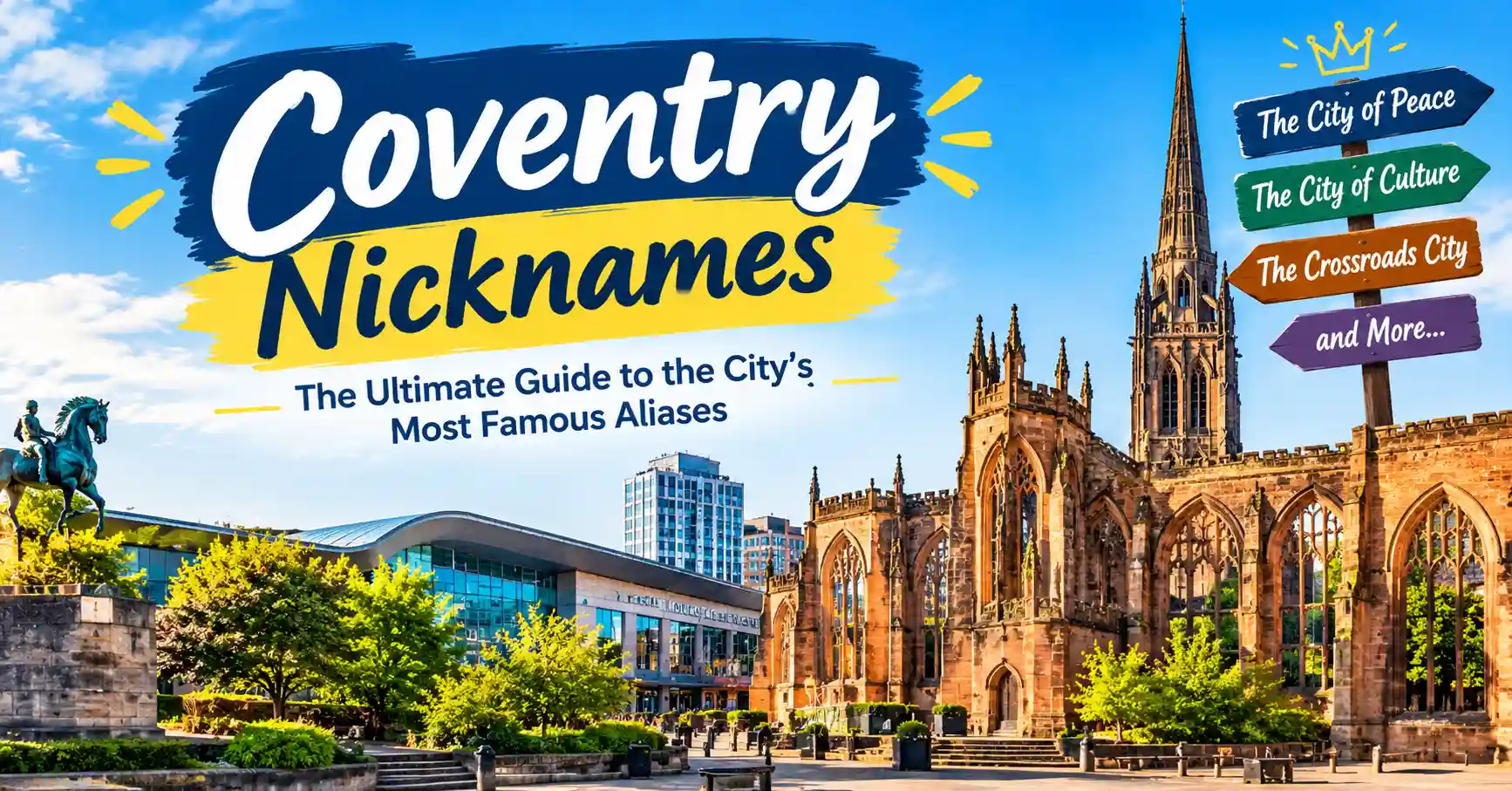
Coventry, a historic cathedral city in the West Midlands of England, carries a rich tapestry of nicknames that reflect its remarkable journey through centuries. From medieval prominence to wartime resilience, each alias tells a story of transformation. The city’s most enduring monikers capture its spirit of rebirth, industrial innovation, and cultural renaissance. These Coventry nicknames have become woven into the fabric of local identity and British heritage.
⚡ Quick Answer Box
The most famous nickname for Coventry is “The Phoenix City” , symbolizing its remarkable rebirth after WWII devastation. Other well-known nicknames include “The Three Spires” , “The City of Culture” , and “Britain’s Motor City.” Each reflects different chapters of Coventry’s storied history.
📊 Quick Facts Table
🏛️ Official Nickname of Coventry
Coventry does not have an officially designated nickname sanctioned by local government or royal charter. However, “The Phoenix City” has gained semi-official recognition through widespread civic usage, particularly following the city’s reconstruction after World War II. This nickname appears in local media, council communications, and community initiatives, effectively functioning as Coventry’s unofficial official title.
The nickname’s historical connection to Coventry is deeply rooted in the city’s motto “Camera Principis” (The Prince’s Chamber) and its later association with resilience and renewal. While not legally official, “The Phoenix City” carries the weight of civic pride and historical significance that makes it the de facto official nickname.
📝 What Are the Nicknames of Coventry?
Coventry’s nicknames span multiple eras and aspects of its identity. These aliases reflect the city’s medieval religious importance, its industrial heritage, its wartime suffering, and its cultural achievements. Understanding these nicknames provides insight into how Coventry has been perceived throughout history and how locals continue to identify with their city.
The most recognized Coventry nicknames fall into several categories: those referencing its architectural landmarks, those commemorating its wartime resilience, those highlighting its industrial contributions, and those celebrating its cultural renaissance. Each nickname serves as a window into a particular chapter of Coventry’s fascinating story.
📋 Complete List of Coventry Nicknames
🌟 Most Popular Nicknames of Coventry
Among all the nicknames associated with Coventry, three stand out as the most widely recognized and frequently used: The Phoenix City, The Three Spires, and Britain’s Motor City. These nicknames have transcended local usage to become recognized nationally and even internationally.
The Phoenix City resonates most strongly with both locals and visitors because it encapsulates Coventry’s defining characteristic: the ability to rise from ashes. This nickname carries emotional weight and historical significance that few other city nicknames can match.
The Three Spires offers a visual identifier that immediately connects Coventry to its medieval heritage. This nickname is particularly beloved by architecture enthusiasts and historians who appreciate the city’s surviving medieval churches.
Britain’s Motor City represents Coventry’s industrial golden age, when the city was synonymous with automotive innovation and manufacturing excellence. This nickname continues to be used in business contexts and industrial heritage discussions.
📖 Main Nicknames Explained
🦅 The Phoenix City
Meaning: A symbol of rebirth, renewal, and triumph over adversity, referencing the mythical bird that rises from its own ashes.
Short Origin Story: Coventry was devastated during the Coventry Blitz of November 14, 1940, when German Luftwaffe bombing destroyed much of the medieval city center, including the beloved St. Michael’s Cathedral. The city’s determination to rebuild and thrive gave rise to the phoenix metaphor.
Historical Background: The Coventry Blitz represented one of the most concentrated bombing campaigns on a British city during World War II. Over 4,000 homes were destroyed, and the cathedral was left in ruins. Rather than simply rebuilding what was lost, Coventry chose to create a new cathedral alongside the ruins, symbolizing hope and forgiveness.
Modern Usage: “The Phoenix City” appears regularly in local media, tourism materials, and civic branding. The phoenix symbol is incorporated into various Coventry organizations and events. The city’s football club, Coventry City FC, has used phoenix imagery in its branding.
Cultural Impact: The phoenix metaphor has become central to Coventry’s identity, representing not just physical rebuilding but also the city’s capacity for reinvention. It speaks to resilience in the face of economic challenges, industrial decline, and social change.
Interesting Fact: The new Coventry Cathedral, consecrated in 1962, stands physically connected to the ruins of the old St. Michael’s Cathedral, creating a powerful architectural statement about honoring the past while embracing the future.
⛪ The Three Spires
Meaning: A reference to Coventry’s three surviving medieval church spires that dominate the city’s skyline.
Short Origin Story: During the medieval period, Coventry was one of England’s most important cities, rivaling London in significance. The city’s wealth and religious importance led to the construction of numerous churches, three of which retained their spires through centuries of change.
Historical Background: The three spires belong to St. Michael’s Church (now the ruined cathedral), Holy Trinity Church, and Christ Church (now destroyed). These structures represented Coventry’s medieval prosperity and religious devotion. The phrase “sending to Coventry” may have originated from the city’s reputation during the English Civil War.
Modern Usage: “The Three Spires” remains a popular descriptor in tourism literature and local pride campaigns. The spires feature prominently in Coventry’s skyline photographs and are often used as a symbol of the city’s enduring heritage.
Cultural Impact: The three spires represent continuity amidst change, connecting modern Coventry to its medieval past. They serve as visual anchors in a city that has undergone dramatic transformation.
Interesting Fact: Coventry’s three spires were once described as being “as famous as the spires of Oxford” before the industrial revolution transformed the city’s character.
🚗 Britain’s Motor City
Meaning: Recognition of Coventry’s role as the center of the British automotive industry during the 20th century.
Short Origin Story: Coventry’s industrial transformation began with bicycle manufacturing in the late 19th century, which naturally evolved into motorcycle and automobile production. By the early 20th century, Coventry was home to numerous car manufacturers.
Historical Background: Companies like Jaguar, Rover, Triumph, and Daimler all had significant operations in Coventry. At its peak, the city produced more cars per capita than any other British city. The Coventry Climax engine company became famous for its racing engines.
Modern Usage: While mass automobile manufacturing has largely departed Coventry, the nickname persists in heritage contexts and business branding. The Coventry Transport Museum celebrates this industrial legacy.
Cultural Impact: “Britain’s Motor City” represents both pride in industrial achievement and acknowledgment of the economic challenges that followed deindustrialization. It connects Coventry to other automotive cities worldwide, such as Detroit.
Interesting Fact: Coventry’s motor industry employed over 50,000 people at its peak, and the city’s skyline was once dominated by factory buildings rather than church spires.
🎭 The City of Culture
Meaning: Recognition of Coventry’s cultural achievements and its designation as UK City of Culture 2021.
Short Origin Story: Coventry was awarded the UK City of Culture designation for 2021, recognizing its vibrant arts scene, diverse communities, and commitment to cultural regeneration.
Historical Background: Coventry has a rich cultural heritage including the Coventry Carol, mystery plays, and a tradition of innovation in performing arts. The city was also home to the influential 2-Tone music scene.
Modern Usage: The City of Culture designation has been incorporated into Coventry’s ongoing cultural strategy and branding. The nickname represents both an achievement and a continuing aspiration.
Cultural Impact: The designation brought significant investment and attention to Coventry’s cultural sector, helping to reshape perceptions of the city.
Interesting Fact: Coventry’s City of Culture year was extended into 2022 due to the COVID-19 pandemic, allowing more people to experience the cultural program.
🕊️ The City of Peace and Reconciliation
Meaning: A testament to Coventry’s role in promoting peace and forgiveness following World War II.
Short Origin Story: After the devastating bombing of 1940, Coventry chose a path of forgiveness rather than bitterness, establishing relationships with German cities and creating international peace initiatives.
Historical Background: The Coventry Cathedral’s decision to forgive and reconcile with Germany was revolutionary. The cathedral established the Community of the Cross of Nails, an international network promoting reconciliation.
Modern Usage: This nickname is used in diplomatic and peace-building contexts. Coventry hosts various peace conferences and events, continuing its legacy of reconciliation.
Cultural Impact: The peace and reconciliation identity has given Coventry international significance beyond its size, positioning the city as a moral leader in conflict resolution.
Interesting Fact: The Cross of Nails, made from medieval nails salvaged from the ruined cathedral, has been presented to leaders worldwide as a symbol of reconciliation.
🏆 Which Nickname Is Most Famous?
“The Phoenix City” stands as Coventry’s most famous nickname, surpassing others in recognition and emotional resonance. Several factors contribute to its prominence:
First, the nickname tells a compelling story that captures Coventry’s defining historical moment. The image of a city rising from the ashes of wartime destruction is both dramatic and inspiring, making it memorable and shareable.
Second, “The Phoenix City” has been actively promoted by Coventry’s civic institutions, appearing in tourism materials, council communications, and local media. This consistent usage has cemented its place in public consciousness.
Third, the nickname resonates beyond Coventry’s borders. The phoenix metaphor is universally understood, requiring no explanation for international audiences. This accessibility has helped the nickname travel further than more locally specific alternatives.
Finally, “The Phoenix City” continues to feel relevant as Coventry faces contemporary challenges. The spirit of renewal it represents applies to economic regeneration, cultural renaissance, and social transformation.
🔍 How Coventry Got Its Nicknames
Coventry’s nicknames emerged from distinct historical periods and circumstances, each adding a layer to the city’s identity. The medieval period gave us “The Three Spires,” reflecting the city’s religious architecture and importance. The industrial revolution brought “Britain’s Motor City” and “The Cycle City,” celebrating manufacturing achievement. World War II and its aftermath produced “The Phoenix City” and “The City of Peace and Reconciliation,” capturing destruction and rebirth. More recently, “The City of Culture” reflects contemporary cultural achievements.
Unlike some cities where nicknames are coined by outsiders or marketing campaigns, most Coventry nicknames arose organically from historical events and local character. This authenticity gives them lasting power and genuine meaning for residents.
📌 Other Nicknames at a Glance
- The City of the Three Spires – Extended version of the three spires nickname
- Cov – Affectionate local abbreviation
- The Motor City of Britain – Variation emphasizing British context
- The Birthplace of 2-Tone – Reference to the influential music genre
- The Cathedral City – Recognition of Coventry’s religious heritage
- The City of Innovation – Acknowledgment of technological contributions
- The UK’s Detroit – Industrial comparison emphasizing automotive heritage
🎉 Fun Facts About Coventry
- Coventry was England’s first “twin city” – It established the modern concept of city twinning by partnering with Dresden, Germany, and other cities after WWII.
- The phrase “sent to Coventry” – This idiom meaning to be ostracized likely originated from the English Civil War when Royalist prisoners were sent to the Parliamentarian-held city.
- Lady Godiva’s legendary ride – The famous nude horseback ride through Coventry streets is commemorated with a statue in the city center.
- Coventry had Britain’s first pedestrianized shopping precinct – Following WWII reconstruction, the city pioneered car-free shopping areas.
- The Coventry Carol is over 400 years old – This haunting Christmas song from the 16th century remains one of the city’s cultural treasures.
- Coventry invented the modern bicycle – The Rover Safety Bicycle, designed in Coventry in 1885, established the template for all modern bicycles.
- The city has been rebuilt three times – Medieval prosperity, Victorian industrialization, and post-war reconstruction each transformed Coventry’s built environment.
- Coventry’s cathedral ruins are Grade I listed – Despite being a ruin, St. Michael’s Cathedral is protected as a building of exceptional historical importance.
- The 2-Tone music genre was born in Coventry – Bands like The Specials and The Selecter launched from Coventry in the late 1970s.
- Coventry is the UK’s 12th largest city – Despite its modest size, the city has punched above its weight in cultural and historical significance.
🏰 Famous Attractions in Coventry
Coventry offers visitors a compelling mix of historical and modern attractions. Coventry Cathedral stands as the city’s most iconic site, with the ruined medieval structure and Sir Basil Spence’s modernist masterpiece existing side by side. The Coventry Transport Museum houses one of the world’s largest collections of British vehicles, celebrating the city’s automotive heritage.
St. Mary’s Guildhall provides a glimpse into medieval Coventry, while the Herbert Art Gallery and Museum showcases the city’s cultural history. Lady Godiva’s statue in Broadgate commemorates the legendary figure, and Coventry Market continues a trading tradition dating back to the 12th century.
The Coventry Music Museum celebrates the city’s musical heritage, and War Memorial Park offers green space for recreation and reflection. The Priory Visitor Centre reveals Coventry’s medieval monastic past.
⚖️ Nickname Comparison: Coventry vs Manchester
🔗 Related Cities and Their Nicknames
❓ Frequently Asked Questions
What is the official nickname of Coventry?
Coventry does not have an officially designated nickname. However, “The Phoenix City” functions as a de facto official nickname, widely used in civic contexts and recognized both locally and nationally as the city’s primary alias.
Why is Coventry called The Phoenix City?
Coventry is called The Phoenix City because of its remarkable recovery from the devastating bombing during World War II. The city rose from the ashes of destruction, rebuilding its cathedral and city center while maintaining its spirit and identity, much like the mythical phoenix.
Who gave Coventry its nickname The Phoenix City?
The nickname emerged organically following World War II, likely coined by local journalists, civic leaders, or residents who recognized the parallel between Coventry’s reconstruction and the phoenix myth. No single individual is credited with creating the nickname.
When did Coventry’s nicknames become popular?
Different nicknames gained popularity at different times. “The Three Spires” emerged during the medieval and Victorian periods. “Britain’s Motor City” became popular in the early 20th century. “The Phoenix City” gained prominence after WWII, and “The City of Culture” became widely used following the 2021 designation.
Do locals use Coventry nicknames?
Yes, Coventry residents regularly use these nicknames, particularly “The Phoenix City” and “The Three Spires.” Local media, sports teams, and community organizations frequently reference these aliases, and they appear in everyday conversation among residents.
🎯 Conclusion
Coventry’s nicknames represent far more than casual labels—they are chapters in a remarkable story of resilience, innovation, and cultural rebirth. From the medieval grandeur suggested by “The Three Spires” to the industrial might of “Britain’s Motor City,” and from the poignant symbolism of “The Phoenix City” to the contemporary celebration of “The City of Culture,” these Coventry nicknames capture the essence of a city that has repeatedly reinvented itself while honoring its past.
For those interested in exploring more about Coventry’s history and heritage, the Historic England website offers comprehensive resources on the city’s architectural and historical significance. Whether you’re a history enthusiast, a cultural explorer, or simply curious about this fascinating city, Coventry’s nicknames provide meaningful entry points into understanding its unique character and enduring spirit.