
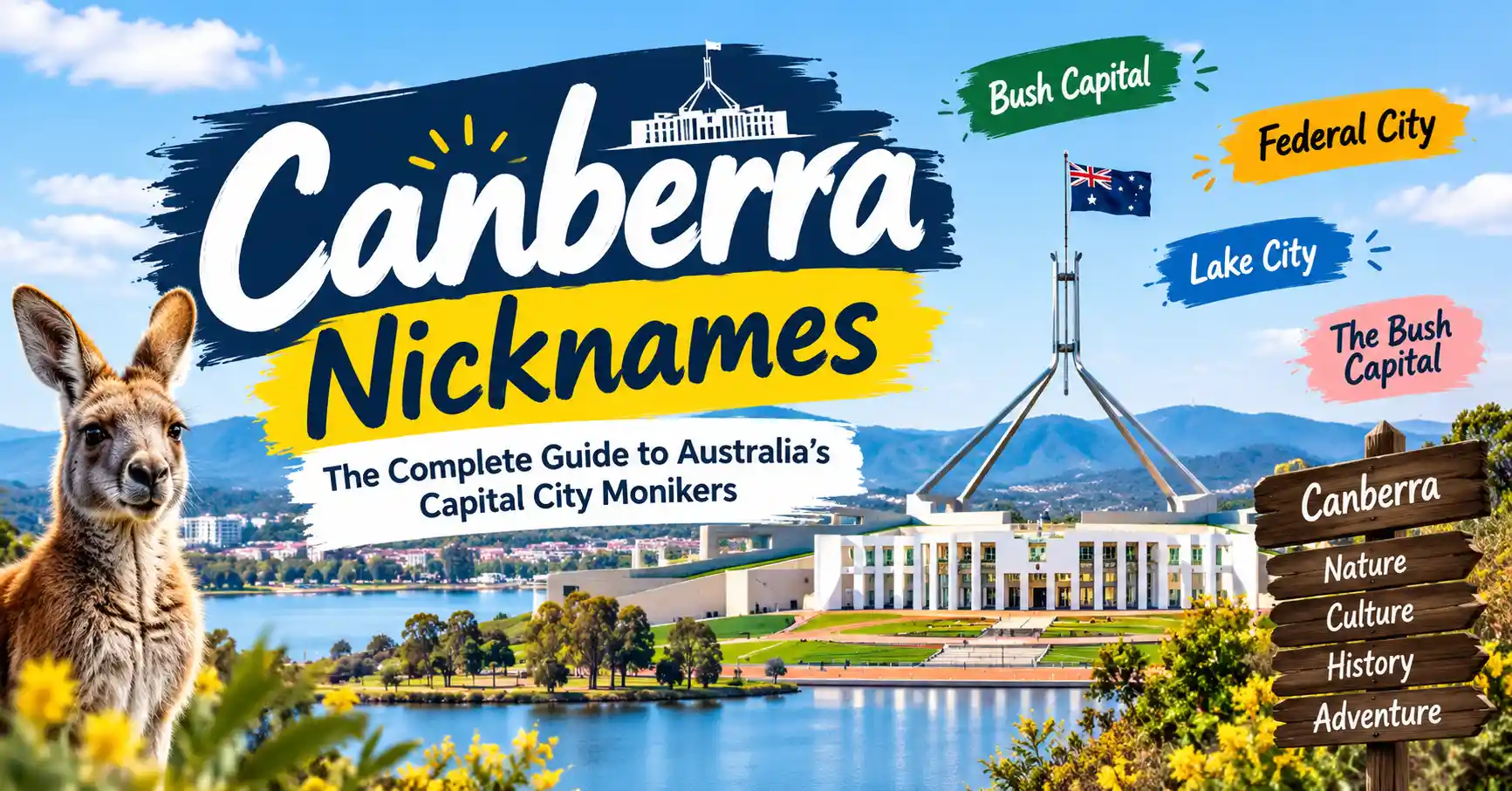
Canberra, Australia’s meticulously planned capital, is a city of contrasts—a purpose-built metropolis nestled in the bush, home to Parliament House and kangaroos alike. While often overshadowed by Sydney and Melbourne, Canberra has earned several distinctive nicknames that reflect its unique character, from “The Bush Capital” to “The Canberra Bubble.”
The Canberra nicknames tell the story of a city that balances national significance with natural beauty, political intrigue with suburban tranquility. Each moniker captures a different facet of this fascinating city that many Australians love to debate about.
🎯 What Is Canberra’s Most Famous Nickname?
🏛️ The Most Famous Nickname of Canberra
The most famous nickname of Canberra is “The Bush Capital.” Other well-known nicknames include “The Nation’s Capital,” “The Capital,” “The ‘Berra,” and “The Canberra Bubble.” These names reflect Canberra’s unique blend of urban planning and natural surroundings, along with its political significance.
📊 Quick Facts: Canberra at a Glance
🏛️ Official Nickname of Canberra
Canberra does not have an officially designated nickname. Unlike some cities that have passed resolutions or proclamations establishing official monikers, Australia’s capital has never formally adopted one through government action.
However, “The Bush Capital” functions as a de facto official nickname. It’s used extensively by Tourism Australia, government publications, and local media. The nickname has become so ingrained in the city’s identity that it appears in official marketing materials and is recognized nationwide.
Other commonly used names like “The Nation’s Capital” are descriptive rather than official designations. This distinction matters because while these names are widely recognized, they haven’t been formally bestowed through any governmental or civic process.
📍 What Are the Nicknames of Canberra?
Canberra’s nicknames fall into several distinct categories, each reflecting different aspects of the city’s identity:
Geographic and Environmental Nicknames highlight Canberra’s unique position as a city built within the Australian bush, surrounded by nature reserves and native vegetation.
Political and Administrative Nicknames emphasize Canberra’s role as the seat of federal government and the center of Australian political life.
Affectionate and Colloquial Nicknames represent how Australians casually refer to the capital, often with a mix of affection and gentle teasing.
Media and Cultural Nicknames have emerged from journalism, popular culture, and public discourse about the city.
📋 Complete List of Canberra Nicknames
🌟 Most Popular Nicknames of Canberra
Among Canberra’s numerous nicknames, three stand out as most widely recognized and used across Australia and internationally. “The Bush Capital” leads the pack, appearing in tourism campaigns, news articles, and casual conversation about the city. “The Nation’s Capital” serves as a straightforward descriptor emphasizing Canberra’s political role. “The ‘Berra” represents the affectionate Australian tendency to abbreviate place names, transforming the formal “Canberra” into something warmer and more casual.
These three nicknames capture different aspects of Canberra’s identity—its natural setting, political function, and cultural character—making them the most enduring and widely used monikers for Australia’s capital city.
📖 Main Canberra Nicknames Explained
🌿 The Bush Capital
Meaning: A city built within and surrounded by natural Australian bushland, blending urban development with preserved natural environments.
Short Origin Story: The nickname emerged from Canberra’s unique design, which incorporated extensive natural reserves and native vegetation into the city plan from its inception.
Historical Background: When American architect Walter Burley Griffin won the international design competition in 1912, his plan deliberately integrated the city with the surrounding landscape rather than replacing it entirely. This approach was revolutionary for its time.
Modern Usage: “The Bush Capital” is used by Tourism Australia, local government, and media outlets. It highlights Canberra’s distinctive characteristic—where else can you see kangaroos grazing near Parliament House?
Cultural Impact: The nickname has shaped Canberra’s identity as an environmentally conscious city. It influences everything from local branding to residential development policies that maintain green corridors.
Interesting Fact: Canberra’s urban forest covers approximately 60% of the city, with over 400,000 trees planted in public spaces, making the “Bush Capital” nickname literally accurate.
🏛️ The Nation’s Capital
Meaning: A direct reference to Canberra’s status as the seat of the Australian federal government.
Short Origin Story: The name gained prominence after Canberra officially became the capital, replacing Melbourne in 1927.
Historical Background: Following Australian Federation in 1901, a compromise was reached between rival cities Sydney and Melbourne to create an entirely new capital. Canberra’s founding was the result of this political compromise.
Modern Usage: This nickname appears constantly in news reports, political commentary, and general discourse about Australian governance. It’s the most straightforward and functional of Canberra’s nicknames.
Cultural Impact: The nickname reinforces Canberra’s central role in Australian democracy while sometimes carrying undertones of the city being distant from the concerns of ordinary Australians.
Interesting Fact: Canberra’s name derives from the Ngunnawal language word “Kamberra,” meaning “meeting place,” which was fitting for a city designed to bring together the nation’s government.
🗣️ The ‘Berra
Meaning: An affectionate Australian abbreviation of “Canberra.”
Short Origin Story: This colloquialism follows the Australian tradition of shortening words and adding “-er” or similar endings, transforming Canberra into “The Berra.”
Historical Background: While the exact first usage is difficult to trace, the nickname gained popularity in the late 20th century as part of broader Australian slang trends.
Modern Usage: “The Berra” is used primarily by younger Australians, locals, and in informal contexts. It appears frequently on social media and in casual conversation.
Cultural Impact: The nickname represents local pride and the Australian tendency to make even formal places feel casual and approachable.
Interesting Fact: “The Berra” fits the pattern of Australian nicknames like “Brissie” for Brisbane, “Tassie” for Tasmania, and “Freo” for Fremantle.
🔮 The Canberra Bubble
Meaning: A reference to the perceived insular nature of Canberra’s political and media culture, where residents supposedly lose touch with broader Australian life.
Short Origin Story: This nickname emerged in Australian political journalism during the 2000s and 2010s as commentary on the disconnect between politicians and the public.
Historical Background: The term gained traction as Australian politics became increasingly focused on personalities and internal party dynamics rather than broader policy debates.
Modern Usage: Journalists, commentators, and politicians themselves use “The Canberra Bubble” to critique political insularity and groupthink within the capital’s political class.
Cultural Impact: The nickname has become a powerful rhetorical tool for criticizing political culture. Politicians often claim to “break out of the Canberra Bubble” to connect with ordinary Australians.
Interesting Fact: The phrase has become so common that it’s now used self-referentially by Canberra insiders, who acknowledge the phenomenon while continuing to operate within it.
🏞️ A City in a Park
Meaning: Emphasizing Canberra’s extensive green spaces, gardens, and parklands that define the city’s character.
Short Origin Story: This description emerged from appreciation of Walter Burley Griffin’s design, which reserved large areas for parks and natural reserves.
Historical Background: Griffin’s winning design specified that the city would be “a city in a park,” with the Molonglo River (now Lake Burley Griffin) at its center.
Modern Usage: The nickname appears in urban planning discussions, tourism materials, and descriptions of Canberra’s livability.
Cultural Impact: It reinforces Canberra’s reputation as one of Australia’s most livable cities, with excellent access to nature.
Interesting Fact: Canberra has more green space per capita than any other Australian capital city, with over 2,000 parks and nature reserves.
🏆 Which Canberra Nickname Is Most Famous?
“The Bush Capital” stands as Canberra’s most famous nickname. Several factors explain its prominence:
Official Adoption: Tourism Australia and the ACT government use the nickname extensively in marketing campaigns, giving it quasi-official status.
Unique Distinction: The nickname highlights something genuinely unique about Canberra—no other Australian capital city is so thoroughly integrated with natural bushland.
Visual Accuracy: Visitors immediately understand the nickname when they see kangaroos near Parliament House or drive through the city’s tree-lined parkways.
Historical Depth: The nickname connects directly to Walter Burley Griffin’s original vision, giving it authenticity and historical significance.
International Recognition: “The Bush Capital” appears in international media coverage of Australia, making it the nickname most recognized outside the country.
While “The Nation’s Capital” is more straightforward and “The ‘Berra” is more affectionate, “The Bush Capital” uniquely captures Canberra’s distinctive character.
📜 How Canberra Got Its Nicknames
Canberra’s nicknames developed through several distinct pathways:
Design-Driven Origins: Walter Burley Griffin’s emphasis on integrating nature into the city plan directly inspired “The Bush Capital” and “A City in a Park.” These nicknames emerged from the city’s physical reality rather than later commentary.
Political Function: Nicknames like “The Nation’s Capital” and “The Canberra Bubble” arose from Canberra’s political role. The former is purely descriptive, while the latter reflects cultural critique.
Australian Language Patterns: “The ‘Berra” exemplifies the Australian tendency to abbreviate and modify place names. Similar nicknames exist for virtually every Australian city and region.
Media Commentary: “The Canberra Bubble” gained prominence through political journalism, where it served as shorthand for the perceived disconnection between political elites and ordinary Australians.
Environmental Awareness: Growing appreciation for Canberra’s natural setting in the late 20th century reinforced “The Bush Capital” and related nature-focused nicknames.
📝 Other Canberra Nicknames at a Glance
Beyond the main nicknames, Canberra has attracted various less common monikers:
- The Roundabout City: A humorous reference to Canberra’s numerous roundabouts, which are a distinctive feature of its road network
- The Public Service Town: Acknowledging that a significant portion of Canberra’s workforce is employed by the Australian Public Service
- The Parliamentary Triangle: Referring to the geometric arrangement of Parliament House, the High Court, and other national institutions
- The Bush City: A variation of “The Bush Capital” that emphasizes the city’s natural setting
- The Planned City: Highlighting Canberra’s status as a purpose-built capital with a comprehensive urban design
- The Compromise Capital: A reference to Canberra’s creation as a compromise between Sydney and Melbourne
- The Political Capital: Similar to “The Nation’s Capital” but emphasizing politics specifically
- The Lake City: Referring to Lake Burley Griffin, the artificial lake at Canberra’s center
- The Man-Made Capital: Emphasizing that Canberra was deliberately created rather than naturally developing
🎉 Fun Facts About Canberra
- Designed by an American: Walter Burley Griffin, from Chicago, won the international competition to design Canberra in 1912, beating 136 other entries.
- Kangaroos at Parliament: It’s common to see eastern grey kangaroos grazing on the lawns of Parliament House and other government buildings.
- The Name’s Origin: “Canberra” comes from the Ngunnawal word “Kamberra,” meaning “meeting place.”
- A Lake in the City Center: Lake Burley Griffin is artificial, created by damming the Molonglo River in 1963.
- The Highest Building Restrictions: Canberra has strict building height limits to preserve views of the city’s landscape and landmarks.
- More Trees Than People: Canberra’s urban forest includes over 400,000 trees in public spaces—more trees than the city has residents in some estimates.
- The Roundabout Capital: Canberra reportedly has more roundabouts per capita than any other Australian city.
- A Scientific Hub: Despite its political focus, Canberra is home to world-class scientific institutions including CSIRO and the Australian National University.
- The Seat of Power Since 1927: Canberra officially became Australia’s capital in 1927, though Parliament didn’t move there until 1927.
- A National Treasure Trove: Canberra houses the National Gallery, National Museum, National Library, and National Archives, making it Australia’s cultural repository.
🏛️ Famous Attractions in Canberra
Canberra’s attractions reflect its dual identity as a political center and cultural destination:
Parliament House sits atop Capital Hill, offering free tours and views from its grass-covered roof. The building represents one of Australia’s most significant architectural achievements.
Australian War Memorial stands as one of the nation’s most important cultural institutions, commemorating Australians who served in wars and peacekeeping operations.
National Gallery of Australia houses over 160,000 works of art, including significant Indigenous Australian and Asian art collections.
Lake Burley Griffin provides recreational opportunities and scenic beauty at the city’s center, with the Captain Cook Memorial Jet shooting water 147 meters into the air.
Australian National Botanic Gardens showcases native Australian flora in a stunning setting on Black Mountain’s slopes.
National Museum of Australia explores the country’s social history through innovative exhibitions and interactive displays.
Questacon brings science to life with hands-on exhibits, making it a favorite for families.
Royal Australian Mint allows visitors to see coins being produced and learn about Australian currency.
⚖️ Nickname Comparison: Canberra vs Sydney
🏛️ Canberra Nicknames
- The Bush Capital — Nature-integrated city
- The Nation’s Capital — Political center
- The ‘Berra — Affectionate abbreviation
- The Canberra Bubble — Political insularity
- A City in a Park — Green spaces
🌉 Sydney Nicknames
- The Harbour City — Iconic harbor setting
- The Emerald City — From “The Wizard of Oz”
- Sydneyside — Beach culture reference
- The Big Smoke — Major metropolitan area
- The Premier State’s Capital — NSW capital status
Both cities’ nicknames reflect their distinct identities. Canberra’s nicknames emphasize its political function and natural setting, while Sydney’s highlight its harbor, beaches, and status as Australia’s largest city. Interestingly, Canberra’s “The Bush Capital” contrasts sharply with Sydney’s “The Harbour City”—one emphasizes nature preservation, the other natural beauty.
The comparison reveals how nicknames capture essential truths about cities. Canberra’s nicknames acknowledge its planned, political, and nature-integrated character. Sydney’s nicknames celebrate its spectacular setting and urban sophistication. Together, they illustrate the diversity of Australian urban identity.
🔗 Related Cities and Their Nicknames
🌉 Sydney Nicknames
The Harbour City, The Emerald City, and more
🎭 Melbourne Nicknames
The Cultural Capital, Marvelous Melbourne
☀️ Brisbane Nicknames
Brisvegas, The River City
🌊 Perth Nicknames
The City of Lights, The Wildflower City
❓ Frequently Asked Questions
What is the official nickname of Canberra?
Canberra does not have an officially designated nickname. However, “The Bush Capital” functions as a de facto official nickname, appearing extensively in government publications and tourism marketing. The name has become so closely associated with Canberra that many assume it holds official status.
Why is Canberra called The Bush Capital?
Canberra is called “The Bush Capital” because the city was designed to integrate with the natural Australian bushland rather than replace it. Walter Burley Griffin’s winning design for the city incorporated extensive natural reserves and native vegetation, creating a unique urban environment where nature and city coexist. Today, kangaroos, cockatoos, and other native wildlife are common sights throughout the city.
Who gave Canberra its nickname?
The nickname “The Bush Capital” emerged organically from Canberra’s unique design and was popularized through tourism marketing and media coverage rather than being bestowed by any individual. “The Canberra Bubble” was coined by political journalists in the 2000s to describe the insular nature of the capital’s political culture.
When did the nickname become popular?
“The Bush Capital” gained popularity in the mid-to-late 20th century as Canberra matured and its unique characteristics became more apparent. “The Canberra Bubble” emerged in the 2000s and 2010s as Australian political commentary increasingly focused on the disconnect between politicians and ordinary Australians.
What are other nicknames of Canberra?
Other Canberra nicknames include “The Nation’s Capital,” “The ‘Berra,” “A City in a Park,” “The Roundabout City,” “The Public Service Town,” and “The Planned City.” Each reflects different aspects of Canberra’s identity, from its political function to its urban design.
Do locals use these nicknames?
Yes, locals use several of these nicknames regularly. “The Berra” is particularly common among younger residents and in informal contexts. “The Bush Capital” is used proudly by many Canberrans who appreciate the city’s natural setting. “The Canberra Bubble” is often used self-referentially by locals who acknowledge the city’s unique political culture.
What does “The Canberra Bubble” mean?
“The Canberra Bubble” refers to the perceived insular nature of Canberra’s political and media culture, where politicians, journalists, and public servants supposedly become disconnected from the concerns of ordinary Australians. The phrase is often used to criticize political groupthink and the tendency of Canberra’s political class to focus on internal matters rather than broader national issues.
Is Canberra’s nickname officially recognized?
No, Canberra’s nicknames are not officially recognized by any government body. They are informal designations that have gained widespread acceptance through common usage. “The Bush Capital” comes closest to official recognition through its extensive use in government tourism materials.
🎯 Conclusion
Canberra’s nicknames—from “The Bush Capital” to “The Canberra Bubble”—capture the essence of Australia’s unique capital city. These names tell the story of a place deliberately created to serve a nation, designed to harmonize with nature, and occasionally criticized for its political insularity. Whether you call it The Bush Capital, The Berra, or simply The Nation’s Capital, Canberra’s nicknames reveal as much about Australian culture and values as they do about the city itself.
Understanding these Canberra nicknames provides insight into how Australians view their capital and themselves. The affectionate abbreviations, the nature-focused descriptions, and the political commentary embedded in these names all reflect the complex relationship between Australians and their seat of government. For more information about Australian cities and their unique identities, explore the rich resources available through Tourism Australia, the official tourism website that celebrates the country’s diverse urban landscapes.