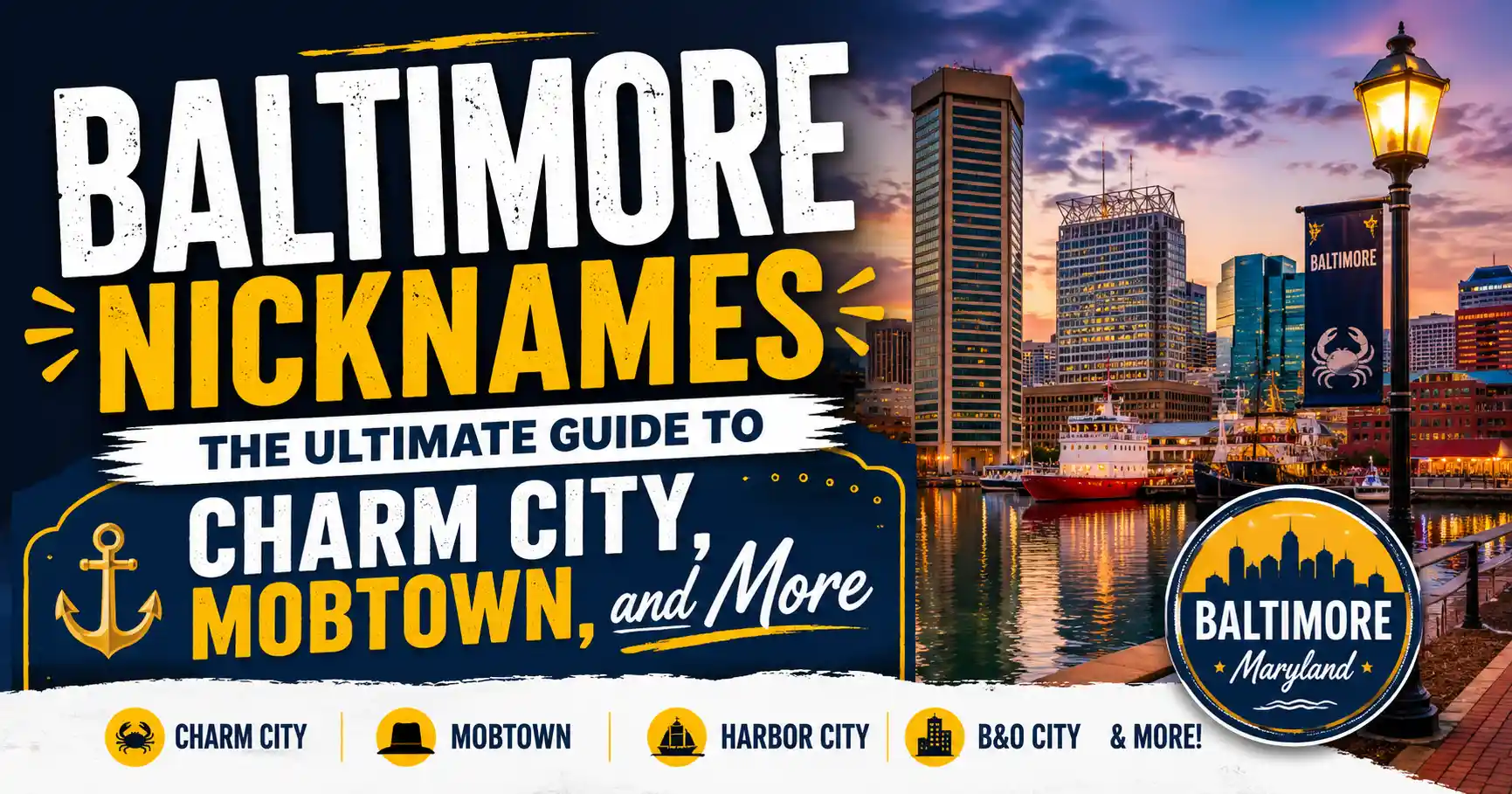
Baltimore is a city of historic rowhouses, Chesapeake blue crabs, and an unmistakable working-class soul—and its many Baltimore nicknames tell that story better than any travel brochure. From the welcoming sound of “Charm City” to the 19th-century grit of “Mobtown,” these monikers reveal how Baltimore has been seen, marketed, and remembered across more than 200 years.
What Are the Baltimore Nicknames?
💡 Quick Answer
The most famous Baltimore nickname is “Charm City.” Other well-known nicknames include “Monumental City,” “Mobtown,” “Clipper City,” “City of Firsts,” “B’More,” and “Smalltimore.” “Charm City” was introduced in 1975 as a tourism slogan and remains the city’s most recognized moniker today.
Quick Facts About Baltimore
🏛️ Official Nickname of Baltimore
Baltimore does not have a single nickname written into the city charter or Maryland law. In everyday practice, “Charm City” functions as the city’s unofficial official nickname because it has been used by Visit Baltimore, city agencies, local media, and businesses since the mid-1970s. The older “Monumental City” still appears in historical writing and civic ceremonies, while “City of Firsts” is often used in educational and promotional materials.
📜 Complete List of Baltimore Nicknames
🌟 Most Popular Nicknames of Baltimore
The most recognized Baltimore nicknames range from official-sounding tourism brands to everyday local shorthand. The top tier includes:
- Charm City — the city’s dominant identity
- B’More — the casual, affectionate abbreviation
- Monumental City — the historic formal nickname
- Smalltimore — the modern social nickname
- Mobtown — the gritty 19th-century name still known by history lovers
🔎 Main Nicknames Explained
Charm City
- Meaning: A charming, appealing city worth visiting.
- Short Origin Story: The nickname was created in 1975 as part of a tourism campaign championed by then-Mayor William Donald Schaefer and advertising executive Bill Evans. The goal was to counter negative perceptions of Baltimore during a period of industrial decline.
- Historical Background: In the 1970s, Baltimore faced population loss and an image problem. City leaders placed “Charm City” on billboards, bumper stickers, and tourism brochures.
- Modern Usage: Visit Baltimore, local businesses, sports teams, and national media regularly use “Charm City.”
- Cultural Impact: It became one of the most successful city rebranding campaigns in modern American history.
- Interesting Fact: “Charm City” was initially a marketing slogan, but residents eventually adopted it as a genuine point of pride.
Monumental City
- Meaning: A city defined by important public monuments.
- Short Origin Story: President John Quincy Adams reportedly called Baltimore “the monumental city” during an 1827 visit because of its monuments.
- Historical Background: Baltimore built the first major public monument to George Washington, begun in 1815, and the Battle Monument after the War of 1812.
- Modern Usage: The name appears in historical societies, museum exhibits, and formal civic writing.
- Cultural Impact: It highlights Baltimore’s early architectural and national significance.
- Interesting Fact: Robert Mills, who designed Baltimore’s Washington Monument, later designed the Washington Monument in Washington, D.C.
Mobtown
- Meaning: A city known for mobs, street riots, and political violence.
- Short Origin Story: Nineteenth-century newspapers used the label after repeated riots in Baltimore.
- Historical Background: Baltimore experienced violent episodes including the 1812 anti-Federalist riots, the 1835 bank riots, and the Know-Nothing riots of the 1850s.
- Modern Usage: Mostly used in historical contexts, true-crime storytelling, or regional sports banter.
- Cultural Impact: The name still shapes Baltimore’s tough, independent image.
- Interesting Fact: The 1877 Great Railroad Strike riots in Baltimore reinforced the “Mobtown” reputation well after the Civil War.
Clipper City
- Meaning: A reference to the fast Baltimore clipper ships built in local shipyards.
- Short Origin Story: Between the 1790s and mid-1800s, Baltimore shipyards produced some of the fastest sailing vessels in the world.
- Historical Background: Baltimore clippers were prized for speed and were used as privateers during the War of 1812.
- Modern Usage: Used by maritime museums, neighborhood organizations, and local breweries.
- Cultural Impact: It connects modern Baltimore to its maritime and shipbuilding roots.
- Interesting Fact: The USS Constellation docked in the Inner Harbor is a reminder of Baltimore’s naval heritage.
City of Firsts
- Meaning: Baltimore claims a long list of American firsts in transportation, medicine, and technology.
- Short Origin Story: The nickname grew out of Baltimore’s record of innovation in the 19th and early 20th centuries.
- Historical Background: The first chartered common-carrier railroad in the U.S., the Baltimore and Ohio Railroad, was founded in 1827. The first telegraph message was sent from Washington to Baltimore in 1844, and the world’s first dental school opened in Baltimore in 1840.
- Modern Usage: Schools, local government, and media use the term to promote civic pride.
- Cultural Impact: It reinforces Baltimore’s role in American innovation.
- Interesting Fact: Baltimore’s first public monument to George Washington is another “first” often cited for this nickname.
B’More and Smalltimore
- Meaning: “B’More” is a clipped, affectionate form of Baltimore. “Smalltimore” means a large city with surprisingly close social networks.
- Short Origin Story: “B’More” emerged naturally from local speech. “Smalltimore” became popular in the early 2000s as locals shared stories of unexpected connections.
- Historical Background: Baltimore’s strong neighborhood identities and tight professional circles created the “Smalltimore” phenomenon.
- Modern Usage: Both names are common in conversation, social media, and local marketing.
- Cultural Impact: They show how Baltimoreans blend pride with an insider’s sense of community.
- Interesting Fact: Many residents joke that in Baltimore there are only “two degrees of separation,” not six.
🏆 Which Nickname Is Most Famous?
“Charm City” is by far the most famous Baltimore nickname. It has outlasted its original marketing campaign and is now used by locals, visitors, sports teams, journalists, and city officials. The nickname works because it is short, positive, and flexible enough to describe Baltimore’s historic neighborhoods, waterfront attractions, and resilient character. While “Monumental City” is more formal and “Mobtown” is more historical, “Charm City” is the nickname people actually recognize.
🧭 How Baltimore Got Its Nicknames
Baltimore nicknames generally come from three main sources: marketing campaigns, historical commentary, and local slang. Names like “Charm City” and “The City That Reads” were designed to improve public perception. Names like “Monumental City” and “Mobtown” came from outside observers and newspaper reporters in the 19th century. Names like “B’More” and “Smalltimore” grew naturally from the way Baltimoreans talk about their city. This mixture is why Baltimore’s identity feels both polished and proudly unpolished.
💬 Other Nicknames at a Glance
- Monument City — shortened form of Monumental City
- The City That Reads — 1980s–1990s literacy slogan
- The Greatest City in America — early 2000s civic pride slogan
- Crab Cake Capital of the World — informal food identity
- Crab City — Chesapeake blue crab reference
- Harm City — derogatory crime-related nickname
- Bodymore, Murderland — derogatory wordplay, not city-endorsed
🎉 Fun Facts About Baltimore
- Baltimore’s Washington Monument was the first major public monument to George Washington in the United States.
- Francis Scott Key wrote “The Star-Spangled Banner” during the War of 1812 at Fort McHenry in Baltimore.
- The Baltimore and Ohio Railroad, founded in 1827, was the first chartered common-carrier railroad in the country.
- The world’s first dental school, the Baltimore College of Dental Surgery, opened in 1840.
- Edgar Allan Poe died in Baltimore in 1849 and is buried there; the Baltimore Ravens NFL team is named after his poem “The Raven.”
- Baltimore has more than 200 distinct historic neighborhoods.
- Old Bay seasoning, a Chesapeake staple, was created in Baltimore in 1939 by German immigrant Gustav Brunn.
- The Inner Harbor was transformed from an industrial waterfront into a major tourism destination beginning in the 1980s.
- Baltimore is an independent city, meaning it is not part of any surrounding county.
- “The Wire,” one of the most critically acclaimed television dramas ever made, was set and filmed in Baltimore.
🏙️ Famous Attractions in Baltimore
- Inner Harbor
- Fort McHenry National Monument and Historic Shrine
- Oriole Park at Camden Yards
- National Aquarium
- Johns Hopkins University
- B&O Railroad Museum
- Lexington Market
- Fell’s Point Historic District
- American Visionary Art Museum
- Edgar Allan Poe House and Museum
⚖️ Nickname Comparison: Baltimore vs New York City
🦀 Baltimore — “Charm City”
Origin: 1975 tourism campaign
Vibe: Gritty, historic, unpretentious, neighborhood-focused
Known For: Inner Harbor, blue crabs, rowhouses, Johns Hopkins
🍎 New York City — “The Big Apple”
Origin: Popularized in the 1920s and again in the 1970s
Vibe: Fast, global, dense, entertainment-driven
Known For: Skyscrapers, Broadway, finance, five boroughs
Baltimore’s “Charm City” and New York’s “The Big Apple” are both tourism-friendly nicknames, but they project very different personalities: intimate and historic versus massive and aspirational. See the full guide to New York City Nicknames for more.
🗺️ Related Cities and Their Nicknames
“The District” Philadelphia Nicknames
“City of Brotherly Love” Richmond Nicknames
“River City” Annapolis Nicknames
“Sailing Capital of America”
❓ Frequently Asked Questions
What is the official nickname of Baltimore?
Baltimore has no single nickname codified in city law. “Charm City” is the city’s most recognized and widely used nickname, functioning as an unofficial official brand. “Monumental City” is the older formal nickname, and “City of Firsts” is used in civic and educational materials.
Why is Baltimore called Charm City?
Baltimore is called Charm City because of a 1975 tourism marketing campaign created to improve the city’s image. Then-Mayor William Donald Schaefer and advertising professionals introduced the name to highlight Baltimore’s historic neighborhoods, waterfront, and welcoming character.
Who gave Baltimore the “Charm City” nickname?
“Charm City” was not given by a single resident or author. It emerged from a 1975 tourism campaign developed under Mayor William Donald Schaefer. Advertising executive Bill Evans is often credited with creating the phrase.
When did “Charm City” become popular?
The nickname became popular in the late 1970s and was fully embraced by the 1980s. Since then, it has become the default nickname for Baltimore in tourism, sports, media, and everyday speech.
What are other nicknames for Baltimore?
Other nicknames for Baltimore include “Monumental City,” “Mobtown,” “Clipper City,” “City of Firsts,” “B’More,” “Smalltimore,” “The City That Reads,” and “The Greatest City in America.” Some informal food-related names include “Crab City” and “Crab Cake Capital of the World.”
🏁 Conclusion
Baltimore nicknames tell a larger story of reinvention, pride, and resilience. “Charm City” may be the headline, but “Monumental City,” “Mobtown,” “Clipper City,” “City of Firsts,” “B’More,” and “Smalltimore” each add a different layer to the city’s identity. For current events, official visitor information, and a deeper look at what makes Baltimore unique, explore Visit Baltimore.