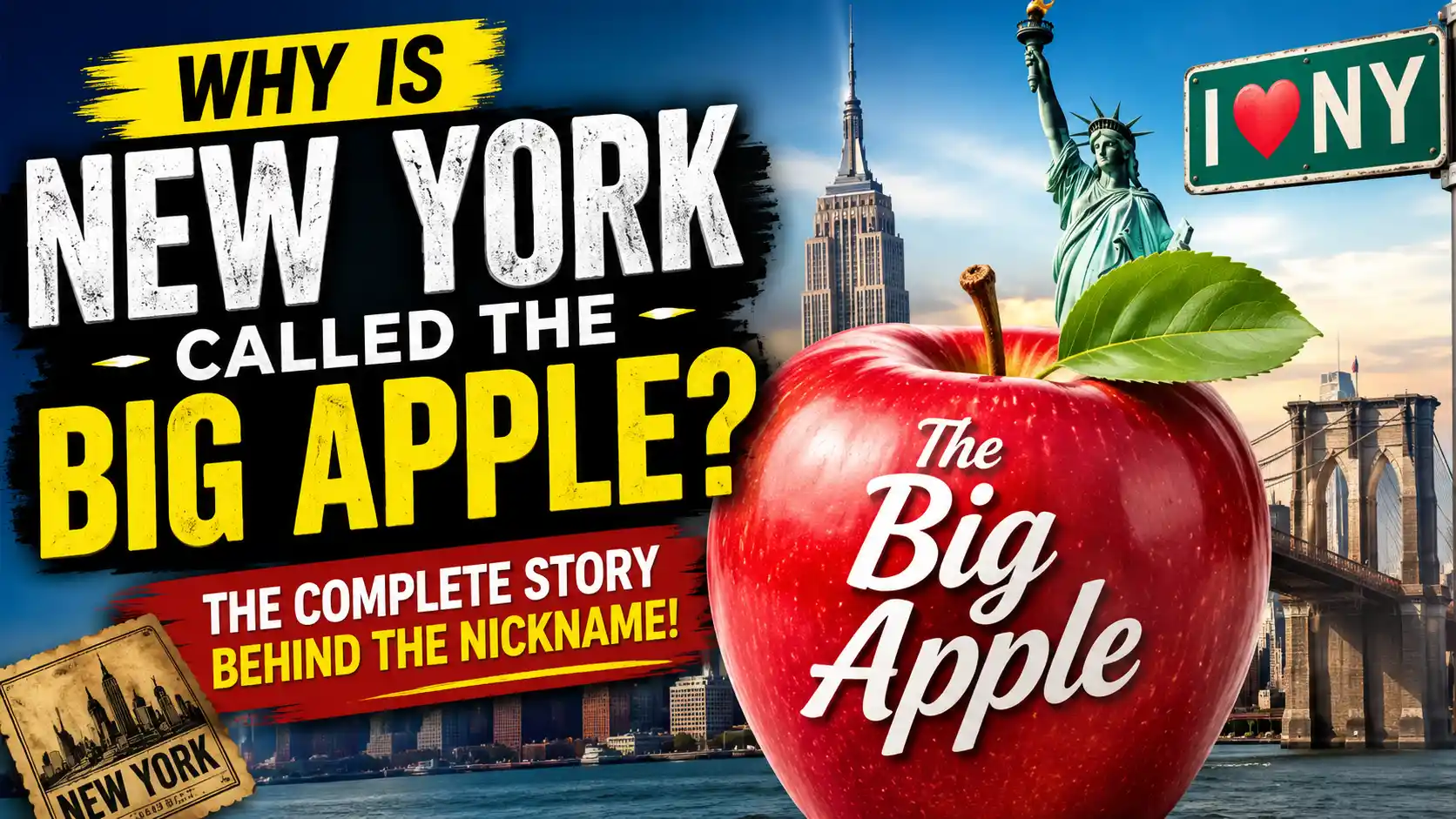
If you want to know about “Why Is New York Called the Big Apple?” Here is a Ans below
New York City is a place of towering ambition, relentless energy, and countless stories—and no nickname captures its outsized personality quite like “The Big Apple.” Whether you’re strolling through Times Square, hailing a yellow cab, or watching a Broadway curtain rise, the phrase is everywhere. But how did a simple piece of fruit become the ultimate symbol of the world’s most iconic city? The answer weaves together horse racing, jazz, a forgotten sportswriter, and one of the most successful tourism campaigns in American history.
Short Answer
New York City is called The Big Apple because of a 1920s horse‑racing term that meant “the biggest prize.” Sportswriter John J. Fitz Gerald overheard African American stable hands in New Orleans call New York’s racetracks “the big apple”—the ultimate destination for any jockey or trainer. He popularized the phrase in his newspaper columns, and a savvy 1970s tourism campaign revived it, turning a local racetrack saying into a global symbol of ambition, excitement, and endless possibility.
Quick Facts
| City | State/Country | Nickname | Meaning | First Known Usage | Popularized By | Known For |
|---|---|---|---|---|---|---|
| New York City | New York, USA | The Big Apple | The premier city; the ultimate prize or destination, especially in sports, entertainment, and business | May 3, 1921 (in print by John J. Fitz Gerald) | Charles Gillett & the New York Convention and Visitors Bureau (1971 tourism campaign) | Global finance, Broadway theater, cultural diversity, iconic skyline, fashion, and media |
What Does “The Big Apple” Mean?
At its simplest, the nickname paints New York as the biggest, most desirable stage in America. In the context of horse racing—where the phrase was born—it meant the top-tier tracks and the richest purses. Over time, the meaning expanded. Today, calling New York “The Big Apple” conveys that it’s the place where you go to make it, whether you’re an actor, a banker, a musician, or a dreamer of any kind. There are many apples on the tree, the saying goes, but only one is the biggest and juiciest.
Why Is New York Called “The Big Apple”?
The complete answer lies at the intersection of sports journalism, African American vernacular, and brilliant marketing. The nickname was not invented by city officials or poets. It bubbled up from the racetrack, was captured by a reporter with a good ear, faded for decades, and then was deliberately resurrected to sell the city to tourists. Each layer of the story—1920s horse racing, the 1930s jazz scene, and the 1970s “I ❤️ NY” era—added a coat of polish to the apple.
The Origin of the Nickname
In the early 1920s, New Orleans was a winter hub for thoroughbred racing. At the Fair Grounds racetrack, jockeys, trainers, and stable hands from around the country gathered. Among them were African American workers who used the slang phrase “the big apple” to describe the New York racing circuit—Saratoga, Belmont Park, Aqueduct, and Jamaica. To them, traveling to New York meant a shot at the largest prizes and the highest prestige. The city was the “big time,” and “apple” was simply a metaphor for a prize or reward.
A young sportswriter named John J. Fitz Gerald, who covered horse racing for the New York Morning Telegraph, overheard the term during a trip to New Orleans. He found it vivid, authentic, and perfectly suited to the dreams that pulled people toward Gotham.
Who Coined the Nickname?
There is little doubt among historians: John J. Fitz Gerald is the man who introduced “The Big Apple” to the world. He didn’t create the phrase out of thin air, but he was the first to put it in print, explain its meaning, and build an entire column around it. The leading theory—backed by etymologist Barry Popik and the City of New York—is that Fitz Gerald overheard African American stable hands at the Fair Grounds racetrack in New Orleans. He then used the expression in his racing reports and, starting in 1924, launched a column titled “Around the Big Apple.”
In one column, Fitz Gerald wrote that he heard two stable hands say they were heading to “the big apple.” When he asked what they meant, they replied it was New York—the place where the big money and big races were. That exchange became the cornerstone of the legend.
Some alternative theories have floated a jazz origin or a connection to a dance, but the documentary evidence points squarely to the racetrack. Fitz Gerald himself repeatedly credited the stable hands, and his early newspaper columns leave a clear paper trail.
History Behind the Nickname
New York in the 1920s was already a magnet for talent, but the racing world had its own insular vocabulary. The phrase “apple” had long been slang for something desirable—think “apple of my eye.” In the rough-and-tumble world of barns and betting, “the big apple” meant the grandest stage of all. Fitz Gerald’s Morning Telegraph columns cemented the term inside the sports pages. He wrote “Around the Big Apple” for years, and other racing writers occasionally borrowed the phrase.
By the 1930s, “apple” had jumped from the stables to the jazz clubs. Musicians on tour began calling any city “an apple,” and New York was naturally “the Big Apple.” It’s a parallel evolution: the horse-racing origin remained, but the jazz community gave the nickname a second life, even as the general public started to forget it. Meanwhile, a dance craze called the Big Apple—originating in South Carolina—swept the nation, but that phenomenon was entirely separate and did not refer to New York City.
For a few decades, the term lay dormant. Then, in the early 1970s, New York was grappling with a gritty image: rising crime, fiscal crisis, and negative headlines. Charles Gillett, president of the New York Convention and Visitors Bureau, decided the city needed a friendly, fresh symbol. He rediscovered the “Big Apple” phrase and launched an aggressive tourism campaign.
Volunteers handed out red apple stickers, celebrities posed with apples, and the slogan “The Big Apple” was suddenly on billboards, matchbooks, and T-shirts. The campaign worked brilliantly, and the nickname that was born at a dusty racetrack became inseparable from New York’s global identity.
Timeline of the Nickname
| Year | Event |
|---|---|
| 1921 | John J. Fitz Gerald uses “the big apple” in a May 3 *Morning Telegraph* article, the earliest known printed reference, to describe a string of horses heading to New York. |
| 1924 | Fitz Gerald launches the column “Around the Big Apple” and explains that African American stable hands coined the term for New York’s premier racetracks. |
| 1930s | Jazz musicians adopt “apple” as slang for any city; New York solidifies as “the Big Apple.” The unrelated Big Apple dance craze spreads. |
| 1971 | Charles Gillett and the New York Convention and Visitors Bureau launch the “Big Apple” tourism campaign with a bright red apple logo, giving the nickname worldwide fame. |
| 1997 | The intersection of Broadway and West 54th Street is officially named “Big Apple Corner” in honor of Fitz Gerald, who lived nearby. |
| Present | “The Big Apple” is an inseparable part of New York’s identity, used in marketing, media, sports, and everyday conversation worldwide. |
How the Nickname Became Popular
The journey from racetrack slang to universal symbol is a masterclass in cultural resonance and marketing. In the 1920s and 1930s, Fitz Gerald’s newspaper work spread the term inside niche sporting and jazz circles, but it never became a household phrase. The 1971 campaign, however, hit every note perfectly. Charles Gillett invited celebrities, distributed millions of red apple decals, and encouraged businesses to use the logo. The message was simple: New York is a city of opportunity and excitement, just like the big apple on top of the tree.
Media coverage amplified the effort. New York’s newspapers and national magazines ran features on the campaign, and visitors started bringing home souvenirs stamped with “The Big Apple.” Soon the nickname was no longer a slogan—it was the city’s informal anthem. Even after the formal campaign ended, the name stuck because it felt organic and optimistic, a stark contrast to the era’s urban decay narrative.
Myths vs Facts
| Myth | Reality |
|---|---|
| The nickname came from the 1930s Big Apple dance craze. | The dance originated in South Carolina and had no connection to New York; the term for the city appeared in print a decade earlier. |
| It referred to apples sold by homeless men during the Great Depression. | The term “Big Apple” was already in use in 1921, nearly a decade before the Depression, and originated in horse racing, not street vending. |
| A New Orleans brothel madam named Eve inspired the name. | No credible evidence supports this story. The documented trail leads straight to the racetrack and Fitz Gerald’s columns. |
Is the Nickname Still Used Today?
Absolutely. “The Big Apple” appears on official tourism websites, in news headlines, and in the lyrics of countless songs. The red apple logo, while no longer the sole trademark of the visitors bureau, remains a beloved visual cue. New York sports teams, businesses, and cultural institutions all lean on the moniker. It has become so deeply embedded that a visitor mentioning “the Big Apple” in a conversation will be understood anywhere on the planet.
Cultural Impact of the Nickname
The nickname’s influence goes far beyond souvenirs. It shapes how New Yorkers see themselves and how the world imagines the city. A few standout areas include:
- Local identity: Native New Yorkers may use the nickname with a wink, but they recognize it as a badge of ambition and resilience.
- Tourism branding: The “Big Apple” identity paved the way for other iconic campaigns, most notably “I ❤️ NY,” which built on the same emotional foundation.
- Sports: From the New York Mets’ “Big Apple” home-run display in Citi Field to countless sports headlines, the nickname is a fixture in the city’s athletic life.
- Media and pop culture: Films, TV shows, and songs—Frank Sinatra’s “New York, New York,” anyone?—continuously reference the apple. It serves as shorthand for glamour, grit, and limitless possibility.
- The Big Apple Circus and the Big Apple Comic Con are just two examples of events that borrow the name to signal New York’s one-of-a-kind energy.
Interesting Facts About the Nickname
- An etymologist cracked the case. Researcher Barry Popik spent years tracking down the earliest printed uses of “The Big Apple,” finally crediting John J. Fitz Gerald and bringing the racetrack origin to light in the 1990s.
- A street corner honors the sportswriter. In 1997, Mayor Rudy Giuliani signed a bill co-naming Broadway and West 54th Street “Big Apple Corner,” where Fitz Gerald lived from 1934 to 1963.
- The red apple logo became a global icon. During the 1971 campaign, the apple appeared on everything from lapel pins to shopping bags, and the city even enlisted celebrities like Louis Armstrong and Pearl Bailey to pose with it.
- Jazz musicians gave it a second life. Even before the tourism campaign, beboppers and swing bands used “apple” to mean a city; going to “the Big Apple” meant hitting the top.
- The campaign was born from crisis. New York’s image was so tarnished by the early ’70s that Charles Gillett’s team had to fight to convince hotel owners and businesses that a friendly fruit could help.
- It isn’t the city’s only edible nickname. New York has also been called “Gotham,” “The City That Never Sleeps,” and “The Capital of the World,” but none match the warmth and approachability of “The Big Apple.”
- The Mets’ home-run apple is a direct descendant. The giant apple that rises from the outfield at Citi Field is a playful nod to the city’s most famous symbol.
- Frank Sinatra never recorded a song called “The Big Apple,” but his anthems to New York helped cement the nickname’s romantic aura.
- The term almost died. By the 1960s, “The Big Apple” had largely vanished from popular usage until the tourism bureau revived it.
- It’s been translated around the world. In Spanish, you’ll hear “La Gran Manzana”; in French, “La Grosse Pomme”—all paying homage to the same racetrack slang.
Other Nicknames of New York
New York City has collected many nicknames over the centuries, each capturing a different facet of its personality. You’ll hear “Gotham,” “The City That Never Sleeps,” “Empire City,” “The Capital of the World,” and “The Melting Pot,” to name a few. Each one has its own fascinating backstory—so much so that they deserve their own deep dive. If you’re curious, explore our full guide to New York Nicknames to uncover the stories behind them all.
Colonial streets and hearty cuisine hold clues to the flavorful reason Boston earned the nickname Beantown.
Comparison: The Big Apple vs. The Windy City
How does “The Big Apple” stack up against Chicago’s famous nickname? Both are iconic, both have mysterious origins that have sparked debate, and both now drive tremendous civic pride. Here’s a side-by-side look.
🍎 The Big Apple
City: New York City, NY
Origin: 1920s horse racing slang
Coined/Popularized: John J. Fitz Gerald (1921–1924); Charles Gillett (1971)
Core Meaning: The ultimate prize, the city of greatest opportunity
Vibe: Glamour, ambition, non-stop energy
🌬️ The Windy City
City: Chicago, IL
Origin: 19th-century rivalry and blustery politics
Coined/Popularized: 1870s newspapers (possibly boosted by the 1893 World’s Fair)
Core Meaning: A city of blustery talk and strong winds off Lake Michigan
Vibe: Bold, resilient, Midwestern charm with a chip on its shoulder
Want the full windy story? Read our deep dive into Why Is Chicago Called the Windy City?
Related City Nicknames
New York isn’t the only city with a nickname that sticks. Click through to discover the tales behind these famous monikers.
Frequently Asked Questions
What does “The Big Apple” mean?▼
It means New York City is the ultimate prize or top destination—the biggest and best “apple” on the tree, a metaphor for opportunity and success.
Who coined the nickname “The Big Apple”?▼
Sportswriter John J. Fitz Gerald didn’t invent the phrase but was the first to publish it, in the New York Morning Telegraph, after hearing African American stable hands use it.
When was the term “Big Apple” first used in print?▼
May 3, 1921, in a horse racing article by Fitz Gerald. He later launched the recurring column “Around the Big Apple” in 1924.
Why do they call New York the Big Apple?▼
Because 1920s stable hands in New Orleans called New York’s premier racetracks “the big apple,” meaning the big time. The term was revived in 1971 as a tourism slogan.
How did the Big Apple get its name from horse racing?▼
African American stable hands used “apple” as slang for a prize. New York’s tracks offered the richest purses, so they called it “the big apple.”
Did the nickname come from the Big Apple dance?▼
No. The dance originated in South Carolina in the 1930s and had nothing to do with New York. The city’s nickname was already in print a decade earlier.
Who made the Big Apple nickname popular worldwide?▼
Charles Gillett and the New York Convention and Visitors Bureau revived it in 1971 with a red apple logo campaign, making it globally famous.
Is “The Big Apple” an official nickname?▼
It is not the city’s legal name, but it is recognized officially by New York City government and tourism authorities. In 1997, “Big Apple Corner” was designated at Broadway and 54th Street.
Do New Yorkers actually call their city the Big Apple?▼
Locals rarely use it in casual conversation; it’s more of a tourism and media nickname. However, New Yorkers embrace it with pride as a symbol of the city’s identity.
What are other nicknames for New York City?▼
Gotham, The City That Never Sleeps, Empire City, The Capital of the World, and The Melting Pot are all frequently used.
When did the tourism campaign start using the Big Apple?▼
The official “Big Apple” campaign launched in 1971 under the leadership of Charles Gillett, helping to counteract the city’s negative image at the time.
What is Big Apple Corner?▼
It’s the intersection of Broadway and West 54th Street in Manhattan, officially named in 1997 to honor John J. Fitz Gerald, who lived nearby when he coined the nickname.
Why is New York also called Gotham?▼
The name “Gotham” was popularized by Washington Irving in the early 1800s, borrowing from a legendary English village known for its foolish inhabitants, and later took on a darker, more majestic tone.
Explore More City Nicknames
Conclusion
“The Big Apple” is far more than a piece of fruit. It’s a story about overlooked voices—African American stable hands who used a vivid phrase to chase their dreams—and the sportswriter who listened. It’s a story of a city that lost its luster and found it again by embracing a friendly, optimistic symbol. From a dusty New Orleans racetrack to the bright lights of Broadway, the nickname has traveled an extraordinary path, and today it remains one of the most recognized and beloved city monikers on Earth. Next time you bite into an apple or spot a red apple sticker, you’ll know you’re holding a piece of New York history.