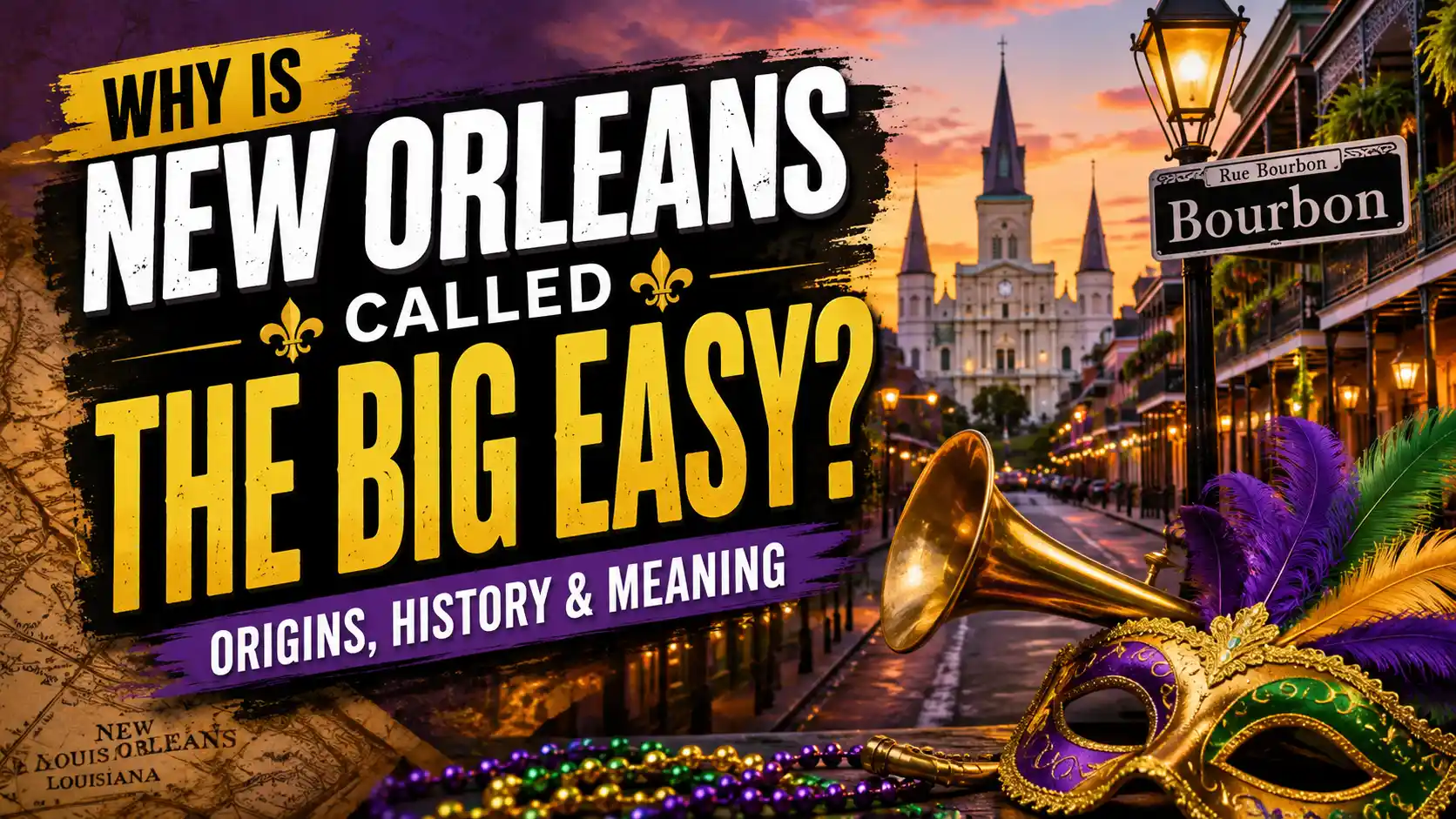
If you want to know about “Why Is New Orleans Called the Big Easy?” Here is a Ans below
Short Answer: New Orleans is called “The Big Easy” because of its famously relaxed, unhurried way of life, especially when compared to faster cities like New York (“The Big Apple”). The nickname was popularized in the 1970s by local columnist Betty Guillaud, who used it to contrast the city’s easygoing culture with the hustle of the Big Apple. It was later cemented in the national imagination by the 1987 film The Big Easy. Some trace the phrase back even further—to an early 20th‑century dance hall or to jazz musicians who found it easy to get work in the Crescent City.
| Category | Detail |
|---|---|
| City | New Orleans |
| State / Country | Louisiana, United States |
| Nickname | The Big Easy |
| Meaning | A place where life moves at a leisurely, easy‑going pace; historically also a reference to a low cost of living and abundant music work. |
| First Known Usage | ~1970 in print by columnist Betty Guillaud (some trace earlier oral use by musicians or a 1910s dance hall). |
| Popularized By | Betty Guillaud’s newspaper column and the 1987 film The Big Easy. |
| Known For | Jazz, Creole cuisine, Mardi Gras, Southern hospitality, relaxed living. |
What Does “The Big Easy” Mean?
At its simplest, “The Big Easy” suggests a place that is big on ease—a city where stress seems to melt into the humid air. The phrase captures New Orleans’ legendary “laissez les bons temps rouler” (let the good times roll) spirit. Whether you’re lingering over a café au lait in the French Quarter, catching a second line parade on a random Sunday, or hearing live jazz spill from a doorway at midnight, the city has always celebrated taking things slow and savoring the moment. Historically, the name also hinted at an affordable cost of living and a welcoming music scene where a performer could easily find a gig.
Why Is New Orleans Called “The Big Easy”?
The complete answer weaves together journalism, cinema, and the city’s own personality. New Orleans earned the name because it stood—and still stands—as the laid‑back counterpoint to America’s more hurried metropolises. While New York was “The Big Apple,” a place of ceaseless ambition, New Orleans became “The Big Easy,” a town that valued leisure, pleasure, and human connection over the rat race. That central idea was sharpened and broadcast by a local newspaper columnist in the early 1970s, then amplified by a hit movie. But the seeds of the nickname may go back much further.
The Origin of the Nickname
Like many beloved city monikers, “The Big Easy” doesn’t have a single, undisputed birth certificate. Instead, it’s a layered story that draws from at least three streams: an old dance hall, working musicians’ slang, and a clever journalist’s pen.
- The Dance Hall Theory: In the early 1900s, a popular dance hall on South Rampart Street was reportedly called “The Big Easy.” That address sat in the heart of a neighborhood that was critical to the birth of jazz. While a direct line from that club to the citywide nickname is hard to prove, the name was certainly in the air.
- Musicians’ Slang: By the mid‑20th century, Black jazz and blues musicians were using “the Big Easy” in conversation. For them, New Orleans was a place where you could always get a gig, the cost of living was low, and the vibe was forgiving—musically and personally.
- The Columnist’s Coinage (Most Accepted Origin): The person who first put “The Big Easy” into print as a deliberate city nickname was Betty Guillaud, a beloved society and gossip columnist. In the late 1960s and early 1970s, she used the phrase to contrast her easy‑tempo hometown with New York’s “Big Apple,” which had recently been revived by a tourism campaign. Guillaud’s writing gave the nickname a permanent public face.
Who Coined the Nickname?
The most widely recognized creator of the city nickname is Betty Guillaud. Writing for the New Orleans States-Item (which later merged into The Times‑Picayune), Guillaud began calling New Orleans “the Big Easy” around 1970. In her column, she would describe the city’s gentle pace, its tolerance for long lunches, and its refusal to be rushed—painting it as the polar opposite of fast‑paced, work‑obsessed New York. No single column headline is universally cited as the very first, but Guillaud’s consistent use over several years firmly planted the phrase in the local lexicon.
Some older residents insist the term was already floating around the music clubs before Guillaud’s columns. While that oral usage adds rich context, the paper trail points to Guillaud as the person who formalized the nickname and gave it staying power.
History Behind the Nickname
To understand why “The Big Easy” stuck, you have to know something about New Orleans’ identity in the post‑World War II decades. The city had long been a cultural treasure chest, but it was also economically sluggish compared to the booming Sun Belt. Tourism boosters and locals alike began leaning into what made New Orleans different: not its speed, but its sweetness.
By the 1970s, New York City was busy marketing itself as “The Big Apple,” a campaign that started in 1971 and exploded. New Orleans didn’t want to compete on those terms. Guillaud’s counter‑branding—The Big Easy—was perfectly timed. It told visitors, “Come here and relax; we do life differently.” The nickname appealed to people exhausted by the grind, and it dovetailed with the city’s rising image as a destination for food, music, and good times above all else.
Timeline of the Nickname
| Year | Event |
|---|---|
| 1910s | A dance hall called “The Big Easy” reportedly operates on South Rampart Street, a cradle of early jazz. While its connection to the later nickname remains speculative, the name circulates in the neighborhood. |
| 1940s–1960s | Traveling musicians refer to New Orleans casually as “the Big Easy” for its low‑cost, gig‑rich environment. This usage stays largely within music circles. |
| circa 1970 | Betty Guillaud, society columnist for the New Orleans States-Item, begins using “The Big Easy” in print to describe the city’s relaxed culture. She frames it as a deliberate contrast to New York’s “Big Apple.” |
| 1971 | New York City officially launches its “Big Apple” tourism campaign, increasing national awareness of city nicknames and accidentally making “The Big Easy” an even more attractive counter‑brand. |
| 1987 | The film The Big Easy, starring Dennis Quaid and Ellen Barkin, opens nationwide. The crime drama set in New Orleans brings the nickname into mainstream American pop culture. |
| 1990s–present | Tourism boards, businesses, and media fully embrace “The Big Easy.” It becomes the city’s unofficial brand, used on everything from T‑shirts to festival names. |
How the Nickname Became Popular
The Big Easy evolved from local jargon to an international brand through a one‑two punch of journalism and Hollywood. Betty Guillaud’s recurring column references gave New Orleanians a handy phrase that captured how they already saw themselves. When the 1987 film hit theaters, the rest of the country got a crash course. The movie’s title and its steamy, saxophone‑drenched depiction of the city sealed the deal: after 1987, you couldn’t hear “The Big Easy” without thinking of New Orleans.
Tourism officials quickly adopted the name. Visitor guides, hotel marketing, and city campaigns embraced it because it distilled the city’s personality into three words. Instead of selling a mere destination, they sold a state of mind—the promise that in New Orleans, everything was just a little easier.
Myths vs Facts
| Myth | Reality |
|---|---|
| The nickname was invented by the 1987 movie. | The film popularized the name nationally, but it had been used by locals and in print for at least 15 years before the movie. |
| “Big Easy” originally referred to the city’s lax law enforcement. | While New Orleans has a reputation for a certain permissiveness, the nickname consistently points to the pace of life, not police leniency. |
| Betty Guillaud coined the phrase from scratch. | Guillaud almost certainly gave the phrase its public, recorded life, but she may have been repeating a term already spoken by musicians and locals. |
| The nickname means life was easy for everyone in New Orleans. | The term romanticizes a reality that was often hard. The city has faced poverty, hurricanes, and inequality; “easy” described a cultural attitude, not a universal experience. |
Is the Nickname Still Used Today?
Absolutely. “The Big Easy” is woven into the city’s DNA. You’ll see it on souvenir shops, restaurant names (The Big Easy Grill, Big Easy Daiquiris), music venues, and real estate signs. Television shows set in New Orleans frequently drop the phrase. Local news outlets use it as shorthand. In everyday speech, both residents and visitors refer to “The Big Easy” as comfortably as they might say “NOLA.” It is so well established that it sometimes feels official—even though no city ordinance ever adopted it.
Cultural Impact of the Nickname
The Big Easy is more than a tag; it’s a lens through which the world sees New Orleans. Culturally, the nickname reinforces the city’s identity as a place apart from the American mainstream, somewhere time slows down and pleasure is a priority.
- Tourism branding: Almost every campaign from New Orleans & Company (the city’s tourism marketing organization) has at some point leaned on “The Big Easy” theme to promise visitors a stress‑free, sensory‑rich escape.
- Food and drink: The name has been borrowed by countless bars and restaurants across the globe hoping to bottle New Orleans’ laid‑back magic.
- Sports: While the Saints and Pelicans don’t officially use it, sportscasters frequently call New Orleans “The Big Easy” during broadcasts, especially when contrasting it with tougher road environments. The golfer Ernie Els, nicknamed “The Big Easy” for his effortless swing, created a happy accidental connection—Els himself has said he loves the city and the shared nickname.
- Media and pop culture: Beyond the 1987 film, the phrase shows up in song lyrics, book titles, and travel shows. It functions as an instant mood‑setter.
Interesting Facts About the Nickname
- A dance hall on South Rampart Street may have carried the name “The Big Easy” long before any columnist used it, planting a seed in the jazz cradle.
- The nickname is shared with South African golfer Ernie Els, whose smooth, unhurried swing earned him the same moniker—a coincidence that tourism promoters love to highlight.
- The phrase was a direct answer to “The Big Apple.” Betty Guillaud’s early 1970s columns deliberately positioned New Orleans as the anti‑New York.
- Before 1970, few outside the music scene used the term. Oral histories suggest traveling musicians considered New Orleans “easy” because of the low cost of a good time and the sheer number of gigs.
- The 1987 film was almost made in another city. Early production discussions considered Chicago or Miami, but the script’s deep New Orleans flavor made the location non‑negotiable.
- Some locals once resisted the nickname, feeling it glossed over the city’s real struggles. Over time, however, the affection in the name won out.
- “Big Easy” doesn’t appear in any city charter, yet it’s printed on official‑looking merchandise and even used by police and fire department fundraisers.
- Mardi Gras krewes and walking clubs have adopted the phrase for parade themes and throws, further embedding it in civic ritual.
- A short‑lived TV series in 1996, The Big Easy, capitalized on the city’s notoriety, airing for two seasons on USA Network.
- The nickname appears in the lyrics of multiple songs, from jazz standards to hip‑hop tracks, often as shorthand for an anything‑goes, easy‑living atmosphere.
Other Nicknames of New Orleans
New Orleans collects nicknames the way the Mississippi collects silt. Beyond “The Big Easy,” you’ll often hear:
- The Crescent City – for the curve of the Mississippi River around the original settlement.
- The City That Care Forgot – a phrase from the late 19th century that celebrates a worry‑free, dreamy existence.
- NOLA – the modern, punchy acronym that’s ubiquitous on social media and in casual conversation.
- The Birthplace of Jazz – a factual honorific that is less a nickname and more a declaration of heritage.
These names each tell a piece of the city’s story. To dive deeper into all of them, explore the full New Orleans Nicknames pillar page.
Lakefront gusts are only part of the windy equation when you dive into the blustery tale of how Chicago became the Windy City.
Comparison: The Big Easy vs. The Big Apple
The Big Easy
New Orleans
Meaning: Relaxed, leisurely pace of life.
Origin era: Popularized in the 1970s, with earlier music‑scene roots.
Vibe: Jazz, slow afternoons, courtyard dining, letting the good times roll.
Tourism message: Come slow down and indulge.
The Big Apple
New York City
Meaning: A city of big opportunities and outsized ambition.
Origin era: Jazz‑age slang revived by a 1971 tourism campaign.
Vibe: Fast, competitive, 24/7 energy, the center of the universe.
Tourism message: Come chase your dreams.
Related City Nicknames
Frequently Asked Questions
Why is New Orleans called the Big Easy?
The nickname reflects the city’s famously laid‑back, slow‑paced culture. It was popularized in the 1970s by columnist Betty Guillaud, who used it to contrast New Orleans with New York’s “Big Apple,” and it was later cemented by a 1987 film.
Who coined the term “The Big Easy” for New Orleans?
The most credible source is Betty Guillaud, a society columnist for the New Orleans States-Item. She began using the phrase in print around 1970 to describe the city’s easygoing nature.
When did New Orleans become known as the Big Easy?
The nickname entered local use in the early 1970s through Guillaud’s columns. It gained broad national popularity after the 1987 movie The Big Easy and has been widely used ever since.
Is “The Big Easy” an official nickname of New Orleans?
No. The city has never legally adopted the nickname, but it is universally recognized and used by residents, businesses, and government agencies in an unofficial capacity.
What does the Big Easy mean?
It means a place where life is relaxed, unhurried, and pleasure‑focused. Historically it also referred to the low cost of living and the ease with which musicians could find work.
Did the movie The Big Easy create the nickname?
No, the movie didn’t create it. The nickname was already used locally for over a decade before the film’s release. The movie did, however, introduce it to a massive national and international audience.
Was there really a dance hall called The Big Easy?
Oral history suggests an early‑20th‑century dance hall on South Rampart Street carried the name. Whether that venue directly inspired the citywide nickname is uncertain, but it may have seeded the phrase in local culture.
How is the Big Easy different from the Big Apple?
“The Big Easy” (New Orleans) emphasizes a leisurely, enjoy‑the‑moment lifestyle, while “The Big Apple” (New York City) symbolizes ambition, speed, and big‑time opportunity. They are essentially cultural opposites in the American imagination.
Do locals actually call New Orleans the Big Easy?
Yes, though not constantly. Locals use it when talking to visitors, in tourism contexts, or when emphasizing the city’s relaxed nature. In everyday conversation they are more likely to say “New Orleans” or “NOLA.”
What are other nicknames for New Orleans?
The most common are The Crescent City, The City That Care Forgot, NOLA, and the Birthplace of Jazz. Each reflects a different facet of the city’s geography, history, or culture.
Why is New Orleans also called the Crescent City?
Because the original city was built on a sharp bend of the Mississippi River, creating a crescent shape. It’s the city’s oldest and most geographically literal nickname.
What is the City That Care Forgot?
A nickname that emerged in the late 1800s to describe New Orleans as a dreamy, carefree place removed from the worries of the wider world. It’s often used interchangeably with the Big Easy to underline the city’s tranquil spirit.
Who is Ernie Els, and why is he called the Big Easy?
Ernie Els is a South African professional golfer nicknamed “The Big Easy” for his fluid, seemingly effortless swing. The shared nickname with New Orleans is a coincidence, but one that both the city and Els have embraced playfully.
Is the Big Easy still used in tourism today?
Very much so. The nickname appears in official tourism slogans, on merchandise, and across marketing materials as an instantly recognizable shorthand for the city’s relaxed brand.
What is the oldest known use of “Big Easy” for New Orleans?
The earliest verifiable print use dates to the early 1970s in Betty Guillaud’s newspaper columns. Oral use by musicians may predate that, but no earlier written record has been confirmed.
Explore More
The complete guide to every moniker of the Crescent City.
From Baton Rouge to Shreveport, the stories behind the names.
A coast‑to‑coast collection of America’s most colorful city tags.
Similar nicknames and how they compare to the Big Easy.
Conclusion
“The Big Easy” is far more than a catchy tourism slogan—it’s a genuine expression of New Orleans’ character. Born from the intuitive opposition to the Big Apple, nurtured by a sharp‑witted columnist, and launched onto the world stage by a Hollywood crime thriller, the nickname endures because it rings true. In a city where music floats through the streets, meals last for hours, and strangers quickly become friends, the easy way isn’t just an option—it’s the whole point. Whether you call it the Crescent City, NOLA, or the Big Easy, New Orleans remains a place that invites you to exhale, smile, and take life as it comes.