Stretching across the High Plains of the Texas Panhandle, Amarillo stands as a city where raw Western heritage collides with aerospace innovation, nuclear science, and a deep-rooted cowboy culture. Founded as a railroad town in 1887, it has grown into a regional hub of nearly 200,000 people, yet it holds onto a small-town, larger-than-life personality.
That personality bursts out through a collection of vivid nicknames that capture everything from the Spanish translation of “yellow” and the world’s helium supply to punk-rock defiance and military helicopters. Understanding Amarillo nicknames is a shortcut to understanding the city itself.
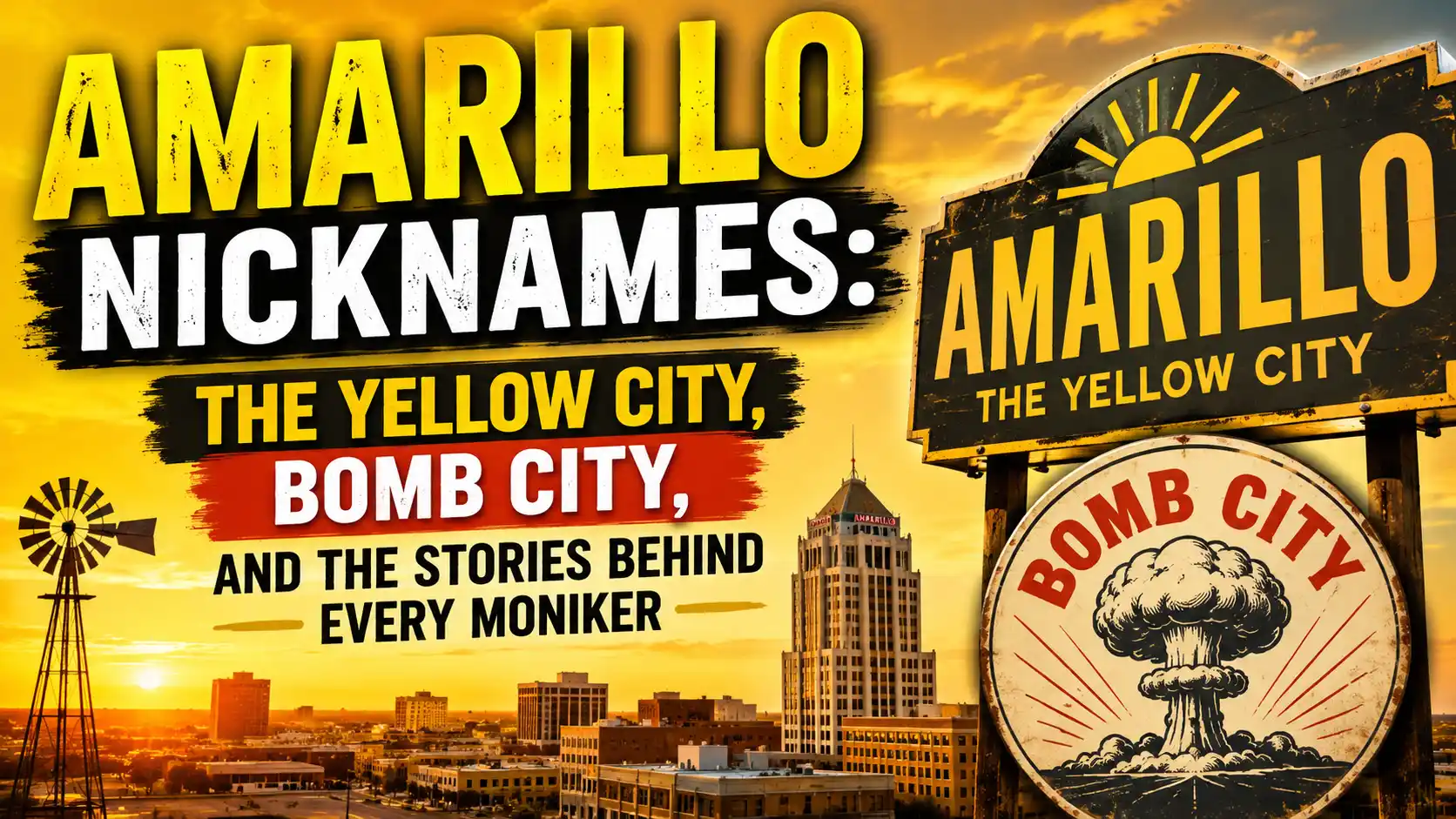
Few American cities own a roster of monikers as colorful as Amarillo’s. The most globally recognized nickname is “The Yellow City” — a literal translation of the Spanish word amarillo — but locals and travelers alike encounter “Bomb City,” “Helium Capital of the World,” “Rotor City, USA,” and “The Yellow Rose of Texas.” Each one tells a distinct chapter of Amarillo’s past and present, and together they make the city a delightful puzzle for geography nerds and travel writers.
💬 Quick Answer Box
Amarillo’s Most Famous Nickname
The most famous nickname of Amarillo is “The Yellow City.” Other well-known nicknames include “Bomb City,” “Helium Capital of the World,” and “Rotor City, USA.”
📊 Quick Facts Table
📋 Amarillo at a Glance
🔎 Sources: U.S. Census Bureau, City of Amarillo, local historical records.
Official Nickname of Amarillo
Amarillo does not have a single, legally codified official nickname in the way some cities adopt a slogan by council resolution. However, “The Yellow City” is universally treated as the city’s de facto official nickname. It appears on municipal documents, in tourism branding, and in everyday conversation. The name Amarillo itself means “yellow” in Spanish, and the nickname is a direct, organic extension of the city’s identity.
The Chamber of Commerce and the Amarillo Convention & Visitor Council frequently use “Yellow City” to evoke the golden wildflowers, vibrant sunsets, and the ochre tones of the Llano Estacado landscape. Additionally, “The Yellow Rose of Texas” is sometimes used in a promotional or honorary sense, leveraging the famous folk song, but it functions more as a symbolic floral tag than a standalone city moniker.
What Are the Nicknames of Amarillo?
Amarillo’s nicknames emerge from geology, military industry, aviation, pop culture, and even a punk-rock documentary. While “The Yellow City” is the anchor, the roster shows how a mid-sized Panhandle city can wear many hats — from the center of global helium supply to a defiant “bomb city” that challenged stereotypes. Below is a quick look at the main categories, each with a short paragraph and bullet points to explain the identity behind the label.
Categories of Amarillo Nicknames
Historical & Geographical Nicknames
These nicknames are deeply rooted in the city’s founding and the natural resources that put it on the map. They reflect the land, the early industries, and the pride of the first settlers.
- The Yellow City – A direct translation of amarillo, referencing the yellow blooms of wildflowers and the golden plains.
- Helium Capital of the World – Recognizes the vast helium reserves in the Panhandle’s natural gas fields and the historic Amarillo Helium Plant.
- Queen City of the Panhandle – An early 20th-century nickname that highlighted Amarillo’s role as the economic and cultural queen of the Texas Panhandle.
Industrial & Military Nicknames
Amarillo’s economy and global significance gave rise to nicknames tied to defense, energy, and advanced manufacturing.
- Bomb City – A no-nonsense nickname born from the Pantex Plant, the nation’s primary nuclear weapons assembly and disassembly facility.
- Rotor City, USA – A modern branding nickname adopted as Bell’s V-22 Osprey and future tiltrotor assembly lines made Amarillo a hub of rotary-wing aviation.
Pop Culture & Affectionate Nicknames
Media, music, and local swagger created lighter, sometimes rebellious labels.
- The Yellow Rose of Texas – Drawn from the iconic Texas folk song, it’s used poetically to equate Amarillo with the state’s legendary flower.
- The Big A – A casual, shorthand nickname that locals and travelers on Route 66 use in signage, merch, and social media.
- Bomb City (dual category) – Also adopted by the punk and skate communities after the 1997 Brian Deneke case, immortalized in the film Bomb City.
📋 Complete List of Amarillo Nicknames
📇 Every Amarillo Nickname at a Glance
Popularity based on widespread recognition, local usage frequency, and media references.
Most Popular Nicknames of Amarillo
Some nicknames stick because they capture a physical reality, others because they carry an attitude. The following are the five most recognized and culturally potent nicknames that you’ll hear across Texas and beyond.
Main Nicknames Explained
The Yellow City
Meaning
A literal translation of the Spanish word amarillo, referencing the color yellow. It evokes the golden grasses, wild sunflowers, and the butter-colored yucca blossoms that blanket the Panhandle in spring.
Short Origin Story
Early settlers and mapmakers in the late 19th century noted the yellowish hue of the soil and the abundant yellow wildflowers along Amarillo Creek. The name Amarillo itself may have come from the yellow banks of the creek or the golden flowers. The nickname was organic — it required no campaign; it simply was.
Historical Background
The town was originally called Oneida, but renamed Amarillo after the nearby creek and lake. By the 1890s, newspapers casually referred to the town as “the Yellow City,” and it became an enduring descriptor. The railroad promoted the term, and it stuck as a source of civic pride.
Modern Usage
“The Yellow City” appears on the city’s website, in the local visitor’s guide, and in hashtags like #YellowCity. Restaurants, breweries, and shops incorporate it into their names — Yellow City Street Food, Yellow City Co-op, etc.
Cultural Impact
The nickname reinforces a unique geographical identity on the High Plains. It’s a way for Amarillo to stand out among Texas cities that are named after people, battles, or Spanish missions, linking the city directly to the landscape.
Interesting Fact
Despite the Spanish name, the city’s early anglo settlers pronounced it “Am-ah-RILL-oh” instead of the Spanish “Ah-mah-REE-yoh,” which later became the standard local pronunciation.
Bomb City
Meaning
A gritty, bold moniker derived from the presence of the Pantex Plant, the primary United States facility for the final assembly, dismantlement, and maintenance of nuclear weapons.
Short Origin Story
Pantex was established in 1942 as a conventional bomb plant, but it became synonymous with nuclear weapons during the Cold War. Local punk and skate communities adopted “Bomb City” in the 1980s and 1990s as a defiant self-identifier.
Historical Background
During the Cold War, Pantex assembled nearly every nuclear weapon in the U.S. arsenal. Its massive employment and cultural footprint made Amarillo uniquely tied to the atomic age. Over time, the nickname jumped from underground scenes to mainstream consciousness, especially after the 1997 death of punk musician Brian Deneke brought the “Bomb City” label into national headlines.
Modern Usage
The 2017 film Bomb City dramatized the conflict between punk kids and jocks, cementing the nickname. Today, “Bomb City” appears on craft beer (Bomb City Distillery), events like Bomb City Jam, and merchandise that locals wear with pride.
Cultural Impact
The nickname reclaims an often-maligned identity. Instead of shying away from the nuclear association, much of younger Amarillo embraced it as a symbol of rebellious nonconformity and resilience.
Interesting Fact
Pantex is the only facility in the United States that can assemble and disassemble nuclear weapons; it has supported the nickname’s literal and figurative firepower for over seven decades.
Helium Capital of the World
Meaning
A science-based superlative that denotes Amarillo’s historic and ongoing dominance in helium production and storage.
Short Origin Story
In 1903, natural gas was discovered near Amarillo, and it was found to be unusually rich in helium. The U.S. government established the Amarillo Helium Plant in 1929, and a massive underground storage reservoir, the Cliffside Field, became the strategic helium reserve.
Historical Background
Between the 1920s and 1960s, the federal government operated the Federal Helium Reserve near Amarillo, controlling the global helium supply. The city became the hub for helium extraction and research, and the nickname was officially endorsed by local governments and chambers of commerce.
Modern Usage
Although the reserve has been privatized, Amarillo remains a critical center for helium production. The nickname appears on museum exhibits at the Don Harrington Discovery Center and in educational materials about the element.
Cultural Impact
The nickname has inspired Amarillo’s quirky roadside attraction, the Helium Monument, a 6-story stainless steel column that marks the city as the “Helium Capital of the World.” It’s both a scientific tribute and a tourism photo-op.
Interesting Fact
The Helium Monument, erected in 1968, doubles as a time capsule with items sealed inside to be opened in 2968 — celebrating helium’s 1000th anniversary of discovery.
Rotor City, USA
Meaning
A 21st-century industrial branding nickname positioning Amarillo as the national home of tiltrotor and helicopter assembly.
Short Origin Story
In 1999, Bell Helicopter opened a manufacturing facility in Amarillo to assemble the V-22 Osprey. Later, the Amarillo Economic Development Corporation and city leaders officially launched the “Rotor City, USA” campaign around 2018 to attract aerospace investment and workforce.
Historical Background
Building on the region’s aviation history and skilled labor base, Amarillo became the final assembly location for the V-22 and future vertical-lift programs. The nickname was a strategic move to shift the city’s image toward high-tech manufacturing.
Modern Usage
Rotor City, USA is used in economic development brochures, at air shows, and in discussions about the future of military and civilian tiltrotor aircraft. It’s slowly entering the local vocabulary.
Cultural Impact
The nickname signals a deliberate reinvention from “just a cowtown” to an aerospace powerhouse. It’s more corporate than grassroots, but represents the city’s ambition.
Interesting Fact
Bell’s Amarillo assembly center has delivered over 400 V-22 Ospreys, and the site was selected for the U.S. Army’s Future Long-Range Assault Aircraft, cementing the Rotor City identity.
The Yellow Rose of Texas
Meaning
A poetic, romantic nickname linking Amarillo to the iconic Texas folk song about a biracial woman who helped win the Texas Revolution, and to the widespread yellow rose imagery.
Short Origin Story
Tourism boards in the mid-20th century capitalized on the name Amarillo (yellow) and blended it with the famous “Yellow Rose of Texas” song. The phrase started appearing on postcards and promotional materials.
Historical Background
Unlike the other nicknames, this one isn’t rooted in a specific historical event in Amarillo. It’s a clever marketing adaptation: since Amarillo means yellow, the city could logically be “the yellow rose.” It lacks the grit of Bomb City but adds a layer of Southern charm.
Modern Usage
You’ll find “Yellow Rose of Texas” used in bed-and-breakfast names, garden clubs, and occasionally in city-wide branding for festivals celebrating Texas heritage.
Cultural Impact
It ties Amarillo to the larger Texas mythos without appropriating the more contested aspects of the song. However, it remains less authentic to everyday Amarillo life compared to “Yellow City” or “Bomb City.”
Interesting Fact
The yellow rose does not grow naturally in the Panhandle; Amarillo’s wild yellow blooms are primarily sunflowers, prickly pear cactus blossoms, and yucca.
Which Nickname Is Most Famous?
Without question, “The Yellow City” is the most famous and broadly recognized nickname for Amarillo. Its simplicity and direct translation make it intuitive even for those who don’t speak Spanish. While “Bomb City” has gained cult notoriety — especially among fans of true crime, punk history, and the film — it does not have the same neutral, everyday usage that “Yellow City” enjoys. Walk into any diner on Route 66, and the coffee mug likely reads “Yellow City.” The Amarillo Sod Poodles, the minor league baseball team, even toyed with a “Yellow City” alternate identity. It is the city’s calling card.
How Amarillo Got Its Nicknames
Amarillo’s nicknames were not crafted by a branding agency all at once; they emerged from geography, geology, defense infrastructure, and community subcultures. The “Yellow City” identity was baked in from the town’s naming in 1887 when the color yellow — whether from flowers, soil, or simply Spanish translation — became inseparable from the city’s name. The discovery of helium-rich natural gas in the early 20th century added “Helium Capital of the World” as a legitimate scientific designation.
The Cold War and Pantex Plant gave rise to “Bomb City,” a term that evolved from a disquieting fact into a punk badge of honor. More recently, corporate and civic leadership carefully cultivated “Rotor City, USA” to highlight Amarillo’s aerospace manufacturing base. Meanwhile, tourism promoters massaged “The Yellow Rose of Texas” into the mix to leverage an instantly recognizable Texas song. Together they form a layered story of how a city can be simultaneously sun-bleached and atomic.
Other Nicknames at a Glance
- The Big A – A casual, shorthand term used by locals and travelers, similar to “Big D” for Dallas.
- Queen City of the Panhandle – An early booster nickname from the 1910s–1930s; rarely used today.
- Gateway to Palo Duro Canyon – A tourism tag that highlights Amarillo as the primary access point to the second-largest canyon in the United States.
- Cowboy Capital of the Plains – Sometimes applied loosely in Western heritage contexts, though not an official moniker.
Fun Facts About Amarillo
- Amarillo means “yellow” in Spanish, but local pronunciation ignores the double “l” as a “y” sound — it’s “am-uh-RILL-oh.”
- The Helium Monument on the grounds of the Don Harrington Discovery Center stands as a 6-story time capsule sealed until the year 2968.
- Palo Duro Canyon State Park, just south of Amarillo, is the second-largest canyon in the U.S. and inspired the nickname “Gateway to Palo Duro Canyon.”
- The Big Texan Steak Ranch made Amarillo famous for its free 72-ounce steak challenge — finish it in under an hour and the meal is on the house.
- Cadillac Ranch, a quirky art installation of half-buried, graffiti-covered Cadillacs, sits along historic Route 66 just west of the city.
- The Pantex Plant has assembled or dismantled every nuclear weapon in the U.S. stockpile since the 1970s, employing thousands of Amarillo residents.
- Amarillo is one of the windiest cities in America, giving residents an extra reason to embrace the sometimes dusty yellow landscape.
- The American Quarter Horse Association is headquartered in Amarillo, tying the city deeply to cowboy and equestrian culture.
- Route 66 runs right through the city’s historic 6th Street district, earning it the nostalgic nickname “The Mother Road town” among road-trippers.
- The area was originally a major buffalo hunting ground and later a hub for the famous XIT Ranch, the largest fenced ranch in the world at its peak.
Famous Attractions in Amarillo
Amarillo’s attractions are as eclectic as its nicknames. The jaw-dropping Palo Duro Canyon State Park offers hiking, horseback riding, and the outdoor musical drama TEXAS. On Route 66, you can spray-paint your own mark on the iconic Cadillac Ranch and browse antique shops in the 6th Street Historic District. The Big Texan Steak Ranch serves up kitschy Texas hospitality and the legendary 72-ounce steak challenge.
For history buffs, the Panhandle-Plains Historical Museum — Texas’s largest history museum — sits just down the road in Canyon, while the American Quarter Horse Hall of Fame & Museum and the Don Harrington Discovery Center (home of the Helium Monument) provide family-friendly learning. The RV Museum on the historic Route 66 alignment adds another quirky stop, celebrating the road-trip culture that threads through Amarillo’s identity.
Out on the High Plains, the spirit of this West Texas hub comes alive through what locals proudly call Lubbock, a nickname culture rooted in music, dust storms, and fierce resilience.
⚖️ Nickname Comparison: Amarillo vs. Lubbock
⚖️ Texas Panhandle Showdown: Amarillo vs. Lubbock Nicknames
Amarillo
- 🟡 The Yellow City
- ☢️ Bomb City
- 🎈 Helium Capital
- 🚁 Rotor City, USA
Lubbock
- 🌐 Hub City
- 🎸 Birthplace of Rock ‘n’ Roll?
- 🏈 West Texas Powerhouse
- 🌾 Cotton Capital
Amarillo flaunts its yellow and atomic swagger, while Lubbock — just 120 miles south — is the regional “Hub City” of the South Plains, a music and agricultural crossroads. Both cities share windy High Plains grit, but their nicknames highlight starkly different identities: raw energy vs. central convergence. Explore Lubbock’s nicknames →
🏙️ Related Cities and Their Nicknames
Frequently Asked Questions
What is the official nickname of Amarillo?
Amarillo does not have a legislated official nickname, but “The Yellow City” is widely recognized and used by the city government and tourism office as the de facto official moniker.
Why is Amarillo called the Yellow City?
The name “Amarillo” is the Spanish word for yellow. Early settlers and cartographers noted the yellow wildflowers and yellow-toned soil of the region, and the nickname “The Yellow City” grew naturally from the city’s name.
Why is Amarillo called Bomb City?
“Bomb City” comes from the Pantex Plant just northeast of the city, the primary U.S. facility for nuclear weapons assembly and disassembly. The nickname became popularized through local punk culture and later a 2017 movie titled Bomb City.
Who gave Amarillo the nickname “Helium Capital of the World”?
The U.S. government and local chambers of commerce promoted the title after the discovery of helium-rich natural gas in the Panhandle and the establishment of the Federal Helium Reserve in the 1920s. It became an official-sounding designation used in business and tourism for decades.
When did “Rotor City, USA” become a nickname for Amarillo?
The Rotor City brand was officially launched around 2018 by the Amarillo Economic Development Corporation, though Bell’s tiltrotor assembly had been anchoring the aerospace identity since the late 1990s. It is the newest of Amarillo’s major nicknames.
Conclusion
From the golden fields that gave it a name to the nuclear facility that gave it an edge, Amarillo wears its nicknames like badges on a dusty leather jacket. “The Yellow City” remains the sun-washed heart of the Panhandle’s identity, while “Bomb City” adds a countercultural pulse, “Helium Capital” evokes scientific wonder, and “Rotor City, USA” aims for the skies. No other Texas city can claim such a spectrum — a place where you can gaze at the nation’s largest canyon, watch a V-22 Osprey test-flight, and spray-paint a Cadillac all in a single afternoon.
For a deeper dive into the city’s heritage and attractions, the Amarillo Convention & Visitor Council offers official resources and up-to-date travel information. Whether you call it the Yellow Rose or the Big A, Amarillo’s monikers invite you to look a little closer and stay a little longer.