
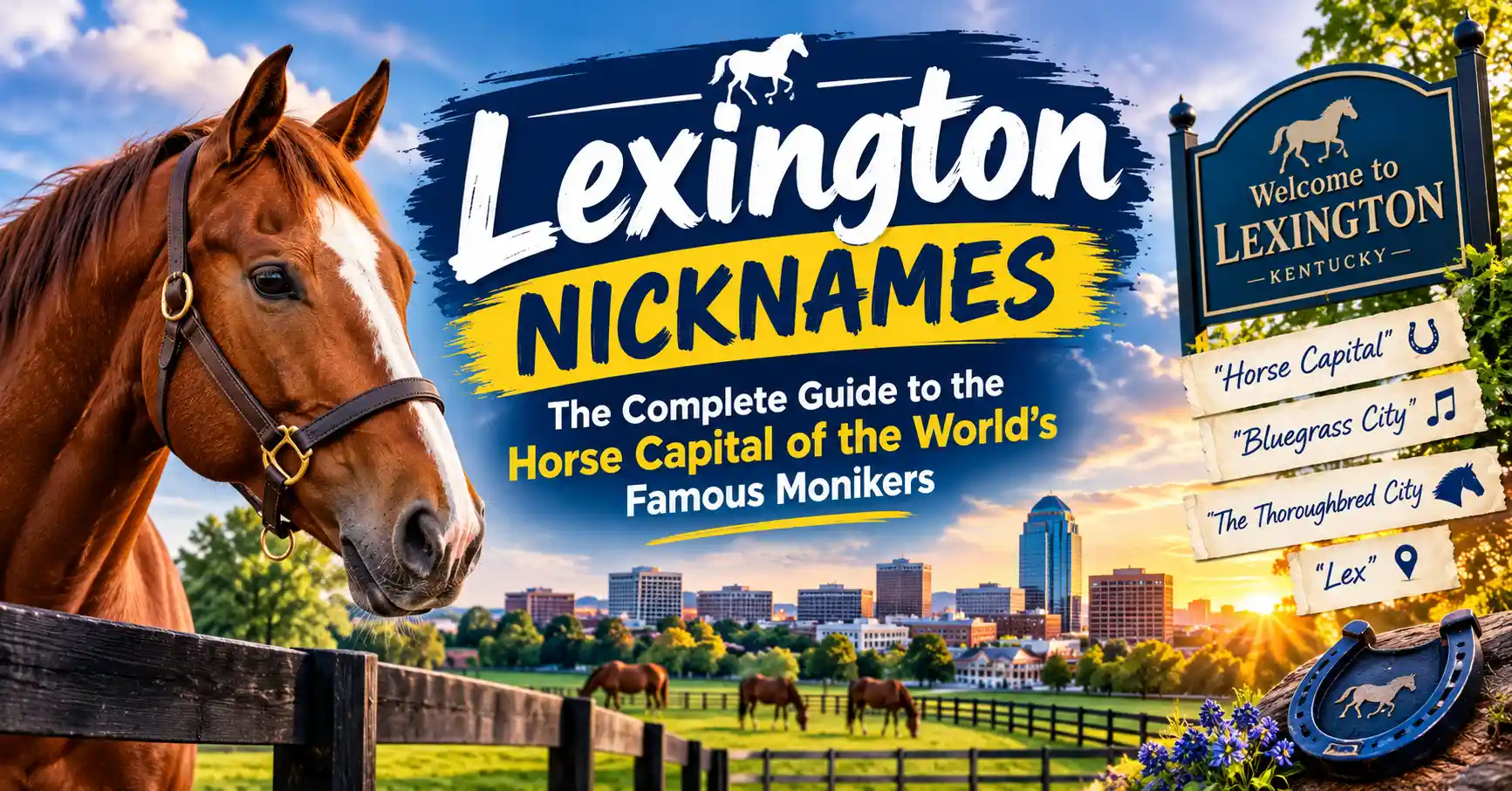
Lexington, Kentucky, is a city where rolling bluegrass pastures meet vibrant urban culture. Known worldwide for its Thoroughbred horses and bourbon heritage, this charming Southern city has earned several memorable Lexington nicknames that capture its unique identity and storied past.
Quick Facts Table
Official Nickname of Lexington
Lexington does not have an officially designated nickname by city ordinance or government proclamation. However, “Horse Capital of the World” functions as a de facto official title, widely used by the Lexington Convention and Visitors Bureau, local businesses, and tourism materials. This nickname is commonly recognized and embraced by residents and has become synonymous with the city’s identity.
The nickname’s informal official status stems from Lexington’s undeniable global prominence in the Thoroughbred racing and breeding industry. The region is home to some of the world’s most prestigious horse farms and historic racetracks.
What Are the Nicknames of Lexington?
Lexington’s nicknames reflect its rich history, cultural achievements, and equine excellence. From its early days as a center of learning to its modern status as a global horse industry hub, each nickname tells a story about what makes this Kentucky city special.
The city’s nicknames generally fall into several categories:
- Equine-related nicknames: Celebrating Lexington’s Thoroughbred industry
- Cultural and intellectual nicknames: Honoring its educational institutions and arts scene
- Geographic nicknames: Referencing the famous Bluegrass region
- Historical nicknames: Stemming from the city’s founding and development
Complete List of Lexington Nicknames
Most Popular Nicknames of Lexington
The most recognized Lexington nicknames are undoubtedly “Horse Capital of the World” and “Athens of the West.” These two monikers represent the twin pillars of Lexington’s identity: its equine excellence and its intellectual heritage. While “Horse Capital of the World” dominates modern usage and tourism marketing, “Athens of the West” carries historical weight that speaks to the city’s early role as a beacon of education and culture on the American frontier.
Main Nicknames Explained
🐎 Horse Capital of the World
Meaning: This nickname declares Lexington as the global epicenter of Thoroughbred horse breeding, training, and racing.
Short Origin Story: The title emerged organically as Lexington’s horse farms produced legendary champions and attracted international attention from the equine industry.
Historical Background: By the early 20th century, Fayette County’s limestone-rich soil and ideal climate had established the region as the premier location for raising Thoroughbreds. Historic farms like Calumet, Claiborne, and Spendthrift became world-renowned.
Modern Usage: The Lexington Convention and Visitors Bureau prominently features this nickname in tourism campaigns. It appears on signage, marketing materials, and is referenced by media outlets worldwide when covering major races like the Kentucky Derby, where many competitors train in Lexington.
Cultural Impact: The nickname has shaped Lexington’s economy, tourism industry, and civic pride. It influences everything from local business names to the city’s annual events calendar.
Interesting Fact: The Kentucky Horse Park, located in Lexington, is the only park in the world dedicated to the history and celebration of the horse.
🏛️ Athens of the West
Meaning: This nickname compares Lexington to ancient Athens, Greece, as a center of learning, culture, and intellectual achievement.
Short Origin Story: The nickname arose in the early 1800s when Transylvania University attracted scholars and students from across the young nation.
Historical Background: Founded in 1780, Transylvania University was the first university west of the Allegheny Mountains. Its presence drew intellectuals, writers, and future leaders to Lexington, creating a vibrant cultural atmosphere on the frontier.
Modern Usage: While less common in everyday conversation, “Athens of the West” appears in historical literature, university materials, and cultural programming. It remains a point of civic pride.
Cultural Impact: The nickname reinforces Lexington’s identity as more than just a horse town—it’s a city with deep intellectual roots and ongoing commitment to education and the arts.
Interesting Fact: Transylvania University’s early faculty and alumni included future presidents, Supreme Court justices, and prominent national figures.
👑 Queen of the Bluegrass
Meaning: This nickname positions Lexington as the dominant city within Kentucky’s famous Bluegrass region.
Short Origin Story: As Lexington grew into the largest and most influential city in the Bluegrass region, the regal title emerged naturally.
Historical Background: The Bluegrass region, named for the distinctive blue-green grass that grows in its limestone-rich soil, has long been Kentucky’s cultural and economic heartland. Lexington sits at its center.
Modern Usage: Local media, businesses, and civic organizations use this nickname to celebrate Lexington’s regional leadership.
Cultural Impact: The nickname connects Lexington to the romantic imagery of the Bluegrass region—horse farms, rolling hills, and Southern charm.
Interesting Fact: The “blue” in bluegrass actually refers to the bluish-purple seed heads that appear in spring, not the grass blades themselves.
🏇 Thoroughbred City
Meaning: A direct reference to Lexington’s association with Thoroughbred horses.
Short Origin Story: This modern nickname emerged as a concise way to brand the city’s equine identity.
Historical Background: Thoroughbred racing and breeding have been central to Lexington’s economy since the late 18th century.
Modern Usage: Used in tourism branding, local business names, and promotional materials.
Cultural Impact: Reinforces the city’s global equine reputation in a streamlined, memorable way.
Interesting Fact: Lexington-area farms have produced numerous Kentucky Derby winners and champions.
Which Nickname Is Most Famous?
“Horse Capital of the World” is unquestionably Lexington’s most famous nickname. This title has achieved international recognition and is used by media outlets, tourism organizations, and equine industry publications worldwide.
Several factors contribute to its prominence:
- Global reach: The Thoroughbred industry is international, and Lexington is its acknowledged capital
- Economic significance: The equine industry generates billions for the regional economy
- Media exposure: Major races and horse sales bring worldwide attention
- Official adoption: Tourism and civic organizations consistently use the nickname
While “Athens of the West” holds historical significance, “Horse Capital of the World” dominates contemporary usage and recognition.
How Lexington Got Its Nicknames
Lexington’s nicknames developed organically over more than two centuries, reflecting the city’s evolution from a frontier settlement to a global equine capital.
The “Athens of the West” nickname emerged first, during the early 1800s, when Transylvania University made Lexington a center of learning. Visitors and writers marveled at the cultural sophistication they found on the frontier.
As the horse industry grew throughout the 19th and 20th centuries, Lexington’s identity became increasingly tied to Thoroughbreds. The “Horse Capital of the World” title solidified as the region’s farms produced champion after champion.
“Queen of the Bluegrass” reflects Lexington’s role as the largest city in Kentucky’s most distinctive region, while “Thoroughbred City” represents modern branding efforts.
Other Nicknames at a Glance
- Lex – Casual shorthand used by locals
- The Athens of Kentucky – State-focused variation of the classical nickname
- Horse Country – Informal reference to the surrounding region
- Bourbon City – Occasionally used, referencing nearby distilleries
- Wildcat Country – Reference to University of Kentucky athletics
Fun Facts About Lexington
- Largest city in the Bluegrass: Lexington merged with Fayette County in 1974, creating one of the largest city-county governments in the United States.
- Horse population: In Fayette County, horses outnumber people in some rural areas, with over 450 horse farms in the region.
- Transylvania University: Founded in 1780, it was the first college west of the Allegheny Mountains.
- Bourbon connection: Lexington is within an hour’s drive of numerous Kentucky Bourbon Trail distilleries.
- Kentucky Horse Park: This 1,200-acre working horse farm and museum hosts the Rolex Kentucky Three-Day Event.
- Thoroughbred sales: Keeneland’s annual sales attract buyers from around the world, with individual horses selling for millions.
- Literary heritage: Lexington was home to noted authors including James Lane Allen and Elizabeth Madox Roberts.
- Bluegrass music: The city played a role in the development of bluegrass music, though the genre’s name comes from the region, not the city.
- Aviation history: Lexington was an early center of aviation, with the first licensed woman pilot in Kentucky hailing from the area.
- Historic districts: Downtown Lexington features numerous historic buildings, including the Victorian Square and Cheapside Pavilion.
Famous Attractions in Lexington
Lexington offers visitors a blend of equine attractions, historical sites, and cultural experiences:
Equine Attractions:
- Kentucky Horse Park
- Keeneland Race Course
- The Red Mile harness racing track
- Various Thoroughbred farms offering tours
Historical and Cultural Sites:
- Transylvania University campus
- Mary Todd Lincoln House
- Ashland, the Henry Clay Estate
- Lexington History Museum
Outdoor and Recreational:
- The Legacy Trail
- Raven Run Nature Sanctuary
- Jacobson Park
- Kentucky River Palisades
Dining and Entertainment:
- Distillery District
- Downtown Lexington’s restaurant scene
- Rupp Arena (University of Kentucky basketball)
Nickname Comparison
Related Cities and Their Nicknames
🌬️ Chicago Nicknames
The Windy City, Second City, and more
🗽 New York City Nicknames
The Big Apple, Gotham, and more
🎸 Nashville Nicknames
Music City, Athens of the South
🐎 Louisville Nicknames
Derby City, River City
🌾 Kentucky City Nicknames
Explore nicknames across the Bluegrass State
Frequently Asked Questions
What is the official nickname of Lexington?
Lexington does not have an officially designated nickname. However, “Horse Capital of the World” functions as a de facto official title, widely used in tourism and civic contexts.
Why is Lexington called the Horse Capital of the World?
Lexington earned this nickname because of its global prominence in Thoroughbred breeding and racing. The region’s limestone-rich soil and ideal climate produce exceptional horses, and hundreds of farms call the area home.
Who gave Lexington the nickname “Athens of the West”?
The nickname emerged organically in the early 1800s when Transylvania University attracted scholars from across the nation. Visitors and writers coined the term to describe the city’s unexpected cultural sophistication on the frontier.
When did Lexington’s nicknames become popular?
“Athens of the West” gained popularity in the early 19th century. “Horse Capital of the World” became widely used in the 20th century as the equine industry grew and gained international recognition.
Do locals use these nicknames?
Yes, locals commonly use “Horse Capital of the World” and “Lex” in everyday conversation. “Athens of the West” is more often used in historical and cultural contexts.
Is Lexington the horse capital of the world officially recognized?
While not an official government designation, the title is recognized worldwide by the equine industry, media, and tourism organizations.
What does “Queen of the Bluegrass” mean?
This nickname refers to Lexington’s status as the largest and most influential city in Kentucky’s Bluegrass region, known for its rolling hills and horse farms.
How many nicknames does Lexington have?
Lexington has several nicknames, with the most prominent being “Horse Capital of the World,” “Athens of the West,” “Queen of the Bluegrass,” and “Thoroughbred City.”
Conclusion
Lexington nicknames capture the essence of a city that has carved out a unique identity in the American landscape. From the intellectual aspirations of “Athens of the West” to the global equine dominance implied by “Horse Capital of the World,” these monikers tell the story of a community that has always punched above its weight.
Whether you’re planning a visit to explore the Kentucky Horse Park, touring historic distilleries along the Bourbon Trail, or simply soaking in the beauty of the Bluegrass region, understanding Lexington’s nicknames adds depth to your experience. The city’s identity continues to evolve, but its core—a place of horses, learning, and Southern charm—remains constant.
For more comprehensive information about Lexington and its equine heritage, visit the Kentucky Horse Park official website, a world-class institution dedicated to celebrating the horse.