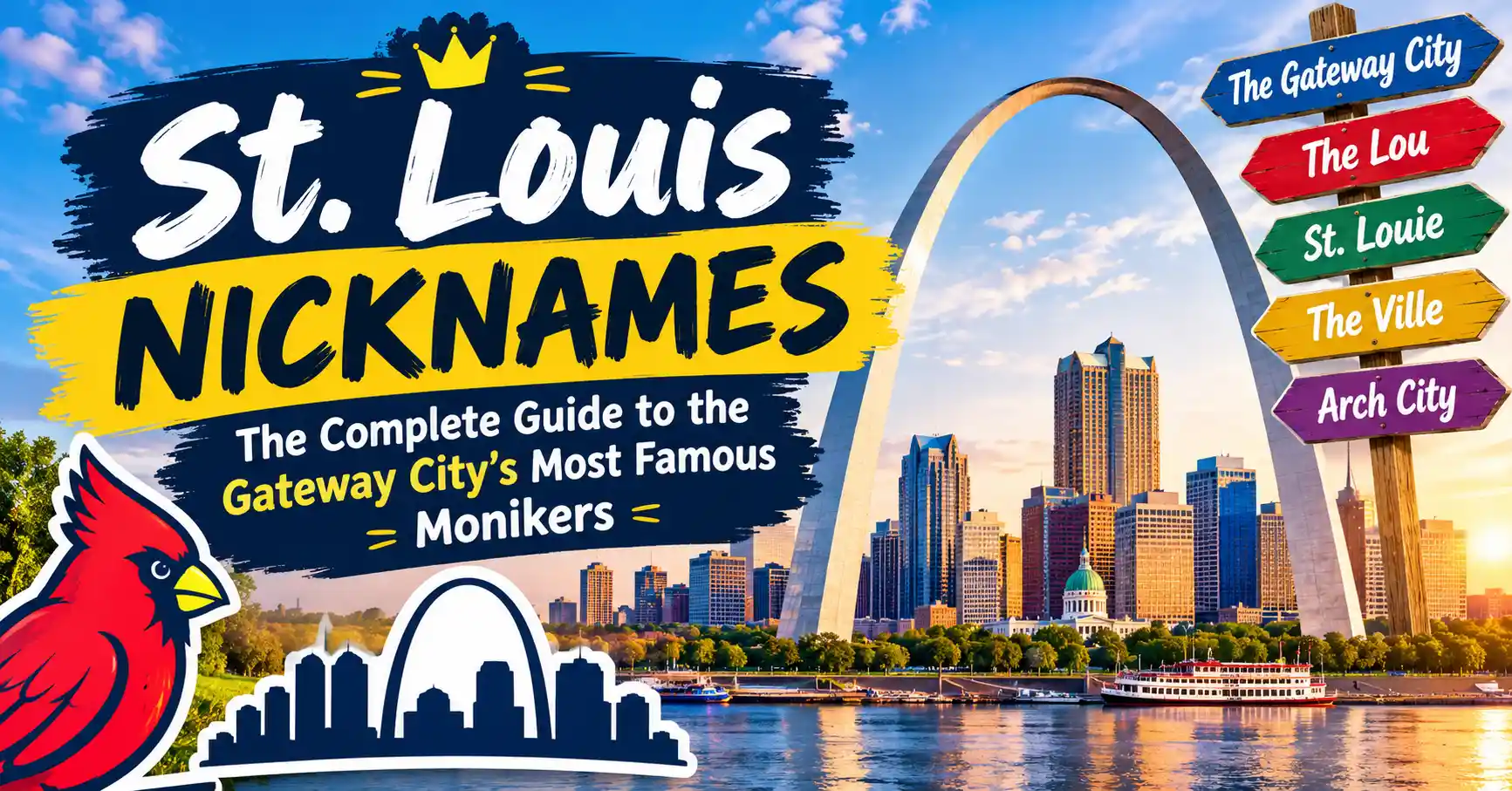
St. Louis, Missouri, sits proudly on the western bank of the Mississippi River, serving as a cultural and historical crossroads of the American Midwest. From its iconic Gateway Arch to its rich baseball tradition, this vibrant city has earned numerous memorable nicknames throughout its storied history. These St. Louis nicknames reflect the city’s role as a gateway to the West, its deep German heritage, and its passionate sports culture.
The story of St. Louis is one of ambition, resilience, and civic pride. Founded as a fur trading post in 1764, the city grew into a major industrial and cultural center that served as the launching point for westward expansion. This unique position in American history gave rise to nicknames that capture both the city’s geography and its pioneering spirit.
📊 Quick Facts About St. Louis
| Fact | Details |
|---|---|
| City | St. Louis |
| State | Missouri, USA |
| Official Nickname | None officially designated |
| Most Famous Nickname | The Gateway City |
| Population | Approximately 280,000 (city); 2.8 million (metro) |
| Founded | 1764 |
| Known For | Gateway Arch, Blues music, Cardinals baseball, barbecue |
| Area | 66 square miles (city) |
| Time Zone | Central Standard Time (CST) |
Official Nickname of St. Louis
St. Louis does not have an officially designated nickname by any governmental authority or legislative act. However, “The Gateway City” and “Gateway to the West” are widely recognized as the city’s de facto official nicknames due to their historical significance and common usage in official tourism materials and civic branding.
The Gateway Arch, completed in 1965 as part of the Jefferson National Expansion Memorial, cemented this nickname in the public consciousness. The 630-foot stainless steel structure symbolizes St. Louis’s historic role as the launching point for westward expansion in the 19th century.
While “The Gateway City” enjoys near-official status, other nicknames like “The Lou” and “Mound City” are more informal and reflect different aspects of local culture and history.
What Are the Nicknames of St. Louis? 🏷️
St. Louis has accumulated a diverse collection of nicknames over its more than 250-year history. These monikers stem from various sources: the city’s geography, its historical role in American expansion, its architectural heritage, and its passionate sports culture.
Some nicknames celebrate the city’s grandeur and ambition, while others reflect its working-class roots and industrial past. Understanding these nicknames provides insight into how St. Louisans view their city and how the rest of the nation perceives this Midwest metropolis.
Categories of St. Louis Nicknames
Geographic and Historical Nicknames
These nicknames derive from St. Louis’s location and role in American history.
- Gateway City – References the city’s role as the starting point for westward expansion
- Mound City – Named for the Native American earthworks that once dotted the area
- Rome of the West – Acknowledges the city’s numerous Catholic churches and institutions
Cultural and Architectural Nicknames
These reflect the city’s built environment and cultural achievements.
- The Brick City – References the distinctive red brick architecture throughout the city
- Paris of the West – Highlights the city’s French heritage and cultural ambitions
- St. Louie – An affectionate, colloquial pronunciation used by locals
Sports-Related Nicknames
St. Louis’s passionate sports culture has generated several nicknames.
- Baseball City – Celebrates the city’s deep connection to America’s pastime
- Hockey Town – Recognizes the city’s enthusiastic support for the St. Louis Blues
- The Lou – A hip-hop influenced nickname popularized in recent decades
📋 Complete List of St. Louis Nicknames
| Nickname | Meaning | Origin | Popularity |
|---|---|---|---|
| The Gateway City | Portal to the American West | 19th century westward expansion | Very High |
| Gateway to the West | Starting point for western exploration | Lewis and Clark era | Very High |
| The Lou | Affectionate short form | Hip-hop culture, local slang | High |
| Mound City | City of ancient earthworks | Native American mounds | Moderate |
| The Brick City | Red brick architecture | 19th century construction | Moderate |
| Rome of the West | Center of Catholicism | Catholic heritage | Moderate |
| Paris of the West | Cultural sophistication | French colonial heritage | Low-Moderate |
| St. Louie | Colloquial pronunciation | Local dialect | High (local) |
| Baseball City | Baseball passion | Cardinals fan culture | Moderate |
| Hockey Town | Blues hockey support | NHL fan culture | Moderate |
Most Popular Nicknames of St. Louis
Among the many St. Louis nicknames, several stand out for their widespread recognition and frequent usage. “The Gateway City” and “Gateway to the West” are undoubtedly the most famous, appearing in tourism campaigns, history textbooks, and national media coverage. These nicknames capture the essence of St. Louis’s historical significance as the departure point for countless pioneers heading west.
“The Lou” has gained tremendous popularity in recent decades, particularly among younger generations and in popular culture. This casual, affectionate nickname appears in music, social media, and everyday conversation. It represents a modern, urban identity that celebrates the city’s unique character without the historical weight of older monikers.
“Mound City” holds a special place in local history, referencing the sophisticated Native American civilization that once inhabited the region. While less commonly used today, it reminds residents of the area’s deep indigenous heritage.
Main Nicknames Explained
The Gateway City 🌉
Meaning: St. Louis serves as the historic gateway between the eastern United States and the western frontier.
Short Origin Story: The nickname emerged during the 19th century when St. Louis functioned as the last major city before the vast western territories. Explorers, fur traders, and pioneers passed through en route to the Pacific.
Historical Background: Meriwether Lewis and William Clark departed from St. Louis in 1804 on their famous expedition. The city became the primary staging ground for westward expansion, earning its reputation as the portal to new opportunities.
Modern Usage: The Gateway Arch, completed in 1965, permanently enshrined this nickname. Today, “Gateway City” appears in tourism materials, business names, and civic promotions.
Cultural Impact: The nickname symbolizes St. Louis’s role as a bridge between East and West, a meeting point of cultures, and a city of endless possibilities.
Interesting Fact: The Gateway Arch, at 630 feet, is the tallest man-made monument in the United States and was designed by architect Eero Saarinen.
The Lou 🎵
Meaning: An affectionate, abbreviated form of “St. Louis” used by locals and popularized through music and popular culture.
Short Origin Story: “The Lou” emerged from local slang and gained national attention through hip-hop artists who referenced the city in their lyrics during the 1990s and 2000s.
Historical Background: While the shortened form has existed informally for decades, its modern usage as a cool, urban nickname developed relatively recently.
Modern Usage: “The Lou” appears everywhere from social media hashtags to merchandise. It’s particularly popular among younger residents and the city’s creative communities.
Cultural Impact: The nickname represents a modern, confident St. Louis identity that embraces the city’s urban culture and rejects outdated stereotypes.
Interesting Fact: Several hip-hop artists, including Nelly, have prominently featured “The Lou” in their music, helping spread the nickname nationally.
Mound City 🏔️
Meaning: References the numerous Native American earthworks and burial mounds that once covered the area.
Short Origin Story: Before European settlement, the region around present-day St. Louis was home to the Mississippian culture, which built sophisticated earthen mounds, including the large complex at Cahokia.
Historical Background: By the time St. Louis was founded in 1764, many mounds remained visible. Early settlers named the settlement “Mound City” for these distinctive features.
Modern Usage: While less common today, “Mound City” appears in historical contexts and among residents interested in the area’s indigenous heritage.
Cultural Impact: The nickname serves as a reminder of the sophisticated civilizations that thrived in the region long before European contact.
Interesting Fact: Cahokia Mounds, located just across the Mississippi River in Illinois, was the largest pre-Columbian city north of Mexico and is now a UNESCO World Heritage Site.
The Brick City 🧱
Meaning: Refers to the distinctive red brick architecture that characterizes many of St. Louis’s historic neighborhoods.
Short Origin Story: During the 19th century, St. Louis experienced a construction boom using locally produced red brick, creating a unified architectural aesthetic.
Historical Background: The city’s clay-rich soil and numerous brickyards made brick the preferred building material. Entire neighborhoods, from Soulard to Lafayette Square, showcase this distinctive architecture.
Modern Usage: “The Brick City” celebrates St. Louis’s architectural heritage and appears in preservation and neighborhood branding efforts.
Cultural Impact: The nickname highlights the city’s commitment to preserving its historic built environment.
Interesting Fact: St. Louis contains one of the largest collections of Victorian-era brick architecture in the United States.
Rome of the West ⛪
Meaning: Acknowledges St. Louis’s significant Catholic heritage and the numerous churches, cathedrals, and religious institutions in the region.
Short Origin Story: The nickname emerged during the 19th century when St. Louis became a major center of Catholicism in the American Midwest.
Historical Background: The Archdiocese of St. Louis, established in 1826, grew to become one of the most influential Catholic jurisdictions in the United States. The city’s Cathedral Basilica is renowned for its mosaics.
Modern Usage: “Rome of the West” appears primarily in religious and historical contexts.
Cultural Impact: The nickname recognizes the city’s role as a spiritual center and its contributions to American Catholic history.
Interesting Fact: The Cathedral Basilica of Saint Louis houses one of the largest collections of mosaics in the world, covering 83,000 square feet.
Which Nickname Is Most Famous?
“The Gateway City” and its variant “Gateway to the West” are undoubtedly the most famous St. Louis nicknames. This recognition stems from several factors:
First, the nickname connects directly to the iconic Gateway Arch, which dominates the city’s skyline and serves as an instantly recognizable symbol of St. Louis. The arch’s status as a national monument and architectural marvel ensures the nickname receives constant reinforcement.
Second, the nickname captures a fundamental truth about St. Louis’s historical significance. The city genuinely served as the gateway for westward expansion, making the nickname historically accurate and meaningful.
Third, tourism and civic organizations have consistently promoted “Gateway City” branding, ensuring its prominence in national consciousness.
Finally, the nickname resonates with St. Louisans themselves, who take pride in their city’s role as a crossroads of American history.
How St. Louis Got Its Nicknames
St. Louis nicknames developed organically over more than two centuries, reflecting the city’s evolution from a French fur trading post to a major American metropolis.
The earliest nicknames, including “Mound City” and “Pain Court” (French for “short of bread”), emerged during the colonial and early American periods. These names reflected the physical environment and early settlers’ experiences.
As St. Louis grew into a major gateway for western expansion, new nicknames emerged to capture this role. “Gateway City” and “Gateway to the West” became increasingly common during the 19th century.
The late 19th and early 20th centuries saw nicknames celebrating the city’s cultural and religious institutions. “Rome of the West” and “Paris of the West” reflected civic pride and aspirations to cultural sophistication.
In recent decades, newer nicknames like “The Lou” have emerged from popular culture, demonstrating that St. Louis’s nickname tradition continues to evolve.
Other Nicknames at a Glance
- Pain Court – French for “short of bread,” referencing early food shortages
- The American Venice – Comparing the city’s layout to the Italian canal city
- Cardinal Nation – Celebrating the passionate fanbase of the St. Louis Cardinals
- Blues City – Honoring the city’s blues music heritage and NHL team
- The STL – The airport code turned shorthand for the city
- Lion of the Valley – Recognizing St. Louis’s prominent position in the Mississippi Valley
- Chesterfield – Sometimes used informally, though technically a separate municipality
Fun Facts About St. Louis
- The Gateway Arch is the world’s tallest arch, standing 630 feet tall and 630 feet wide at its base.
- St. Louis hosted the 1904 Summer Olympics, becoming the first American city to do so, alongside the World’s Fair.
- The 1904 World’s Fair introduced many American staples, including the ice cream cone, iced tea, and Dr Pepper.
- St. Louis is home to the oldest continuously operating cathedral west of the Mississippi River, the Basilica of Saint Louis.
- The city’s Forest Park is larger than New York’s Central Park, covering 1,371 acres.
- St. Louis was the first city to host the modern Olympic Games in the United States, in 1904.
- The St. Louis Cardinals have won 11 World Series championships, making them one of baseball’s most successful franchises.
- Chuck Berry, Josephine Baker, and Maya Angelou all have connections to St. Louis.
- The city’s zoo, founded in 1910, was the first zoo in the United States to receive a zoo-donated elephant, Miss Jim.
- St. Louis-style pizza, with its thin crust and Provel cheese, is a unique local culinary tradition.
Famous Attractions in St. Louis
St. Louis offers numerous world-class attractions that draw millions of visitors annually. The Gateway Arch National Park anchors the downtown riverfront, offering spectacular views from its observation deck. The Old Courthouse, where the Dred Scott case began, stands nearby as a testament to the city’s complex history.
Forest Park, one of the largest urban parks in the country, houses the Saint Louis Zoo, Saint Louis Art Museum, Missouri History Museum, and the Muny outdoor theater. The City Museum, an eclectic collection of repurposed architectural and industrial objects, has become a must-visit destination for its innovative, interactive design.
The Cathedral Basilica of Saint Louis showcases stunning mosaic artwork, while the Anheuser-Busch Brewery offers tours of one of America’s most famous beer producers. The Delmar Loop, a vibrant entertainment district, features restaurants, shops, and live music venues.
⚔️ Nickname Comparison: St. Louis vs. Chicago
🏙️ St. Louis
- Primary: The Gateway City
- Secondary: The Lou, Mound City
- Theme: Westward expansion, history
- Icon: Gateway Arch
- Vibe: Underdog, authentic, rising
🌆 Chicago
- Primary: The Windy City
- Secondary: Second City, Chi-Town
- Theme: Commerce, architecture, politics
- Icon: Willis Tower, Cloud Gate
- Vibe: Bold, brash, world-class
While Chicago nicknames emphasize the city’s role as America’s “Second City” and its windy reputation, St. Louis nicknames celebrate its historical role as the nation’s gateway to the West. Both cities have rich nickname traditions that reflect their unique identities and contributions to American culture.
Related Cities and Their Nicknames
Explore more city nickname guides from across the United States:
Frequently Asked Questions
What is the official nickname of St. Louis?
St. Louis does not have an officially designated nickname. However, “The Gateway City” and “Gateway to the West” are widely recognized as the city’s de facto official nicknames, appearing in tourism materials, civic branding, and common usage.
Why is St. Louis called the Gateway City?
St. Louis earned the nickname “Gateway City” because of its historical role as the primary starting point for westward expansion in the 19th century. Explorers, pioneers, and settlers passed through St. Louis before heading into the vast western territories. The Gateway Arch, completed in 1965, commemorates this heritage.
Who gave St. Louis its nickname “Gateway to the West”?
The nickname emerged organically during the 19th century as St. Louis became the last major city before the western frontier. No single person coined the term; it developed naturally from the city’s role in westward expansion and was reinforced by the Lewis and Clark expedition’s departure from the area in 1804.
When did “The Lou” become a popular nickname?
“The Lou” gained widespread popularity in the 1990s and 2000s, particularly through hip-hop culture. Artists from St. Louis, including Nelly and others, used the nickname in their music, helping it spread nationally. Today, it’s commonly used by younger residents and in social media.
What are other nicknames for St. Louis?
Beyond “Gateway City” and “The Lou,” St. Louis has been called “Mound City,” “The Brick City,” “Rome of the West,” “Paris of the West,” “St. Louie,” “Baseball City,” and “Hockey Town,” among others. Each nickname reflects a different aspect of the city’s history, culture, or geography.
Conclusion
St. Louis nicknames tell the story of a city that has played a central role in American history. From its days as a Native American mound-building center to its era as the gateway for westward expansion, St. Louis has earned its many monikers through genuine historical significance and cultural achievement.
Whether you call it “The Gateway City,” “The Lou,” or simply “St. Louis,” this Mississippi River metropolis continues to capture the American imagination. Its nicknames reflect pride in the past, confidence in the present, and optimism for the future.
For those interested in learning more about American city nicknames and their origins, the National Geographic Society offers excellent resources on American geography and urban history that provide valuable context for understanding how cities earn their famous monikers.