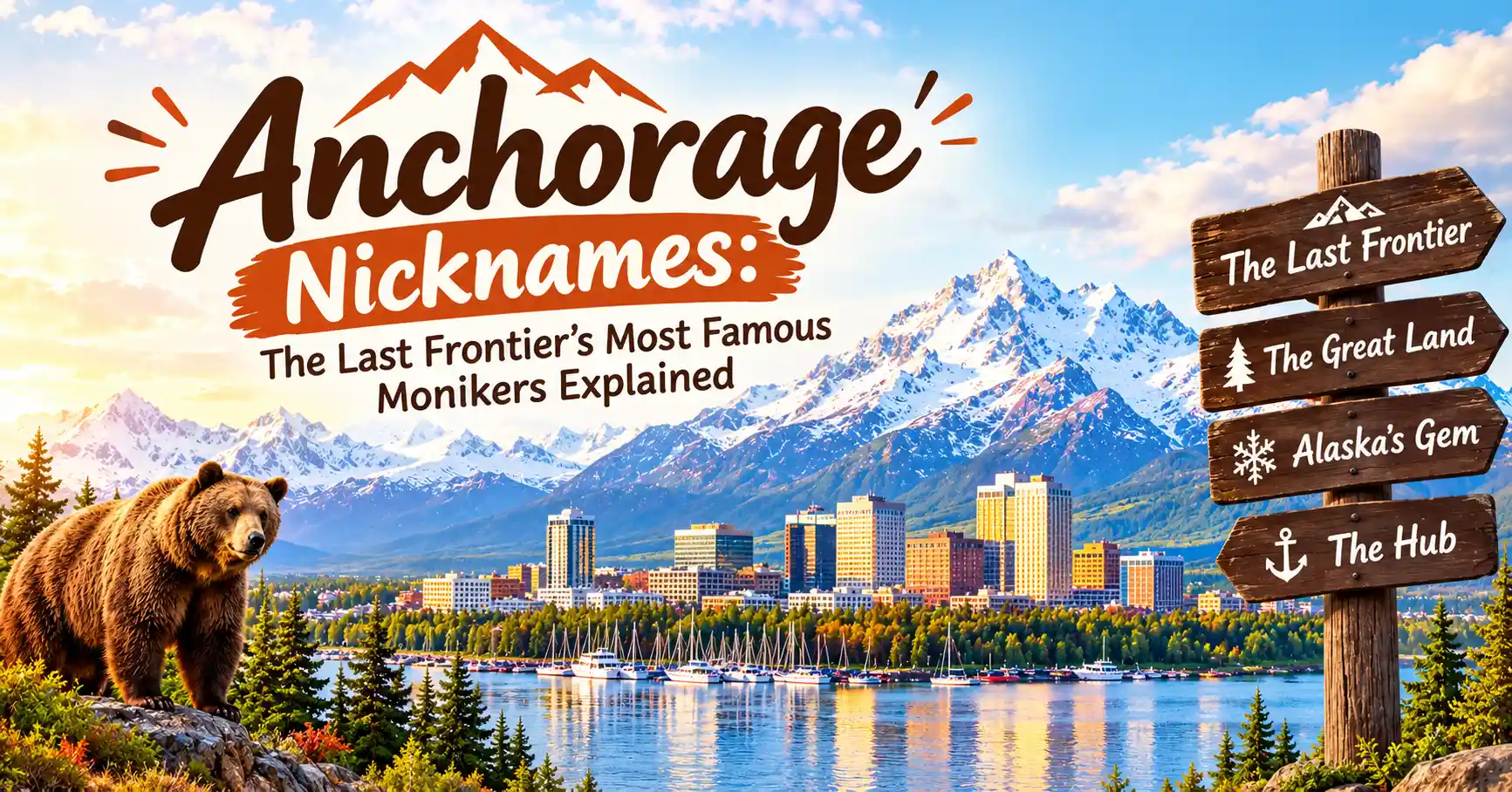
Anchorage, Alaska’s largest city, is a place of stunning contrasts—where modern skyscrapers meet wild moose, and where summer days stretch endlessly under the midnight sun. But beyond its breathtaking landscapes, Anchorage has earned several memorable nicknames that capture its unique spirit, strategic importance, and cultural identity. From “The Last Frontier” to “The Air Crossroads of the World,” these Anchorage nicknames tell the story of a city that defies expectations at every turn.
🌟 What Is Anchorage’s Most Famous Nickname?
🏔️ The Answer
The most famous nickname for Anchorage is “The Last Frontier” (shared with the state of Alaska). Other well-known nicknames include “The Air Crossroads of the World,” “The City of Lights and Flowers,” and “Anchortown.” Each captures a different aspect of this remarkable northern city.
📊 Quick Facts About Anchorage
| Fact | Details |
|---|---|
| City | Anchorage |
| State | Alaska, USA |
| Official Nickname | None officially designated |
| Most Famous Nickname | The Last Frontier |
| Population | ~291,000 (2020 Census) |
| Founded | 1914 (incorporated 1920) |
| Known For | Wildlife, glaciers, aurora borealis, Iditarod |
| Area | 1,961 sq miles (larger than Rhode Island) |
🏛️ Official Nickname of Anchorage
Anchorage does not have an officially designated city nickname. However, “The Last Frontier” is often informally associated with the city because it is the official state nickname of Alaska, adopted in 1967. The term “Last Frontier” reflects Alaska’s vast wilderness, pioneering spirit, and status as one of the last places in North America to be significantly developed.
While Anchorage itself has no formal municipal nickname, several unofficial titles have become widely recognized through tourism marketing, media coverage, and local usage. These nicknames reflect different aspects of the city—its role as a transportation hub, its stunning natural setting, and its unique cultural character.
🏷️ What Are the Nicknames of Anchorage?
Anchorage has accumulated a variety of nicknames over its relatively short history. Unlike older American cities that developed nicknames over centuries, Anchorage grew rapidly during the 20th century, and its nicknames often reflect its strategic importance, natural beauty, or frontier identity.
These nicknames fall into several categories:
- Geographic nicknames – Based on location and landscape
- Historical nicknames – Stemming from significant events or eras
- Cultural nicknames – Reflecting local character and community
- Aviation-related nicknames – Highlighting Anchorage’s role in global air travel
📋 Complete List of Anchorage Nicknames
| Nickname | Meaning | Origin | Popularity |
|---|---|---|---|
| The Last Frontier | Reference to Alaska’s wilderness and pioneering spirit | Alaska state nickname (1967) | Very High |
| The Air Crossroads of the World | Global aviation hub between Asia and North America | Mid-20th century aviation boom | High |
| The City of Lights and Flowers | Vibrant summer blooms and northern lights | Local tourism promotion | Moderate |
| Anchortown | Affectionate local shorthand | Local slang | Moderate |
| The Gateway to Alaska | Primary entry point for visitors and goods | Tourism and transportation | High |
| The Paris of the North | Cultural comparison to Paris | Early 20th century promotion | Low |
| Los Anchorage | Comparison to sprawling Los Angeles | Local informal usage | Low |
| The Anchorage Bowl | Geographic reference to the city’s valley location | Geographic description | Moderate |
⭐ Most Popular Nicknames of Anchorage
Among the various Anchorage nicknames, a few stand out as the most recognized and widely used. “The Last Frontier” dominates due to its connection to Alaska’s official state identity. “The Air Crossroads of the World” holds historical significance from the mid-20th century when Anchorage International Airport became a critical refueling stop for transpolar flights. “The Gateway to Alaska” remains popular in tourism contexts, while “The City of Lights and Flowers” has gained traction in recent decades as Anchorage has invested in beautification projects and celebrated its unique light phenomena.
📖 Main Nicknames Explained
🏔️ The Last Frontier
Meaning: A reference to Alaska’s vast, untamed wilderness and its status as one of the last regions in North America to be significantly settled and developed.
Short Origin Story: Alaska adopted “The Last Frontier” as its official state nickname in 1967, recognizing the state’s pioneering spirit and enormous untamed landscapes. Anchorage, as Alaska’s largest city, naturally shares this identity.
Historical Background: The phrase gained popularity during the mid-20th century as Americans became fascinated with Alaska’s frontier character. The 1949 film “The Last Frontier” and subsequent media coverage cemented the association.
Modern Usage: Used extensively in tourism marketing, local branding, and popular culture references to Anchorage and Alaska.
Cultural Impact: The nickname embodies Alaska’s independent spirit and attracts visitors seeking adventure and wilderness experiences.
Interesting Fact: Despite being called “The Last Frontier,” Anchorage is a modern city with all the amenities of any major American metropolis.
✈️ The Air Crossroads of the World
Meaning: A recognition of Anchorage’s strategic location as a major aviation hub connecting North America and Asia.
Short Origin Story: During the Cold War and the rise of transpolar commercial aviation, Anchorage became a critical refueling stop for flights between the United States, Europe, and Asia.
Historical Background: Ted Stevens Anchorage International Airport grew into one of the world’s busiest cargo airports. At its peak, it handled more cargo than any other airport globally.
Modern Usage: Still used in aviation industry contexts and by locals proud of the city’s global connections.
Cultural Impact: The nickname highlights Anchorage’s role in global commerce and its cosmopolitan character.
Interesting Fact: Anchorage is roughly equidistant from New York, Tokyo, and London—about 9.5 hours by air to each.
🌸 The City of Lights and Flowers
Meaning: A celebration of Anchorage’s spectacular summer flowers and the ethereal northern lights (aurora borealis).
Short Origin Story: This nickname emerged from tourism campaigns highlighting Anchorage’s unexpected beauty—vibrant flower baskets downtown in summer and the dazzling aurora in winter.
Historical Background: Anchorage has invested heavily in beautification since the 1980s, including the iconic hanging flower baskets that line downtown streets.
Modern Usage: Popular in tourism materials and local civic pride campaigns.
Cultural Impact: The nickname challenges stereotypes of Alaska as merely a frozen wilderness.
Interesting Fact: Anchorage’s summer days can last nearly 20 hours, allowing flowers to grow exceptionally large.
🏘️ Anchortown
Meaning: An affectionate, informal nickname used by locals.
Short Origin Story: Like “Chi-town” for Chicago or “Beantown” for Boston, “Anchortown” is a casual, familiar way residents refer to their city.
Historical Background: The nickname has been used informally for decades, appearing in local music, social media, and casual conversation.
Modern Usage: Common among younger residents and in local social media.
Cultural Impact: Represents local pride and familiarity.
Interesting Fact: The nickname appears in songs by Alaska-based musicians and in local merchandise.
🚪 The Gateway to Alaska
Meaning: Anchorage serves as the primary entry point for most visitors to Alaska.
Short Origin Story: With the state’s largest airport and most extensive infrastructure, Anchorage naturally became the first stop for tourists and new residents.
Historical Background: The completion of the Alaska Railroad in 1923 and later the aviation boom cemented Anchorage’s role as Alaska’s gateway.
Modern Usage: Widely used in tourism marketing and economic development materials.
Cultural Impact: Shapes Anchorage’s identity as a cosmopolitan hub in a wild state.
Interesting Fact: Approximately 90% of Alaska’s visitors pass through Anchorage.
🗼 The Paris of the North
Meaning: A comparison suggesting Anchorage offers cultural sophistication amid northern wilderness.
Short Origin Story: Early boosters used this nickname to attract settlers and investment, comparing Anchorage’s ambitions to the French capital.
Historical Background: Popular in early 20th-century promotional materials, though never widely adopted.
Modern Usage: Rare today, occasionally used ironically or in historical contexts.
Cultural Impact: Minimal contemporary usage.
Interesting Fact: The comparison was aspirational rather than literal.
🌆 Los Anchorage
Meaning: A somewhat tongue-in-cheek comparison to Los Angeles, referencing urban sprawl and traffic.
Short Origin Story: As Anchorage grew, some Alaskans from smaller communities used this term to critique the city’s “big city” problems.
Historical Background: Gained usage in the late 20th century as Anchorage expanded.
Modern Usage: Used locally, sometimes critically, sometimes affectionately.
Cultural Impact: Reflects tensions between urban and rural Alaska.
Interesting Fact: Anchorage’s population is roughly 40% of Alaska’s total.
🏞️ The Anchorage Bowl
Meaning: A geographic description of the city’s location in a valley surrounded by mountains.
Short Origin Story: The Chugach Mountains to the east and the Cook Inlet to the west create a bowl-like setting.
Historical Background: Used primarily in weather forecasts, real estate, and geographic descriptions.
Modern Usage: Common in local media and everyday conversation.
Cultural Impact: Highlights the city’s dramatic natural setting.
Interesting Fact: The “bowl” creates temperature inversions that can make downtown warmer than outlying areas.
🏆 Which Nickname Is Most Famous?
“The Last Frontier” is undeniably the most famous nickname associated with Anchorage. Its fame stems from its official adoption as Alaska’s state nickname, its frequent use in tourism marketing, and its embodiment of the frontier spirit that defines Alaska in the American imagination. When people think of Anchorage and Alaska, “The Last Frontier” immediately comes to mind, capturing both the state’s vast wilderness and its pioneering character.
🔍 How Anchorage Got Its Nicknames
Anchorage’s nicknames emerged from a combination of factors: its strategic geographic location, its rapid growth as a transportation hub, its stunning natural setting, and the promotional efforts of local boosters and tourism officials. Unlike older cities whose nicknames evolved organically over centuries, Anchorage’s nicknames largely developed during the 20th century as the city grew from a railroad construction camp to a modern metropolis. Aviation played a particularly important role, as Anchorage’s position on the globe made it a natural crossroads for international travel. The state’s frontier identity also shaped how Anchorage presented itself to the world.
📝 Other Nicknames at a Glance
- The Frozen North – A general reference to Alaska’s cold climate
- The Land of the Midnight Sun – Shared with all of Alaska, referencing summer’s endless daylight
- The Northern Lights City – Highlighting aurora viewing opportunities
- Alaska’s Largest City – A simple factual descriptor
- The Hub of Alaska – Acknowledging its central role in the state
- The 907 – A reference to Alaska’s area code, used informally
- The Snow City – A casual winter reference
🎉 Fun Facts About Anchorage
- Largest City by Area: Anchorage’s municipality covers 1,961 square miles—larger than Rhode Island and Delaware combined.
- Moose Outnumber People in Some Areas: An estimated 1,500 moose live within city limits, and moose-vehicle collisions are a real concern.
- Nearly Endless Summer Days: On the summer solstice, Anchorage enjoys about 19 hours and 21 minutes of daylight.
- Aurora Borealis Visibility: Northern lights can be seen roughly 100 nights per year, even within the city.
- Global Aviation Hub: Ted Stevens Anchorage International Airport is one of the busiest cargo airports in the world.
- Earthquake History: The 1964 Good Friday Earthquake (magnitude 9.2) remains the most powerful ever recorded in North America.
- No Sales Tax: Anchorage has no city or state sales tax, making it a shopping destination.
- Iditarod Connection: The famous Iditarod Trail Sled Dog Race has its ceremonial start in Anchorage each March.
- Diverse Population: About 10% of Anchorage residents are of Alaska Native heritage.
- Tidal Extremes: Cook Inlet tides can vary by up to 30 feet, among the largest tidal ranges in the world.
🏔️ Famous Attractions in Anchorage
Anchorage offers an impressive array of attractions that showcase its unique position between civilization and wilderness:
- Chugach State Park – One of America’s largest urban-adjacent state parks
- Alaska Wildlife Conservation Center – Home to bears, moose, bison, and other native wildlife
- Anchorage Museum – The state’s largest museum, featuring art, history, and science
- Tony Knowles Coastal Trail – An 11-mile scenic trail along Cook Inlet
- Flattop Mountain – The most-climbed peak in Alaska
- Alaska Native Heritage Center – Preserving and sharing Alaska Native cultures
- Earthquake Park – Commemorating the 1964 earthquake
- Kincaid Park – A 1,500-acre park with moose, trails, and a world-class Nordic ski facility
⚖️ Nickname Comparison: Anchorage vs. Chicago
Both cities have developed rich nickname traditions, but Anchorage’s are more closely tied to its geographic isolation and strategic importance, while Chicago’s reflect its urban culture and meteorological reputation. Explore more Chicago nicknames to compare.
🔗 Related Cities and Their Nicknames
🗽 New York City Nicknames
The Big Apple, The City That Never Sleeps, Gotham
🎰 Las Vegas Nicknames
Sin City, The Entertainment Capital of the World
🎸 Austin Nicknames
Live Music Capital of the World, ATX
🌴 Miami Nicknames
The Magic City, Gateway to the Americas
🇺🇸 USA City Nicknames
Explore nicknames from cities across America
❓ Frequently Asked Questions
What is the official nickname of Anchorage?
Anchorage does not have an officially designated city nickname. However, “The Last Frontier” is the official state nickname of Alaska, adopted in 1967, and is commonly associated with Anchorage as the state’s largest city.
Why is Anchorage called “The Air Crossroads of the World”?
Anchorage earned this nickname because of its strategic location on the globe, roughly equidistant from major cities in North America, Europe, and Asia. Ted Stevens Anchorage International Airport became a critical refueling stop for transpolar flights, and today it remains one of the world’s busiest cargo airports.
Who gave Anchorage its nicknames?
Anchorage’s nicknames developed organically over time rather than being bestowed by a single person. “The Last Frontier” came from Alaska’s official state designation. “The Air Crossroads of the World” emerged from the aviation industry. Tourism officials and local boosters promoted others like “The City of Lights and Flowers.”
When did Anchorage’s nicknames become popular?
Most of Anchorage’s nicknames gained popularity during the mid-to-late 20th century. “The Air Crossroads of the World” became prominent during the 1950s and 1960s aviation boom. “The Last Frontier” gained widespread use after Alaska achieved statehood in 1959 and officially adopted the nickname in 1967.
Do locals use these nicknames?
Yes, locals commonly use “Anchortown” in casual conversation and on social media. “The Last Frontier” is used with pride by many residents. “The Air Crossroads of the World” is more common in aviation and business contexts, while tourism-related nicknames appear frequently in visitor-facing materials.
🎯 Conclusion
Anchorage nicknames capture the essence of a city that defies easy categorization. From “The Last Frontier” to “The Air Crossroads of the World,” these monikers reflect Anchorage’s unique position as a modern metropolis in the heart of the Alaskan wilderness. Whether you’re drawn to its frontier spirit, its global aviation connections, or its stunning natural beauty, Anchorage offers an experience unlike any other American city.
For more information about Alaska’s largest city, visit the official Visit Anchorage website to plan your adventure to this remarkable destination where urban amenities meet untamed wilderness.