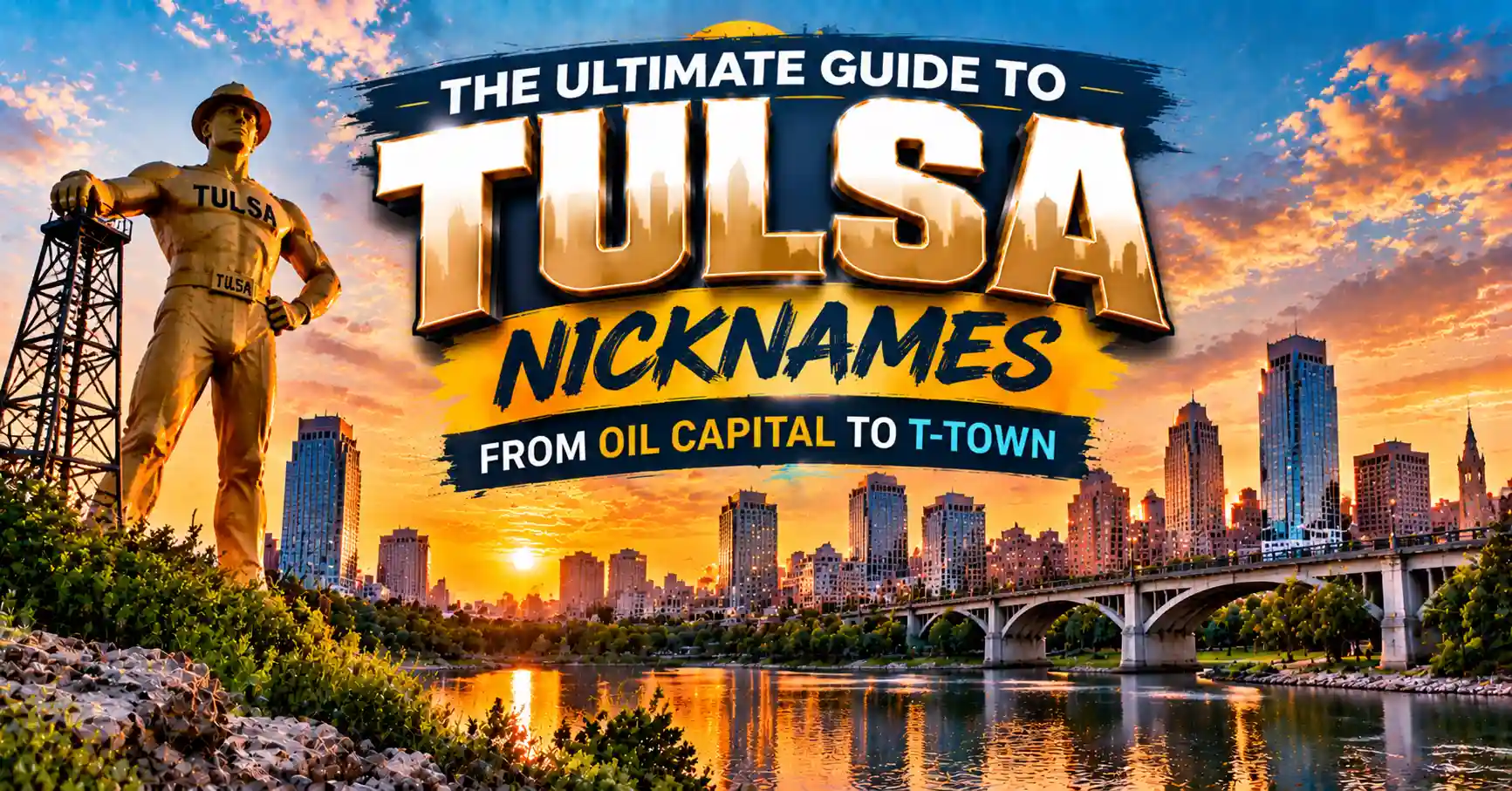
Tulsa, Oklahoma, a vibrant city nestled in the heart of Green Country, has earned a remarkable collection of nicknames throughout its storied history. From its meteoric rise as the “Oil Capital of the World” to the affectionate local shorthand “T-Town,” these monikers tell the story of a city shaped by oil booms, cultural renaissance, and unwavering community pride. Understanding Tulsa nicknames reveals the identity of a metropolis that has continually reinvented itself while honoring its roots.
Tulsa nicknames capture the essence of a city that transformed from a modest railroad town into a global energy powerhouse and cultural destination. Whether you know it as “The Oil Capital” or simply “T-Town,” each nickname reflects a distinct chapter in Tulsa’s fascinating journey. This comprehensive guide explores the origins, meanings, and cultural significance of every Tulsa nickname, providing locals and visitors alike with a deeper appreciation for Oklahoma’s second-largest city.
⚡ Quick Answer
The most famous nickname of Tulsa is “Oil Capital of the World.” Other well-known nicknames include “T-Town,” “The 918,” and “Green Country’s Capital.” Tulsa earned its oil nickname during the early 20th century when it became the global center of petroleum exploration and production.
Quick Facts Table
Official Nickname of Tulsa
Tulsa does not have an officially designated nickname by city ordinance or government proclamation. However, “Oil Capital of the World” is widely recognized as the city’s most historically significant and globally acknowledged nickname. This moniker was earned through decades of petroleum industry dominance and remains a point of civic pride.
While not “official” in a legal sense, several nicknames have become commonly recognized through popular usage, tourism marketing, and local tradition. “T-Town” functions as an informal but universally understood shorthand among residents and visitors. The Tulsa Regional Chamber and local tourism organizations have embraced these nicknames in promotional materials, further cementing their place in the city’s identity.
What Are the Tulsa Nicknames? 🏷️
Tulsa nicknames represent a rich tapestry of historical events, geographic characteristics, cultural achievements, and local pride. These names have evolved over more than a century, reflecting the city’s transformation from a frontier railroad settlement to a modern metropolitan hub. Each nickname carries specific meaning and often connects to significant periods in Tulsa’s development.
The following categories help organize Tulsa’s nicknames by their primary inspiration:
- Industry-Based Nicknames: Names derived from Tulsa’s economic foundations, particularly oil and energy
- Geographic Nicknames: Names referencing Tulsa’s location within Oklahoma and the broader region
- Cultural Nicknames: Names stemming from Tulsa’s artistic, musical, and cultural contributions
- Colloquial Nicknames: Informal names used affectionately by locals and surrounding communities
Complete List of Tulsa Nicknames
Most Popular Nicknames of Tulsa
Among Tulsa’s many nicknames, three stand above the rest in recognition and usage: “Oil Capital of the World,” “T-Town,” and “The 918.” These nicknames appear most frequently in media, tourism materials, and everyday conversation among residents.
“Oil Capital of the World” carries the most historical weight and international recognition. “T-Town” serves as the go-to informal reference used by locals in casual conversation and social media. “The 918” has emerged as a modern cultural identifier, particularly among younger generations who use the area code as a badge of local pride.
Main Tulsa Nicknames Explained
Oil Capital of the World 🛢️
Meaning: Tulsa served as the global headquarters for petroleum exploration, production, and refining during the early-to-mid 20th century.
Short Origin Story: Following the discovery of the Glenn Pool oil field in 1905 and subsequent major strikes, Tulsa transformed from a small railroad town into the epicenter of the American oil industry. Hundreds of oil companies established headquarters in the city, drawing investors, engineers, and workers from around the world.
Historical Background: By the 1920s, Tulsa boasted more oil company headquarters per capita than any other city globally. The city’s skyline grew rapidly with Art Deco skyscrapers funded by oil wealth. International Petroleum Exposition, held in Tulsa from 1923 to 1979, cemented the city’s status as the industry’s global meeting place.
Modern Usage: While Tulsa’s oil industry prominence has diminished, the nickname remains a point of civic pride. Local institutions like the Tulsa Historical Society continue to celebrate this heritage.
Cultural Impact: The nickname shaped Tulsa’s identity for generations, influencing architecture, philanthropy, and civic ambition. Oil wealth funded cultural institutions including the Philbrook Museum of Art and Gilcrease Museum.
Interesting Fact: At its peak, Tulsa was home to over 800 oil-related companies, and the city’s petroleum club was considered one of the most powerful organizations in the global energy industry.
T-Town 🎯
Meaning: An affectionate shorthand abbreviation of “Tulsa Town.”
Short Origin Story: The nickname emerged organically among locals as a casual, friendly way to refer to their city. Similar to “Chi-Town” for Chicago, “T-Town” conveys familiarity and local pride.
Historical Background: The exact origin is difficult to trace, but “T-Town” gained widespread usage in the late 20th century. It appeared in local music, sports chants, and everyday conversation.
Modern Usage: “T-Town” dominates social media hashtags, local merchandise, and casual conversation. It’s particularly popular among younger residents and the local music scene.
Cultural Impact: The nickname represents Tulsa’s approachable, community-oriented character. Local businesses frequently incorporate “T-Town” into their branding.
Interesting Fact: “T-Town” is also used by residents of Tuscaloosa, Alabama, and Topeka, Kansas, creating occasional friendly confusion among travelers.
The 918 📱
Meaning: A reference to Tulsa’s telephone area code, 918, which covers northeastern Oklahoma.
Short Origin Story: As area codes became cultural identifiers in the 1990s and 2000s, Tulsa residents began using “918” as shorthand for their hometown. The nickname gained traction with the rise of social media and hip-hop culture.
Historical Background: Area code 918 was established in 1953 and has become synonymous with Tulsa and the surrounding Green Country region.
Modern Usage: “The 918” appears frequently in local music, particularly in hip-hop and rap. Artists like Fire in Little Africa have celebrated the 918 identity.
Cultural Impact: The nickname has become a unifying identifier for the region, appearing on apparel, in music, and across social media.
Interesting Fact: The 918 area code was one of the original area codes assigned in Oklahoma and originally covered a much larger territory before being split.
Green Country’s Capital 🌳
Meaning: Tulsa serves as the largest city and economic hub of the Green Country region of northeastern Oklahoma.
Short Origin Story: “Green Country” refers to the lush, forested landscape of northeastern Oklahoma, distinct from the flatter, drier regions of the state. As the region’s dominant city, Tulsa naturally became its capital.
Historical Background: The term “Green Country” gained popularity in the mid-20th century as a tourism and regional identity label.
Modern Usage: The nickname emphasizes Tulsa’s role as the cultural and economic center of a scenic, verdant region.
Cultural Impact: “Green Country” branding appears throughout tourism materials, emphasizing the area’s natural beauty and quality of life.
Interesting Fact: Green Country encompasses 18 counties and features rolling hills, lakes, and some of the most scenic terrain in the central United States.
The Magic City ✨
Meaning: A city that seemed to appear magically overnight due to rapid growth.
Short Origin Story: During Tulsa’s explosive growth in the early 1900s, the city’s population multiplied seemingly overnight. Newspapers and boosters dubbed it “The Magic City” to capture this phenomenal transformation.
Historical Background: Between 1900 and 1920, Tulsa’s population grew from approximately 1,400 to over 72,000—a staggering increase driven by the oil boom.
Modern Usage: The nickname is less commonly used today but appears in historical contexts and nostalgic references.
Cultural Impact: “The Magic City” captures the optimism and ambition that characterized early Tulsa.
Interesting Fact: Tulsa was one of the fastest-growing cities in America during the 1910s, earning comparisons to boomtowns across the frontier.
Tulsa Sound 🎸
Meaning: A distinctive musical style blending rockabilly, blues, country, and jazz that emerged from Tulsa’s vibrant music scene.
Short Origin Story: In the 1950s and 1960s, Tulsa musicians developed a unique sound characterized by relaxed tempos, blues influences, and genre-blending innovation. Artists like Leon Russell, JJ Cale, and Elvin Bishop defined this style.
Historical Background: The Tulsa Sound gained national attention through artists who recorded at local studios and later achieved international fame.
Modern Usage: The nickname celebrates Tulsa’s ongoing musical heritage and influence on American popular music.
Cultural Impact: The Tulsa Sound influenced generations of musicians and contributed to the city’s reputation as a creative hub.
Interesting Fact: Eric Clapton credited the Tulsa Sound as a major influence on his music, particularly the work of JJ Cale.
Which Tulsa Nickname Is Most Famous?
“Oil Capital of the World” stands as Tulsa’s most famous nickname by virtually every measure—historical significance, international recognition, and frequency of use in media and literature. This nickname is uniquely associated with Tulsa; no other city claims it.
The nickname’s fame stems from Tulsa’s undeniable historical role as the global center of petroleum industry leadership. During the early 20th century, Tulsa was not merely a significant oil city—it was the oil city, home to the most influential companies, the most advanced technology, and the wealthiest oil barons.
While “T-Town” is more commonly used by locals in daily conversation, “Oil Capital of the World” carries greater weight in historical contexts, tourism materials, and external references to Tulsa. Visitors researching the city are most likely to encounter this nickname first.
How Tulsa Got Its Nicknames
Tulsa’s nicknames emerged from a combination of organic usage, promotional efforts, and historical circumstances. The oil-related nicknames arose directly from the city’s economic transformation following major petroleum discoveries in the early 1900s.
Geographic nicknames like “Green Country’s Capital” reflect Tulsa’s natural setting in northeastern Oklahoma’s verdant hills. Cultural nicknames like “Tulsa Sound” celebrate the city’s artistic contributions.
Many Tulsa nicknames developed organically through local usage before spreading to broader audiences. Others were promoted by civic boosters, chambers of commerce, and tourism organizations seeking to attract investment and visitors.
The diversity of Tulsa nicknames reflects the city’s multifaceted identity—a place that has been simultaneously an industrial powerhouse, a cultural center, and a community-minded hometown.
Other Tulsa Nicknames at a Glance
- Buckle of the Bible Belt — Reference to the region’s strong religious traditions and numerous churches
- America’s Most Beautiful City — Recognition of Tulsa’s exceptional Art Deco architecture
- Queen City of the Southwest — Historical promotional nickname emphasizing regional leadership
- Where the South Meets the West — Cultural crossroads designation reflecting Oklahoma’s unique position
- The Oil Capital — Common shortened version of the full nickname
- Tulsarado — Playful portmanteau combining Tulsa and Colorado, referencing the city’s unexpected terrain
- Paris of Oklahoma — Occasional nickname referencing Tulsa’s cultural amenities and Art Deco beauty
- The 918 — Modern area code-based identity
- Green Country — Regional designation often used interchangeably with Tulsa
Fun Facts About Tulsa 🎉
- Art Deco Capital: Tulsa possesses one of the nation’s finest collections of Art Deco architecture, with buildings like the Boston Avenue Methodist Church and the Philtower showcasing the style.
- Route 66 Heritage: Tulsa sits prominently along historic Route 66, with numerous landmarks including the iconic Blue Whale of Catoosa.
- Oil Boom Wealth: At its peak, Tulsa had more millionaires per capita than any other American city, thanks to oil wealth.
- The Gathering Place: Tulsa’s Gathering Place, opened in 2018, is one of the largest and most ambitious public parks in the United States, spanning 66 acres along the Arkansas River.
- Music Legacy: The Tulsa Sound influenced artists including Eric Clapton, who cited JJ Cale as a major inspiration.
- Black Wall Street: Tulsa’s Greenwood District was home to “Black Wall Street,” one of the most prosperous African American communities in early 20th century America before the devastating 1921 Tulsa Race Massacre.
- Woody Guthrie: Legendary folk musician Woody Guthrie was born in Okemah but launched his career in Tulsa.
- International Petroleum Exposition: Tulsa hosted the world’s most important oil industry trade show from 1923 to 1979.
- Bob Dylan Connection: Bob Dylan recorded portions of his album “Shot of Love” in Tulsa and has cited the city’s musical heritage as an influence.
- TV Series Setting: The popular television series “Reservation Dogs” is set in the Tulsa area and showcases local culture.
Famous Attractions in Tulsa 🏛️
Tulsa offers a wealth of attractions that showcase its history, culture, and natural beauty:
- The Gathering Place — Award-winning riverfront park with gardens, playgrounds, and recreational facilities
- Philbrook Museum of Art — World-class art museum housed in a stunning 1920s villa
- Gilcrease Museum — Extensive collection of American Western art and Native American artifacts
- Boston Avenue Methodist Church — Masterpiece of Art Deco architecture
- Tulsa Art Deco District — Concentration of stunning 1920s-1930s architecture
- Greenwood Rising — Museum and cultural center documenting the 1921 Tulsa Race Massacre
- Route 66 Historical Village — Preservation of Tulsa’s Mother Road heritage
- BOK Center — Premier entertainment venue hosting major concerts and events
- Oklahoma Aquarium — Popular family attraction in nearby Jenks
- Turkey Mountain Urban Wilderness — Natural escape for hiking and outdoor recreation
Nickname Comparison: Tulsa vs. Oklahoma City
🛢️ Tulsa
- Oil Capital of the World
- T-Town
- The 918
- Green Country’s Capital
- The Magic City
🌆 Oklahoma City
- The Big Friendly
- OKC
- Bricktown
- The 405
- Horse Show Capital
Tulsa and Oklahoma City, while both major Oklahoma cities, have developed distinct nickname traditions. Tulsa’s nicknames emphasize its oil heritage and regional identity within Green Country. Oklahoma City’s nicknames tend toward modern branding (“The Big Friendly”) and entertainment district references (“Bricktown”).
The comparison reveals how each city’s nicknames reflect different aspects of Oklahoma’s identity—Tulsa’s industrial and cultural history versus Oklahoma City’s role as the state capital and modern metropolitan center. Together, these nicknames paint a complete picture of Oklahoma’s urban character. For more city nicknames, explore Chicago Nicknames and New York City Nicknames.
Related Cities and Their Nicknames
🌆 Oklahoma City Nicknames
Explore nicknames of Oklahoma’s capital city
🤠 Dallas Nicknames
Discover nicknames of the Big D
🎷 Kansas City Nicknames
Learn about KC’s famous nicknames
🏛️ Little Rock Nicknames
Explore Arkansas capital’s nicknames
Frequently Asked Questions
What is the official nickname of Tulsa?
Tulsa does not have an officially designated nickname by government proclamation. However, “Oil Capital of the World” is widely recognized as the city’s most historically significant nickname and is commonly treated as its primary identifier.
Why is Tulsa called the Oil Capital of the World?
Tulsa earned this nickname because it served as the global headquarters for the petroleum industry during the early-to-mid 20th century. Hundreds of oil companies were headquartered in the city, and it hosted the International Petroleum Exposition, the industry’s most important trade show.
Who gave Tulsa its nickname “Oil Capital of the World”?
The nickname emerged organically through media coverage, industry publications, and civic promotion during the oil boom of the 1910s and 1920s. No single person is credited with coining the phrase—it developed naturally as Tulsa’s oil industry dominance became internationally recognized.
When did Tulsa nicknames become popular?
Most Tulsa nicknames emerged during the city’s explosive growth period from 1900 to 1930. “Oil Capital of the World” gained prominence during the 1910s and 1920s. “T-Town” became popular in the late 20th century, while “The 918” emerged as a cultural identifier in the 1990s and 2000s.
Do locals use Tulsa nicknames?
Yes, locals frequently use “T-Town” and “The 918” in everyday conversation and on social media. “Oil Capital of the World” is used more formally and appears frequently in tourism materials, historical contexts, and civic promotions. “Green Country” is commonly used to describe the region.
Conclusion
Tulsa nicknames weave together the city’s remarkable journey from frontier railroad town to global oil capital to modern cultural destination. From the internationally recognized “Oil Capital of the World” to the affectionate local shorthand “T-Town,” each nickname captures a distinct facet of Tulsa’s identity and heritage.
These Tulsa nicknames serve as more than casual labels—they represent the pride, history, and community spirit of a city that has continually reinvented itself while honoring its past. Whether you’re a longtime resident or a curious visitor, understanding these nicknames provides deeper insight into what makes Tulsa unique among American cities.
For those interested in exploring America’s rich tradition of city nicknames, the National Geographic Society offers excellent resources on American urban history and cultural geography. Whether you call it T-Town, the 918, or the Oil Capital of the World, Tulsa’s nicknames tell the story of a city that has always punched above its weight on the national stage.