
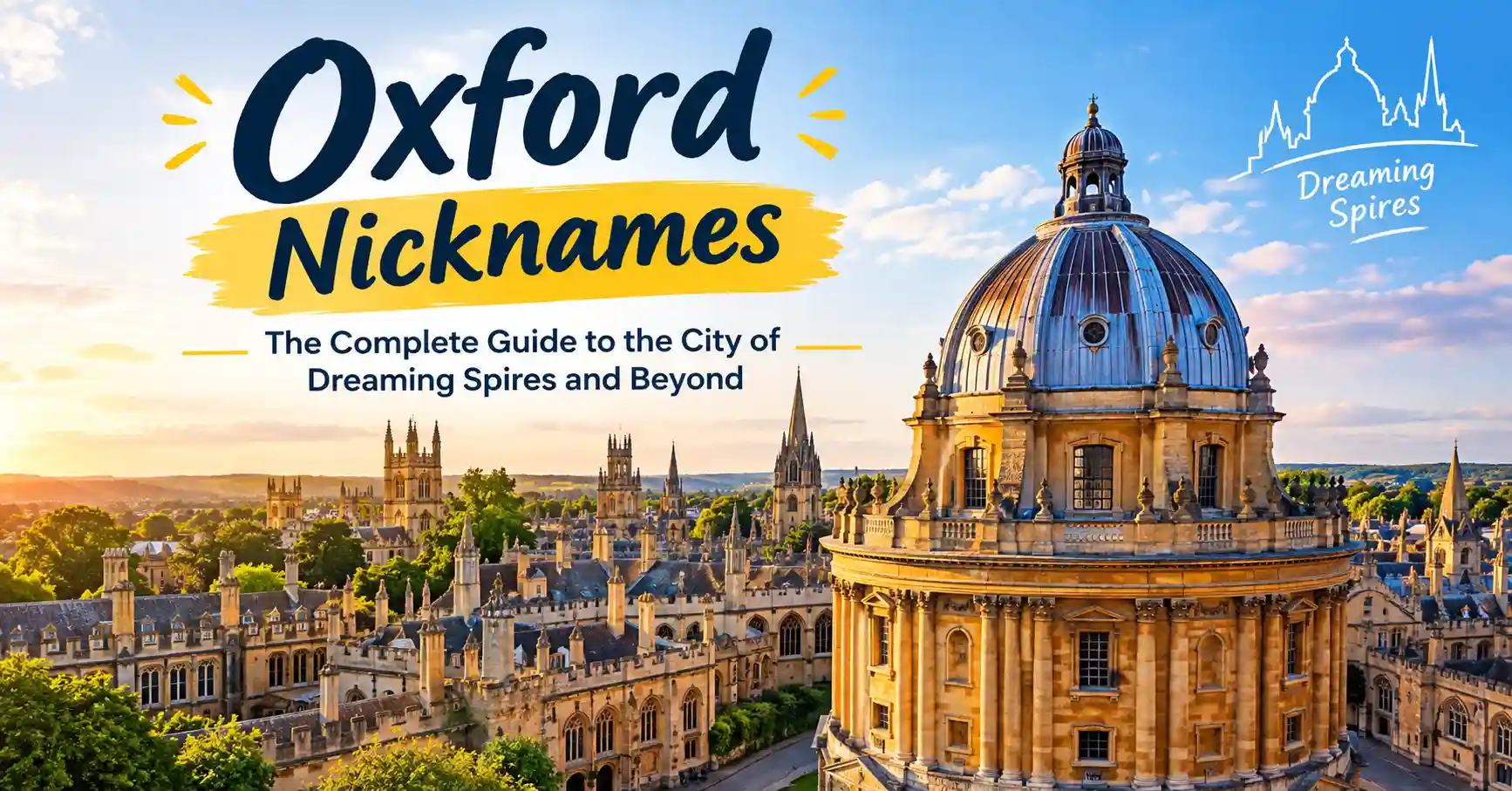
Oxford, England, is a city steeped in academic tradition and architectural splendor. While its most celebrated moniker is “The City of Dreaming Spires,” Oxford boasts several fascinating nicknames that reflect its unique character, history, and cultural significance. From its renowned university to its literary legacy, these Oxford nicknames capture the essence of this historic city.
Quick Answer Box
Quick Answer
The most famous nickname of Oxford is “The City of Dreaming Spires.” Other well-known nicknames include “Oxon” (from its Latin name Oxonia), “The Athens of England,” and “The University City.” These Oxford nicknames reflect its iconic skyline and academic heritage.
Quick Facts Table
| 🏛️ Oxford Quick Facts | |
|---|---|
| City | Oxford |
| Country | England, United Kingdom |
| Official Nickname | None officially designated |
| Most Famous Nickname | The City of Dreaming Spires |
| Population | Approximately 152,000 (2021 census) |
| Founded | Saxon times (c. 8th century); University founded c. 1096 |
| Known For | University of Oxford, historic architecture, literary heritage |
| County | Oxfordshire |
Official Nickname of Oxford
Oxford does not have an officially designated nickname by any governmental or administrative body. However, “The City of Dreaming Spires” is widely recognized and celebrated as the city’s most iconic informal title. This nickname has been embraced by locals, tourists, and academics alike, appearing in tourism materials, literary works, and popular culture.
The term “Oxon” serves as a semi-official abbreviation, derived from the Latin “Oxonia,” and is commonly used in academic and postal contexts. Meanwhile, “The Athens of England” is a historical nickname that gained prominence during the 19th century, highlighting Oxford’s role as a center of learning and intellectual pursuit.
What Are the Nicknames of Oxford?
Oxford’s nicknames emerge from its unique identity as a university city with over nine centuries of academic excellence. These nicknames capture different aspects of Oxford’s character—its architectural beauty, its intellectual prestige, and its historic significance.
The city’s skyline, dominated by the spires and towers of its colleges and churches, inspired its most poetic nickname. Its academic reputation earned it comparisons to ancient centers of learning. Meanwhile, its Latin heritage gave rise to abbreviated forms still used today.
Understanding these Oxford nicknames provides insight into how the city is perceived both by those who live there and by visitors from around the world. Each nickname tells a story about Oxford’s past and present.
Complete List of Oxford Nicknames
| Nickname | Meaning | Origin | Popularity |
|---|---|---|---|
| The City of Dreaming Spires | Poetic reference to Oxford’s architectural skyline | Matthew Arnold’s poem “Thyrsis” (1865) | Very High |
| Oxon | Abbreviation of Latin “Oxonia” | Medieval Latin manuscripts | High |
| The Athens of England | Comparison to ancient Greek center of learning | 19th century academic circles | Moderate |
| The University City | Reference to dominance of University of Oxford | Common descriptive usage | Moderate |
| The English Florence | Comparison to Italian Renaissance cultural center | Victorian era travel writing | Low |
| The Town of Spires | Simplified reference to architectural features | Tourism materials | Low |
Most Popular Nicknames of Oxford
Among the various Oxford nicknames, “The City of Dreaming Spires” stands head and shoulders above the rest in terms of recognition and usage. This poetic title has become synonymous with Oxford’s identity, appearing in everything from travel guides to literary anthologies.
“Oxon” follows as the second most recognized nickname, particularly in academic and formal contexts. Its usage extends beyond casual reference—it appears on official documents, academic credentials, and postal addresses.
“The Athens of England” maintains a respectable position in historical and literary discussions, though its usage has declined in modern times. Nevertheless, it remains an important part of Oxford’s nicknaming heritage.
Main Nicknames Explained
The City of Dreaming Spires
Meaning: This evocative nickname refers to Oxford’s iconic skyline, characterized by the numerous spires, towers, and domes of its historic college buildings and churches. The “dreaming” element suggests a place of contemplation, scholarship, and timeless beauty.
Short Origin Story: The phrase was coined by Victorian poet Matthew Arnold in his 1865 poem “Thyrsis,” written as an elegy for his friend Arthur Hugh Clough. Arnold described Oxford as “that sweet city with her dreaming spires.”
Historical Background: During the 19th century, Oxford underwent significant architectural development, with many of its most famous buildings constructed or renovated in the Gothic Revival style. The proliferation of spires during this period made the description particularly apt.
Modern Usage: Today, “The City of Dreaming Spires” appears in tourism marketing, university publications, and countless books about Oxford. It has become the definitive shorthand for the city’s romantic appeal.
Cultural Impact: The nickname has inspired everything from poetry to popular music. It captures the essence of Oxford as a place where past and present coexist, where medieval architecture houses cutting-edge research.
Interesting Fact: The actual number of spires in Oxford is debated, but the city’s skyline from certain vantage points—particularly from South Park or Boars Hill—reveals dozens of these architectural features.
Oxon
Meaning: “Oxon” is a contraction of “Oxonia,” the Medieval Latin name for Oxford. It functions similarly to abbreviations like “Cantab” for Cambridge.
Short Origin Story: The Latin name Oxonia emerged during the medieval period when Latin was the language of scholarship and official documentation throughout Europe.
Historical Background: Oxford’s university used Latin for centuries in its official records, degrees, and ceremonies. The abbreviation “Oxon” became standard in academic contexts, particularly after a person’s name to indicate their degree or association with the university.
Modern Usage: “Oxon” appears in academic credentials (e.g., “MA Oxon”), postal addresses, and formal references to the city or university. It remains a mark of scholarly connection.
Cultural Impact: The term carries prestige in academic circles worldwide. Being described as “Oxon” in one’s credentials signals an association with one of the world’s oldest and most respected universities.
Interesting Fact: The word “Oxford” itself derives from “Oxenaforda,” meaning “ford of the oxen,” referencing a shallow river crossing used by cattle.
The Athens of England
Meaning: This nickname draws a parallel between Oxford and Athens, the ancient Greek city-state that was the cradle of Western philosophy, democracy, and learning.
Short Origin Story: The comparison emerged during the 19th century when Oxford’s intellectual output and architectural beauty reminded observers of classical Athens.
Historical Background: During the Victorian era, classical education dominated British universities. Oxford’s emphasis on Greek and Latin literature, philosophy, and history made the Athenian comparison natural.
Modern Usage: While less common today, “The Athens of England” still appears in historical texts and occasionally in tourism materials seeking to emphasize Oxford’s intellectual heritage.
Cultural Impact: This nickname reinforces Oxford’s position as a global center of learning and underscores the city’s contributions to philosophy, science, and literature.
Interesting Fact: Athens and Oxford share more than intellectual heritage—both cities feature ancient architecture alongside modern development, creating a unique blend of past and present.
Which Nickname Is Most Famous?
“The City of Dreaming Spires” is undeniably Oxford’s most famous nickname. Several factors contribute to its dominance:
- Poetic Appeal: The phrase evokes beauty, tranquility, and intellectual pursuit—qualities associated with Oxford’s image.
- Literary Credibility: Its origin in Matthew Arnold’s respected poetry lends it cultural weight.
- Visual Accuracy: Anyone who has seen Oxford’s skyline at sunrise or sunset understands why “dreaming spires” is so fitting.
- Marketing Power: Tourism boards and university publications have embraced the nickname, ensuring its continued prominence.
- Emotional Resonance: The nickname captures not just physical appearance but the intangible atmosphere of Oxford—a place of contemplation and dreams.
How Oxford Got Its Nicknames
Oxford’s nicknames emerged from different aspects of the city’s identity over several centuries. The architectural nickname arose from the physical reality of the city’s skyline. The academic nicknames—”The Athens of England” and “Oxon”—stemmed from the university’s intellectual influence.
The process wasn’t deliberate; no committee sat down to assign Oxford its nicknames. Instead, they evolved organically through usage in literature, academia, and popular culture. Some were coined by specific individuals, like Matthew Arnold’s “dreaming spires,” while others developed gradually through common usage.
Other Nicknames at a Glance
- The Town of Spires: Simplified version of the most famous nickname
- The English Florence: Comparison to the Italian Renaissance city
- The University City: Descriptive reference to Oxford’s dominant institution
- Oxenaforda: The original Old English name meaning “ford of the oxen”
- The Seat of Learning: Generic reference to Oxford’s academic role
Fun Facts About Oxford
- Oldest University in English-Speaking World: Teaching at Oxford dates back to 1096, making it the oldest university in the English-speaking world.
- Inspiration for Hogwarts: Many Harry Potter scenes were filmed at Oxford, including the Bodleian Library and Christ Church College.
- Alice in Wonderland Connection: Lewis Carroll, author of “Alice’s Adventures in Wonderland,” was a mathematics professor at Oxford.
- The Real Inspector Morse: Colin Dexter created the famous detective while living and working in Oxford.
- Tolkien’s Day Job: J.R.R. Tolkien was a professor of Anglo-Saxon at Oxford while writing “The Lord of the Rings.”
- Dreaming Spires Count: While the exact number is debated, Oxford’s skyline features dozens of spires visible from key vantage points.
- Academic Dress Tradition: Students still wear traditional academic gowns on formal occasions, a practice dating back centuries.
- Punting Tradition: Oxford’s rivers Cherwell and Isis are popular for punting, a traditional form of boating.
- The Ashmolean: Oxford’s Ashmolean Museum, founded in 1683, is the world’s first university museum.
- Twin City: Oxford is twinned with Bonn, Germany; Grenoble, France; and other cities worldwide.
Famous Attractions in Oxford
Oxford’s attractions reflect its dual identity as a historic city and modern academic center. The University of Oxford’s colleges—particularly Christ Church, Magdalen, and Merton—offer stunning architecture and centuries of history.
The Bodleian Library, one of the oldest libraries in Europe, houses millions of books and manuscripts. The Radcliffe Camera, an iconic circular building, serves as a reading room and appears in countless photographs of the city.
The Ashmolean Museum and the Museum of Natural History provide cultural and scientific enrichment. Meanwhile, the Covered Market offers a taste of local commerce dating back to the 18th century.
Nickname Comparison
Oxford
The City of Dreaming Spires
- Nickname inspired by architecture
- Coined by poet Matthew Arnold (1865)
- References Gothic Revival spires
- Emphasizes beauty and contemplation
- Oldest English-speaking university
New York City
The Big Apple
- Nickname inspired by jazz culture
- Popularized by John J. Fitz Gerald (1920s)
- References horse racing prizes
- Emphasizes ambition and opportunity
- Largest city in the United States
Both Oxford and New York City possess iconic nicknames that have transcended their origins. While Oxford’s “City of Dreaming Spires” celebrates architectural beauty and academic tradition, New York’s “Big Apple” captures the energy and opportunity of urban America.
For more city nicknames, explore our guides on New York City Nicknames and Chicago Nicknames.
Related Cities and Their Nicknames
London Nicknames
The Big Smoke, The Square Mile
🎓Cambridge Nicknames
The Other Place, Silicon Fen
🏛️Boston Nicknames
The Athens of America, Beantown
🇺🇸USA City Nicknames
Complete American collection
Frequently Asked Questions
What is the official nickname of Oxford?
Oxford does not have an officially designated nickname. However, “The City of Dreaming Spires” is the most widely recognized and celebrated informal nickname, embraced by locals and visitors alike.
Why is Oxford called the City of Dreaming Spires?
The nickname comes from Matthew Arnold’s 1865 poem “Thyrsis,” which describes Oxford as “that sweet city with her dreaming spires.” The phrase references the numerous spires, towers, and domes that characterize Oxford’s skyline, particularly those of its historic college buildings and churches.
Who gave Oxford its most famous nickname?
The Victorian poet Matthew Arnold coined “The City of Dreaming Spires” in his elegy “Thyrsis,” written in memory of his friend Arthur Hugh Clough. The poem was published in 1866, though it was written several years earlier.
When did Oxford’s nicknames become popular?
“The City of Dreaming Spires” gained popularity in the late 19th century following the publication of Arnold’s poem. “Oxon” has been used since medieval times in academic contexts. “The Athens of England” became common during the Victorian era when classical education dominated British universities.
What are other nicknames of Oxford?
Other nicknames include “Oxon” (from Latin Oxonia), “The Athens of England,” “The University City,” “The English Florence,” and “The Town of Spires.” Each captures a different aspect of Oxford’s identity and history.
Conclusion
Oxford’s nicknames tell the story of a city that has captured imaginations for centuries. From the poetic beauty of “The City of Dreaming Spires” to the academic prestige of “Oxon,” these Oxford nicknames reflect the many dimensions of this remarkable place. Whether you’re drawn by its architecture, its scholarship, or its literary heritage, Oxford offers endless inspiration.
For those interested in exploring more city nicknames and their fascinating origins, the Oxford English Dictionary provides authoritative etymological resources, while our collection at City Nicknames offers comprehensive guides to nicknames from around the world.