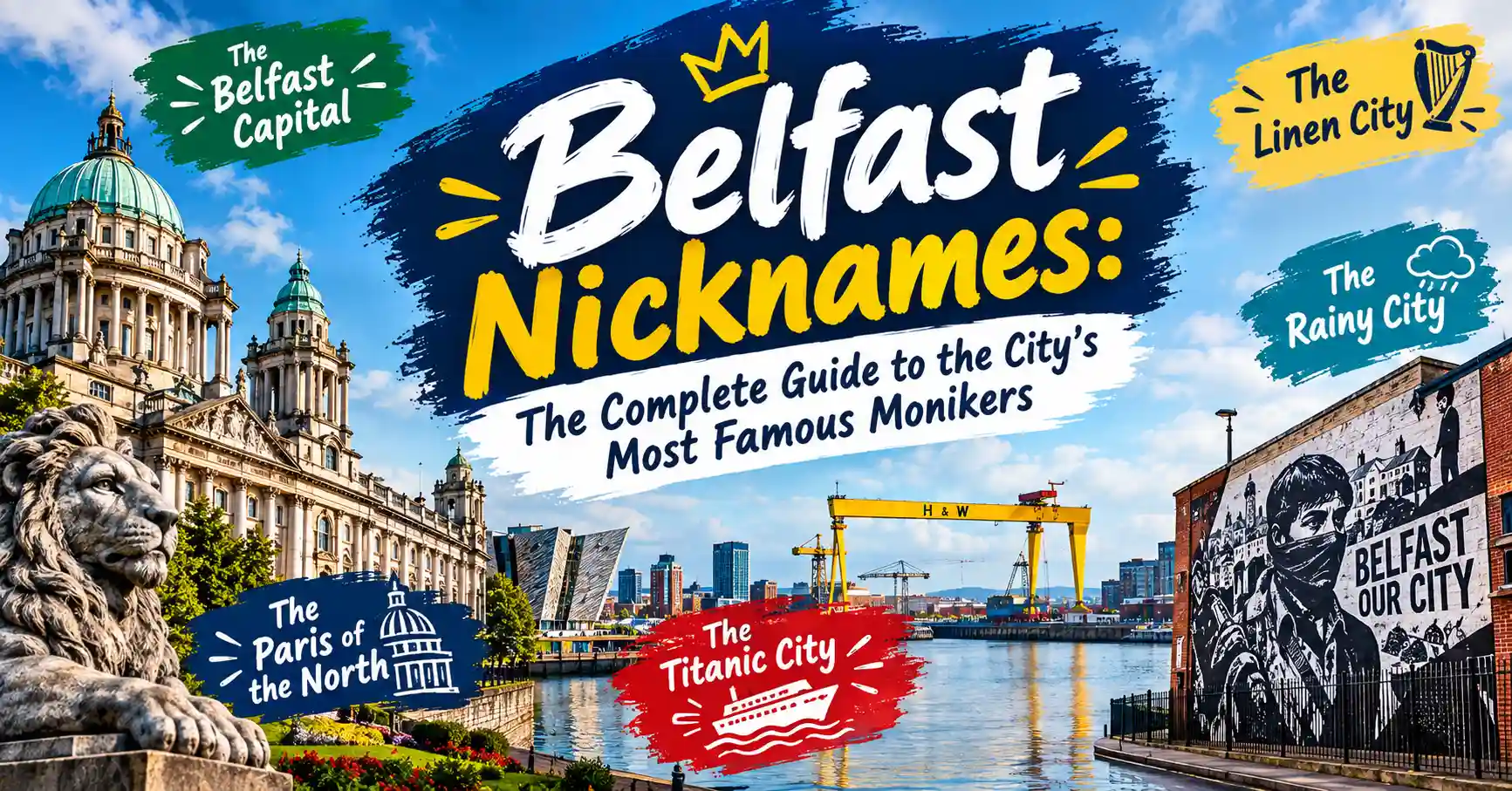
Belfast, the capital of Northern Ireland, carries a rich history reflected in its many nicknames. From “Linenopolis” to “The Athens of the North,” these monikers capture the city’s industrial heritage, cultural contributions, and resilient spirit.
Understanding Belfast nicknames offers a fascinating window into how this vibrant city earned its place in history. Let’s explore the stories behind each one.
🎯 What are the most famous nicknames of Belfast?
The most famous nickname of Belfast is “Linenopolis,” reflecting its historic linen industry dominance. Other well-known nicknames include “The Athens of the North,” “The Black North,” and “Belfast City.” Each nickname captures a unique aspect of Belfast’s industrial, cultural, and political identity.
📊 Quick Facts Table
🏛️ Official Nickname of Belfast
Belfast does not have an officially designated nickname. However, “Linenopolis” is widely recognized as its most historically significant moniker. This nickname emerged during the 19th century when Belfast dominated global linen production.
Unlike some cities that formally adopt nicknames through government proclamation, Belfast’s nicknames developed organically through cultural usage, historical events, and local pride. These unofficial titles carry significant weight in representing the city’s identity.
📝 What Are the Nicknames of Belfast?
Belfast nicknames reflect different eras of the city’s development. Some celebrate its industrial achievements, while others acknowledge its cultural and political significance. The nicknames fall into several categories:
Industrial Heritage Nicknames
- These celebrate Belfast’s manufacturing dominance
- Include references to linen, shipbuilding, and rope-making
Cultural and Intellectual Nicknames
- Highlight Belfast’s contributions to arts and learning
- Compare the city to classical centers of culture
Geographic and Political Nicknames
- Reference Belfast’s location in Northern Ireland
- Acknowledge its political significance
Modern and Affectionate Nicknames
- Used by locals and visitors alike
- Reflect contemporary pride in the city
📋 Complete List of Belfast Nicknames
⭐ Most Popular Nicknames of Belfast
Among the many Belfast nicknames, several stand out for their widespread recognition and cultural significance. “Linenopolis” remains the most historically important, while “The Athens of the North” captures the city’s intellectual ambitions. “Titanic Town” has gained international recognition through the story of the famous ship.
These popular nicknames appear frequently in tourism materials, historical accounts, and local conversations. Understanding them provides valuable insight into how Belfast sees itself and how others perceive this remarkable city.
🔍 Main Nicknames Explained
1. Linenopolis
Meaning: City of Linen
Short Origin Story: During the 19th century, Belfast became the world’s largest producer of linen, earning this nickname that combines “linen” with the Greek suffix “-opolis” (meaning city).
Historical Background: The linen industry transformed Belfast from a modest town into an industrial powerhouse. At its peak, the city produced more linen than anywhere else on Earth, employing thousands of workers and generating enormous wealth.
Modern Usage: Today, “Linenopolis” appears in historical contexts and tourism marketing. The Linen Hall Library and various heritage sites keep this legacy alive.
Cultural Impact: The nickname represents Belfast’s industrial golden age and remains a source of civic pride.
Interesting Fact: Belfast’s linen exports once clothed people across the British Empire and beyond, making the city globally significant in textile production.
2. The Athens of the North
Meaning: A northern center of culture and learning
Short Origin Story: This nickname emerged in the 19th century when Belfast developed a reputation for intellectual and cultural achievements comparable to ancient Athens.
Historical Background: During the Victorian era, Belfast established several important institutions, including the Queen’s College (now Queen’s University), the Linen Hall Library, and the Belfast Natural History Society. This cultural flourishing earned the city its classical comparison.
Modern Usage: The nickname is often used in promotional materials highlighting Belfast’s literary and artistic heritage.
Cultural Impact: It positioned Belfast as more than just an industrial city, emphasizing its contributions to education, science, and the arts.
Interesting Fact: Belfast-born writers, scientists, and thinkers have included Nobel laureates, pioneering physicists, and influential poets.
3. The Black North
Meaning: A reference to Belfast’s industrial character and location
Short Origin Story: This nickname developed during the industrial revolution, when Belfast’s factories and shipyards created a distinctive smoky atmosphere.
Historical Background: The term “Black North” distinguished Belfast and its surrounding region from the rest of Ireland. The “black” referred both to the industrial smoke and the darker, more industrial character of the northern city.
Modern Usage: The nickname is now used more affectionately, acknowledging Belfast’s grit and resilience. It appears in literature and cultural commentary.
Cultural Impact: It captures the working-class identity and industrial heritage that shaped Belfast’s development.
Interesting Fact: Despite the industrial associations, Belfast sits in a region of stunning natural beauty, with hills surrounding the city.
4. Titanic Town
Meaning: The city where the RMS Titanic was built
Short Origin Story: Belfast’s Harland & Wolff shipyard constructed the RMS Titanic between 1909 and 1912, creating the world’s most famous ocean liner.
Historical Background: At its peak, Harland & Wolff was the largest shipyard in the world, employing over 30,000 workers. The Titanic represented the pinnacle of Belfast’s shipbuilding achievement.
Modern Usage: Today, “Titanic Town” attracts visitors to the Titanic Belfast museum, one of the city’s top attractions.
Cultural Impact: The Titanic story is both a source of pride and tragedy for Belfast. The city has embraced this heritage through world-class tourism experiences.
Interesting Fact: The Titanic Quarter in Belfast has been transformed into a thriving cultural and residential area, anchored by the Titanic Belfast visitor experience.
5. The Shipyard City
Meaning: A city defined by shipbuilding
Short Origin Story: This straightforward nickname acknowledges Belfast’s role as one of the world’s great shipbuilding centers.
Historical Background: Beyond the Titanic, Harland & Wolff built hundreds of ships that sailed the world’s oceans. The shipyard was the economic heart of Belfast for generations.
Modern Usage: The nickname appears in historical accounts and discussions of Belfast’s industrial past.
Cultural Impact: Shipbuilding shaped Belfast’s geography, economy, and social structure. Generations of families worked in the yards.
Interesting Fact: The cranes Samson and Goliath, still standing in Belfast, are iconic symbols of the city’s shipbuilding heritage.
6. Linen City
Meaning: A city built on the linen trade
Short Origin Story: A simpler variation of “Linenopolis,” this nickname directly references Belfast’s most important industry.
Historical Background: The linen trade brought unprecedented prosperity to Belfast, funding the construction of grand buildings and establishing the city as a major commercial center.
Modern Usage: The nickname is used in tourism and heritage contexts, celebrating Belfast’s textile history.
Cultural Impact: The linen industry employed vast numbers of women, giving Belfast a distinctive social character.
Interesting Fact: The Linen Hall Library, founded in 1788, remains one of Belfast’s most important cultural institutions, preserving the city’s linen heritage.
🏆 Which Nickname Is Most Famous?
“Linenopolis” holds the distinction of being Belfast’s most famous nickname. Its fame stems from several factors:
Historical Accuracy: The nickname perfectly captures Belfast’s most significant historical achievement. During the 19th century, the city was genuinely the linen capital of the world.
Unique Identity: Unlike generic nicknames, “Linenopolis” is specific to Belfast. It immediately communicates something distinctive about the city.
Continued Relevance: The nickname remains in active use, appearing in tourism materials, historical accounts, and cultural discussions.
International Recognition: While Belfast has many nicknames, “Linenopolis” is the one most likely to be recognized by people outside Ireland.
🗺️ How Belfast Got Its Nicknames
Belfast’s nicknames emerged from a combination of historical circumstances:
Industrial Revolution: The arrival of large-scale manufacturing created new ways to describe the city. The linen and shipbuilding industries generated nicknames that celebrated Belfast’s economic power.
Cultural Ambitions: Victorian Belfast wanted recognition beyond industry. Nicknames like “The Athens of the North” reflected aspirations to be seen as a center of learning and culture.
Geographic Identity: Being in the north of Ireland, and being a majority-Protestant city, shaped how Belfast distinguished itself from other Irish cities.
Popular Usage: Many nicknames developed organically through newspaper articles, literature, and everyday speech. They became embedded in Belfast’s identity through repetition and cultural reinforcement.
Modern Rebranding: In recent decades, Belfast has strategically used its nicknames to attract tourism and investment, particularly through the “Titanic” connection.
📌 Other Nicknames at a Glance
- “The Northern Capital” – Reference to Belfast’s status in Northern Ireland
- “Queens City” – Association with Queen’s University
- “The Lagan City” – Named for the River Lagan that flows through it
- “Samson’s City” – Reference to the iconic crane
- “Cradle of the Titanic” – Another shipbuilding reference
- “The Metropolitan City” – Acknowledging Belfast’s urban status
- “The Industrial Giant” – Describing Belfast’s manufacturing heritage
🎉 Fun Facts About Belfast
- Belfast was once the fastest-growing city in the British Empire. During the 19th century, its population exploded from around 20,000 to over 350,000.
- The city’s name comes from Irish Gaelic. “Béal Feirste” means “mouth of the sandbank” or “mouth of the ford,” referring to the River Farset.
- Belfast has a Nobel Prize connection. Seamus Heaney, who won the Nobel Prize in Literature in 1995, was born in County Derry but spent significant time in Belfast.
- The Belfast Blitz damaged the city severely. During World War II, German bombing raids killed over 1,000 people and destroyed much of the city center.
- Belfast City Hall is a architectural masterpiece. Completed in 1906, it stands on the site of the former White Linen Hall, symbolizing the city’s linen heritage.
- C.S. Lewis was born in Belfast. The author of “The Chronicles of Narnia” drew inspiration from the Northern Irish landscape.
- The Titanic Belfast is the world’s largest Titanic attraction. This award-winning museum opened in 2012 on the site where the ship was built.
- Belfast has a thriving food scene. The city’s restaurants and markets have earned international recognition in recent years.
- The city has two airports. Belfast International and George Best Belfast City Airport serve the region.
- Belfast is a UNESCO City of Music. This designation recognizes the city’s rich musical heritage, from traditional Irish music to contemporary rock.
🏰 Famous Attractions in Belfast
Belfast offers visitors an impressive array of attractions:
Titanic Belfast: This world-class museum tells the story of the Titanic and Belfast’s shipbuilding heritage. It’s the city’s most popular tourist destination.
Belfast City Hall: This magnificent building in Donegall Square is the heart of civic Belfast, surrounded by gardens and monuments.
Ulster Museum: Located in the Botanic Gardens, this museum houses extensive collections covering art, history, and natural sciences.
St. George’s Market: One of Belfast’s oldest attractions, this Victorian market offers food, crafts, and local culture.
Crumlin Road Gaol: This former prison is now a popular visitor attraction, offering tours that explore Belfast’s darker history.
Belfast Castle: Situated on Cave Hill, this Victorian castle offers stunning views of the city and Belfast Lough.
Cathedral Quarter: This vibrant area is known for its pubs, restaurants, and cultural venues.
Stormont Parliament Buildings: The seat of the Northern Ireland Assembly sits on a hill overlooking the city.
⚖️ Nickname Comparison: Belfast vs Dublin
Both Belfast and Dublin have rich traditions of nicknames, but they reflect different aspects of Irish identity. Belfast’s nicknames emphasize its industrial heritage and unique position in Northern Ireland, while Dublin’s nicknames often celebrate its literary and cultural contributions to Ireland as a whole.
🔗 Related Cities and Their Nicknames
❓ Frequently Asked Questions
What is the official nickname of Belfast?
Belfast does not have an officially designated nickname. However, “Linenopolis” is widely recognized as its most historically significant nickname, reflecting the city’s dominance in the linen industry during the 19th century.
Why is Belfast called Linenopolis?
Belfast earned the nickname “Linenopolis” because it was the world’s largest producer of linen during the 19th century. The city’s mills and factories supplied linen to markets across the British Empire and beyond, making it the undisputed capital of linen production.
Who gave Belfast its nickname “The Athens of the North”?
The nickname “The Athens of the North” emerged organically during the 19th century as Belfast developed a reputation for cultural and intellectual achievements. It wasn’t attributed to a single person but rather reflected the city’s growing status as a center of learning, with institutions like Queen’s College and the Linen Hall Library.
When did Belfast nicknames become popular?
Most Belfast nicknames became popular during the 19th and early 20th centuries, when the city experienced rapid industrial growth and cultural development. “Linenopolis” and “The Athens of the North” emerged during this period, while “Titanic Town” gained prominence after 1912.
Do locals use these nicknames?
Yes, many Belfast locals use these nicknames, particularly “Linenopolis” and “Titanic Town.” The nicknames are also common in tourism marketing, historical discussions, and cultural commentary about the city.
🎯 Conclusion
Belfast nicknames tell the story of a city that transformed itself from a modest settlement into an industrial powerhouse and cultural center. From “Linenopolis” to “The Athens of the North,” these monikers capture different facets of Belfast’s remarkable identity.
Understanding these nicknames provides valuable insight into Belfast’s history, culture, and character. Whether you’re a history enthusiast, a traveler planning a visit, or simply curious about this fascinating city, exploring Belfast nicknames opens a window into one of the most interesting places in the United Kingdom.
For more detailed information about Belfast’s history and heritage, visit Visit Belfast, the official tourism website for the city.