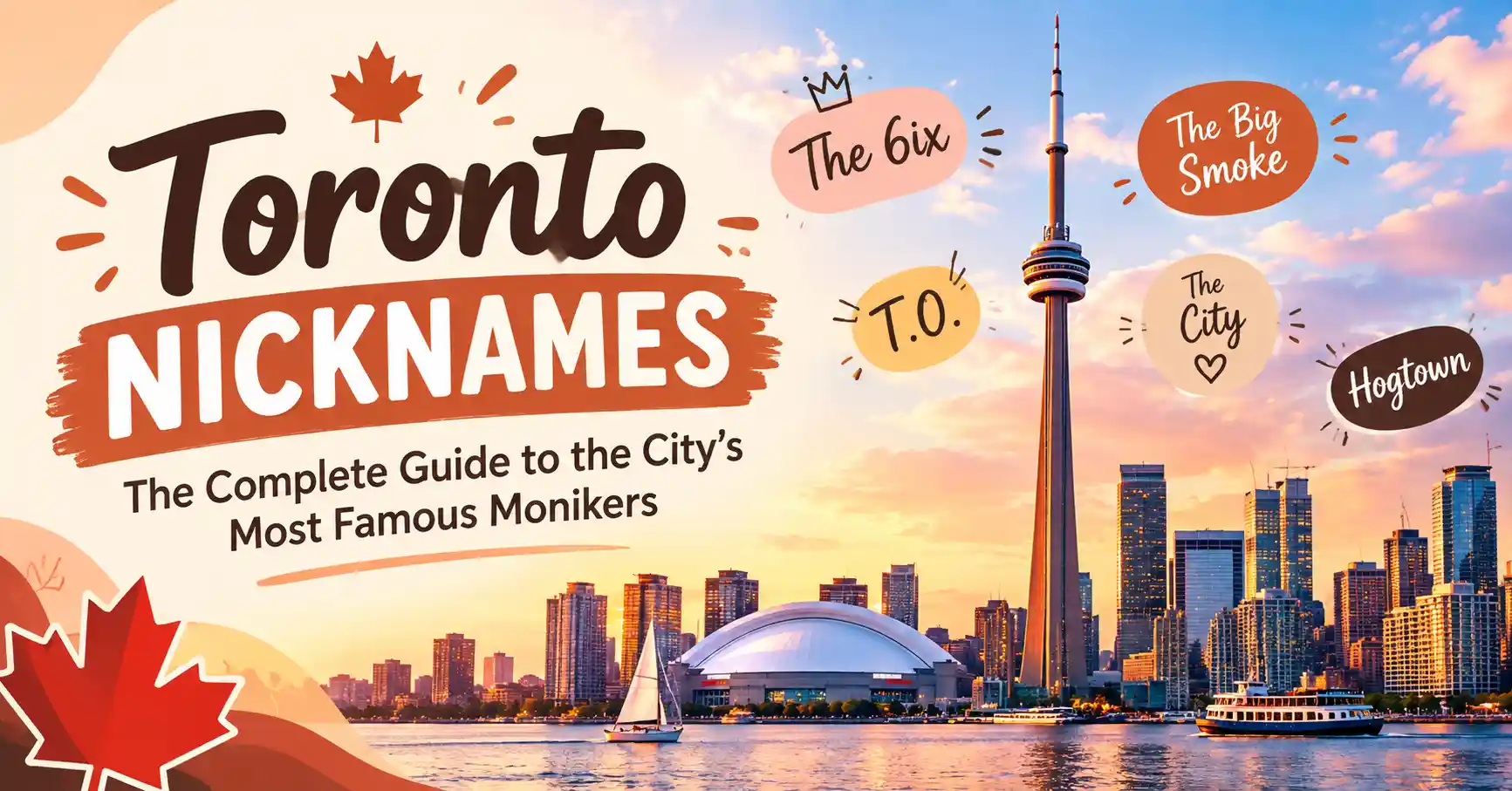
Toronto, Canada’s largest and most vibrant city, is a global metropolis known for its diverse culture, towering skyline, and passionate sports fans. But beyond its official name, Toronto has earned numerous nicknames that reflect its unique character, history, and identity. From “The Six” to “Hogtown,” these monikers tell the story of a city that has evolved from a modest colonial settlement into a world-class urban powerhouse.
Understanding Toronto nicknames opens a window into the city’s soul—its triumphs, its quirks, and the deep affection locals hold for their home. Whether you’re a curious traveler, a proud Torontonian, or a geography enthusiast, this comprehensive guide explores every nickname that has shaped Toronto’s identity.
Quick Answer Box Section
Quick Answer
The most famous nickname of Toronto is “The Six” (or “The 6ix”), popularized by rapper Drake. Other well-known nicknames include “T.O.” (Toronto, Ontario), “Hogtown” (referencing the city’s historic pork industry), and “The Big Smoke” (acknowledging its status as Canada’s largest city).
Quick Facts Table
📊 Toronto Quick Facts
Official Nickname of Toronto
Toronto does not have an officially designated nickname approved by the municipal government. Unlike some cities that have formally adopted monikers through city council resolutions, Toronto’s nicknames have emerged organically through popular usage, media references, and cultural evolution.
The nicknames discussed throughout this article are unofficial but widely recognized. They range from historical terms like “Hogtown” and “Muddy York” to modern cultural phenomena like “The Six.” While none carry official status, several have become so deeply embedded in local and international vocabulary that they function as de facto identifiers for the city.
It’s worth noting that Toronto’s official name itself has Indigenous origins. “Toronto” is believed to derive from the Mohawk word “tkaronto,” meaning “where there are trees standing in the water,” referring to the weirs used by Indigenous peoples in the area.
What Are the Nicknames of Toronto?
Toronto’s nicknames reflect different eras, industries, and cultural movements that have shaped the city. From its early days as a British colonial outpost to its current status as a global metropolis, each nickname captures a distinct facet of Toronto’s identity.
These nicknames can be categorized into several themes:
- Geographic References: Nicknames based on location or regional identity
- Historical/Industrial Origins: Names stemming from the city’s early economy
- Cultural/Pop Culture: Modern nicknames popularized through music, media, or sports
- Descriptive Terms: Names describing the city’s characteristics or atmosphere
Complete List of Toronto Nicknames
🏙️ Complete List of Toronto Nicknames
Most Popular Nicknames of Toronto
Among Toronto’s many nicknames, a few stand out as the most recognized and frequently used in everyday conversation, media, and popular culture. “The Six” has become the dominant nickname for younger generations, while “T.O.” remains a classic staple. “Hogtown” carries historical weight, and “Hollywood North” reflects the city’s modern entertainment industry significance.
The popularity of these nicknames varies by context. Sports broadcasters might reference “The Big Smoke,” while hip-hop artists and their fans champion “The Six.” Understanding these nuances helps paint a complete picture of how Torontonians and outsiders perceive the city.
Main Nicknames Explained
The Six (The 6ix)
Meaning: A shorthand reference to Toronto, derived from the city’s area codes (416 and 647), which both contain the number six.
Short Origin Story: While the term had been used sporadically before, rapper Drake popularized “The Six” in the mid-2010s through his music, social media, and public appearances. Drake, a Toronto native, frequently referenced the nickname in songs and interviews.
Historical Background: The nickname emerged from Toronto’s telecommunications area codes. The original 416 code served the city for decades before 647 was added in 2001 due to population growth. The shared “6” became a unifying symbol.
Modern Usage: “The Six” is now ubiquitous in Toronto slang, music, and marketing. It’s especially popular among millennials and Gen Z.
Cultural Impact: Drake’s global influence transformed “The Six” from local slang into an internationally recognized identifier for Toronto. It represents civic pride and the city’s growing cultural influence.
Interesting Fact: Drake filed a trademark application for “The Six” in 2016, though the application was later abandoned.
T.O.
Meaning: An abbreviation for “Toronto, Ontario.”
Short Origin Story: “T.O.” emerged in the early 20th century as a convenient shorthand for the city’s full name and province. It appeared in newspapers, business names, and casual conversation.
Historical Background: The abbreviation gained widespread use as Toronto grew into a major metropolitan center. It was practical for headlines and signage.
Modern Usage: “T.O.” remains widely used, particularly by older generations and in business contexts. Sports teams and local businesses frequently incorporate it into branding.
Cultural Impact: “T.O.” represents a classic, no-nonsense way of referring to the city—straightforward and functional.
Interesting Fact: The Toronto Raptors’ 2019 championship rally saw fans chanting “T.O.” as a rallying cry.
Hogtown
Meaning: A reference to Toronto’s historical pork processing and meatpacking industry.
Short Origin Story: In the late 19th and early 20th centuries, Toronto was home to numerous slaughterhouses and meatpacking plants, particularly in the Junction neighborhood. The smell and prominence of the industry led to the “Hogtown” moniker.
Historical Background: The William Davies Company, one of the British Empire’s largest pork processors, was based in Toronto. At its peak, the city was a major exporter of pork products.
Modern Usage: “Hogtown” is less common today but retains a nostalgic, somewhat affectionate quality. It’s often used by older Torontonians and in historical contexts.
Cultural Impact: The nickname serves as a reminder of Toronto’s industrial roots and the working-class communities that built the city.
Interesting Fact: The Junction neighborhood, once dominated by meatpacking, is now a trendy area known for boutiques and cafes—a dramatic transformation from its “Hogtown” days.
The Big Smoke
Meaning: A term indicating a large, bustling, and somewhat polluted metropolis.
Short Origin Story: “The Big Smoke” was originally used to describe London, England, but was adopted for Toronto as the city grew into Canada’s largest urban center. The term references the smoke from factories and the general “hustle and bustle” of big-city life.
Historical Background: As Toronto industrialized, smokestacks from factories contributed to air pollution, reinforcing the nickname.
Modern Usage: “The Big Smoke” is used less frequently today but still appears in media and casual conversation, particularly when comparing Toronto to smaller Canadian cities.
Cultural Impact: The nickname captures Toronto’s status as Canada’s premier metropolis—a place of opportunity, ambition, and urban energy.
Interesting Fact: Some Indigenous communities also used “The Big Smoke” to refer to Toronto, referencing early treaties and council fires in the area.
Hollywood North
Meaning: A recognition of Toronto’s prominence in film and television production.
Short Origin Story: Beginning in the 1970s and accelerating in the 1990s and 2000s, Toronto became a preferred filming location for Hollywood productions due to favorable tax incentives, diverse architecture, and skilled crews.
Historical Background: The city’s ability to double for American cities like New York and Chicago made it invaluable for filmmakers seeking cost-effective alternatives.
Modern Usage: “Hollywood North” is widely used in the entertainment industry and media to describe Toronto’s film production hub status.
Cultural Impact: The nickname highlights Toronto’s role in global entertainment and its economic importance to the region.
Interesting Fact: Major films and TV shows filmed in Toronto include “Suicide Squad,” “The Shape of Water,” “The Handmaid’s Tale,” and “Schitt’s Creek.”
Toronto the Good
Meaning: A nickname reflecting Toronto’s historical reputation for morality, order, and conservative values.
Short Origin Story: Coined in the late 19th century, “Toronto the Good” described a city known for its strict Sunday laws, temperance movement, and overall propriety.
Historical Background: Toronto was historically a very Protestant, morally strict city. Alcohol sales were restricted, and Sunday activities were limited.
Modern Usage: The nickname is now used ironically or nostalgically, as Toronto has evolved into a diverse, cosmopolitan city.
Cultural Impact: “Toronto the Good” serves as a contrast to modern Toronto’s vibrant nightlife and diverse culture.
Interesting Fact: The phrase is sometimes attributed to journalist and poet E.J. Pratt, though its exact origin is debated.
Which Nickname Is Most Famous?
“The Six” (or “The 6ix”) is currently the most famous nickname for Toronto.
Several factors explain its dominance:
- Celebrity Influence: Drake’s global fame brought unprecedented attention to the nickname.
- Social Media: Platforms like Instagram and Twitter amplified its use among younger demographics.
- Simplicity: The nickname is short, catchy, and easy to remember.
- Civic Pride: It represents a modern, confident Toronto that embraces its cultural contributions.
- International Recognition: Even non-Canadians now associate “The Six” with Toronto.
While “T.O.” and “Hogtown” have historical significance, “The Six” captures contemporary Toronto’s spirit and global aspirations.
How Toronto Got Its Nicknames
Toronto’s nicknames emerged from a combination of historical events, economic activities, cultural movements, and media influence. Understanding how Toronto got its nicknames requires examining the city’s evolution from a colonial settlement to a global metropolis.
Early nicknames like “Muddy York” and “Queen City” reflected Toronto’s colonial origins and geography. Industrial-era nicknames like “Hogtown” and “The Big Smoke” captured the city’s economic activities and urban challenges. Modern nicknames like “The Six” and “Hollywood North” reflect Toronto’s cultural exports and entertainment industry.
Each nickname tells a story about a particular moment in Toronto’s history, creating a rich tapestry of identity that continues to evolve.
Other Nicknames at a Glance
- Muddy York: Reference to the muddy conditions of early York (Toronto’s former name)
- Queen City: Toronto’s royal connection and status as a leading Canadian city
- The Centre of the Universe: A tongue-in-cheek reference to Toronto’s self-perceived importance
- Scarberia: A humorous nickname for the Scarborough district
- The 416: Reference to the city’s primary area code
- Toronto the Good: Historical nickname reflecting the city’s moral reputation
- The T-Dot: Another hip-hop-inspired nickname for Toronto
- York: The city’s original name before 1834
Fun Facts About Toronto
- Toronto is the fourth-largest city in North America by population, after Mexico City, New York City, and Los Angeles.
- The CN Tower was the world’s tallest freestanding structure for over 30 years (1976–2007).
- Toronto has over 1,500 parks and is one of the greenest cities in North America.
- More than 140 languages are spoken in Toronto, making it one of the most diverse cities on Earth.
- The Toronto Islands were formed from sandbars and are home to a small year-round community.
- Yonge Street was once recognized by Guinness World Records as the longest street in the world (though this claim has since been disputed).
- Toronto’s PATH is the world’s largest underground shopping complex, with over 30 kilometers of tunnels.
- The city was originally called York and was renamed Toronto in 1834.
- Toronto hosted the 2015 Pan American Games and was a candidate for the 2008 Summer Olympics.
- The Toronto Raptors’ 2019 NBA Championship was the first for a Canadian team, sparking massive celebrations.
Famous Attractions in Toronto
Toronto offers a wealth of attractions that draw millions of visitors annually:
- CN Tower: Iconic landmark offering stunning city views
- Royal Ontario Museum (ROM): World-class museum of art and natural history
- Art Gallery of Ontario (AGO): Major art museum with an extensive collection
- Ripley’s Aquarium of Canada: Popular aquarium at the base of the CN Tower
- Casa Loma: Historic Gothic Revival mansion and gardens
- St. Lawrence Market: Historic market offering local and international foods
- Toronto Islands: Scenic getaway with beaches and recreational activities
- Distillery District: Victorian-era industrial area transformed into a cultural hub
- High Park: Large urban park with trails, gardens, and a zoo
- Scotiabank Arena: Home to the Toronto Maple Leafs and Toronto Raptors
Nickname Comparison: Toronto vs. Chicago
⚖️ Toronto vs. Chicago Nicknames
Both Toronto and Chicago have rich nickname traditions that reflect their unique histories and cultural identities. While Chicago’s “Windy City” is rooted in 19th-century political rhetoric, Toronto’s “The Six” emerged from modern telecommunications and hip-hop culture. These nicknames, along with others like “Hogtown” and “The Second City,” showcase how cities develop multifaceted identities over time.
For more city nickname comparisons, explore our guides on Chicago Nicknames and New York City Nicknames.
Related Cities and Their Nicknames
🔗 Related City Nicknames
Frequently Asked Questions
What is the official nickname of Toronto?
Toronto does not have an officially designated nickname. While nicknames like “The Six,” “T.O.,” and “Hogtown” are widely used, none have been formally adopted by the city government.
Why is Toronto called “The Six”?
“The Six” refers to Toronto’s area codes, 416 and 647, both of which contain the number six. The nickname was popularized by Toronto rapper Drake in the mid-2010s and has since become a global identifier for the city.
Who gave Toronto the nickname “Hogtown”?
“Hogtown” emerged organically in the late 19th century due to Toronto’s prominent pork processing industry. The William Davies Company, a major meatpacker, was central to this industry, and the nickname stuck as a reflection of the city’s industrial identity.
When did “T.O.” become popular?
“T.O.” (short for Toronto, Ontario) became popular in the early 20th century as a convenient abbreviation. It remains widely used today, particularly in business and sports contexts.
Do locals actually use these nicknames?
Yes, locals use several of these nicknames regularly. “The Six” and “T.O.” are especially common in everyday conversation. “Hogtown” is used less frequently but is understood and sometimes used affectionately by older residents.
Conclusion
Toronto’s nicknames are more than just labels—they’re stories. From the muddy streets of early York to the global stage of “The Six,” each moniker captures a moment in the city’s ongoing journey. Whether you call it T.O., Hogtown, or Hollywood North, Toronto remains a city of endless reinvention, welcoming millions of visitors and newcomers each year.
These nicknames reflect the pride, humor, and resilience of Torontonians. They connect locals to their history while embracing the city’s modern, multicultural identity. For anyone seeking to understand Toronto, learning its nicknames is a fascinating first step.
To explore more about Toronto’s history and culture, visit the official City of Toronto website, which offers comprehensive resources on the city’s heritage, attractions, and community programs.
Whether you’re a lifelong resident or a first-time visitor, the many names of Toronto invite you to discover the layers of this remarkable city—one nickname at a time.