Boston nicknames are a compact history lesson. Boston, Massachusetts—founded in 1630—is one of America’s oldest and most influential cities, known for revolutionary politics, world-class universities, championship sports teams, and a distinct local culture.
This guide draws on historical records, local usage, and travel research to separate documented Boston nicknames from popular myth. You’ll learn which Boston nicknames are official, unofficial, most famous, and still used today.
Boston Nicknames: At a Glance 🏙️
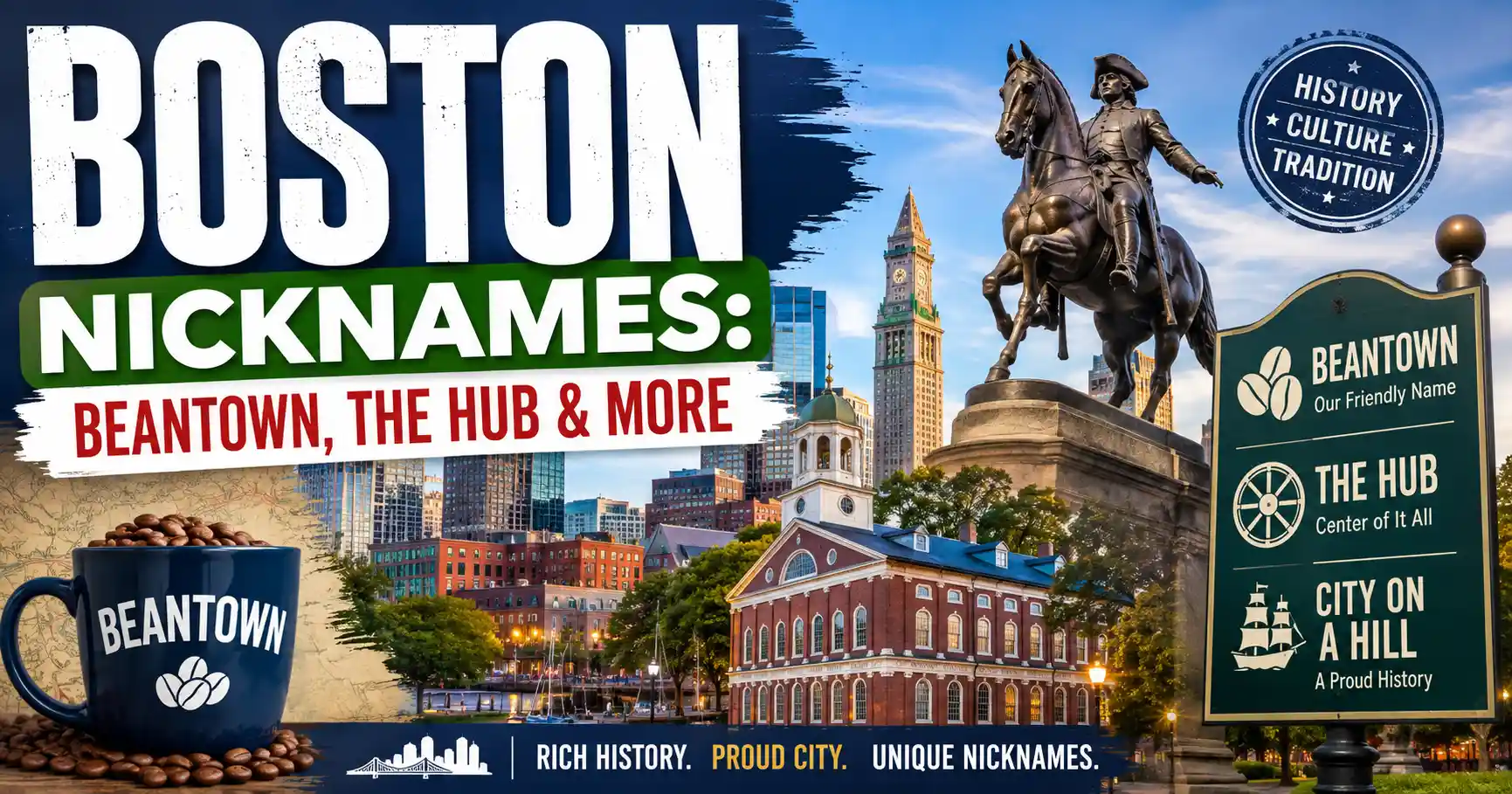
Quick Answer: The most famous Boston nickname is “Beantown.” Other well-known Boston nicknames include “The Hub” (or “Hub of the Universe”), “The Cradle of Liberty,” “The Athens of America,” “City on a Hill,” and “The Walking City.”
Quick Facts About Boston 📋
Official Nickname of Boston 🏛️
Boston does not have one legally designated official nickname. Massachusetts does not grant an official city nickname to Boston, so the city’s identity is carried by informal and historically recognized names. “Beantown” and “The Hub” are overwhelmingly popular in media and tourism, but they are not official. “The Cradle of Liberty” has a semi-official feel because it is tied to Boston’s Revolutionary War sites and appears in historical programming, while “City on a Hill” is a biblical phrase associated with the city’s founding ideals. When people ask for Boston’s official nickname, the most accurate answer is that there is not a single official name—but “Beantown” remains the most famous.
What Are the Nicknames of Boston? 🤔
Boston nicknames fall into five broad categories: food, revolutionary history, intellectual life, religious founding, and sports. The food-inspired “Beantown” comes from the city’s long association with baked beans and molasses. “The Cradle of Liberty” speaks to Boston’s role in the American Revolution. “The Athens of America” highlights its universities and literary culture. “City on a Hill” reflects its Puritan founders’ belief that Boston should be a moral example. “Title Town” and “The Walking City” are more modern additions tied to sports dominance and urban walkability. Together, these names give Boston a nickname portfolio that is unusually rich for an American city of its size.
Complete List of Boston Nicknames 📜
Most Popular Nicknames of Boston 🌟
If you ask a visitor, a sports fan, or a history buff, you will hear different Boston nicknames. The five most recognized are “Beantown,” “The Hub,” “The Cradle of Liberty,” “The Athens of America,” and “City on a Hill.” “Beantown” leads in popular culture and tourism. “The Hub” is more common among locals and regional media. “The Cradle of Liberty” dominates history-focused travel and education. “The Athens of America” appears in academic and cultural contexts. “City on a Hill” shows up in political speeches and discussions about Boston’s founding ideals.
Main Nicknames Explained 📖
Beantown 🫘
Meaning: Boston’s historic love of baked beans sweetened with molasses.
Short Origin Story: Boston’s 18th- and 19th-century merchants traded heavily in molasses from the Caribbean. Baked beans became a local staple, especially on Saturdays and Sundays.
Historical Background: Puritans avoided work on the Sabbath, so slow-cooked beans could be prepared ahead and eaten warm. The city’s connection to the bean pot became so strong that early baseball teams were called the Boston Beaneaters.
Modern Usage: “Beantown” appears on souvenirs, restaurant names, sports merchandise, and tourist guides. Locals use it less frequently than visitors.
Cultural Impact: The nickname gives Boston a cozy, old-fashioned identity, even though the city is now a global education and tech hub.
Interesting Fact: The old Boston Beaneaters baseball club eventually evolved into the franchise now known as the Atlanta Braves.
The Hub / Hub of the Universe 🌌
Meaning: Boston as the center of culture, intellect, and society.
Short Origin Story: In 1858, writer Oliver Wendell Holmes Sr. joked that the Boston State House was “the hub of the solar system.” The phrase caught on and eventually became “Hub of the Universe.”
Historical Background: In the 19th century, Boston was a powerhouse of American literature, reform, and education. The nickname reflected both pride and self-importance.
Modern Usage: “The Hub” is used by Boston media, businesses, transit, and local residents. It is more natural in daily speech than “Beantown.”
Cultural Impact: The name reinforces Boston’s status as a dense, connected, and intellectually confident city.
Interesting Fact: Holmes originally wrote “hub of the solar system,” but popular usage expanded it to “universe.”
The Cradle of Liberty 🔔
Meaning: Boston as the birthplace of the American Revolution.
Short Origin Story: Events like the Boston Massacre, Boston Tea Party, Paul Revere’s ride, and the Battle of Bunker Hill made Boston the center of resistance to British rule.
Historical Background: Faneuil Hall, a meeting place for patriots, is often specifically called the “Cradle of Liberty.” The nickname expanded to describe the entire city.
Modern Usage: Tour guides, history books, and the National Park Service use the nickname along the Freedom Trail.
Cultural Impact: It connects Boston’s revolutionary past to its current identity as a city of civic engagement.
Interesting Fact: Faneuil Hall has been a marketplace and meeting hall since 1742, and it is still open to visitors today.
The Athens of America 📚
Meaning: Boston as a center of learning, literature, philosophy, and the arts.
Short Origin Story: In the 19th century, Boston’s concentration of universities, libraries, and writers led observers to compare it to ancient Athens.
Historical Background: Harvard, MIT, Boston College, Boston University, and the Boston Public Library helped anchor the city’s intellectual reputation. Writers like Ralph Waldo Emerson, Henry David Thoreau, and Louisa May Alcott added to the image.
Modern Usage: Universities, museums, and cultural institutions still use the nickname in mission statements and marketing.
Cultural Impact: Boston’s economy and identity are deeply tied to higher education and research.
Interesting Fact: The Boston area is home to more than 35 colleges and universities, which gives the nickname modern relevance.
City on a Hill ⛪
Meaning: A biblical phrase meaning a moral example for the world.
Short Origin Story: John Winthrop, a Puritan leader, used the phrase “a city upon a hill” in his 1630 sermon “A Model of Christian Charity” before the Massachusetts Bay colonists landed.
Historical Background: The phrase comes from Jesus’ Sermon on the Mount: “You are the light of the world. A city set on a hill cannot be hidden.” Winthrop wanted Boston to be a model Christian community.
Modern Usage: Politicians, including John F. Kennedy and Ronald Reagan, later used the phrase to describe America’s ideals.
Cultural Impact: The nickname ties Boston to larger American ideas of exceptionalism and moral purpose.
Interesting Fact: Winthrop delivered the sermon aboard the Arbella, but the phrase became attached to Boston as the colony’s spiritual center.
The Walking City 🚶
Meaning: Boston is compact, walkable, and best explored on foot.
Short Origin Story: Boston’s narrow, winding streets and short blocks predate the automobile. The city’s layout makes walking practical and pleasant.
Historical Background: Neighborhoods like Beacon Hill, the North End, and Back Bay developed before car-dependent planning. The Freedom Trail, a 2.5-mile walking route, became a signature tourist experience.
Modern Usage: Real estate listings, travel guides, and city planners highlight Boston’s walkability.
Cultural Impact: The nickname supports Boston’s reputation as a healthy, historic, and accessible city.
Interesting Fact: Boston frequently ranks among the top three most walkable large cities in the United States.
Title Town / City of Champions 🏆
Meaning: Boston is a city of sports championships.
Short Origin Story: Starting in the early 2000s, Boston’s professional teams delivered an extraordinary run of titles.
Historical Background: The Red Sox ended an 86-year championship drought in 2004, the Patriots became an NFL dynasty, the Celtics added banners, and the Bruins won the Stanley Cup in 2011.
Modern Usage: Sports media and fans use “Title Town” during playoff runs and victory parades.
Cultural Impact: The nickname reflects Boston’s intense sports culture and civic pride.
Interesting Fact: Between 2002 and 2019, Boston’s four major professional teams combined to win 12 championships.
Which Nickname Is Most Famous? 🏅
“Beantown” is the most famous Boston nickname, especially outside New England. It is short, memorable, and food-based, which makes it popular in tourism, sports broadcasting, and national media. However, many locals prefer “The Hub” because it feels more contemporary and less like a tourist badge. “The Cradle of Liberty” is more famous in historical and educational settings. If you only know one Boston nickname, it will almost certainly be “Beantown.”
How Boston Got Its Nicknames 🧭
Boston’s nicknames come directly from its long history and distinct geography. The food nickname “Beantown” grew out of Boston’s rum and molasses trade, which made baked beans a local staple. The intellectual nickname “Athens of America” came from the city’s early strength in publishing, universities, and public libraries. The revolutionary nickname “Cradle of Liberty” emerged from Boston’s central role in the American Revolution. “City on a Hill” comes from the Puritan mission to build a model society. More modern names like “The Walking City” and “Title Town” reflect urban design and sports success. Together, these names show that Boston has never been just one thing.
Oklahoma City has developed several nicknames that reflect its history, culture, and growing identity. Explore Oklahoma City Nicknames to learn the meaning and origins behind its best-known monikers.
Other Nicknames at a Glance 🔍
- The Puritan City — a nod to Boston’s 17th-century religious founders.
- The City of Notions — a 19th-century reference to Boston’s ideas, reforms, and Yankee commerce.
- The Hub of the Solar System — the original Holmes phrase, now usually shortened to “The Hub.”
- America’s Walking City — an expanded version of “The Walking City.”
- The Cradle of American Independence — a formal variant of “The Cradle of Liberty.”
- The City of Champions — used interchangeably with “Title Town” during championship runs.
Fun Facts About Boston 🎉
- Boston Common, established in 1634, is the oldest public park in the United States.
- The first American subway system opened in Boston in 1897.
- Fenway Park, opened in 1912, is the oldest Major League Baseball ballpark still in use.
- The Boston Marathon, first run in 1897, is the world’s oldest annual marathon.
- Boston Light, first lit in 1716, is the oldest lighthouse station in America.
- Boston cream pie is the official state dessert of Massachusetts.
- Harvard University, founded in 1636, is the oldest institution of higher education in the United States.
- The Freedom Trail connects 16 historic sites over 2.5 miles.
- Boston’s “Sweet Caroline” sing-along at Fenway Park has been a tradition since the late 1990s.
- The Boston Tea Party of 1773 helped ignite the American Revolution.
Famous Attractions in Boston 🗺️
- Freedom Trail — a walking route through Revolutionary War landmarks.
- Faneuil Hall and Quincy Market — historic meeting hall and marketplace.
- Boston Common and Public Garden — green space in the heart of the city.
- Fenway Park — home of the Boston Red Sox.
- Museum of Fine Arts — one of the largest art museums in the country.
- Boston Tea Party Ships & Museum — an interactive re-creation of the 1773 protest.
- Beacon Hill and Acorn Street — one of the most photographed streets in America.
- Paul Revere House — the oldest surviving structure in downtown Boston.
- Boston Public Library — the first large free municipal library in the U.S.
- USS Constitution — the world’s oldest commissioned naval warship still afloat.
Nickname Comparison: Boston vs Chicago Nicknames ⚖️
For a deeper dive into the Midwest counterpart, see our guide to Chicago Nicknames.
Related Cities and Their Nicknames 🗺️
Chicago Nicknames
The Windy City, Second City, Chi-Town
🍎New York City Nicknames
The Big Apple, The City That Never Sleeps, Gotham
🎰Las Vegas Nicknames
Sin City, The Entertainment Capital of the World
🎸Austin Nicknames
Live Music Capital of the World, ATX, Bat City
🌴Miami Nicknames
The Magic City, Gateway to the Americas
Frequently Asked Questions ❓
What is the official nickname of Boston?
Boston does not have a single legally designated official nickname. “Beantown” is the most famous, while “The Hub” and “The Cradle of Liberty” are widely recognized but informal.
Why is Boston called Beantown?
Boston became known as Beantown because of its historic association with baked beans sweetened with molasses. The nickname grew from the city’s 18th- and 19th-century molasses trade and the local custom of slow-cooking beans.
Who gave Boston the nickname “The Hub”?
The nickname “The Hub” comes from writer Oliver Wendell Holmes Sr., who in 1858 described the Boston State House as “the hub of the solar system.” The phrase eventually expanded into “Hub of the Universe.”
Is “Beantown” officially recognized?
No, “Beantown” is not an official nickname. It is a popular and widely known informal nickname, but Boston has no official city nickname under Massachusetts law.
Do locals use the nickname Beantown?
Locals sometimes use “Beantown,” but it is more common among tourists and national media. Many Boston residents prefer “The Hub” or simply say “Boston.” “Beantown” still appears on local businesses, sports merchandise, and event names.
Conclusion 🏁
Boston nicknames are more than colorful labels—they are a shorthand guide to the city’s food, faith, revolution, intellect, and sports obsession. “Beantown” remains the most famous, but “The Hub,” “The Cradle of Liberty,” “The Athens of America,” and “City on a Hill” each reveal a different layer of Boston’s identity.
Whether you are walking the Freedom Trail, catching a game at Fenway, or exploring Beacon Hill, the city’s many names help explain why Boston feels unlike anywhere else in the United States. For additional historical context, visit the official City of Boston website.