
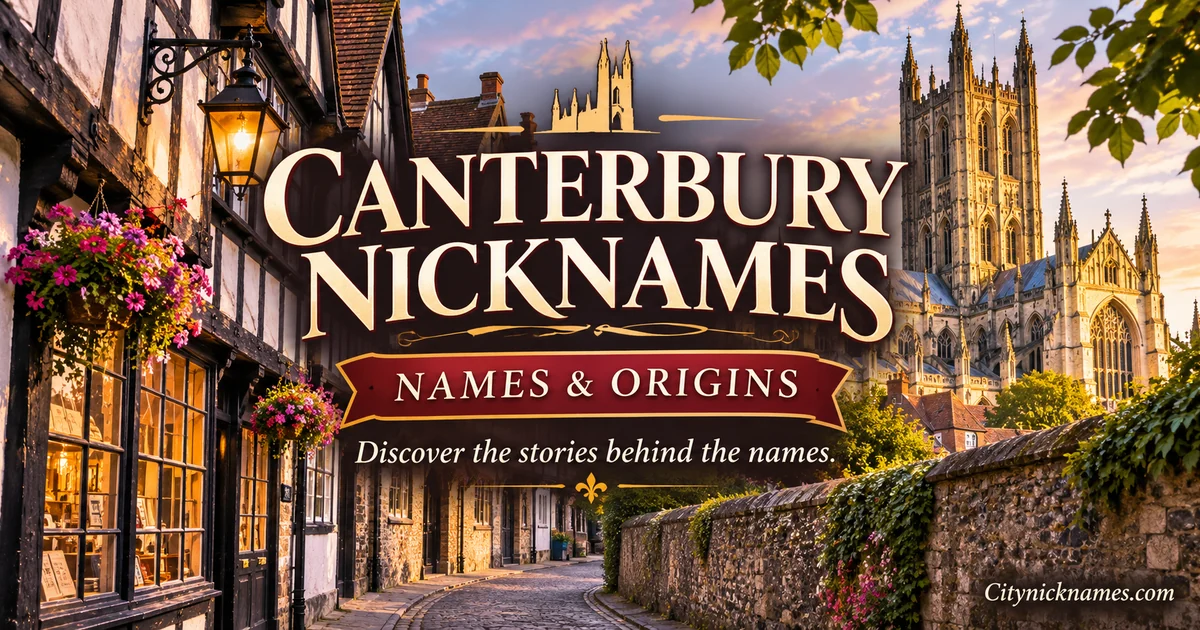
Canterbury Nicknames can point to a documented local expression, an older settlement name or a label used for one part of the area. Canterbury, in Kent, England, has layers of history that make those distinctions useful. The guide below traces the leading term to a source and explains which other phrases refer to the city, a region or a landmark.
The 2021 population shown below refers to Canterbury local authority district. In areas that contain several towns or settlements, that is different from a count of the historic city center.
⚡ Canterbury Nicknames: Quick Answer
📊 Quick Facts About Canterbury
| Field | Details |
|---|---|
| City | Canterbury |
| Location | Kent, England, United Kingdom |
| Official city nickname | None separately verified |
| Leading expression | Canterbury — established city name; no distinct citywide nickname verified |
| 2021 Census population | about 157,400 (Canterbury local authority district) |
| Origins and milestones | Augustine’s mission in 597; Thomas Becket’s murder in 1170 |
| Known for | Canterbury Cathedral, St Augustine’s Abbey, Westgate Towers and Roman Museum |
The population is the rounded 2021 Census figure for Canterbury local authority district. The Office for National Statistics area profile identifies its boundary. A single “founded” date would be misleading when a Roman settlement, medieval institutions and a later city-status decision represent different chapters.
🏛️ Official Nickname of Canterbury
No separately enacted legal nickname for Canterbury was established by the sources used here. The most defensible description of Canterbury is established city name; no distinct citywide nickname verified. The cathedral’s Mother Church title belongs to Canterbury Cathedral and the Anglican Communion, while the city itself is a long-standing pilgrimage destination; neither is an adopted substitute name for the whole city. A title appearing in local promotion or historical writing can still be valuable without becoming a statutory city name.
🔎 What Are the Nicknames of Canterbury?
The source review did not find a distinct, established nickname for the whole city. Instead, it found religious and historical expressions frequently associated with Canterbury: a cathedral title, a pilgrimage description and a Roman-era place name. They are useful to know, with their different meanings preserved.
📋 Complete List of Canterbury Nicknames and Related Names
| Nickname or term | Meaning | Origin | Popularity |
|---|---|---|---|
| Canterbury | established city name; no distinct citywide nickname verified | The cathedral’s Mother Church title belongs to Canterbury Cathedral and the Anglican Communion, while the city itself is a long-standing pilgrimage destination; neither is an adopted substitute name for the whole city. | Documented leading expression |
| Mother Church of the Anglican Communion | title of the cathedral, not the city | Related local history or usage; see scope | Contextual term, not an equal-ranked civic nickname |
| Pilgrim City | descriptive wording for Canterbury’s visitor history, not a verified formal nickname | Related local history or usage; see scope | Contextual term, not an equal-ranked civic nickname |
| Durovernum Cantiacorum | Roman-era name, not a current civic title | Related local history or usage; see scope | Contextual term, not an equal-ranked civic nickname |
The usage labels describe documented context, not numerical search volume or a citywide recognition survey. An entry may appear here precisely because people mistake a historic title or narrower local name for a civic nickname.
🌟 Most Popular Names Associated With Canterbury
The best-known associated title is Mother Church of the Anglican Communion, but it belongs to Canterbury Cathedral. Canterbury’s pilgrimage history is also widely known, particularly through the story of Thomas Becket. Neither piece of evidence establishes a popular alternate name for the whole city.
Other expressions matter for different reasons. Mother Church of the Anglican Communion refers to title of the cathedral, not the city. That narrower description should travel with the term wherever it is quoted. Local recognition can change with audience: a visitor may remember a tourism phrase, while a historian means a Roman name and a resident uses neither in daily speech.
🧭 Main Names Explained
Mother Church — Meaning
“Mother Church of the Anglican Communion” means Canterbury Cathedral’s religious role within the Anglican Communion. It describes an institution with an international significance; the term does not rename the streets, homes and neighborhoods that make up Canterbury.
Mother Church — Short Origin Story
The cathedral traces its Christian story to Augustine’s mission in 597. Becket’s murder in 1170 later drew pilgrims from across Europe. The title “Mother Church” identifies the cathedral’s Anglican role; neither medieval date supplies evidence of a citywide nickname being coined.
Pilgrimage and Roman Background
The cathedral says exactly what it means by Mother Church: its institution and worldwide religious role. A reader may describe Canterbury as a pilgrimage city because routes converged on Becket’s shrine, yet that remains a descriptive phrase unless a source uses it as an established name. The Roman and medieval layers add historical names without turning them into contemporary nicknames. Canterbury district population includes other settlements, so the council-area count is clearly labelled.
Mother Church — Modern Usage
Use “Mother Church” for the cathedral when explaining Anglican history. For a city guide, describe Canterbury directly as a pilgrimage destination. A modern map, municipal page or census table still uses Canterbury as the city name, while the surrounding district is a larger statistical geography.
Pilgrimage — Cultural Impact
Canterbury visitors may encounter this history near Canterbury Cathedral, St Augustine’s Abbey, Westgate Towers and Roman Museum. A visitor’s encounter with a museum, monument or branded district can keep an old phrase visible. The significance is cultural and interpretive; it does not by itself prove formal civic adoption.
Canterbury — Interesting Fact
A cathedral title can be internationally famous even when there is no corresponding nickname for the city containing it. That is why a search for Canterbury nicknames can turn up “Mother Church” without making the phrase a civic name.
🥇 Which Nickname Is Most Famous?
There is no verified citywide nickname to rank as the most famous. “Mother Church” is probably the most important related title in this guide because it identifies the cathedral’s role, but calling the entire city “Mother Church” changes the subject. The safer short answer is that the city has a well-known pilgrimage identity without an established alternate civic name.
If the reader specifically asks for an official nickname, the answer is more limited: the consulted material did not establish a distinct legally adopted nickname. A documented marketing identity or historical name still makes a good article subject, provided the article says exactly what kind of name it is.
🕰️ How Canterbury Got Its Names
Places gather names through settlement, institutions, trade, politics and tourism. For Canterbury, the major chronological markers are Augustine’s mission in 597; Thomas Becket’s murder in 1170. Each period can leave a different trace in maps, archives and everyday speech. A Roman form is an old place name; a descriptive tourism line is a later way to explain the city to visitors.
The cathedral’s own account supports its institutional title. Pilgrimage belongs to the city’s medieval story, and Durovernum Cantiacorum belongs to a much earlier Roman layer. These are three different kinds of evidence. There is no reason to credit one person with inventing all three, or to treat any one of them as an adopted modern nickname.
👀 Other Names at a Glance
- Mother Church of the Anglican Communion: title of the cathedral, not the city; use this narrower description rather than assuming it is an adopted name for the entire city.
- Pilgrim City: descriptive wording for Canterbury’s visitor history, not a verified formal nickname; use this narrower description rather than assuming it is an adopted name for the entire city.
- Durovernum Cantiacorum: Roman-era name, not a current civic title; use this narrower description rather than assuming it is an adopted name for the entire city.
✨ Fun Facts About Canterbury
- The key fact is that no distinct citywide nickname was verified; “Mother Church” is the cathedral’s title.
- The 2021 Census count of about 157,400 applies to Canterbury local authority district, not automatically to the historic core.
- A key timeline runs through Augustine’s mission in 597; Thomas Becket’s murder in 1170.
- An orientation for visitors includes Canterbury Cathedral, St Augustine’s Abbey, Westgate Towers and Roman Museum.
- Mother Church of the Anglican Communion is title of the cathedral, not the city.
- The principal local source explains the leading expression; the ONS source supplies a separate population geography.
- Pilgrim City has its own scope: descriptive wording for Canterbury’s visitor history, not a verified formal nickname.
📍 Famous Attractions in Canterbury
Canterbury Cathedral, St Augustine’s Abbey, Westgate Towers and Roman Museum offer concrete points of reference for the city’s past and present. A place in this list may illustrate a historical period without being the source of the leading expression. Check the attraction’s own website for current opening times and ticket information.
⚖️ Nickname Comparison: Canterbury vs Bath
| Question | Canterbury | Bath |
|---|---|---|
| Main expression | Canterbury | Aquae Sulis |
| What it identifies | established city name; no distinct citywide nickname verified | Roman-era place name; not a modern nickname |
| Caution | Keep the city, era and geography precise | Keep the other city’s documented scope precise |
Compare this guide with Bath nicknames. The two expressions have different histories and levels of civic recognition. Their comparison helps a reader identify an actual local story, rather than treating every historic name or place brand as the same kind of official nickname.
🔗 Related Cities and Their Nicknames
❓ Frequently Asked Questions
What is the official nickname of Canterbury?
No separately adopted legal nickname was verified in the cited sources. Canterbury is described here as established city name; no distinct citywide nickname verified.
Why is Canterbury associated with Canterbury?
The cathedral’s Mother Church title belongs to Canterbury Cathedral and the Anglican Communion, while the city itself is a long-standing pilgrimage destination; neither is an adopted substitute name for the whole city.
Is Canterbury a current name for the whole city?
Its documented scope is established city name; no distinct citywide nickname verified. Do not extend that scope to the whole municipality or the present day without a source.
What are other names linked with Canterbury?
Mother Church of the Anglican Communion (title of the cathedral, not the city); Pilgrim City (descriptive wording for Canterbury’s visitor history, not a verified formal nickname); Durovernum Cantiacorum (Roman-era name, not a current civic title).
Does the population shown mean only the city center?
No. The approximate 2021 figure, about 157,400, refers to Canterbury local authority district, as identified in the ONS profile.
✅ Conclusion
Canterbury Nicknames is a search for an alternate civic name, but none was verified here. “Mother Church” belongs to the cathedral, “Pilgrim City” is descriptive and Durovernum Cantiacorum is a Roman name. For the religious history, consult Canterbury Cathedral’s own account; for the quoted district population, use the ONS boundary. Keeping those scopes clear makes the guide more useful than a long list of invented titles.