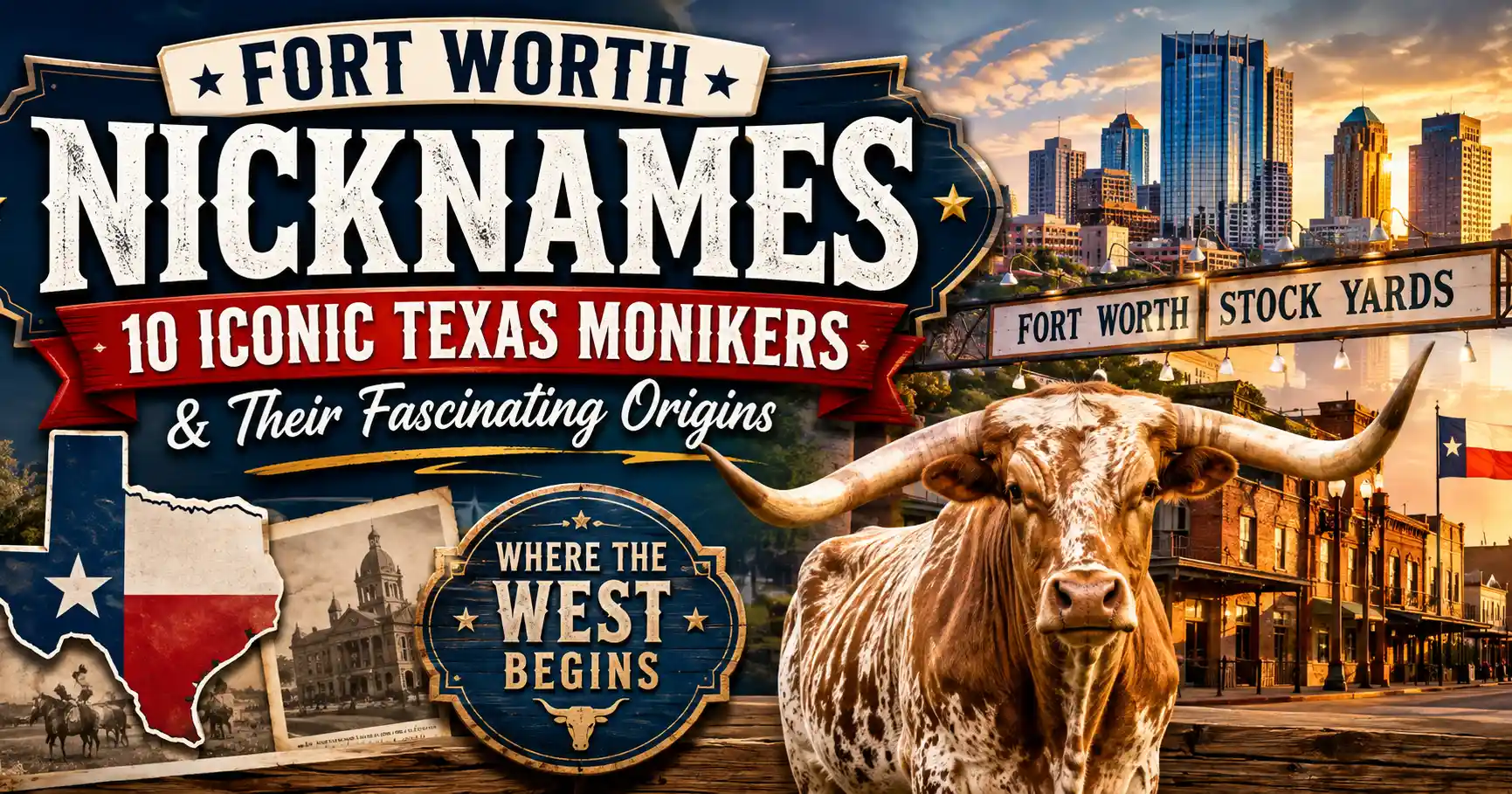
Fort Worth, Texas, is a city where cattle drives, cowboy culture, and world-class museums share the same streets. Over more than 175 years, the community has collected a colorful set of Fort Worth nicknames that reflect its frontier past, civic pride, and modern reinvention. From Cowtown to Panther City, these monikers tell a story no history book can match.
As a city historian and travel writer, I’ve traced how these names emerged from cattle trails, newspaper jokes, and civic branding campaigns. This guide covers the most famous Fort Worth nicknames, their meanings, origins, and the local culture behind each one.
🥇 Quick Answer: Fort Worth’s most famous nickname is “Cowtown.” Other well-known Fort Worth nicknames include “Panther City,” “Where the West Begins,” and “City of Cowboys and Culture.”
| City | Fort Worth |
|---|---|
| State/Country | Texas, United States |
| Official Nickname | City of Cowboys and Culture (official brand/tagline) |
| Most Famous Nickname | Cowtown |
| Population | 956,709 (2022 U.S. Census estimate) |
| Founded | 1849 as a U.S. Army outpost |
| Known For | Fort Worth Stockyards, cattle drives, Cultural District museums, TCU, Sundance Square |
| More | County seat of Tarrant County; part of the Dallas–Fort Worth metroplex |
🏛️ Official Nickname of Fort Worth: Understanding Fort Worth Nicknames
Fort Worth does not have a single nickname officially written into law. That said, “City of Cowboys and Culture” functions as the city’s official marketing tagline and brand identity. It is the phrase most often used by Visit Fort Worth, city government, and economic development materials.
By contrast, “Cowtown” and “Panther City” are unofficial but deeply historic names. They are widely recognized, proudly used by locals, and stamped across businesses, sports teams, and public art. In everyday conversation, those two names carry more emotional weight than the official branding.
🌵 What Are the Nicknames of Fort Worth?
Fort Worth’s nickname list mixes Old West grit, railroad-era pride, and modern Texas swagger. The most complete Fort Worth nicknames list includes historical labels, tourism slogans, and local shorthand. Some names are affectionate, some are jokes turned badges of honor, and some are still used in official marketing.
The city’s nicknames fall into a few loose themes:
- Western cattle heritage: Cowtown, Where the West Begins
- Historical civic identity: Panther City, Queen City of the Prairie
- Modern branding and culture: City of Cowboys and Culture, Funky Town
📋 Complete List of Fort Worth Nicknames
| Nickname | Meaning | Origin | Popularity | Notes |
|---|---|---|---|---|
| Cowtown | Center of the cattle trade and cowboy culture | Chisholm Trail-era cattle drives and the Fort Worth Stockyards | Very High | Most famous Fort Worth nickname |
| Panther City | A joke about a sleepy town that became a badge of honor | 1875 Dallas newspaper story about a panther sleeping downtown | High | Used on police and fire insignia |
| Where the West Begins | Gateway between East Texas and the Western frontier | Early 20th-century civic branding and Western identity | High | Still used in tourism and local branding |
| City of Cowboys and Culture | Blend of Western heritage and major arts institutions | Modern official tourism and economic development brand | High | Official city tagline |
| Funky Town | Local arts, live music, and offbeat creative culture | Late 20th-century local music and arts scene | Medium | Mostly informal and local |
| Queen City of the Prairie | Prosperous railroad and trade hub on the open prairie | Late 19th-century railroad expansion and commerce | Historical/Low | Rarely used today |
🌟 Most Popular Nicknames of Fort Worth
Three nicknames dominate Fort Worth’s public identity: Cowtown, Panther City, and Where the West Begins. Each represents a different chapter of the city’s story. Cowtown is the rugged cattle-era label, Panther City is the scrappy underdog name, and Where the West Begins is the romantic frontier slogan.
Locals may not agree on which one is truly number one, but Cowtown has the strongest national recognition. It appears in business names, event titles, and casual speech more than any other Fort Worth nickname.
🤠 Main Nicknames Explained
🐄 Cowtown
Meaning: Cowtown refers to Fort Worth’s historic role as a cattle trading and shipping center.
Short Origin Story: In the late 1860s and 1870s, cowboys drove millions of Texas longhorns along the Chisholm Trail. Fort Worth became one of the last major supply stops before the herds continued north.
Historical Background: After the Civil War, the cattle industry exploded. Fort Worth grew as a railhead and later became home to the Fort Worth Stockyards, Swift and Armour meatpacking plants, and one of the largest livestock markets in the country.
Modern Usage: Cowtown remains the go-to nickname for residents, media, and businesses. You’ll see it in restaurant names, Western wear shops, rodeo promotions, and tourism campaigns.
Cultural Impact: The nickname anchors Fort Worth’s identity as a genuine Western city rather than just another Texas metro. It fuels tourism at the Stockyards and keeps cowboy heritage alive.
Interesting Fact: The Fort Worth Stockyards still runs a twice-daily longhorn cattle drive through Exchange Avenue.
🐆 Panther City
Meaning: Panther City was originally a sarcastic jab suggesting Fort Worth was so quiet that a panther could sleep downtown.
Short Origin Story: In 1875, after an economic downturn, a Dallas newspaper reportedly published a story claiming a panther was found sleeping in front of the Fort Worth courthouse.
Historical Background: Fort Worth’s economy had slumped when the Texas & Pacific Railway bypassed the city for a time. The Dallas press mocked Fort Worth as sleepy and dead. Instead of fighting the joke, Fort Worth leaned into it.
Modern Usage: Panther City appears on local merchandise, craft beer, real estate branding, and the Panther Island redevelopment area. It is also used by police and fire departments.
Cultural Impact: The name symbolizes Fort Worth’s ability to turn criticism into civic pride. It is a reminder that the city has repeatedly reinvented itself after hard times.
Interesting Fact: The panther has appeared on Fort Worth police and fire insignia for decades.
🌅 Where the West Begins
Meaning: The phrase positions Fort Worth as the cultural and geographic threshold of the American West.
Short Origin Story: In the early 20th century, civic leaders and newspaper publisher Amon G. Carter popularized the idea that Fort Worth was the last eastern-style city before the open Western frontier.
Historical Background: While Dallas leaned into finance and commerce, Fort Worth leaned into stockyards, railroads, and Western symbolism. The slogan became a powerful piece of regional branding.
Modern Usage: “Where the West Begins” still appears in tourism materials, local signs, and city marketing. It remains a proud statement of Fort Worth’s Western identity.
Cultural Impact: The nickname has shaped how Fort Worth presents itself to visitors and how residents distinguish their city from Dallas.
Interesting Fact: Amon G. Carter was famous for his intense Fort Worth–Dallas rivalry and often promoted Fort Worth as the true West.
🎨 City of Cowboys and Culture
Meaning: This modern nickname highlights Fort Worth’s balance between cowboy heritage and high-caliber arts.
Short Origin Story: The phrase emerged as official branding in the late 20th and early 21st centuries as the Cultural District grew alongside the Stockyards.
Historical Background: Fort Worth invested heavily in museums and performing arts. The Kimbell Art Museum, Modern Art Museum of Fort Worth, Amon Carter Museum of American Art, Bass Performance Hall, and National Cowgirl Museum all became major draws.
Modern Usage: The city uses this tagline in economic development, tourism marketing, and official communications.
Cultural Impact: It broadens Fort Worth’s image beyond cowboys, showing visitors that the city has world-class culture, too.
Interesting Fact: Fort Worth’s Cultural District contains one of the most concentrated museum districts in Texas.
🎸 Funky Town
Meaning: Funky Town is an informal nickname tied to Fort Worth’s live music, local art, and independent creative spirit.
Short Origin Story: The name grew out of the local music and arts scene, especially as Fort Worth developed a reputation for honky-tonks, indie venues, and public art.
Historical Background: While not an official nickname, Funky Town became popular among younger residents and artists. It captures the city’s less polished, more creative side.
Modern Usage: You’ll hear Funky Town used by locals, event promoters, and small businesses. It is more common in casual conversation than in official city branding.
Cultural Impact: The nickname adds a contemporary edge to Fort Worth’s otherwise Western identity.
Interesting Fact: Fort Worth has a deep music heritage, from Western swing to modern indie rock, which helps Funky Town feel earned.
🏆 Which Nickname Is Most Famous?
Cowtown is the most famous Fort Worth nickname. It has the longest continuous usage, the strongest tourism connection, and the widest recognition outside Texas.
Panther City is a close second among locals and history lovers, but Cowtown wins on sheer cultural visibility. When national media, travel writers, and visitors refer to Fort Worth, Cowtown is the name they use most often.
🧭 How Fort Worth Got Its Nicknames
Fort Worth’s nicknames grew out of geography, industry, media rivalry, and civic marketing. The city started as an Army outpost in 1849, but it truly boomed when cattle drives brought cowboys, money, and railroads. That cattle era created Cowtown.
A later economic slump and a mocking Dallas newspaper created Panther City. In the 20th century, boosters like Amon G. Carter created “Where the West Begins” to give Fort Worth a distinct regional identity. Modern branding added “City of Cowboys and Culture,” while local artists and musicians embraced Funky Town.
🗂️ Other Nicknames at a Glance
- Queen City of the Prairie: Late 19th-century railroad-era label for Fort Worth’s commercial growth.
- Cowtown USA: An extended tourism-friendly version of Cowtown.
- The City of Cowboys and Culture: The official branding phrase.
- Funky Town: Local creative and music-scene shorthand.
- Panther City: Historical nickname still used on badges and business names.
🎉 Fun Facts About Fort Worth
- Fort Worth was founded in 1849 and named after General William Jenkins Worth.
- The Fort Worth Stockyards was once one of the largest livestock markets in the United States.
- The Stockyards hosts the world’s only twice-daily longhorn cattle drive.
- Cowtown Coliseum hosted the first indoor rodeo in 1918.
- Fort Worth’s Cultural District is home to five major museums within walking distance.
- The Kimbell Art Museum building is considered an architectural masterpiece designed by Louis I. Kahn.
- Fort Worth is consistently one of the fastest-growing large cities in the United States.
- Sundance Square occupies a former red-light district once known as Hell’s Half Acre.
- The Fort Worth Zoo is frequently ranked among the best zoos in the nation.
- Fort Worth and Dallas share the world-famous DFW International Airport but maintain fiercely different identities.
🏙️ Famous Attractions in Fort Worth
- Fort Worth Stockyards National Historic District
- Sundance Square
- Kimbell Art Museum
- Modern Art Museum of Fort Worth
- Amon Carter Museum of American Art
- Fort Worth Botanic Garden
- Fort Worth Water Gardens
- Fort Worth Zoo
- Texas Christian University
- Panther Island Pavilion
🆚 Nickname Comparison
🤠 Fort Worth Nicknames
- Cowtown — Western cattle legacy
- Panther City — 1875 newspaper joke
- Where the West Begins — frontier gateway
- City of Cowboys and Culture — official brand
🏙️ Dallas Nicknames
- Big D — larger, glitzier image
- D-Town — modern local shorthand
- The Metroplex — shared DFW identity
- City of Hate — outdated historical label rarely used today
Read more: Dallas Nicknames
🧩 Related Cities and Their Nicknames
Live Music Capital of the World, ATX 🚀 Houston Nicknames
Space City, Bayou City, H-Town ⚔️ San Antonio Nicknames
Alamo City, River City, Military City USA
❓ Frequently Asked Questions
Q. What is the official nickname of Fort Worth?
Ans: Fort Worth’s official branding tagline is “City of Cowboys and Culture.” However, “Cowtown” and “Panther City” are the most famous unofficial nicknames.
Q. Why is Fort Worth called Cowtown?
Ans: Fort Worth is called Cowtown because of its historic role in the Texas cattle industry. The city sat along the Chisholm Trail and later became home to the Fort Worth Stockyards and major meatpacking plants.
Q. Why is Fort Worth called Panther City?
Ans: Panther City began as a joke. In 1875, a Dallas newspaper supposedly reported that a panther was found sleeping in downtown Fort Worth because the city was so quiet. Fort Worth embraced the name instead of rejecting it.
Q. Who gave Fort Worth the nickname “Where the West Begins”?
Ans: The phrase was popularized in the early 20th century by Fort Worth boosters, most notably newspaper publisher and civic leader Amon G. Carter.
Q. When did the nickname Cowtown become popular?
Ans: Cowtown became popular during the late 1860s and 1870s, when Fort Worth was a major stop on the Chisholm Trail. It remained common after the Stockyards opened in the early 1900s.
🏁 Conclusion
Fort Worth nicknames are not just casual labels. They are a timeline of the city’s evolution from frontier outpost to cattle capital to modern cultural hub. Cowtown captures the Western soul, Panther City captures the defiant spirit, and City of Cowboys and Culture captures the city’s modern ambitions. Whether you call it Funky Town or Where the West Begins, Fort Worth remains one of Texas’s most distinctive cities. For more information about Fort Worth’s attractions, events, and Western heritage, visit the official Fort Worth Convention & Visitors Bureau.